
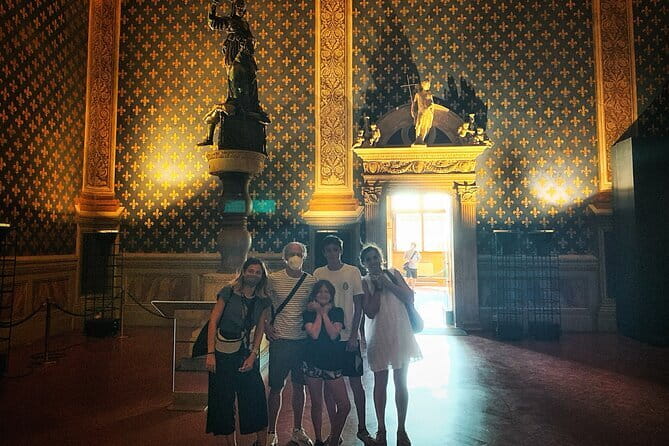
Reviewed · FLORENCE CHURCHES & PALAZZOS
Palazzo Vecchio Tales – into Medici’s secrets and mythology simbols
The most striking part of this private Palazzo Vecchio visit is how it links art with power. You move from Michelozzo’s frescoed courtyard to the vast Salone del Cinquecento, then into Medici rooms filled with portraits, myths, and political messages. Donatello’s Judith and Holofernes and Machiavelli’s personal office add real weight to the story.
I like the focus on details you could easily miss, especially why the courtyard shows Austrian scenery and how the great hall changed over time. I also like the private format, plus radios and headphones that let you hear the guide clearly inside the museum. If Daniele is your guide, expect a lively storyteller who can handle detailed questions.
The main drawback is practical: the museum ticket costs extra, and you pay the museum on the day. Palazzo Vecchio is also unheated in winter, with few places to sit while the guide speaks, so wear a warm layer and comfortable shoes.
In This Review
- Key points at a glance
- Why Palazzo Vecchio tells Florence’s political story so well
- Meeting at Piazza della Signoria
- Michelozzo’s courtyard and its Austrian frescoes
- The Salone del Cinquecento and its many changes
- Medici rooms filled with portraits and myth
- Donatello’s Judith and Holofernes
- Machiavelli’s personal office and political thought
- What the private format adds
- Timing, comfort, and the extra ticket cost
- Who should book this Palazzo Vecchio visit
- Should you book it?
- FAQ
- Where does the Palazzo Vecchio tour begin?
- Where does the tour end?
- How long does the experience last?
- Is museum admission included in the price?
- Is the tour offered in English?
- Is this a private tour?
- What is included besides the guide?
- Can service animals participate?
- Can I cancel for a full refund?
Key points at a glance
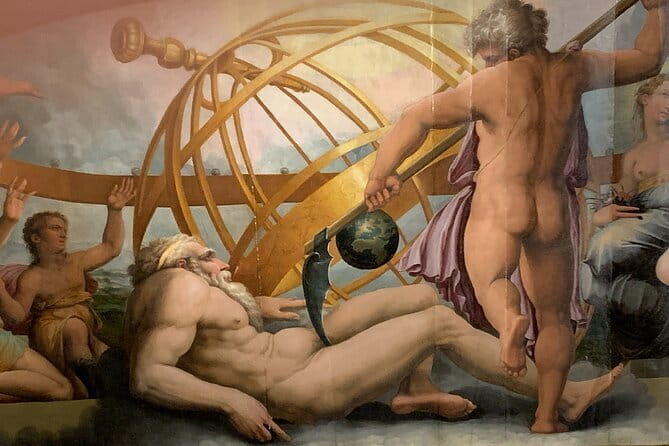
- Austrian scenes in the courtyard: Learn why a Florentine palace courtyard carries frescoes showing faraway Central European scenery.
- The Salone del Cinquecento: See Florence’s grand political hall and follow its several changes over time.
- Medici power in paint: Portraits, historical scenes, and mythological gods turn family rooms into a visual message about rule.
- Donatello’s Judith: View the original Judith and Holofernes, one of the palace’s most important works.
- Machiavelli’s office: Visit a room tied to the development of European political thought.
- Private English visit: Your group has its own licensed guide, with headsets supplied for easier listening.
Why Palazzo Vecchio tells Florence’s political story so well

Florence has no shortage of beautiful churches and galleries, but Palazzo Vecchio feels different. This is a building where art was made to explain power. The rooms do not simply display attractive paintings. They show how the Medici family wanted authority, learning, military success, religion, and mythology to be understood.
That makes this tour a good choice if you want more than a quick look at decorated ceilings. Your guide helps connect the images to the people and events behind them. You will hear about the Medici family rooms, the historical scenes painted on their walls, and the gods and heroes used as symbols.
The visit lasts about 1 hour 45 minutes. That is long enough to cover the main rooms without turning into an all-day museum session. You still need energy for the rest of Florence, but you get enough time for the palace to make sense rather than feeling like a parade of grand interiors.
I especially like the way the tour appears to balance famous sights with less obvious details. Donatello’s sculpture will draw attention, but the explanation of the Austrian scenes in the courtyard may be the sort of small fact you remember later. Those connections are often what turn a museum visit into a useful lesson.
More Medici trails:
- The Best tour in Florence: Renaissance & Medici Tales – guided by a STORYTELLER
★ 5.0 · 12,316 reviews - The Best Tour in Florence: Renaissance and Medici Tales
★ 5.0 · 10,810 reviews - Florence: Renaissance and Medici Tales Guided Walking Tour
★ 4.8 · 1,549 reviews
Meeting at Piazza della Signoria
The tour begins at Piazza della Signoria, directly outside the Palazzo Vecchio area. This is a practical starting point because you are already in Florence’s main civic square, surrounded by major public buildings and sculpture.
Your guide meets you at the listed point on Piazza della Signoria and leads the visit from there. The activity returns to the same meeting point at the end, which makes planning easier if you have another appointment nearby.
The booking reserves a specific date and time, and the experience includes a skip-the-line reservation. That matters at Palazzo Vecchio because a fixed entry time gives your day more structure. It does not mean the museum ticket is included, though. You pay the admission cost directly to the museum on the tour date, so add that expense to the advertised $150.19 per person.
The price is easier to justify if you value a private guide and a focused visit. It is less attractive if you only want to walk through the palace at your own pace or plan to spend several hours studying every room. This tour is paying for interpretation, timing, and a personal guide, not just entry.
Michelozzo’s courtyard and its Austrian frescoes
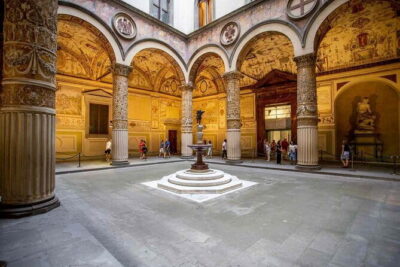
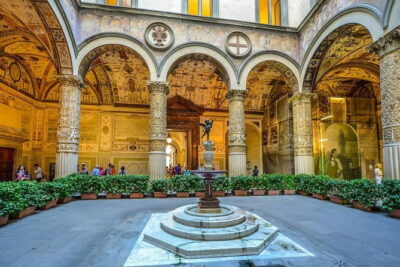
The first major part of the visit is Michelozzo’s courtyard. It is fully decorated with frescoes from the 1500s, which already gives you a lot to look at before reaching the famous interior halls.
The unusual point is the presence of Austrian scenery. At first, those scenes may seem out of place in a Florentine palace. Your guide explains why they appear there, turning what could be a passing visual detail into a clue about the palace’s wider political and cultural connections.
This is a fine example of why a guide helps at Palazzo Vecchio. You can admire the paintings on your own, but you may not ask why a particular place was chosen or what the decoration was meant to communicate. Here, the courtyard is not just a pretty entrance. It sets up the tour’s main theme: images carry political meaning.
Take a moment to look upward and around the walls before following the group onward. The courtyard is busy with visual information, and the explanation is easier to follow if you give yourself a few seconds to notice the setting first.
The Salone del Cinquecento and its many changes
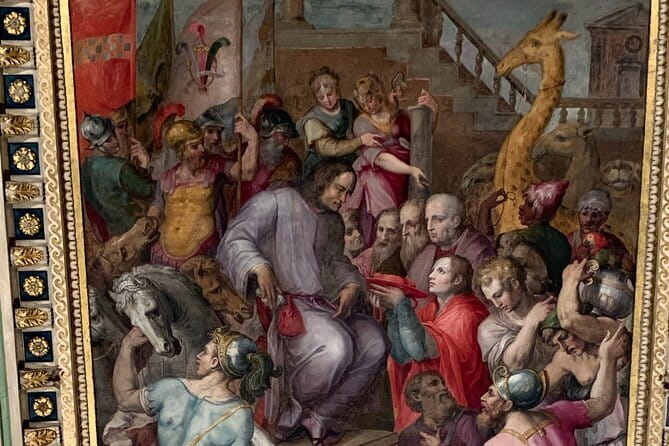
The Salone del Cinquecento is the grand centerpiece of the visit. Its scale shifts the mood at once. You move from a decorated courtyard into a hall built for major civic and political purposes.
The important point is not only the room’s size. Your guide explains its several transformations, showing how the hall changed as Florence’s political needs and ruling powers changed. That history gives the room more meaning than a simple photo stop.
The hall is also where the tour’s art and politics meet most clearly. Large historical scenes and powerful decoration were not placed there by accident. They helped present an image of authority to anyone entering the civic center of Florence.
You will probably spend much of the tour standing here while the guide talks. The museum has few opportunities to sit, and that is worth keeping in mind if you have foot or back problems. The supplied radio and headphones are helpful in a large room, since you can hear the explanation without standing right beside the guide.
Do not rush this part. The hall can feel overwhelming at first, especially if you try to study every painted surface. Let the guide provide the main framework, then use your remaining time to look at the details that catch your eye.
More churches and palazzos worth an hour:
- Florence: Palazzo Vecchio Entrance Ticket & Audioguide
★ 4.4 · 4,822 reviews - Florence: Palazzo Vecchio Guided Tour
★ 4.8 · 1,260 reviews - Florence: Timed Entrance Ticket to San Marco Museum
★ 4.6 · 396 reviews - Florence: Palazzo Vecchio Skip-the-Line Entry Ticket
★ 4.2 · 349 reviews
Medici rooms filled with portraits and myth

After the great civic hall, the visit moves into rooms connected with the Medici family. These interiors are more personal in scale, but they remain highly political.
Portraits show the family and the people around them. Historical events place their power into a larger story. Allegories of mythological gods bring another layer, using familiar figures and symbols to suggest qualities such as strength, wisdom, justice, or victory.
You do not need to know every Roman or Greek myth before arriving. The useful part of the explanation is how those figures functioned inside the rooms. A god on a wall was not merely decoration. The image could support an argument about the family’s right to rule or the virtues it wanted viewers to associate with its leadership.
I like this section because it gives you a way to read the rooms. Instead of asking only who painted a scene or how old it is, you start asking what the Medici wanted people to think. That is a more rewarding approach to palace art.
The portraits and historical scenes also help put faces to the period. The family’s presence is constant, but the surrounding images show how personal identity and public authority were tied together.
Donatello’s Judith and Holofernes
One of the key works on the route is the original Judith and Holofernes by Donatello. The sculpture gives the tour a strong artistic anchor because you are not only hearing about Medici symbolism in general. You are looking at a specific work with a powerful subject.
Judith’s story centers on courage, violence, and the defeat of a threatening enemy. That makes the sculpture especially suited to a palace where political power is a constant theme. Your guide can connect the work to the wider ideas running through the building.
Give the sculpture a little time rather than treating it as one more item on the route. The subject is dramatic, and the work carries more force when you consider how it fits into the palace’s message about strength and leadership.
This stop is also useful for people who do not want a tour made up only of architecture. Palazzo Vecchio offers grand spaces, but Donatello provides a close encounter with a major work of sculpture. It breaks up the large-scale rooms and gives you something specific to study.
Machiavelli’s personal office and political thought
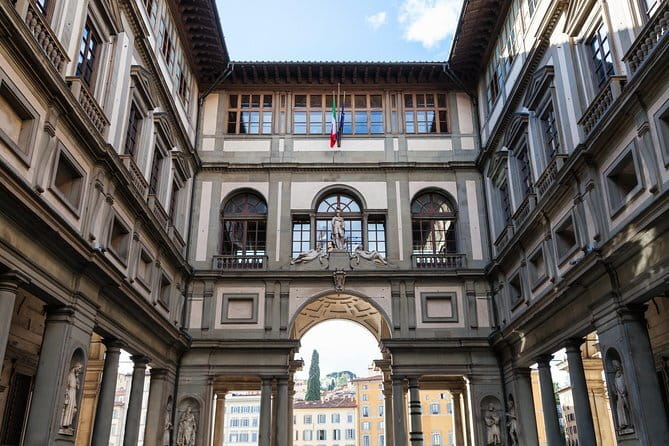
The visit also includes Niccolò Machiavelli’s personal office. That detail makes the tour especially appealing if you enjoy the history of ideas as much as painting and sculpture.
Machiavelli’s connection to Florence brings the palace down from mythological heroes to the practical problems of government. Seeing his office gives the political story a human scale. You are no longer looking only at official rooms designed to impress. You are also considering the place associated with a man whose work shaped European political thought.
The office is meaningful because it shows how Palazzo Vecchio connects art, government, and individual people. The Medici rooms present power through images. Machiavelli represents the effort to understand and describe power through writing and political analysis.
This is one of the tour’s more unusual inclusions. Many first visits to Florence focus on the Duomo, Michelangelo, or the Uffizi. A stop tied to Machiavelli offers a different view of the city, one based on civic life and political thought.
If you are traveling with someone who enjoys history but is less interested in decorative interiors, this room may be the point that keeps the whole tour engaging.
What the private format adds
This is a private activity, so only your group participates. That gives the tour a more personal feel than a large museum walk, though the exact group size is not stated.
A private visit is most useful when you have questions or a particular interest. You can ask for more context about the Medici family, focus on the artwork, or spend extra attention on Machiavelli and political history. The supplied radios and headphones also help you follow the guide inside the museum without straining to hear.
The experience is offered in English and includes a licensed local guide. Daniele is one guide associated with the experience, and his approach is described as strong on storytelling and detailed answers. Your assigned guide may differ, so do not book on the assumption that Daniele will lead your visit.
The private setup also means you are paying more than you would for simple museum admission. That is the central value question. If you like having a person explain what you are seeing and link separate rooms into one story, the cost may feel worthwhile. If you prefer silence, slow independent viewing, or a lower budget, you may want a different arrangement.
Timing, comfort, and the extra ticket cost
The stated price is $150.19 per person, with group discounts listed as an available feature. The museum admission is not part of that amount. You pay the museum directly on the same day, so check the total cost before booking and allow room in your budget for the separate ticket.
The skip-the-line reservation is made for a concrete date and time. This is valuable in Florence because a fixed entry slot helps protect a short sightseeing schedule. You should still arrive at the meeting point with time to spare, since late arrivals can be difficult for any timed museum visit.
The museum is unheated in winter. Florence can be mild outside while historic interiors feel cold, so bring a warm layer during the colder months. You will also spend much of the 1 hour 45 minutes on your feet, and there are not many places to sit while the guide explains the rooms.
Most people can participate, and service animals are allowed. The meeting point is near public transportation, which helps if you are arriving from another part of Florence. Confirmation is sent within 48 hours of booking, subject to availability.
You can cancel for a full refund up to 24 hours before the start time. Changes or cancellations made inside that window are not accepted and are not refunded. The tour also requires a minimum number of participants, and if that minimum is not met, you are offered another date or experience, or a full refund.
Who should book this Palazzo Vecchio visit
I would choose this tour if you want Florence’s political story explained through rooms, paintings, sculpture, and people. It suits first-time visitors who want a clear introduction, as well as returning visitors who have seen the main sights and now want more context.
It is a strong match for you if you enjoy:
- Medici history and family power
- Mythological symbols in art
- Donatello and Renaissance sculpture
- Machiavelli and political thought
- Guided visits with time for questions
- Private tours rather than large groups
I would think twice if you dislike standing, feel cold easily in winter, or want the lowest possible museum cost. The separate admission charge also means the advertised price is not the full amount you will spend.
The tour is offered in English only, so it is best for readers comfortable following a detailed explanation in English. Since it lasts less than two hours and ends at the starting point, it can fit well between other Florence plans.
Should you book it?
Book this Palazzo Vecchio tour if you want the building to make sense, not just look impressive. The Austrian frescoes, the changing Salone del Cinquecento, the Medici rooms, Donatello’s Judith, and Machiavelli’s office create a strong route through Florence’s art and political life.
The best reason to book is the guide’s storytelling. Daniele, when assigned, is particularly suited to visitors who enjoy detail and questions. The tradeoffs are clear: museum admission costs extra, winter interiors can be cold, and you will do much of the visit standing.
For a private English-language visit with a reserved time and licensed local guide, this is a focused way to see Palazzo Vecchio. I would book it when the palace is a priority and the added guide cost fits your budget.
FAQ
Where does the Palazzo Vecchio tour begin?
It begins at Piazza della Signoria, Florence, at the listed address near Palazzo Vecchio.
Where does the tour end?
The activity ends back at the meeting point in Piazza della Signoria.
How long does the experience last?
The guided visit lasts approximately 1 hour 45 minutes.
Is museum admission included in the price?
No. You pay the museum ticket directly to the museum on the same day as the tour.
Is the tour offered in English?
Yes. The experience is offered in English.
Is this a private tour?
Yes. Only your group participates in the private activity.
What is included besides the guide?
The experience includes a licensed local guide, radios and headphones for listening inside the museum, and a skip-the-line reservation for a specific date and time.
Can service animals participate?
Yes. Service animals are allowed.
Can I cancel for a full refund?
Yes. You can cancel at least 24 hours before the start time for a full refund. Cancellations or changes made less than 24 hours before the start time are not accepted or refunded.
Latest additions around Florence
- Florence: Cathedral Tour & Brunelleschi’s Dome Climb Ticket★ 5.0 · 3 reviews
- Palatina Gallery and Pitti Guided Tour in Florence★ 5.0 · 3 reviews
- Florence Uffizi Gallery Skip-the-line Tour w Art Historian Guide★ 5.0 · 3 reviews
- Private Tour: Pisa and Lucca from Florence★ 5.0 · 3 reviews
- San Gimignano Bike Tour (SOFT)★ 4.5 · 3 reviews
- Center of Florence by golf cart★ 5.0 · 3 reviews
- Florence: Tour of Florence by rickshaw★ 5.0 · 3 reviews
- From Firenze | Chianti day tour in a classic car★ 5.0 · 3 reviews
Florence Churches & Palazzos, compared.

Palazzo Vecchio guided experience with entrance ticket
Read our review →
Browse the lists this tour appears in