
Reviewed · MEDICI TOURS
Florence: Renaissance and Medici Tales Guided Walking Tour
Florence’s Renaissance story makes far more sense when you see it as a tale of money, family power, artistic ambition, and political risk. This walking tour connects the Medici family to the buildings around you, then links those stories to Brunelleschi, Michelangelo, Dante, and the symbols carved into the city’s streets and façades. I like the way it turns a pile of famous sights into a readable story. I also like the practical finish, with advice on places to eat, drink, and shop.
The main consideration is that this is an outdoor walking tour, not a ticketed visit inside Florence’s museums or churches. You see the Duomo, Medici buildings, Palazzo Vecchio, Ponte Vecchio, and other landmarks from the route, but entrance tickets are not included. The advertised price is remarkably low, though you should plan for a tip if the guide earns it.
In This Review
- Key points at a glance
- Why Florence’s Renaissance needs a street-level introduction
- Meeting beneath the green umbrella at San Lorenzo
- San Lorenzo and Palazzo Medici Riccardi: power begins at home
- The Duomo complex and Brunelleschi’s great problem
- Dante, symbols, and the city behind the postcard
- Palazzo Vecchio, Piazza della Signoria, and Loggia dei Lanzi
- Ponte Vecchio and the walk toward the Uffizi
- Storytelling is the real feature
- Price, tips, and the real value
- Who should book this Florence walk?
- Practical details before you go
- Should you book the Renaissance and Medici Tales tour?
- FAQ
- How long does the Florence Renaissance and Medici Tales tour last?
- Where does the tour meet?
- Where does the tour finish?
- Which languages are available?
- Is the tour wheelchair accessible?
- Does the tour enter the Duomo or Uffizi Gallery?
- What should I bring?
- Does the tour operate in bad weather?
- Can I cancel the booking?
Key points at a glance
- San Lorenzo start: Meet beneath the green umbrella in Piazza di San Lorenzo, beside the stairs to the church entrance.
- Medici power in plain sight: Follow the family’s influence from the Basilica of San Lorenzo to Palazzo Medici Riccardi and the city center.
- A clear Renaissance introduction: Hear how Florence helped produce figures such as Brunelleschi, Michelangelo, and Dante.
- Major sights without museum tickets: See the Duomo complex, Giotto’s Bell Tower, Brunelleschi’s Dome, Palazzo Vecchio, and Ponte Vecchio from outside.
- Strong storytelling: Guides including Chiara, Michele, Glenda, Angela, Fabio, and Ricardo are repeatedly praised for lively, easy-to-follow presentations.
- Useful local advice: Finish near the Uffizi Gallery with suggestions for food, drinks, shopping, and further sightseeing.
Why Florence’s Renaissance needs a street-level introduction
Florence can feel like an open-air art textbook. The problem is that the city gives you too much at once: a striped marble church, a giant red dome, a palace with a fortress-like front, statues in a public square, and a bridge packed with history. Without a guide, you may admire everything while missing how the pieces connect.
This tour gives you that connection in about two hours, or roughly two hours and fifteen minutes according to the route timing. You move through central Florence on foot while the guide explains how art, banking, religion, and family politics shaped the city.
I especially like the focus on symbols. Florence’s decorations are not just pretty stonework. Coats of arms, Medici emblems, sculptures, and architectural details can reveal who paid for a building, who wanted power, and how a family wished to be remembered. You will not simply be told what you are looking at. You will be shown how to read it.
The tour also works well as a first-day activity. It gives you a map in your head before you return to the Duomo, Uffizi, or Ponte Vecchio on your own. Several guides are praised for answering questions and shifting smoothly between the planned story and what interests the group.
More Medici trails:
- The Best tour in Florence: Renaissance & Medici Tales – guided by a STORYTELLER
★ 5.0 · 12,316 reviews - The Best Tour in Florence: Renaissance and Medici Tales
★ 5.0 · 10,810 reviews - Florence: Mysteries of the Medici Guided Walking Tour
★ 4.4 · 940 reviews
Meeting beneath the green umbrella at San Lorenzo
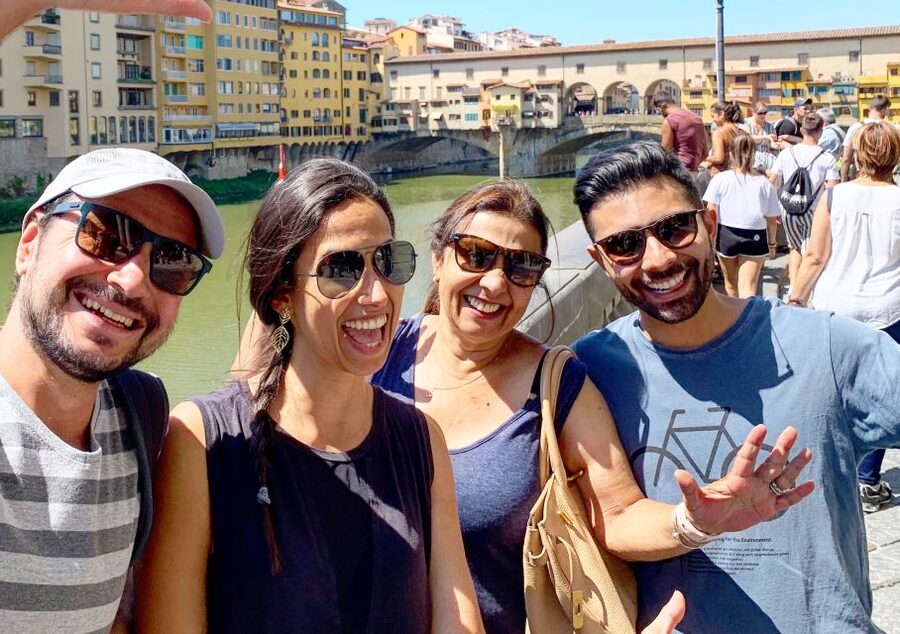
Your starting point is Florence Free Tour-Tale in Piazza di San Lorenzo. Look for the green umbrella in front of the stairs leading to the main entrance of the Basilica of San Lorenzo.
This is a useful place to begin. San Lorenzo brings together Romanesque and Renaissance elements, giving the guide an immediate way to explain Florence’s changing architectural taste. The square also places you close to the Medici story from the first minutes of the walk.
You should arrive ready to stand, listen, and move through busy central streets. Wear comfortable shoes, carry water, and bring clothing suited to the weather. The tour runs rain or shine, so a wet-weather plan matters. A camera is useful, though the real value here is learning what to notice when you later explore alone.
English and Spanish tours are available. The activity is listed as wheelchair accessible, but it remains a city walking route, so you may want to confirm the exact conditions for your booking if street surfaces or group movement are important to you.
San Lorenzo and Palazzo Medici Riccardi: power begins at home
The Basilica of San Lorenzo is more than a handsome starting point. It is tied closely to the Medici family and gives you an early look at how Florence’s leading family used religious and civic projects to shape its public image.
From here, the route continues to Palazzo Medici Riccardi. This palace helps explain the family’s rise. The guide’s job is not only to name the building, but to show how architecture could send a political message. A powerful home in a central location told Florence who had money, influence, and ambition.
This is where the tour’s family drama comes into focus. The Medici were not simply generous patrons who funded beautiful art. They were also political operators whose decisions affected the city for generations. Guides such as Michele, Chiara, and Angela are praised for making this material human and memorable rather than presenting a string of dates.
That approach is helpful if you know little about Florentine history. It is also useful if you already recognize the Medici name but have trouble sorting out the different generations and their roles.
The Duomo complex and Brunelleschi’s great problem
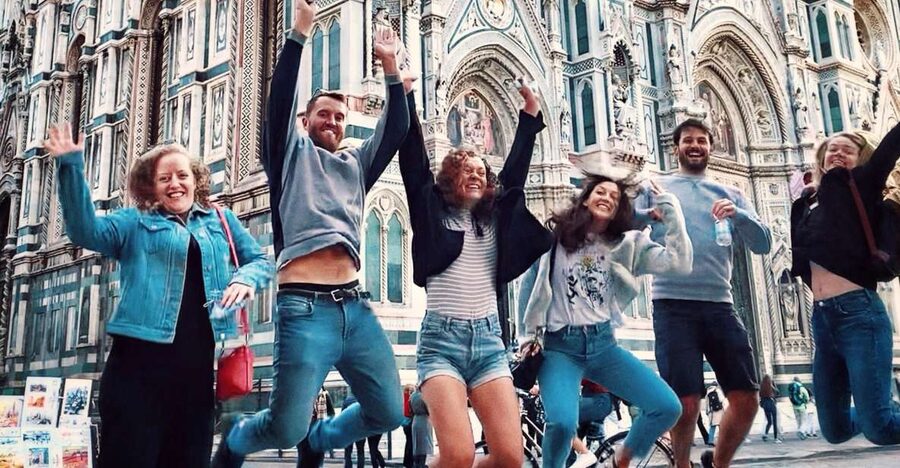
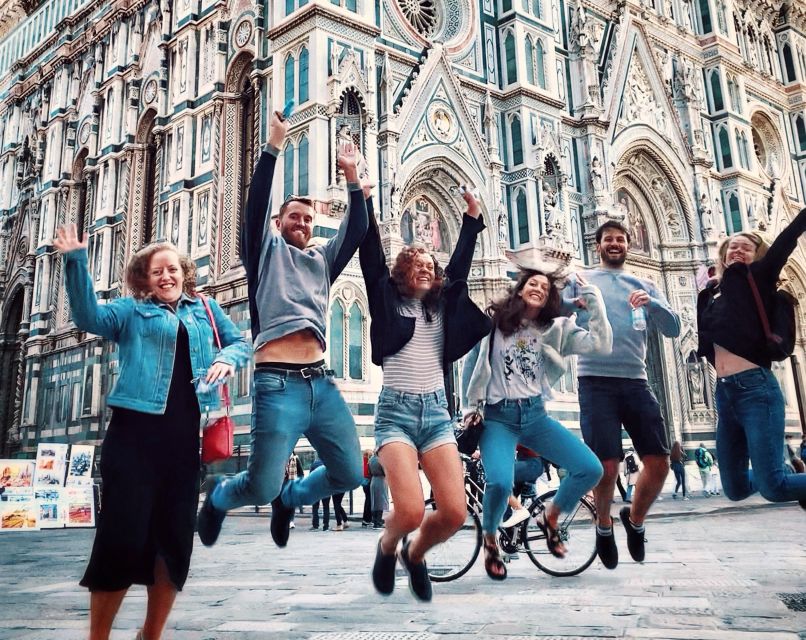
The route then reaches Florence’s Duomo complex, including Giotto’s Bell Tower and Brunelleschi’s Dome. This is the visual high point of the walk, even if you are seeing the buildings from outside.
The cathedral’s scale is hard to grasp in a photograph. From the square, you can take in the patterned marble exterior, the bell tower, and the huge dome as one ambitious project. The guide explains the story behind the dome and why it became such a defining achievement of Renaissance Florence.
Do not expect to climb Brunelleschi’s Dome on this tour. The activity is a guided walk, and no admission is included. That is not a flaw if you want an introduction before deciding how to spend time inside the Duomo complex. It is a limitation if your main goal is interior art, the dome climb, or close study of the cathedral’s details.
The square can be crowded and noisy. One guide used a microphone and ear pieces, which can make a real difference when a group is spread out or surrounded by city traffic. Equipment may vary by guide and departure, so do not assume every tour will use it, but the route is clearly designed around keeping a group together in busy streets.
More Renaissance art days:
- Florence: Timed Entrance Ticket to Michelangelo’s David
★ 4.6 · 16,983 reviews - Florence: Michelangelo’s David Skip-the-Line Entry Ticket
★ 4.5 · 12,764 reviews - Florence: Timed Entry Ticket to Michelangelo’s David & eBook
★ 4.6 · 4,049 reviews - Michelangelo’s David, Accademia & Uffizi Small Group Tour
★ 4.5 · 1,986 reviews
Dante, symbols, and the city behind the postcard
The stop at the House of Dante adds a different layer to the story. The Medici and Renaissance artists tend to dominate Florence’s popular image, but Dante helps place the city in an older cultural and political setting.
The guide uses the route to point out details you might otherwise walk past. This is one of the most useful parts for curious visitors who want more than a checklist of famous buildings. You might notice a symbol on a façade, a family mark, or a sculptural detail and understand that it carries a message about faith, status, politics, or civic identity.
The tour does not promise a full academic history of Florence. Instead, it offers a compact crash course that moves from medieval Florence through the Renaissance and into the later Medici legacy. That broad sweep is a strength for a first visit, though the short format means individual artists and events cannot receive the attention they would get on a specialist tour.
Palazzo Vecchio, Piazza della Signoria, and Loggia dei Lanzi
At Palazzo Vecchio and Piazza della Signoria, Florence’s political story becomes public. The square is filled with sculpture and surrounded by buildings that once helped express the city’s civic power.
The nearby Loggia dei Lanzi adds another open-air art stop. Here, the guide can connect statues and public space to the way Florence displayed strength, ideals, and control. This is also a good moment to ask questions about the artists and symbols you have encountered along the way.
The route is not just a march from one landmark to the next. Guides such as Glenda, Ricardo, Fabio, and Antonio are repeatedly praised for mixing humor with clear explanations. That matters in a square where there is plenty to look at and plenty of noise to compete with the guide.
You should keep your expectations realistic. A two-hour walk cannot explain every statue or palace room. The guide selects the details most useful for understanding Florence as a whole. I would treat this section as an orientation to return to later, perhaps with more time for the Palazzo Vecchio or nearby museums.
Ponte Vecchio and the walk toward the Uffizi
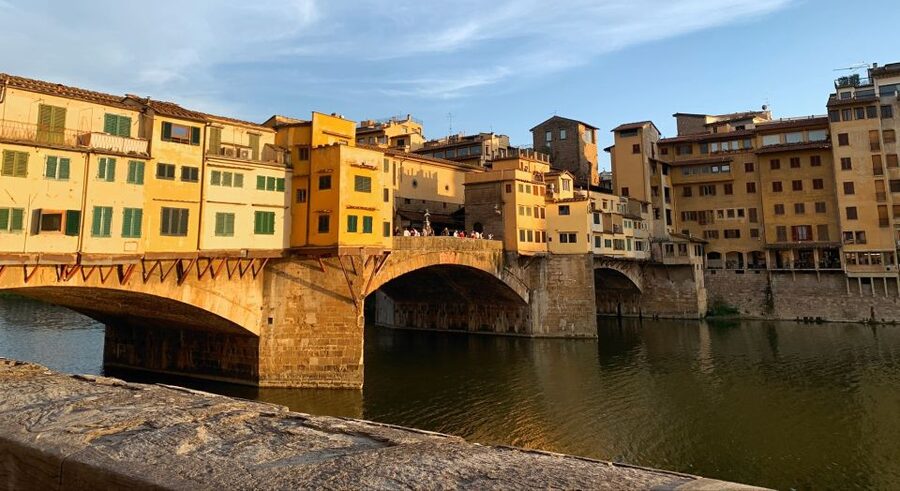
The tour continues to Ponte Vecchio, one of Florence’s most recognizable views. The bridge is photogenic, but its importance is more than visual. It links the two sides of the city and fits naturally into the broader story of Medici movement and influence.
By this point, the route has taken you through religious buildings, family palaces, civic spaces, artists’ stories, and the river crossing. The sequence helps you understand Florence as a compact city where political power and artistic work were always close together.
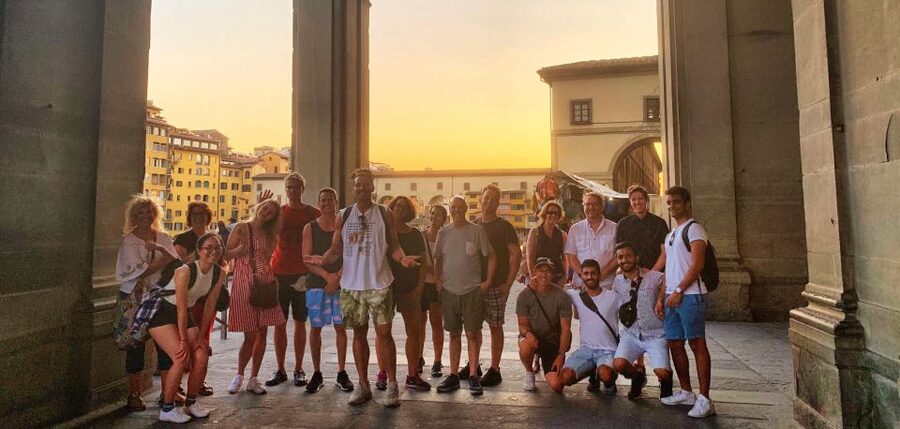
The walk ends outside the Uffizi Gallery. This is a practical finish because you can continue sightseeing in the same area, take photographs, cross back over the river, or stop for a meal. Remember that the tour does not include entry to the Uffizi. If you plan to visit, arrange that separately.
Storytelling is the real feature
The strongest part of this activity is the guide’s delivery. The individual guide can vary, but names praised for warmth, humor, and clear storytelling include Chiara, Michele, Glenda, Angela, Fabio, Ricardo, Antonio, Autumn, Gabriella, Manuel, and others.
That list matters because a walking tour depends heavily on the person leading it. A dry lecture would make Florence’s political history hard work. Here, the emphasis is on stories, personalities, intrigue, and memorable connections. You hear about the Medici as real people with rivals, plans, and long-term effects, not just as names attached to palaces.
The pace is another strong point. The route covers many major sights, but the activity is not described as a frantic race. A good guide slows down at the main sites and allows the group to take in what happened there. One particularly useful feature for families is the broad appeal of the stories. The material can hold the attention of adults and teenagers, especially when the guide connects history to artists such as Michelangelo.
Guides also receive praise for answering questions and offering practical suggestions. That makes the activity feel more personal than a recorded audio route. You can ask about a landmark, clarify a name, or request advice for the rest of your stay.
Price, tips, and the real value
The listed price is $2.36 per person, an unusually low charge for a two-hour guided walk through Florence. This follows the free-tour model: you reserve a place, then tip the guide based on your satisfaction. One booking description refers to a small payment of 4.90 euros, while another specifically advises bringing cash for a tip.
In practical terms, do not treat the advertised amount as the full expected cost. Bring cash and think of the tip as part of the budget. The amount is your choice, but the guide’s time, preparation, and local advice are central to the experience.
The value is strongest if you use the tour as a city orientation. You get a coherent introduction to major sights without paying museum admission, and you can decide afterward which interiors deserve your money and time. If you already know Florence very well, the route may feel basic in places, though the Medici stories and guide interaction can still add detail.
The reserve-now, pay-later option and free cancellation up to 24 hours before departure make it easier to fit the walk into a changing schedule. Check the available start times when booking, since the exact departure matters for your day plan.
Who should book this Florence walk?
I would choose this tour for a first or second day in Florence. It helps you recognize the city’s major landmarks and gives you useful ideas for food, drinks, shopping, and later visits.
It suits:
- First-time visitors who want the big picture before entering museums
- Families with teenagers who prefer stories to long formal lectures
- Art and history fans interested in the Medici, Renaissance artists, and Florence’s symbols
- Short-stay visitors who need a compact introduction
- Independent explorers who want local suggestions before setting off alone
- Visitors who prefer an outdoor overview rather than a museum-heavy activity
It may not suit you if you want lengthy time inside the cathedral, a dome climb, Uffizi admission, or a highly specialized art lecture. It also requires comfort with walking outdoors in changing weather.
Practical details before you go
Meet at the green umbrella in front of the San Lorenzo church stairs. Give yourself enough time to find Piazza di San Lorenzo, especially if you are arriving from another part of central Florence.
Wear shoes you can manage for about two hours. Carry water, a camera, and weather-appropriate clothing. Since the tour runs rain or shine, do not book it without considering the forecast and your own tolerance for wet or cold conditions.
The route is wheelchair accessible according to the activity details. The tour is offered in English or Spanish, with a live guide. Museum and church entry fees are not listed among the inclusions, so plan to pay separately for any interior visits you add before or after the walk.
Should you book the Renaissance and Medici Tales tour?
Book it if you want Florence to make sense quickly. The route covers the city’s essential outdoor sights, but the real payoff is the story connecting San Lorenzo, the Medici palaces, the Duomo, Dante, Piazza della Signoria, Ponte Vecchio, and the Uffizi.
I would especially book it at the start of a Florence stay, carry cash for the tip, and use the guide’s restaurant and shopping advice afterward. Skip it only if you are seeking museum entry or a specialist-level treatment of one artist or building. For a low-cost, story-led introduction to Florence, it offers strong value.
FAQ
How long does the Florence Renaissance and Medici Tales tour last?
The activity is advertised as lasting two hours. The route timing also gives approximately two hours and fifteen minutes, so allow a little more than two hours in your schedule.
Where does the tour meet?
Meet at Florence Free Tour-Tale, beneath the green umbrella in front of the stairs leading to the main entrance of the Basilica of San Lorenzo.
Where does the tour finish?
The walk finishes outside the Uffizi Gallery.
Which languages are available?
The live tour is available in English and Spanish.
Is the tour wheelchair accessible?
Yes. The activity information lists the tour as wheelchair accessible.
Does the tour enter the Duomo or Uffizi Gallery?
The provided details describe a guided walking tour of the exterior sights. Admission to the Duomo complex, Brunelleschi’s Dome, the Uffizi Gallery, or other attractions is not included.
What should I bring?
Bring comfortable shoes, water, a camera, and clothing suited to the weather.
Does the tour operate in bad weather?
Yes. The tour takes place rain or shine.
Can I cancel the booking?
You can cancel up to 24 hours in advance for a full refund. The reserve-now, pay-later option lets you hold a place without paying immediately.
More Walking Routes in Florence
- Florence: Guided Walking Tour
★ 4.5 · 3,334 reviews - Skip the line: Uffizi and Accademia Small Group Walking Tour
★ 4.5 · 3,135 reviews - Florence: Guided Walking Tour
★ 4.6 · 1,602 reviews - Florence: Uffizi & Accademia Small Group Walking Tour
★ 4.7 · 1,380 reviews
Latest additions around Florence
- Florence: Cathedral Tour & Brunelleschi’s Dome Climb Ticket★ 5.0 · 3 reviews
- Palatina Gallery and Pitti Guided Tour in Florence★ 5.0 · 3 reviews
- Private Tour: Pisa and Lucca from Florence★ 5.0 · 3 reviews
- San Gimignano Bike Tour (SOFT)★ 4.5 · 3 reviews
- Florence Uffizi Gallery Skip-the-line Tour w Art Historian Guide★ 5.0 · 3 reviews
- Florence: Tour of Florence by rickshaw★ 5.0 · 3 reviews
- Center of Florence by golf cart★ 5.0 · 3 reviews
- From Firenze | Chianti day tour in a classic car★ 5.0 · 3 reviews
Medici Tours, compared.

The Best tour in Florence: Renaissance & Medici Tales – guided by a STORYTELLER
Read our review →
The Best Tour in Florence: Renaissance and Medici Tales
Read our review →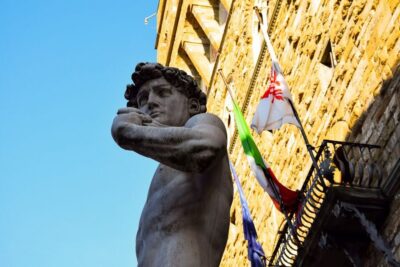
Guided Tour of Medici Family Secrets and Chapels
Read our review →
Pitti Palace, Palatina Gallery and the Medici: Arts and Power in Florence.
Read our review →

Medici Legends & Renaissance Wonders: Florence Small Group Tour
Read our review →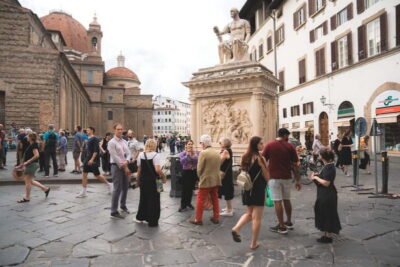
Browse the lists this tour appears in