
Reviewed · RENAISSANCE ART TOURS
Florence: LGBTQ Renaissance Walking Tour with Mila
Florence’s grand Renaissance story looks different when you follow its queer past. On this two-hour walk with local guide Mila, you’ll connect famous sights with medieval laws, public punishments, Medici scandals, and the old gay district near Piazza della Signoria.
I like two things especially: the tour uses places you already want to see, including the Ponte Vecchio and Cellini’s Perseus, and Mila adds careful research, humor, and personal warmth to difficult material. The main consideration is that much of the surviving record centers on gay men, so stories about lesbians and other parts of the LGBTQ community receive less attention.
In This Review
- Key points
- A different way to read Florence’s famous center
- Starting beneath the Loggia at Piazza della Repubblica
- Crossing Santa Trinita Bridge toward Medici territory
- The Ponte Vecchio and Florence’s old cruising culture
- Piazza della Signoria and the old gay district
- Orsanmichele and the public policing of identity
- Returning to Piazza della Repubblica with more context
- What $29 buys you in Florence
- Who will get the most from Mila’s walk
- Practical advice before you book
- Should you book this LGBTQ Florence tour?
- FAQ
- How long is the LGBTQ Renaissance walking tour?
- What language is the tour conducted in?
- Where do I meet Mila?
- Is the tour wheelchair accessible?
- Does the tour run in bad weather?
- What is included in the $29 price?
Key points
- A queer reading of famous Florence: See the Ponte Vecchio, Pitti Palace Square, Piazza della Repubblica, and Piazza della Signoria with a new historical lens.
- Mila’s storytelling: Expect clear explanations, lively anecdotes, and source notes when she discusses disputed or sensitive material.
- Medieval and Renaissance laws: Learn about fines and punishments for people accused of sodomy, and how those rules changed over time.
- Historic cruising ground: Hear why the Ponte Vecchio and nearby streets became associated with male queer culture.
- Good practical format: The walk lasts two hours, includes a headset, is conducted in English, and is listed as wheelchair accessible.
- Strong value at $29: You get a focused local history tour while also covering several central Florence sights.
A different way to read Florence’s famous center
This is not a standard Florence walk with a few LGBTQ facts added at the end. The subject shapes the whole route. Mila uses the city’s squares, bridges, churches, palaces, and statues to show how queer lives were regulated, hidden, punished, joked about, and sometimes protected by powerful families.
That approach makes the tour useful even if you have already seen Florence’s headline sights. You may have crossed the Ponte Vecchio or photographed the copy of Michelangelo’s David before, but the stories attached to those places can change how you understand them.
Mila is the key to the experience. Her style combines serious historical explanation with warmth and dry humor, which matters here. The subject includes persecution and public shame, and a relentlessly grim delivery would make the walk heavy going. Instead, Mila gives the darker facts their proper weight while keeping the group engaged.
I also like that she identifies the sources behind her stories. Florence’s queer past is not always easy to document, and historical records often reflect the prejudices of the people who created them. Mila’s habit of separating documented facts from interpretation gives the tour welcome care.
More Renaissance art days:
- Florence: Timed Entrance Ticket to Michelangelo’s David
★ 4.6 · 16,983 reviews - Florence: Michelangelo’s David Skip-the-Line Entry Ticket
★ 4.5 · 12,764 reviews - The Best tour in Florence: Renaissance & Medici Tales – guided by a STORYTELLER
★ 5.0 · 12,316 reviews
Starting beneath the Loggia at Piazza della Repubblica
Meet Mila in Piazza della Repubblica, next to the Hard Rock Café and under the Loggia. She will have a sign, so the meeting point should be easy to identify in this busy central square.
The opening subject is blunt: how medieval and Renaissance Florence treated people accused of sodomy. You’ll hear about fines, punishments, and the legal systems used against men believed to have broken sexual rules. Mila also explains that the laws did not remain fixed. Florence and Italy changed politically and socially, and official attitudes shifted with them.
This beginning gives you useful context before the walk reaches the monuments. You are not simply hearing isolated anecdotes about famous men. You are learning how law, religion, family honor, class, and public reputation shaped private life.
Piazza della Repubblica is also a practical starting point. It sits close to several major sights, cafés, and shopping streets, making it easy to reach before a morning or evening tour. The square can be crowded and noisy, so the supplied headset matters. It should help you hear Mila without forcing her to compete with city traffic and nearby activity.
Crossing Santa Trinita Bridge toward Medici territory
The route continues across the Santa Trinita Bridge, one of the central crossings over the Arno. This is a pleasant change from a talk held in one square because the city keeps moving around you while the story develops.
From the bridge, the walk reaches Pitti Palace Square. Here, Mila turns to the Medici family, Florence’s famous ruling dynasty, with particular attention to Gian Gastone, the last male member of the family.
This part is valuable because it links LGBTQ history to political power. Gian Gastone is presented as one of the most controversial figures in European history, and his life gives Mila a way to discuss sexuality, inheritance, reputation, and the pressures placed on a ruling family.
Do not expect a palace visit. Entrance fees are not included, and this is an outdoor walking tour rather than a museum experience. The reward is the setting and the context. You see how the Medici world occupied public space, then consider what happened when the private life of a powerful man collided with the expectations of dynasty and church.
Pitti Palace Square can also be a good place to pause and take in the scale of the surroundings. If you have only seen the Medici through paintings and guidebook summaries, this stop gives their power a physical setting.
The Ponte Vecchio and Florence’s old cruising culture
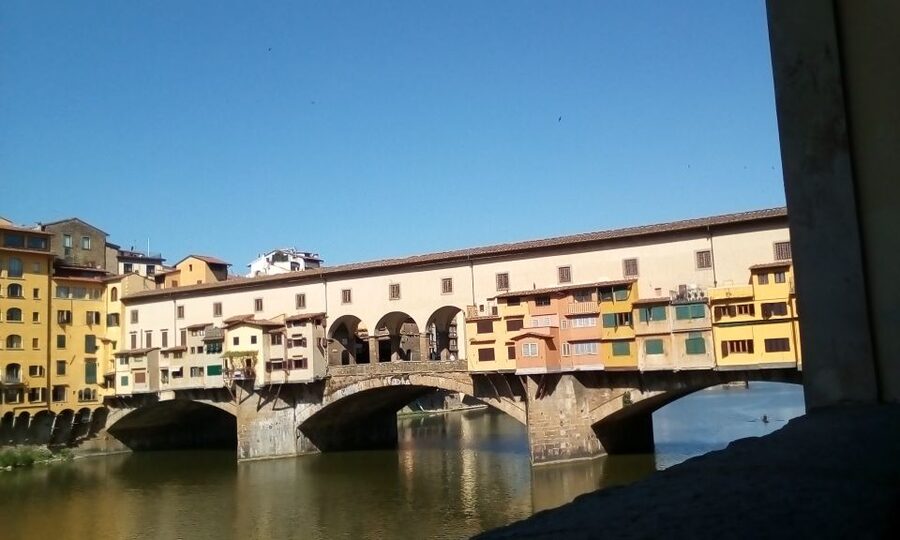
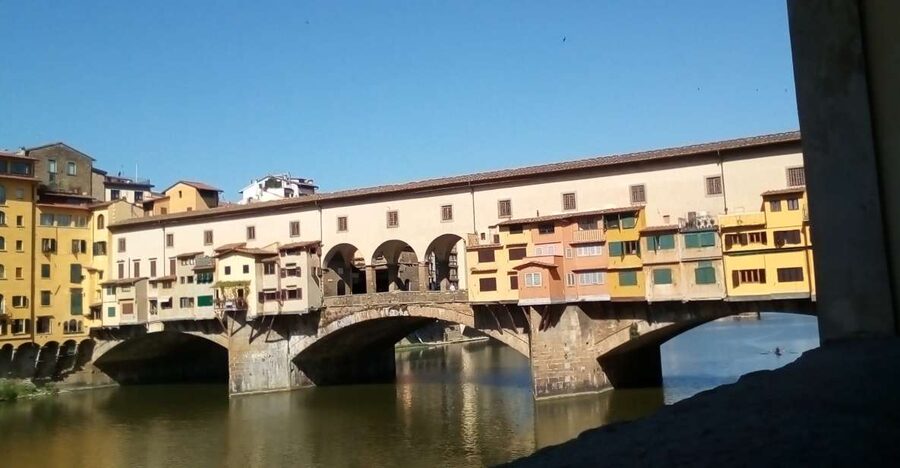
The Ponte Vecchio is the route’s most instantly recognizable landmark. Its shops, arches, and views make it a highlight of almost any Florence walk. Here, though, Mila explains its connection to the queer community.
During the medieval and Renaissance periods, the bridge was associated with male cruising. That detail adds a striking layer to a place usually presented as a pretty crossing or shopping stop. Mila’s interpretation asks you to picture the bridge not only as a monument, but also as a social space where people watched, met, took risks, and tried to find one another.
This is one of the tour’s strongest ideas: public places can carry several histories at once. The same bridge could serve merchants, tourists, officials, couples, and men seeking private contact in a public world.
The Ponte Vecchio is usually one of Florence’s busiest points, so do not expect a quiet, reflective crossing. You may need to stay close to the group and listen through the headset. Still, the crowd makes the historical point in its own way. A site that has always been full of movement and observation was also a place where people learned to communicate discreetly.
More walking routes in Florence:
- Florence: Guided Walking Tour
★ 4.5 · 3,334 reviews - Skip the line: Uffizi and Accademia Small Group Walking Tour
★ 4.5 · 3,135 reviews - Florence: Guided Walking Tour
★ 4.6 · 1,602 reviews - Florence: Renaissance and Medici Tales Guided Walking Tour
★ 4.8 · 1,549 reviews
Piazza della Signoria and the old gay district
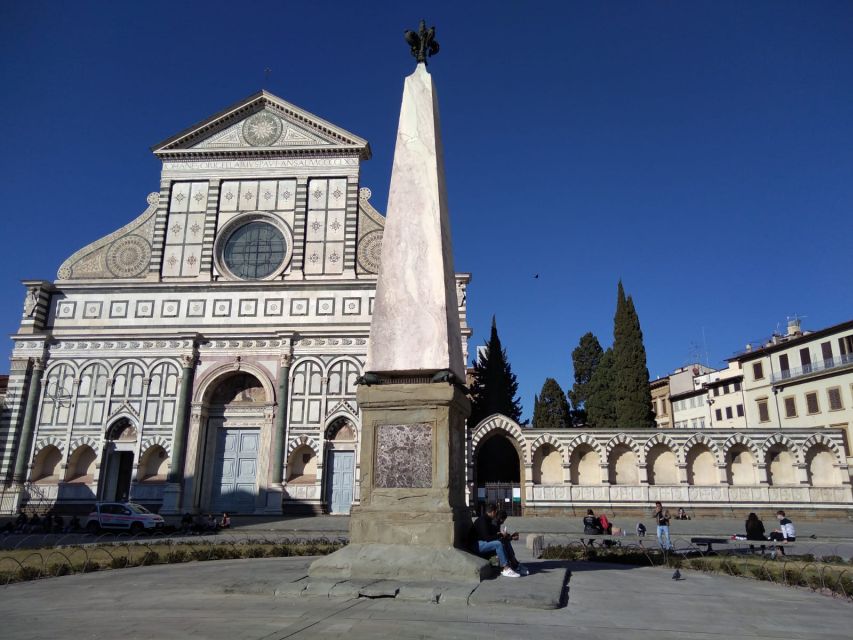
Near Piazza della Signoria, Mila leads you into what is described as Florence’s ancient gay district. This section brings the tour closest to the city’s former queer social geography.
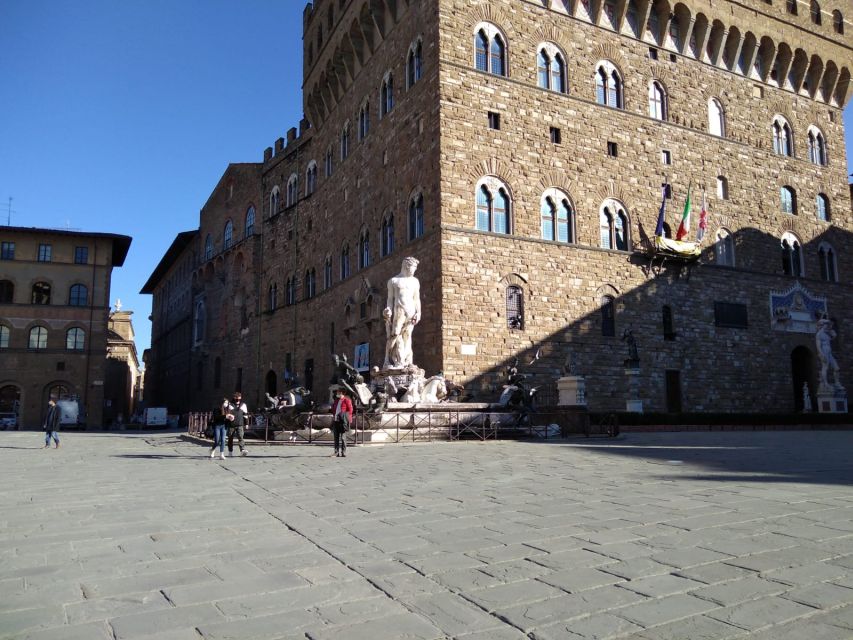
The area is packed with famous art and political symbols. You’ll see a copy of Michelangelo’s David and Benvenuto Cellini’s Perseus with the Head of Medusa in the square. These are not just photo stops. Mila uses the statues and their location to explain the people, ideals, and power structures that shaped Renaissance Florence.
Cellini’s Perseus is especially fitting for this tour because Cellini himself was a major Florentine artist with a controversial private life. The statue also reflects the way Renaissance art, male beauty, violence, ambition, and patronage could overlap. Mila does not need to remove the monument from its artistic setting to discuss its social meaning.
The copy of David offers another familiar image with new questions attached. Florence often presents the sculpture as a symbol of civic strength and male beauty. On this walk, you can also consider how the display of idealized male bodies fit into Renaissance culture and how modern ideas about identity do, and do not, match the categories used in the past.
The district is now one of the city’s major sightseeing zones, not a preserved LGBTQ neighborhood in the modern sense. That distinction matters. You are walking through a historical area linked to queer life, not visiting a clearly marked contemporary gay quarter.
Orsanmichele and the public policing of identity
The walk continues to Orsanmichele Church, where Mila discusses a particularly unsettling part of Florence’s past. The church displayed special boxes used to denounce members of the LGBTQ community, especially gay men.
This stop shows how religious buildings could function as centers of civic control as well as places of worship. Accusations could affect a person’s safety, status, work, and family. The story also helps explain why queer life often appears in historical records through court cases, denunciations, and punishments rather than through ordinary domestic details.
You should expect the tone to become more serious here. Mila has been praised for handling delicate subjects with a balance of education and humor, but this is still difficult material. That balance is useful for younger visitors as well. One parent specifically found the subject suitable for a 15-year-old, provided the young person is ready for honest discussion of discrimination and historical punishment.
Orsanmichele also reinforces a point running through the entire walk: Florence’s art and architecture cannot be separated from the laws and institutions that governed the people who made, funded, and viewed them.
Returning to Piazza della Repubblica with more context
The walk returns to Piazza della Repubblica, completing a loop through the center. Two hours is a good length for this subject. There is enough time for real context without turning the afternoon into a lecture on foot.
The route covers a useful portion of central Florence, but it is not physically demanding in the way a full-day excursion would be. You will be walking over city streets and crossing bridges, so comfortable shoes remain sensible. The tour runs rain or shine, which makes a forecast check worthwhile. In hot weather, Mila has shown care for the group and adjusted her attention to people who needed it.
The experience is listed as wheelchair accessible, an important point for anyone planning around mobility needs. One participant with limited movement received particular care from Mila. Still, city paving, crowds, and bridge approaches can affect comfort from day to day, so it is sensible to ask the provider about your specific needs before booking.
At the end, Mila may also be useful beyond the formal subject. She has offered suggestions for other places to see, eat, and avoid, including a well-received gelato recommendation. Taking the tour early in your stay could help you shape the rest of your Florence plans.
What $29 buys you in Florence
At $29 per person, this is fairly priced for a two-hour guided walk in central Florence. The cost includes Mila or another local guide, the walking tour, and a headset. Hotel pickup, drop-off, and entrance fees are not included, but there is no museum admission built into the route anyway.
The value comes from the focus. A general city walk may point out the same bridge, squares, and statues, but it is unlikely to connect them through LGBTQ history in such a sustained way. You are paying for research, interpretation, and a route designed around a subject that can be difficult to find in ordinary guidebooks.
The tour also works well as an alternative to a standard introductory walk. You still see major landmarks, but the emphasis falls on overlooked people and social forces rather than only on dates, dynasties, and artistic masterpieces.
The 4.9 rating from 85 reviews supports the impression that the strongest part is Mila herself. People repeatedly praise her storytelling, humor, warmth, patience, and care. One person even joined alone after other bookings dropped out, and Mila still ran the tour. That suggests a personal, small-scale spirit, though the exact group size is not specified, so you should not book expecting a guaranteed private tour.
Who will get the most from Mila’s walk
I would choose this tour if you want LGBTQ history treated as real history, not as a token side note. It suits queer visitors looking for a stronger connection to Florence, but you do not need to identify as LGBTQ to get value from it. Anyone interested in law, religion, art, political power, or the hidden social life of cities can follow the story.
It is also a good choice for solo visitors. The subject creates an easy way to meet other people with similar interests, and Mila’s friendly style helps the group connect. For couples and friends, it offers a shared experience that goes beyond taking the same familiar photographs.
Families with older teenagers may find it suitable, especially if you want to discuss how historical societies treated sexuality and difference. The material includes punishment, public accusation, and discrimination, so it is not a child-focused sightseeing walk.
You may want a different tour if your main goal is to enter museums, see detailed Renaissance interiors, or receive a broad survey of Florence’s art. This experience stays outdoors and does not include entrance fees. It also focuses much more heavily on gay men, partly because the surviving records and the city’s historic cruising culture point in that direction. Mila does include some discussion of women and lesbians, but that is not the main thread.
Practical advice before you book
Reserve this for a time when you can listen closely. The route passes through busy public spaces, and the headset helps, but you will get more from Mila if you stay near the group and avoid treating it as a casual stroll.
Bring water, especially in warm months. The walk is only two hours, but Florence’s reflected heat and hard paving can make a short route feel longer. Mila has been attentive to people in hot conditions, yet basic preparation still helps.
Think of the tour as an outdoor history lesson with a strong city walk attached. Wear shoes suited to walking, check the weather, and remember that the tour runs in rain or shine. English is the listed language, and booking can be canceled up to 24 hours in advance for a full refund. You can also reserve now and pay later if you want to keep your plans flexible.
Should you book this LGBTQ Florence tour?
Book it if you want Florence’s famous sights to tell a less familiar story. Mila’s strongest qualities are her research, clear storytelling, humor, and care with difficult subjects. The route is compact, the price is reasonable, and you get a useful introduction to the city’s queer past without giving up the major landmarks.
Skip it if you want a museum-heavy art tour or a broad introduction to every period of Florentine history. Also keep your expectations precise: this is mainly a history of gay men in medieval and Renaissance Florence, with more limited coverage of lesbians and other LGBTQ identities.
For most curious visitors, I would take it early in a Florence stay. You’ll see the Ponte Vecchio, Medici spaces, Piazza della Signoria, and Orsanmichele with fresh questions in mind, then spend the rest of your visit noticing how many private stories sit behind the city’s public monuments.
FAQ
How long is the LGBTQ Renaissance walking tour?
The tour lasts two hours.
What language is the tour conducted in?
The live tour guide speaks English.
Where do I meet Mila?
Meet Mila at Piazza della Repubblica, next to the Hard Rock Café under the Loggia. She will have a sign.
Is the tour wheelchair accessible?
Yes, the activity is listed as wheelchair accessible.
Does the tour run in bad weather?
Yes. The tour takes place rain or shine.
What is included in the $29 price?
The price includes a local guide, headset, and walking tour. Hotel pickup and drop-off and entrance fees are not included.
More LGBTQ-Friendly in Florence
- LGBTQ + friendly Renaissance Gay life in Florence tour
★ 5.0 · 13 reviews
Latest additions around Florence
- Florence: Cathedral Tour & Brunelleschi’s Dome Climb Ticket★ 5.0 · 3 reviews
- Palatina Gallery and Pitti Guided Tour in Florence★ 5.0 · 3 reviews
- Florence Uffizi Gallery Skip-the-line Tour w Art Historian Guide★ 5.0 · 3 reviews
- Private Tour: Pisa and Lucca from Florence★ 5.0 · 3 reviews
- San Gimignano Bike Tour (SOFT)★ 4.5 · 3 reviews
- Florence: Tour of Florence by rickshaw★ 5.0 · 3 reviews
- Center of Florence by golf cart★ 5.0 · 3 reviews
- From Firenze | Chianti day tour in a classic car★ 5.0 · 3 reviews
Renaissance Art Tours, compared.

Timed Entrance Ticket to Michelangelo’s David
Read our review →
Michelangelo’s David Skip-the-Line Entry Ticket
Read our review →
The Best tour in Florence: Renaissance & Medici Tales – guided by a STORYTELLER
Read our review →
The Best Tour in Florence: Renaissance and Medici Tales
Read our review →
Timed Entry Ticket to Michelangelo’s David & eBook
Read our review →
Michelangelo’s David, Accademia & Uffizi Small Group Tour
Read our review →
Michelangelo’s David Entrance Ticket and Audio App
Read our review →
Renaissance and Medici Tales Guided Walking Tour
Read our review →Browse the lists this tour appears in