
Reviewed · ACCADEMIA GALLERY TOURS
Florence: Michelangelo’s David Entrance Ticket and Audio App
Michelangelo’s David is the reason most people come, and seeing the original in Florence is a powerful moment. The statue is larger and more finely finished than many expect, with unfinished Michelangelo sculptures nearby that help you understand how he carved from stone.
I like the timed entry, which can save you from a long ticket-office queue, and I like the freedom of an audio app rather than a guide leading you from room to room. The main catch is that this is not a true instant skip of every wait: timed entry still requires punctuality, and museum staff may hold you outside for 15 to 20 minutes when the galleries are crowded.
In This Review
- Key points to know before booking
- Why David is worth the trip
- The unfinished sculptures and Michelangelo’s method
- A change of mood in the Gipsoteca
- The Medici instruments and Stradivarius violins
- Medieval and Renaissance painting galleries
- Medieval altarpieces on the top floor
- How the timed entrance works
- Using the Pop Guide audio app
- Is $38 a fair price?
- Who should book this Accademia experience?
- My call: book it when time matters
- FAQ
- Where do I meet the activity provider?
- Do I enter the museum with the voucher?
- Does the ticket skip every line?
- Is the ticket timed?
- What is included in the booking?
- Do I need to bring headphones?
- What should I prepare for the audio guide?
- Can children use a discounted ticket?
Key points to know before booking
- David is the main event: Michelangelo’s 17-foot marble statue is the museum’s unforgettable centerpiece.
- The ticket saves time: Exchange your voucher with a host and use the reserved entrance instead of joining the ticket-office line.
- You set the pace: The Pop Guide app gives you commentary while you walk freely through the galleries.
- There is much more than David: See unfinished Michelangelo works, plaster models, Medici instruments, paintings, and medieval altarpieces.
- Prepare your phone: Download Pop Guide before arrival, bring headphones, and make sure your smartphone is charged.
- Timing matters: Late arrival may mean losing entry and receiving no refund.
Why David is worth the trip
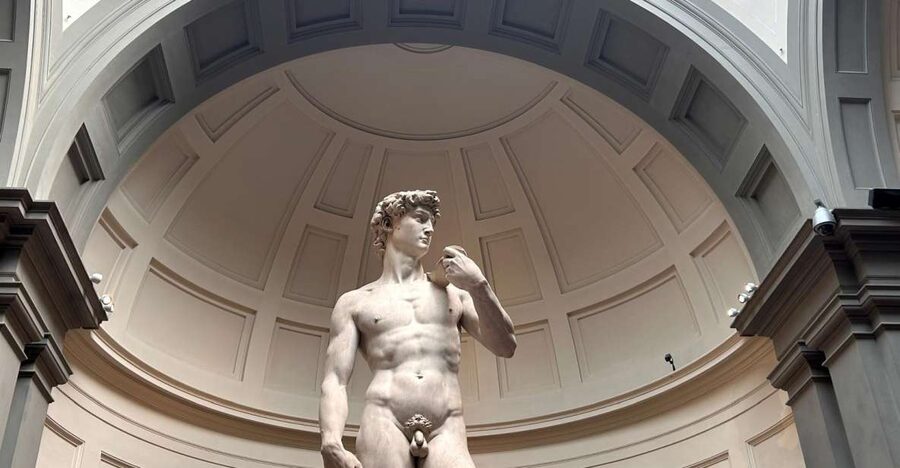
The Accademia Gallery is compact compared with Florence’s enormous Uffizi, but its central sculpture is one of Europe’s great artistic sights. David is not hidden away in a dim corner. You approach through the museum’s long Gallery of the Prisoners, with Michelangelo’s unfinished figures appearing to push their way out of blocks of marble.
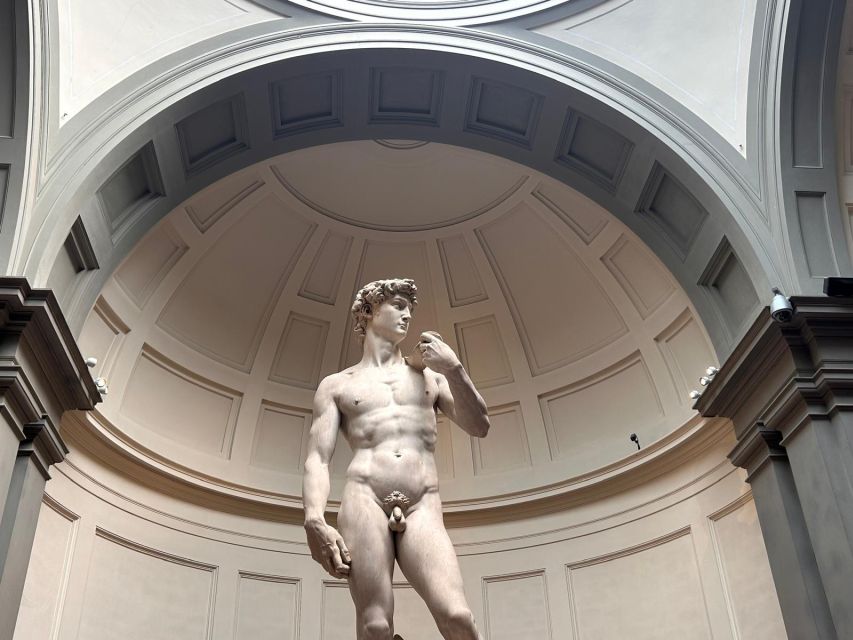
Then the room opens, and David waits beneath the skylight.
The statue shows the biblical hero before his fight with Goliath. Michelangelo captured the moment of thought and tension, rather than the victory afterward. David’s alert expression, oversized hands, and carefully balanced stance make the figure feel ready to move, even though the marble is completely still.
You can walk around the statue and see it from several angles. Look closely at the surface of the marble, the veins in the hands, the curls of the hair, and the tiny details of the face. The scale can be surprising. David is about 17 feet tall, and the proportions were designed to be read from below when the statue was intended for a high outdoor position.
The room can be crowded, especially in summer. You may need patience to find a clear view, and the atmosphere is not always quiet or reflective. Still, this is one of those works where the original matters. Photographs cannot show the full scale, the surface, or the way the statue changes as you walk around it.
More Accademia and David visits:
- Florence: Timed Entrance Ticket to Michelangelo’s David
★ 4.6 · 16,983 reviews - Florence: Michelangelo’s David Skip-the-Line Entry Ticket
★ 4.5 · 12,764 reviews - Florence Accademia Gallery Tour with Entrance Ticket Included
★ 4.5 · 6,148 reviews
The unfinished sculptures and Michelangelo’s method
The works leading toward David are often called the Prisoners or Slaves. They were left unfinished, and that is precisely why they are so useful. You can see bodies emerging from rough marble, with some sections shaped clearly and others still trapped in the stone.
These sculptures offer a rare look at Michelangelo’s working process. Instead of seeing only a polished final product, you see the contrast between rough stone and formed anatomy. The effect also makes the sculptures feel almost alive, as if the figures are struggling toward freedom.
If you are visiting with children or anyone who finds long museum visits tiring, this first section gives you a clear focus. You can spend time with David and the unfinished works, then decide how far through the rest of the museum you want to go.
The audio app can add useful context here, but its quality depends on how easily you can match each recording with the correct object. Some points are brief, and not every artwork has a corresponding stop. I would treat the app as a helpful layer, not as a replacement for a live art historian.
A change of mood in the Gipsoteca
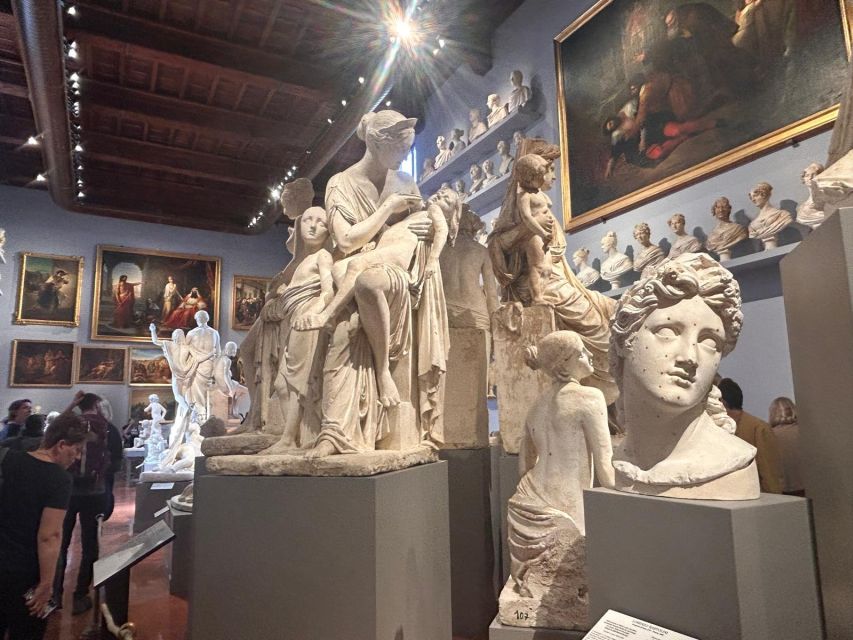
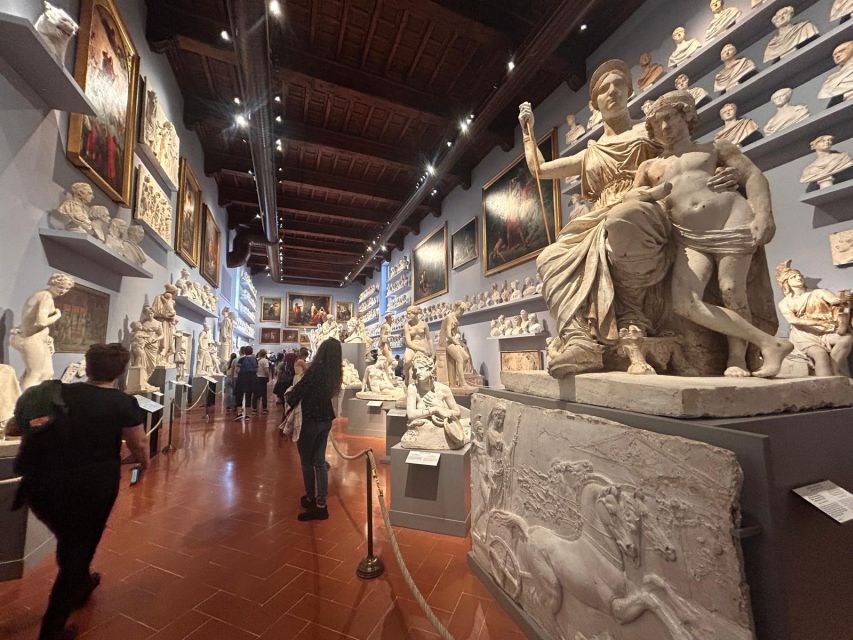
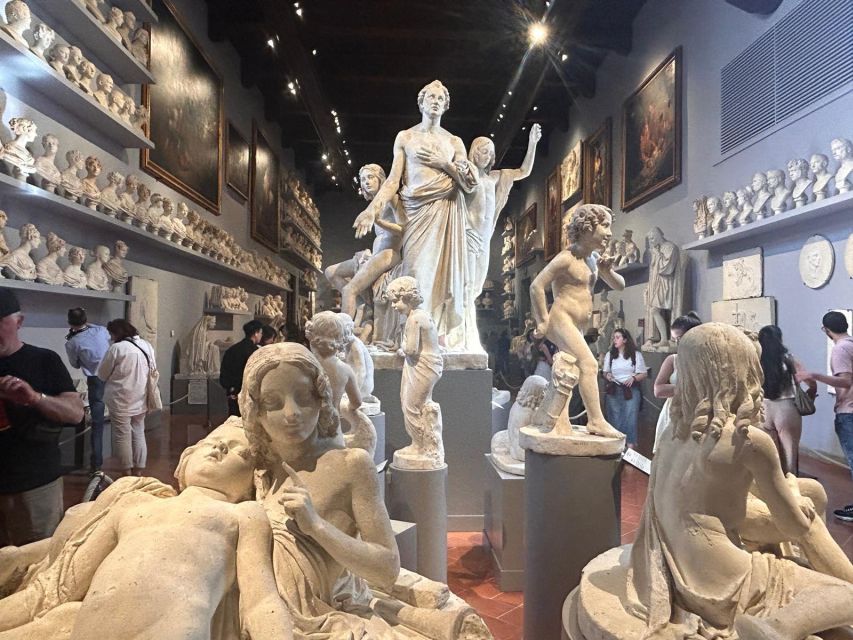
After the Michelangelo rooms, continue to the Gipsoteca, or plaster-cast gallery. Here you see original plaster models made by 19th-century Florentine sculptors.
This section has a different feel from the main David display. The plaster works are less famous, but they reveal how sculptors planned and transferred their designs before producing a finished marble or bronze sculpture. The room also gives you a break from the intense focus on Michelangelo.
You might find this gallery less immediately gripping than David, particularly if your time is short. I would still keep it on your route. It shows that the Accademia is not simply a one-statue museum, and it adds a practical side to your understanding of sculpture.
The Medici instruments and Stradivarius violins
The museum also holds original musical instruments from the Medici collection. Among them are three instruments made by Stradivarius.
This is an easy section to miss if you hurry straight from David to the exit. Take a moment to look at the craftsmanship of the instruments and consider their place within the Medici court collections. They broaden the visit beyond sculpture and painting.
The musical instruments are especially useful for visitors who want to see how Florence’s artistic life extended into performance, patronage, and court culture. The audio app may offer orientation, although the commentary is not guaranteed to cover every display in equal detail.
More Renaissance art days:
- The Best tour in Florence: Renaissance & Medici Tales – guided by a STORYTELLER
★ 5.0 · 12,316 reviews - The Best Tour in Florence: Renaissance and Medici Tales
★ 5.0 · 10,810 reviews - Florence: Timed Entry Ticket to Michelangelo’s David & eBook
★ 4.6 · 4,049 reviews - Michelangelo’s David, Accademia & Uffizi Small Group Tour
★ 4.5 · 1,986 reviews
Medieval and Renaissance painting galleries
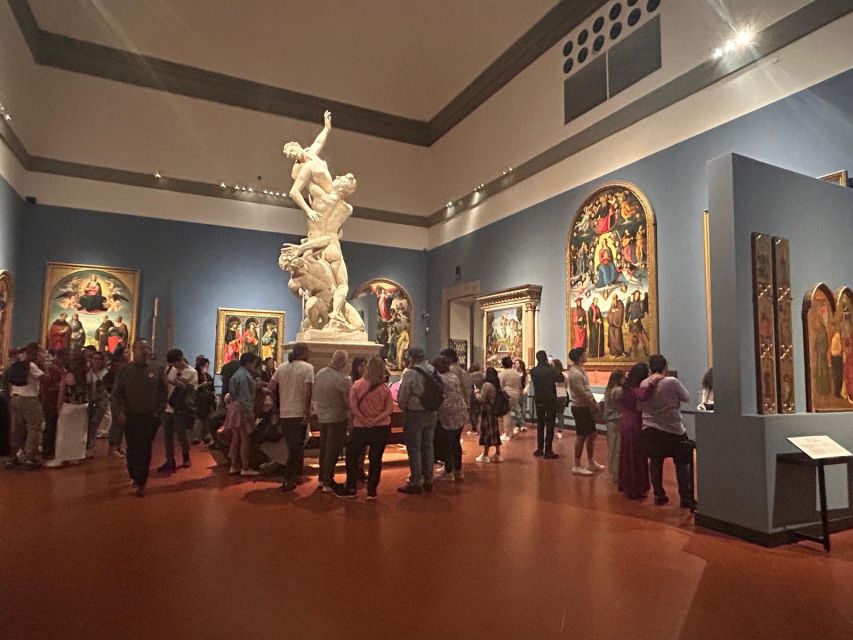
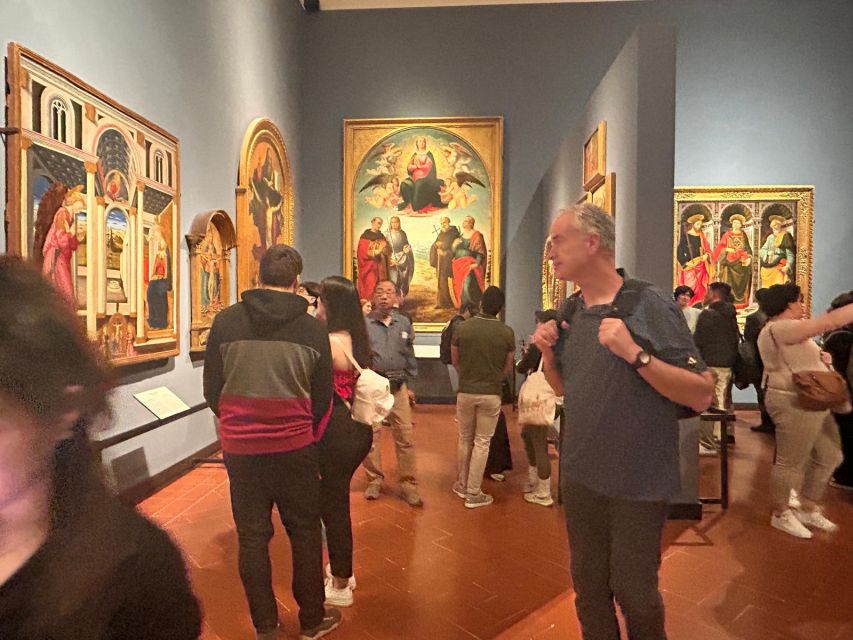
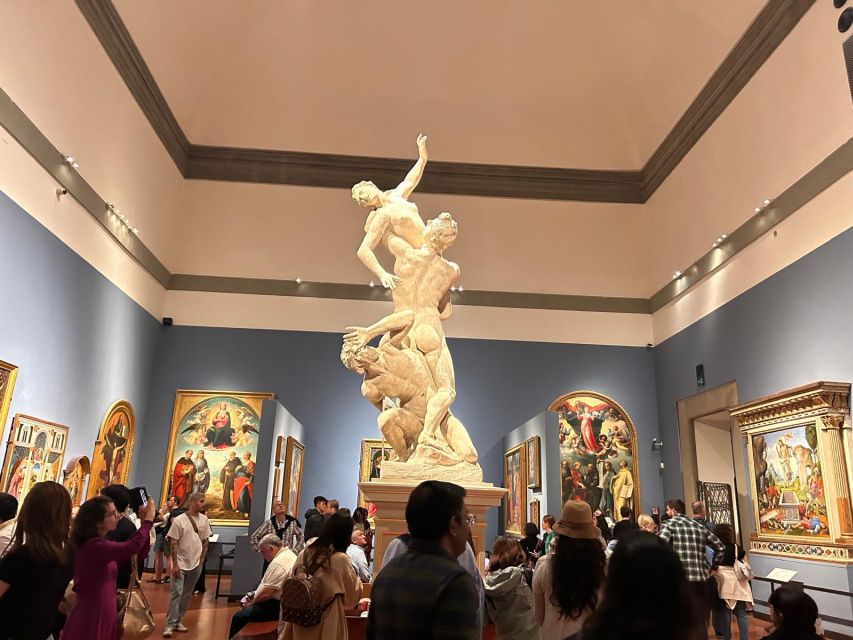
The painting rooms take you into a different side of Florentine art. You will see works by medieval and Renaissance artists, including Giotto and Botticelli.
These galleries help put Michelangelo into a wider artistic setting. The paintings show the development of religious imagery, composition, color, and human expression across different periods. If you have already seen Florence’s major churches, you may recognize the importance of altarpieces and devotional images in the city’s art.
Do not rush through these rooms simply because David was the purpose of your booking. The paintings are quieter and less instantly famous, but they reward a slower look. Compare the stiff, formal qualities of earlier medieval works with the more natural figures and spatial treatment found in later Renaissance pieces.
The Pop Guide lets you pause, skip a stop, or return to something that caught your eye. That flexibility is a real benefit for families and independent visitors. The tradeoff is that you must manage your own route and phone. A live guide would point out details at the right moment and answer questions, while the app gives you privacy and control.
Medieval altarpieces on the top floor
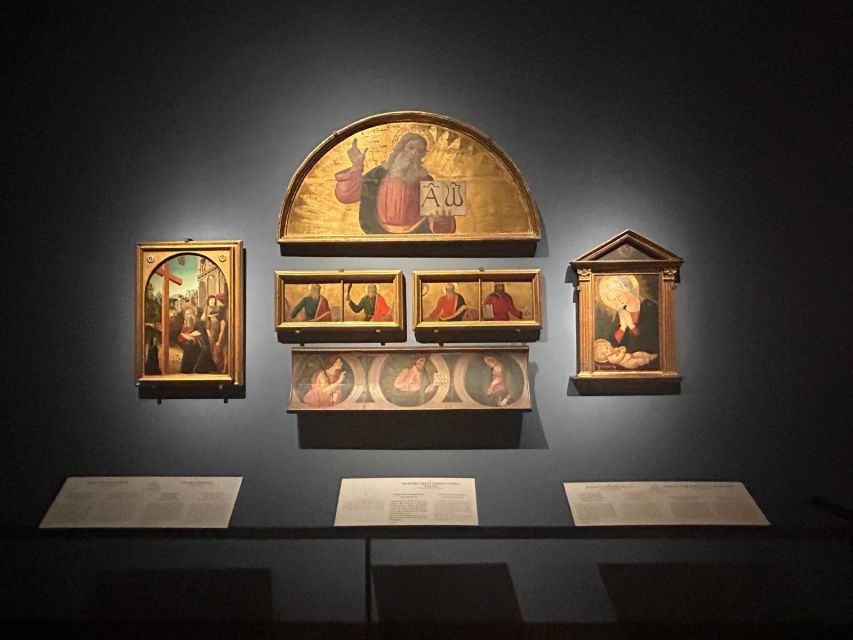
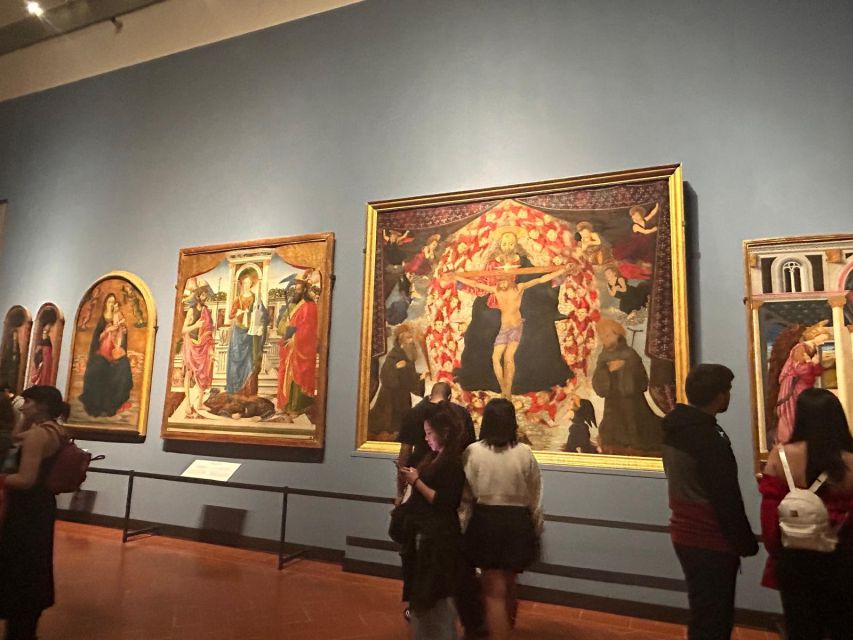
Finish on the top floor, where impressive medieval altarpieces are displayed. These works can be easy to overlook after the spectacle of David, but they are a worthwhile final chapter.
Altarpieces were designed for religious settings, and their original function shaped their size, arrangement, and imagery. Look at the panels as complete compositions rather than isolated pictures. Details that seem simple at first often become clearer when you give your eyes time to adjust.
This final area is a good reason to allow close to the full three hours, even though many people will spend less time inside. The stated duration is the booking window or suggested activity length, not a requirement to remain in every room. You can visit quickly, but you will get more from the museum if you resist making David your only stop.
How the timed entrance works
You do not take the voucher directly to the museum door. First, meet a representative in front of the Carrefour Express Supermarket. Look for the person holding a white flag marked Enjoy Rome, then exchange your voucher for a physical museum ticket.
The meeting point is reported as easy to find, but Florence’s streets can be busy and confusing. I would arrive early enough to locate the supermarket without rushing. The host may give you a sticker or direct you to the correct line before the entry time.
The ticket is timed. If your slot is 13:15, arriving at 13:25 may still work in some situations, but you should not count on it. The terms say late arrivals are not guaranteed entry or a refund. Museum staff can also delay entry when too many people are already inside, with waits of around 15 to 20 minutes possible.
This arrangement is best understood as reserved access, not a magic wand. It avoids the ticket-office line and places you in the proper timed-entry process. Several visitors have entered after only a few minutes, while others have encountered a short wait because of museum crowd controls.
That distinction matters most in high season and during hot weather. Standing in a long outdoor line can drain your energy before you even reach David. Paying extra for a timed ticket can be sensible when your Florence schedule is tight.
Using the Pop Guide audio app
The audio guide is included through the Pop Guide application. Download it before you reach the meeting point, then use the login details supplied by the host. Bring your own headphones, since they are not listed as included.
A charged smartphone is essential. It is also wise to download and set up the application before you leave your hotel or apartment. At the meeting point, you want to collect the ticket and credentials, not spend your entry window dealing with an app installation.
The app’s best feature is independence. You can listen while moving at your own pace, stop when a room gets crowded, and skip commentary that does not interest you. Some people have found it informative and easy to use, while others have had trouble getting the application to work or locating the artwork that matches each recording.
That mixed experience is worth taking seriously. Bring headphones or earbuds, and consider having a backup plan. You can still visit the museum without using the app, and the ticket remains the main value of the booking. If you want detailed interpretation, a live guide will usually offer a fuller and more responsive visit, but this option is cheaper and less restrictive.
Is $38 a fair price?
At $38 per person, this is not the cheapest way into the Accademia. The value depends on the date and on how important your time is.
If official museum tickets are sold out, this booking can be a practical solution. The extra cost may be modest compared with losing hours in a line or missing the museum entirely. Some bookings made close to the visit date have cost only a few euros more than the official ticket, though prices can vary.
You are paying for three things: the timed admission, the host who helps you exchange the voucher and find the correct queue, and the audio app. The host service is simple rather than a guided tour. Once inside, you are on your own.
That is good value if you prefer to explore independently and want to avoid a long ticket-office line. It is less attractive if you already have a museum reservation or do not plan to use the audio guide. In that case, you are paying a premium mainly for the third-party booking and entry assistance.
The overall rating is 4.3 from 1,901 ratings, which fits the experience’s strengths and limits. The entry process receives the strongest praise, while the audio app is the part most likely to disappoint. David himself is rarely the problem.
Who should book this Accademia experience?
I would choose this for a first visit to Florence when David is high on your list and official tickets are unavailable or inconvenient. It is also a good fit for families, since the timed entrance reduces the chance of a long wait and you can move through the museum at your own speed.
Independent museum visitors will appreciate the lack of a fixed group route. You can spend ten minutes with David, linger over the paintings, or leave after the main sculpture without waiting for a tour group.
It also suits people with a packed Florence itinerary. The three-hour duration gives you room to arrive, enter, and visit without treating the museum like a rushed photo stop.
I would hesitate if you strongly prefer personal explanations, questions, and storytelling from a live guide. You should also think twice if you dislike using your phone in museums or do not have headphones. The app is a useful extra, but it is not the central reason to book.
For visitors aged 6 to 17, bring a valid photo ID showing the child’s date of birth. Without it, the child may have to pay the full adult rate. The museum is wheelchair accessible. Pets, luggage, large bags, and bags are not allowed, so arrive with only what you need for the visit.
My call: book it when time matters
Book this experience if you want a straightforward way to see David, need a timed ticket, and value a self-guided visit. The host system is simple, the reserved entry can save a great deal of waiting, and the rest of the Accademia gives you more than the famous statue alone.
Do not book it expecting a personal tour or a guaranteed walk straight through the door at your exact minute. Arrive early, expect possible crowd control, prepare Pop Guide in advance, and bring headphones.
For most first-time visitors, the extra cost is justified when museum tickets are sold out or your Florence schedule is tight. If you can buy a reasonably priced official timed ticket, compare the difference carefully. But when the choice is paying $38 or spending a large part of your day in line, this is a sensible and practical way to meet Michelangelo’s David.
FAQ
Where do I meet the activity provider?
Meet the provider’s staff in front of the Carrefour Express Supermarket. Look for a representative holding a white flag marked Enjoy Rome.
Do I enter the museum with the voucher?
No. You exchange the voucher with the provider’s representative for a physical Accademia Gallery ticket before entering.
Does the ticket skip every line?
It skips the ticket-office line and uses a separate entrance, but museum staff may still impose a wait of around 15 to 20 minutes when visitor numbers are high.
Is the ticket timed?
Yes. The ticket has a specific entry time. Late arrivals are not guaranteed admission or a refund.
What is included in the booking?
The booking includes a timed Accademia Gallery entry ticket and access to the Pop Guide audio guide app.
Do I need to bring headphones?
Yes. Headphones are not included, and you should bring your own headset or earbuds for the audio app.
What should I prepare for the audio guide?
Download the Pop Guide application before arriving, bring a charged smartphone, and collect the login credentials from the host at the meeting point.
Can children use a discounted ticket?
Visitors aged 6 to 17 need valid photo ID showing their date of birth to qualify for the discounted ticket. Without that ID, they must buy the full adult ticket.
More Self-Guided Tours in Florence
- Florence: Uffizi & Accademia Priority Tickets with Audio App
★ 4.4 · 1,253 reviews - Florence: Eco-Friendly Golf Cart City Tour with Audio Guide
★ 4.6 · 1,094 reviews - Florence: Uffizi Skip-the-Line Ticket & Digital Audio Guide
★ 4.2 · 1,044 reviews - Private Self-Guided E-Bike Ride in Tuscany with Vineyard Visit
★ 5.0 · 775 reviews
More Skip-the-Line Entries
- Florence: Skip-The-Line Uffizi Gallery Timed Entry Ticket
★ 4.5 · 27,832 reviews - Florence: Leonardo Interactive Museum Entry Ticket
★ 4.5 · 11,763 reviews - Florence: Uffizi Priority Ticket & Masterpieces Audio App
★ 4.2 · 6,402 reviews - Florence: Hop-on Hop-off Bus Tour: 24, 48 or 72-Hour Ticket
★ 4.0 · 6,283 reviews
Latest additions around Florence
- Palatina Gallery and Pitti Guided Tour in Florence★ 5.0 · 3 reviews
- Florence: Cathedral Tour & Brunelleschi’s Dome Climb Ticket★ 5.0 · 3 reviews
- Florence Uffizi Gallery Skip-the-line Tour w Art Historian Guide★ 5.0 · 3 reviews
- Private Tour: Pisa and Lucca from Florence★ 5.0 · 3 reviews
- San Gimignano Bike Tour (SOFT)★ 4.5 · 3 reviews
- Florence: Tour of Florence by rickshaw★ 5.0 · 3 reviews
- Center of Florence by golf cart★ 5.0 · 3 reviews
- From Firenze | Chianti day tour in a classic car★ 5.0 · 3 reviews
Accademia Gallery Tours, compared.

Timed Entrance Ticket to Michelangelo’s David
Read our review →
Michelangelo’s David Skip-the-Line Entry Ticket
Read our review →
Florence Accademia Gallery Tour with Entrance Ticket Included
Read our review →

Timed Entry Ticket to Michelangelo’s David & eBook
Read our review →
Skip the line: Uffizi and Accademia Small Group Walking Tour
Read our review →

Accademia Gallery Guided Tour with Entry Ticket
Read our review →Browse the lists this tour appears in