
Reviewed · RENAISSANCE ART TOURS
Renaissance & Medieval Florence Guided Walking Tour plus mobile App
Florence’s story comes together quickly on this central walking route, which links the Medici quarter, the Duomo, the political heart of Piazza della Signoria, and the Arno River in about 90 minutes. You get a useful first look at the city rather than spending your first morning guessing which lane leads where.
I like the Medici focus, since it connects art, banking, politics, and church power in one clear thread. I also like the finish at Ponte Vecchio, with the option to keep exploring through the mobile app. The main caution is the language setup: some groups have been conducted in English and another language, which can cut into the time available for English commentary.
In This Review
- Five things to know before you book
- A fast start in the Medici quarter
- San Lorenzo’s quiet cloister
- The Duomo, dome, tower, and Baptistery
- Rubbing the bronze piglet at the Straw Market
- Piazza della Signoria as an outdoor sculpture museum
- Following the Vasari Corridor route to the Arno
- Dante’s quarter and the medieval finish
- How the 90 minutes really feels
- What the Vox City app adds
- Is $30.04 a fair price?
- Who should book this walk?
- Should you book it?
- FAQ
- How long does the Florence walking tour last?
- Where does the tour start?
- Where does the tour end?
- Are attraction entrance tickets included?
- Do I need a smartphone and headphones?
- Can I cancel for a full refund?
Five things to know before you book

- The route covers Florence’s essential center: San Lorenzo, the Duomo, the Straw Market, Piazza della Signoria, the Uffizi courtyard, Ponte Vecchio, and Pitti Palace.
- Brunelleschi appears twice: You see his famous dome and visit the peaceful cloister at San Lorenzo, designed by the same architect.
- The guided portion is short and efficient: At roughly 1 hour 30 minutes, it works well on your first day or during a tight Florence stay.
- The tour ends south of the Arno: You finish at Ponte Vecchio, not back at the starting point near the Duomo.
- The app adds independent sightseeing: Bring your own smartphone and headphones, then use the Vox City app for audio routes after the guided walk.
- Language matters: The tour is offered in English, but bilingual groups have sometimes slowed the pace and reduced English speaking time.
A fast start in the Medici quarter
Meet your guide at Via de’ Martelli 50, close to Florence’s central sights. The exact order can change, but the walk generally begins in San Lorenzo, an excellent place to introduce Florence because the neighborhood mixes daily commerce with grand Medici monuments.
The open-air market here sells leather goods, clothing, and other items. It can feel more commercial than the quieter parts of Florence, but that is part of the point. You see a working shopping district before moving into churches, palaces, and sculpture courts.
The guide uses San Lorenzo to explain the Medici family’s role in Florence. That context matters. Without it, the city’s churches and palaces can seem like unrelated monuments. With it, you begin to see how one banking family shaped public life, architecture, and the art commissioned throughout the city.
You may pass the Medici Chapels, where members of the family are buried. The chapels are associated with Michelangelo and Matteo Nigetti, and they offer an immediate reminder that the Medici legacy was not simply about money. It was also about display, memory, and control of the city’s cultural image.
The nearby Palazzo Medici Riccardi was designed by Michelozzo for Cosimo de’ Medici. Its courtyard gives you another useful piece of the story: the family’s power was expressed through a private residence that looked more like a fortified palace than an ordinary home.
More Renaissance art days:
- Florence: Timed Entrance Ticket to Michelangelo’s David
★ 4.6 · 16,983 reviews - Florence: Michelangelo’s David Skip-the-Line Entry Ticket
★ 4.5 · 12,764 reviews - The Best tour in Florence: Renaissance & Medici Tales – guided by a STORYTELLER
★ 5.0 · 12,316 reviews
San Lorenzo’s quiet cloister
The Basilica of San Lorenzo is one of the most rewarding stops because the tour includes the elegant cloister. The visit is brief, about 15 minutes, but the cloister provides a calm change from the noise of the market and central streets.
Brunelleschi designed it as a green, open courtyard. You can look at the balanced arches and simple lines while your guide explains its place within the Medici district. It is not a long church visit, and this is not an interior-focused religious tour, but the cloister gives you one genuine pause in a busy itinerary.
That short stop also shows the tour’s general character. You are mainly walking from one major sight to the next, learning what you are seeing from outside. If you want extended time inside the Medici Chapels or Basilica of San Lorenzo, you will need a separate visit and an admission ticket.
The Duomo, dome, tower, and Baptistery
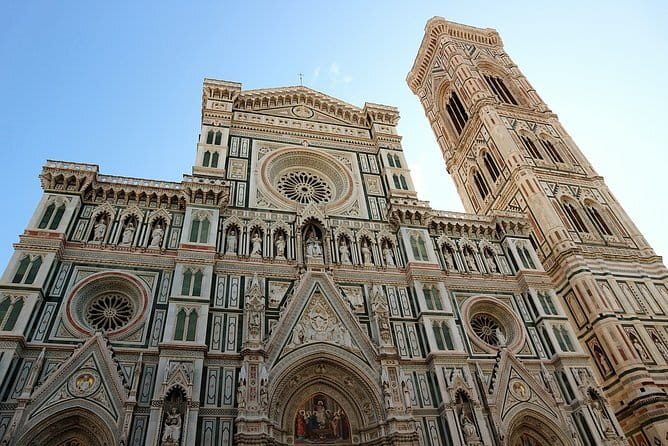
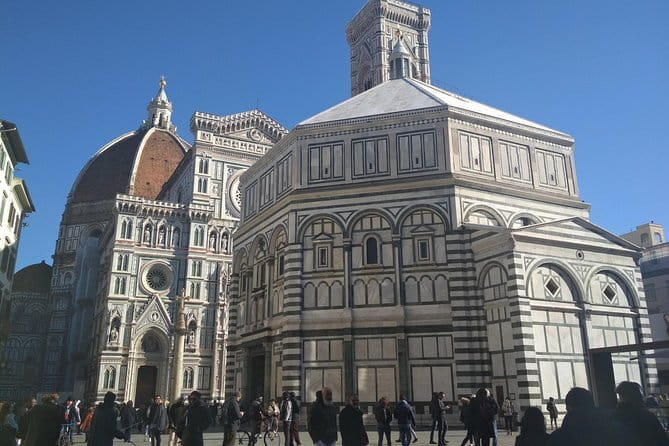
From San Lorenzo, the route reaches Piazza del Duomo. This is Florence’s great architectural gathering point, with Santa Maria del Fiore, Brunelleschi’s Cupola, Giotto’s Bell Tower, and the Baptistery of Saint John.
The tour allows about 20 minutes here. That is enough to study the façade, understand the relationship among the buildings, and hear the basic story of the dome’s construction. It is not enough to climb the dome, visit the cathedral interior at leisure, or explore the Baptistery in detail.
That distinction is important when you compare this tour with ticketed Duomo packages. No attraction entries are included, so you are paying for the guide, the route, the explanations, and the app, not for access to the monuments.
The Baptistery’s Gates of Paradise are another highlight from the square. Even from outside, the group can connect the building’s age and decoration to Florence’s long-running competition among architects, sculptors, patrons, and religious institutions.
For a first orientation, this stop works well. The square is one of those places where a guide helps you sort out what you are looking at. Without some explanation, the dome, bell tower, and cathedral can blur into one enormous photo stop.
Rubbing the bronze piglet at the Straw Market
The walk continues to the Fontana del Porcellino at the Mercato della Paglia, or Straw Market. This bronze piglet is tied to a local superstition: rub its nose for luck.
The stop lasts about 10 minutes. It is lighter in tone than the Medici and Duomo sections, and that is useful. A good city walk needs a few small human details, not just dates and architectural terms. The piglet also gives you a simple landmark to remember if you return to this part of Florence on your own.
The market setting keeps the route connected to ordinary city life. You get another chance to look at shops and street activity before entering the monumental Piazza della Signoria.
More walking routes in Florence:
- Florence: Guided Walking Tour
★ 4.5 · 3,334 reviews - Skip the line: Uffizi and Accademia Small Group Walking Tour
★ 4.5 · 3,135 reviews - Florence: Guided Walking Tour
★ 4.6 · 1,602 reviews - Florence: Renaissance and Medici Tales Guided Walking Tour
★ 4.8 · 1,549 reviews
Piazza della Signoria as an outdoor sculpture museum

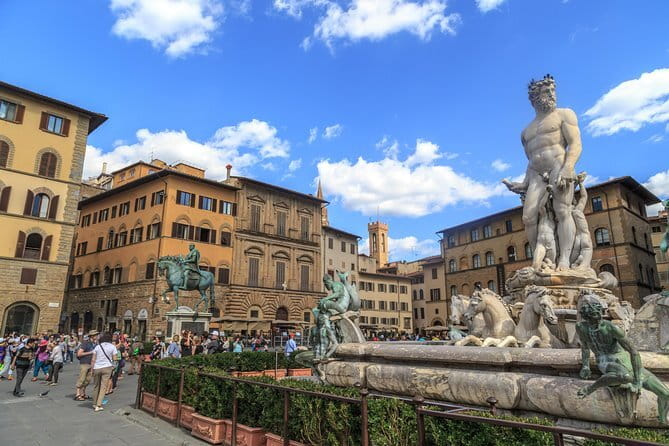
Piazza della Signoria is the political center of the walking tour. The square is dominated by Palazzo Vecchio and lined with sculptures, arcades, cafés, and people moving between the Uffizi and the river.
The guide may point out Giambologna’s Rape of the Sabine Women, a complicated marble group designed to be viewed from several angles. Even if you do not study every sculpture in detail, the square helps explain how Florence used public art to display civic pride and political authority.
You pass Palazzo Vecchio rather than touring its rooms. The same applies to the Uffizi Gallery. The route takes you through the Uffizi courtyard, but museum admission is not part of the experience. That is a benefit if you already have Uffizi plans, since you get an exterior introduction without using your museum time. It is a limitation if you hoped to see Botticelli, Leonardo da Vinci, Michelangelo, or Raphael inside.
The guide’s value here depends heavily on presentation. Several guides have been praised for clear explanations, stories, and useful suggestions for the rest of a Florence stay. Names singled out in individual experiences include Marta, Helena, Larisa, Sylvia, and Maximilian. Maximilian was especially appreciated for anecdotes, while Sylvia was noted for offering ideas about what to see next.
Not every guide produces the same experience. One guide was criticized for adding little beyond the basic tour description, and another did not introduce herself clearly. A small point, perhaps, but introductions matter when you are trying to follow a person through crowded streets.
Following the Vasari Corridor route to the Arno
From Piazza della Signoria, the walk traces the outside route associated with the Vasari Corridor. You pass through the Uffizi courtyard, cross the Arno on the Ponte Vecchio, and continue toward Pitti Palace.
The corridor itself is not an interior visit. You are following its celebrated path from the outside, which helps you understand how the Medici connected their political offices with their residence across the river. This is one of the tour’s most useful connections because it turns several famous places into one story.
Ponte Vecchio is the natural high point of this section. It is Florence’s oldest bridge and is lined with jewelry shops, giving it the familiar nickname of the jewels bridge. The stop lasts about 15 minutes, enough for photos and a short explanation before the group finishes nearby.
The end point is Ponte Vecchio, at 50125 Florence, so plan your next activity from the Oltrarno side of the river. You are not returned to Via de’ Martelli. That can be convenient if you want to continue to Pitti Palace or explore the south bank, but you should not schedule a start near San Lorenzo immediately afterward without allowing time to walk back.
Dante’s quarter and the medieval finish
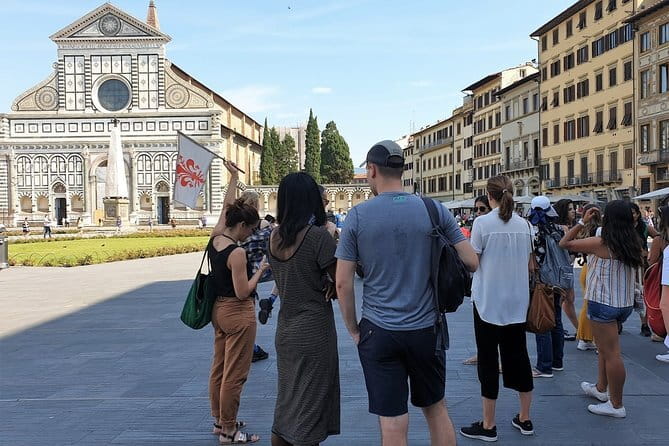
The route also reaches Florence’s medieval quarter, associated with Dante Alighieri. This section includes the Badia Fiorentina and the austere Bargello Palace.
Compared with the Duomo and Ponte Vecchio, these streets can feel less obvious. That is precisely why a guided walk helps. The main landmarks of Florence are easy to find, but the medieval lanes and smaller buildings are easier to miss when you are moving between headline sights.
The Bargello is known for sculpture, though this tour does not include entry. The Badia Fiorentina adds another church and bell tower to a day already full of religious architecture. If you have limited time, the guide’s brief introduction helps you decide which buildings deserve a later, longer visit.
The stated itinerary gives the most attention to San Lorenzo, the Duomo, the Porcellino, Piazza della Signoria, and Ponte Vecchio. The route description also includes Pitti Palace, the Uffizi courtyard, Dante’s quarter, the Badia, and the Bargello. Since the order can change, treat the tour as a broad city introduction rather than a timed visit inside each monument.
How the 90 minutes really feels

This is a walking tour with several stops, not a slow architectural seminar. The listed stop times add up to about 70 minutes, leaving the rest for moving between areas and gathering the group. You will spend much of the experience standing while the guide talks, then walking through streets that can be crowded.
Comfortable shoes are a must. The tour is limited to a maximum of 20 people, though some departures have been much smaller, with groups of five or around ten. A small group makes it easier to ask questions and hear the guide, while a full group may require more patience at the busiest squares.
The pace has generally worked well for an introductory walk. One guide was praised for keeping a comfortable rhythm, and another for adjusting to the group. Still, this is not a route for someone who wants to stop for extended photography at every monument.
The largest practical issue is bilingual guiding. Although the experience is offered in English, some departures have combined English with French or Spanish. In those cases, the guide repeats information, which can make the tour feel longer while giving you less English commentary overall.
If your booking is important because you want a fully English experience, confirm the language arrangement at the meeting point. Also look for the assistant and identify yourself clearly, since one past group found it confusing when staff were not dressed or marked as expected.
What the Vox City app adds
The mobile portion is a useful extra, but it does not replace the guide. You download the Vox City app from the Apple App Store or Google Play, then receive access credentials from the assistant before the walk begins.
You need your own smartphone and headphones. Headphones are not supplied, and the app is meant for use after the guided portion, when you can continue with self-guided city routes and multilingual audio commentary.
This is valuable if you want more structure after the tour ends. The live guide gives you a quick orientation and answers questions. The app then lets you revisit points of interest at your own pace instead of staying with a group.
Check that your phone is charged before you arrive. That is practical advice rather than a special feature: the app depends on your own device, and the tour does not provide headphones.
Is $30.04 a fair price?
At $30.04 per person, this is a reasonable price for a compact, guide-led introduction to central Florence, especially if this is your first morning in the city. You are covering a large amount of ground, getting local context, and receiving an app for further sightseeing.
The value drops if you already know Florence well, have taken another general city walk, or plan to spend the same morning on a longer paid tour. One person found considerable overlap with a previous night tour. That is a good reminder to compare routes before booking two broad introductions.
The price does not include attraction tickets. Add separate admission costs if you want to enter the Medici Chapels, the Duomo complex, the Uffizi, the Bargello, or Pitti Palace. The tour is best understood as a guided orientation, not a bundle of museum visits.
For a short stay, the value is stronger. You can see the city’s main zones, learn how the Medici shaped Florence, and finish at the bridge that leads into the Oltrarno. That saves you from spending your first day only around the Duomo.
Who should book this walk?
I would choose this tour for a first visit, a short stay, or a first-day reset after arriving in Florence. It gives you a mental map and helps you choose which interiors deserve your limited museum time.
It also suits families and mixed-age groups who want a manageable introduction rather than a full-day history program. The route is public and central, near public transportation, and most people can participate.
I would be more cautious if you need advanced art history, long interior visits, or a guaranteed English-only departure. The tour’s strongest guides have made it lively with anecdotes and practical advice, but the standard can vary. A bilingual departure can also reduce the amount of information you receive.
Cancellation is flexible up to 24 hours before the start time for a full refund. Changes or cancellations inside that window are not accepted for a refund, so keep the local start time in mind.
Should you book it?
Book this walk if you want to get your bearings fast and understand how Florence’s Medici, religious, political, and riverfront sights fit together. The San Lorenzo cloister, Piazza della Signoria, and Ponte Vecchio give the route enough variety to keep it from feeling like a simple list of monuments.
Skip it if your priority is entering museums or spending long periods at the Duomo. In that case, put the $30.04 toward a ticketed visit with more interior time.
For most first-time visitors, I see this as a practical opening move. Try to confirm that your departure will be conducted in English, wear comfortable shoes, bring headphones, and keep your afternoon free for whichever museum or palace catches your attention along the way.
FAQ
How long does the Florence walking tour last?
The guided walking tour lasts approximately 1 hour 30 minutes.
Where does the tour start?
The meeting point is Via de’ Martelli 50, 50122 Florence, Italy.
Where does the tour end?
The tour ends at Ponte Vecchio, 50125 Florence, Italy. It does not return you to the starting point.
Are attraction entrance tickets included?
No. Entry to attractions is not included. The route views places such as the Medici Chapels, Duomo complex, Uffizi, Pitti Palace, Bargello, and Palazzo Vecchio from outside or through public areas unless otherwise specified.
Do I need a smartphone and headphones?
Yes. You need your own smartphone and headphones to use the Vox City self-guided itineraries and audio commentary after the guided walk. You should download the app from the App Store before starting.
Can I cancel for a full refund?
Yes, if you cancel at least 24 hours before the experience’s start time. Cancellations or changes made less than 24 hours before the start time are not refunded.
More Self-Guided Tours in Florence
- Florence: Uffizi Priority Ticket & Masterpieces Audio App
★ 4.2 · 6,402 reviews - Florence: Michelangelo’s David Entrance Ticket and Audio App
★ 4.3 · 1,901 reviews - Florence: Uffizi & Accademia Priority Tickets with Audio App
★ 4.4 · 1,253 reviews - Florence: Eco-Friendly Golf Cart City Tour with Audio Guide
★ 4.6 · 1,094 reviews
Latest additions around Florence
- Florence: Cathedral Tour & Brunelleschi’s Dome Climb Ticket★ 5.0 · 3 reviews
- Palatina Gallery and Pitti Guided Tour in Florence★ 5.0 · 3 reviews
- Florence Uffizi Gallery Skip-the-line Tour w Art Historian Guide★ 5.0 · 3 reviews
- Private Tour: Pisa and Lucca from Florence★ 5.0 · 3 reviews
- San Gimignano Bike Tour (SOFT)★ 4.5 · 3 reviews
- Florence: Tour of Florence by rickshaw★ 5.0 · 3 reviews
- Center of Florence by golf cart★ 5.0 · 3 reviews
- The David from Michelangelo.★ 5.0 · 3 reviews
Renaissance Art Tours, compared.

Timed Entrance Ticket to Michelangelo’s David
Read our review →
Michelangelo’s David Skip-the-Line Entry Ticket
Read our review →
The Best tour in Florence: Renaissance & Medici Tales – guided by a STORYTELLER
Read our review →
The Best Tour in Florence: Renaissance and Medici Tales
Read our review →
Timed Entry Ticket to Michelangelo’s David & eBook
Read our review →
Michelangelo’s David, Accademia & Uffizi Small Group Tour
Read our review →
Michelangelo’s David Entrance Ticket and Audio App
Read our review →
Renaissance and Medici Tales Guided Walking Tour
Read our review →Browse the lists this tour appears in