
Reviewed · RENAISSANCE ART TOURS
Renaissance Florence & the rivalry of Michelangelo and Leonardo
Florence’s Renaissance story becomes more lively when you see it as a contest between Michelangelo and Leonardo. This three-hour walk connects their art to Medici power, civic pride, church politics, and the rivalries that shaped the city. The most unusual stop is Santo Spirito, where you’ll see Michelangelo’s wooden crucifix, made when he was only 17.
I like the mix of famous landmarks and lesser-known art. I also like that Antonio brings local suggestions for food, music, drinks, and museums, giving you more than a string of dates and names. The main drawback is that most major sights are viewed from outside, so you’ll need separate tickets and extra time for the Duomo or Palazzo Vecchio interiors.
In This Review
- Key points to know
- Why Michelangelo and Leonardo make a smart route through Florence
- Palazzo Vecchio and the political heart of Florence
- Piazza della Signoria, where sculpture becomes public theater
- The Duomo, Giotto’s tower, and the Baptistery
- San Lorenzo and the Medici family’s mark
- Santa Trinita and the elegant center of town
- Ponte Vecchio and the crossing to Oltrarno
- Santo Spirito and Michelangelo’s wooden crucifix
- What the $31.35 price gives you
- Who will get the most from this Florence walk
- Timing, meeting point, and practical details
- Should you book Renaissance Florence and the rivalry of Michelangelo and Leonardo?
- FAQ
- How long is the tour?
- Where does the tour begin?
- What time does the tour start?
- Where does the tour finish?
- Is the tour conducted in English?
- Is admission to Santo Spirito included?
- Are Palazzo Vecchio and the Duomo admission tickets included?
- How large is the group?
- Can I cancel for a full refund?
Key points to know
- Michelangelo’s young wooden crucifix: See the surprisingly modest Santo Spirito work that helped reveal the artist’s early study of the human body.
- A rivalry-led story: Learn how Michelangelo and Leonardo differed in personality, method, and artistic ambition.
- Florence’s political stage: Palazzo Vecchio and Piazza della Signoria show where art and government met.
- Medici connections: San Lorenzo brings together the family church, Medici Chapels, and Michelangelo’s architectural work.
- Small-group format: The maximum group size is 16, a useful balance between personal attention and a lower price.
- Useful local advice: Antonio provides recommendations for places to eat, hear music, have a drink, and visit museums.
Why Michelangelo and Leonardo make a smart route through Florence
Many Florence walks simply connect one famous building to the next. This one uses the rivalry between Michelangelo and Leonardo as its organizing idea, which gives the city a clear storyline.
You hear about two artists who worked in very different ways. Their contrasting personalities and techniques help explain why Renaissance art was not just about pretty pictures. It was tied to anatomy, civic identity, religious belief, patronage, and the fierce competition among powerful Florentine families.
That political setting matters. A statue in a public square carried a different message from a sculpture made for a private chapel. A church commissioned by the Medici family told you something about wealth and influence. A building project such as the Duomo showed what Florence wanted the wider world to think of its engineering and ambition.
I like this approach because it gives you something to watch for after the tour. You are not just collecting names. You begin to notice who paid for a work, where it was placed, and what it was meant to say.
The guide is Antonio, and the experience is conducted in English. The tour is limited to 16 people, which should make it easier to hear the explanations in busy central Florence. The published duration is about three hours, with a 10 a.m. start.
More Renaissance art days:
- Florence: Timed Entrance Ticket to Michelangelo’s David
★ 4.6 · 16,983 reviews - Florence: Michelangelo’s David Skip-the-Line Entry Ticket
★ 4.5 · 12,764 reviews - The Best tour in Florence: Renaissance & Medici Tales – guided by a STORYTELLER
★ 5.0 · 12,316 reviews
Palazzo Vecchio and the political heart of Florence
The walk begins at Piazza della Signoria, in front of Palazzo Vecchio. You spend about 15 minutes looking at the building’s exterior and front courtyard.
Palazzo Vecchio served as Florence’s seat of government, and its severe, fortress-like appearance suits that role. This is a good place to begin because the tour’s central theme is not art in isolation. Florence’s artists worked within a city where public commissions could support political messages and where artistic competition had real consequences.
You will not enter Palazzo Vecchio on this experience. Admission is not included, so plan a separate visit if you want to see its interior rooms and decorations. That is not a serious flaw for a walking tour, but it is important to understand the value here: you are getting interpretation of the setting, not an interior museum visit.
The short stop also helps you get your bearings. From here, the route moves into one of Florence’s best open-air collections.
Piazza della Signoria, where sculpture becomes public theater
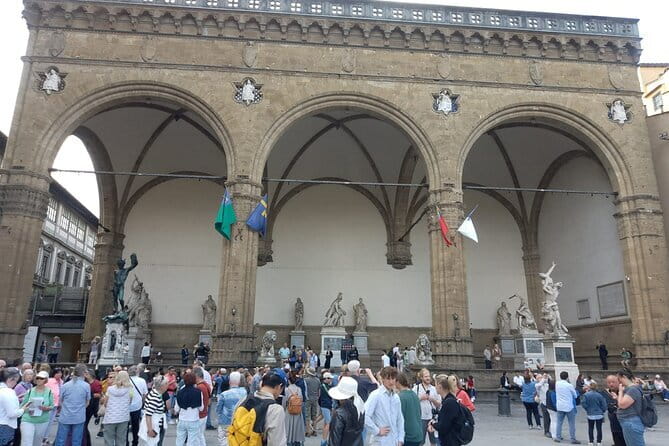
Piazza della Signoria takes around 15 minutes. The square has long been tied to Florentine political life, and its sculptures make that power visible in stone and bronze.
You’ll see the replica of Michelangelo’s David outside Palazzo Vecchio. It is not the original, but its position matters. David was presented as a symbol of Florentine strength and watchfulness, facing the political center of the city.
The nearby Loggia dei Lanzi works like an outdoor sculpture gallery. Among the works you can see are Benvenuto Cellini’s Perseus with the Head of Medusa and Giambologna’s Rape of the Sabine Women. The Fountain of Neptune adds another major landmark to the square.
This is one of the strongest parts of the walk for first-time visitors because you can see a lot without buying another ticket. It is also a useful lesson in how Florence displayed art in public. These works were not tucked away for private admiration. They occupied the city’s main civic stage.
The limitation is time. Fifteen minutes goes quickly, especially if the square is crowded. If you want close study of each sculpture, return later on your own.
The Duomo, Giotto’s tower, and the Baptistery
The next major stop is the cathedral complex, with about 30 minutes outside Santa Maria del Fiore, Giotto’s Bell Tower, and the Baptistery of St. John.
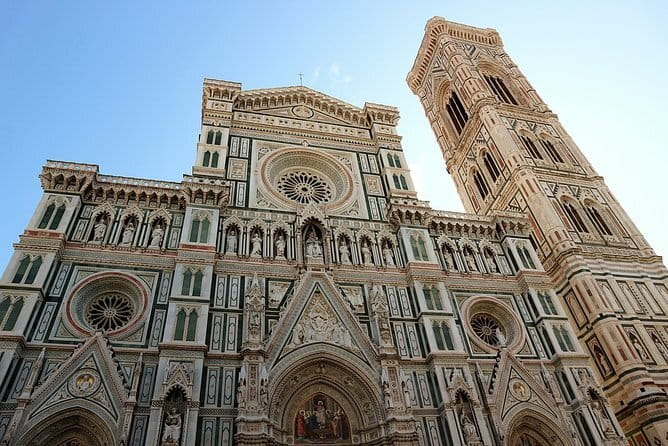
The cathedral’s enormous dome is the star. Filippo Brunelleschi’s double-shell design and herringbone brick pattern allowed Florence to build the largest brick dome ever constructed. Even from street level, you can appreciate the scale and the technical problem it solved.
Giotto’s Bell Tower gives the complex another point of interest. Giotto designed it but lived to see only the lower levels completed. Andrea Pisano and Francesco Talenti continued the work after his death.
The Baptistery completes the group. Together, these buildings show how religious architecture could become a city-wide project, combining faith, civic pride, decoration, and engineering.
The tour views the complex from outside, and admission is not included. You should treat this stop as an introduction rather than a substitute for visiting the cathedral interiors, climbing the dome, or entering the tower. Those activities require separate planning and tickets.
Still, an outside explanation has value. Florence’s cathedral area can feel like a wall of marble, color, and tourists. A guide helps you sort the buildings into a story instead of seeing them as one giant photograph stop.
A different way to spend the same Florence day:
- Florence: Skip-The-Line Uffizi Gallery Timed Entry Ticket
★ 4.5 · 27,832 reviews - Tuscany Day Trip from Florence: Siena, San Gimignano, Pisa and Lunch at a Winery
★ 5.0 · 21,634 reviews - Florence: Leonardo Interactive Museum Entry Ticket
★ 4.5 · 11,763 reviews - The Best Tour in Florence: Renaissance and Medici Tales
★ 5.0 · 10,810 reviews
San Lorenzo and the Medici family’s mark

The walk continues to San Lorenzo, a stop of about 30 minutes. This part is especially useful if you want to understand the Medici family’s role in Florence.
The Basilica di San Lorenzo was the Medici parish church and is among the city’s oldest and largest churches. Nearby are the Medici Chapels, which serve as the family mausoleum. Michelangelo designed the New Sacristy, combining architecture and sculpture in a setting made to honor the dead and advertise family status.
The Laurentian Library adds another Michelangelo connection. He designed both the building and its unusual staircase. Even if you do not enter these sites during the walk, seeing them in relation to one another helps you understand how one family shaped Florence’s religious, artistic, and intellectual life.
San Lorenzo is also home to the San Lorenzo Market. That gives the area a more everyday side, beyond chapels and grand commissions. You may find this stop more layered than the cathedral area because it joins local commerce with major art and architecture.
Again, the tour does not include admissions to the Medici Chapels or Laurentian Library. If Michelangelo’s architecture is your priority, set aside a separate visit. The tour gives you the context to make that visit more rewarding.
Santa Trinita and the elegant center of town
Piazza Santa Trinita is a shorter stop, around 10 minutes. It sits along Via de’ Tornabuoni, Florence’s high-end shopping street, lined with historic buildings.
The square is small, but its position makes it a useful link between the city’s political center and the river. This is the kind of stop that can be easy to overlook when walking alone. Antonio’s explanation should help you read the square as part of Florence’s urban design rather than just a pause between bigger sights.
Do not expect a long museum-style visit here. The attraction is the setting, the architecture around the square, and the way the route moves through central Florence.
Ponte Vecchio and the crossing to Oltrarno
The walk reaches Ponte Vecchio for about 10 minutes. The bridge is one of Florence’s best-known sights, crossing the Arno with shops built along it.
Its crowded appearance is part of its character, but a guide can add useful context about the bridge’s place in the city. This is also the point where the route shifts toward the Oltrarno side of Florence, leading to Santo Spirito.
The stop is brief, so it is more about orientation and atmosphere than a full history lesson. You’ll have time to take in the river views and the unusual line of buildings over the bridge. If you want photographs, keep your camera ready before the group moves on.
Santo Spirito and Michelangelo’s wooden crucifix
The final major highlight is Basilica di Santo Spirito, with about 30 minutes inside. This is the part that gives the experience its strongest reason for existing.
Santo Spirito was designed by Brunelleschi and has a calmer feel than some of Florence’s busiest central sights. Its interior offers a chance to see Renaissance design in a church that is less tied to the standard first-day route.
The church’s most unusual treasure is Michelangelo’s wooden crucifix. He created it when he was about 17 years old, and the work is linked to permission from the prior to study anatomy. That detail matters. Michelangelo’s later command of the human body did not appear by magic. It grew from close study, practice, and access to the subjects that helped him understand bones, muscles, and proportion.
The crucifix is included in the tour price, so this is the one stated interior admission built into the experience. It is also a welcome change from seeing famous works only through reproductions or from the outside.
I would keep your expectations measured. This is an early wooden work, not one of Michelangelo’s giant marble figures. Its importance comes from its age, purpose, and connection to his artistic development. If you want the familiar Michelangelo masterpieces, this stop will feel more personal and less grand.
The tour finishes in front of Santa Croce church. That means the route does not simply return to its starting point, and you can continue exploring this part of Florence afterward.
What the $31.35 price gives you
At $31.35 per person, this is a fair price for a three-hour guided walk with a maximum of 16 people. The cost includes an English-speaking local guide, the professional guide service, and admission to Michelangelo’s wooden crucifix at Santo Spirito.
The value comes mainly from the storytelling and route design. You cover major public sights without paying separate entry fees for every stop. The connection between Leonardo, Michelangelo, the Medici, and Florence’s civic spaces gives the walk more purpose than a simple orientation tour.
The price does not include entry to Palazzo Vecchio or the Duomo complex. That keeps the tour affordable, but it also means your total Florence sightseeing budget will rise if you want to go inside those places.
I see this as a good purchase early in your stay, especially if you plan to visit the major museums and churches afterward. Antonio’s local guide includes recommendations for food, music, drinks, and museums, so you can use the walk to shape the rest of your time in Florence.
The fact that it is often booked well ahead suggests that you should not leave it until the last day you have available. It is typically booked about 122 days before the tour date. That does not guarantee every date fills early, but it is a useful sign to plan ahead during busy periods.
Who will get the most from this Florence walk
I would choose this experience if you like art explained through people and politics. It suits first-time visitors who want a clear introduction to central Florence, as well as returning visitors who have already seen the standard sights and want a more focused theme.
It is also a good fit if you want to see something connected to Michelangelo without spending the entire day in a museum. Santo Spirito’s crucifix gives the route a distinct payoff.
You should be comfortable walking between stops and spending much of the time outdoors. Most participants can take part, and service animals are allowed. The tour runs near public transportation, which helps if you need to reach the starting point or continue from Santa Croce afterward.
I would be more cautious if your main goal is entering every major monument. Palazzo Vecchio and the Duomo are exterior stops here, and the Medici sites are discussed rather than included as interior visits.
Antonio’s style may suit you if you enjoy humor alongside serious history. One particularly strong account describes him as funny and well informed, and a former Florence resident who returned with a teenage son called this their favorite tour in the city. That is useful context: the walk appears designed to work for both adults with a strong interest in art and younger companions who need a lively story.
Timing, meeting point, and practical details
The meeting point is Piazza della Signoria, with a 10 a.m. start. Arrive with enough time to find the exact point in the square, since this is a busy central area.
The tour lasts about three hours. The listed stops are short, with the longest periods at the Duomo, San Lorenzo, and Santo Spirito. Expect a steady walking pace, outdoor explanations, and several brief pauses for photographs.
A mobile ticket is provided. The group size is capped at 16 people, which is small enough to keep the guide’s explanations manageable without making the price feel like a private tour.
The scheduled finish is in front of Santa Croce church. Since the route ends away from the start, think of this as part of your day’s plan. You can continue around Santa Croce or use public transportation from the area.
Free cancellation is available up to 24 hours before the start time for a full refund. Changes made inside that window are not accepted, and late cancellations are not refunded. The tour also requires good weather and a minimum number of participants. If it is canceled for either reason, you are offered another date or experience, or a full refund.
Should you book Renaissance Florence and the rivalry of Michelangelo and Leonardo?
Book it if you want Florence to make sense as a living city of rivalry, patronage, religion, and public power. The strongest reasons are the clear Michelangelo and Leonardo theme, Antonio’s lively approach, the small group, and the included visit to Santo Spirito’s wooden crucifix.
Skip it if you want a full interior tour of the Duomo, Palazzo Vecchio, and Medici Chapels in one sitting. Those require separate admission and more time.
For most visitors, I would schedule this walk near the beginning of a Florence visit. It gives you the city’s main landmarks, then adds the Santo Spirito crucifix as a quieter, more personal stop. At $31.35, that is a useful blend of orientation, art history, and practical local advice.
FAQ
How long is the tour?
The experience lasts approximately three hours.
Where does the tour begin?
It begins at Piazza della Signoria in Florence.
What time does the tour start?
The scheduled start time is 10:00 a.m.
Where does the tour finish?
The tour finishes in front of Santa Croce church.
Is the tour conducted in English?
Yes. A professional English-speaking local guide is included.
Is admission to Santo Spirito included?
Yes. The ticket to see Michelangelo’s wooden crucifix is included.
Are Palazzo Vecchio and the Duomo admission tickets included?
No. Admission tickets for Palazzo Vecchio and the Duomo, Cattedrale di Santa Maria del Fiore, are not included.
How large is the group?
The experience has a maximum of 16 participants.
Can I cancel for a full refund?
Yes, if you cancel at least 24 hours before the experience start time. Cancellations made less than 24 hours in advance are not refunded.
Latest additions around Florence
- Florence: Cathedral Tour & Brunelleschi’s Dome Climb Ticket★ 5.0 · 3 reviews
- Palatina Gallery and Pitti Guided Tour in Florence★ 5.0 · 3 reviews
- Florence Uffizi Gallery Skip-the-line Tour w Art Historian Guide★ 5.0 · 3 reviews
- Private Tour: Pisa and Lucca from Florence★ 5.0 · 3 reviews
- San Gimignano Bike Tour (SOFT)★ 4.5 · 3 reviews
- Florence: Tour of Florence by rickshaw★ 5.0 · 3 reviews
- Center of Florence by golf cart★ 5.0 · 3 reviews
- From Firenze | Chianti day tour in a classic car★ 5.0 · 3 reviews
Renaissance Art Tours, compared.

Timed Entrance Ticket to Michelangelo’s David
Read our review →
Michelangelo’s David Skip-the-Line Entry Ticket
Read our review →
The Best tour in Florence: Renaissance & Medici Tales – guided by a STORYTELLER
Read our review →
The Best Tour in Florence: Renaissance and Medici Tales
Read our review →
Timed Entry Ticket to Michelangelo’s David & eBook
Read our review →
Michelangelo’s David, Accademia & Uffizi Small Group Tour
Read our review →
Michelangelo’s David Entrance Ticket and Audio App
Read our review →
Renaissance and Medici Tales Guided Walking Tour
Read our review →Browse the lists this tour appears in