
Reviewed · RENAISSANCE ART TOURS
Renaissance Explained Tour in Florence
Florence’s Renaissance is easier to grasp when you see it as a story, not a pile of famous buildings. This private tour follows that story from the Middle Ages to the Renaissance and then into the Baroque, with Brunelleschi, Leonardo, sculpture, architecture, and a hands-on perspective experiment along the way.
I like the cohesive storytelling and the way the tour uses ordinary city spaces to explain big ideas. I also like the private format, since your group can stay with the guide’s pace and ask questions without being lost in a crowd.
The main consideration is scope. In about two and a half hours, you visit many places but spend only a few minutes at several of them. This is best for understanding Florence’s artistic ideas and urban story, not for lengthy museum visits or a close study of individual artworks.
In This Review
- Key points to know before booking
- Florence’s Renaissance told as one connected story
- Starting at Piazza Strozzi and meeting Leonardo
- Orsanmichele and Florence’s first Renaissance statue
- Brunelleschi’s cathedral and the problem of the dome
- Piazza del Duomo and the perspective experiment
- The Baptistery and the Paradise Gates
- A hazelnut gelato pause at Piazza Duomo
- Leonardo’s Vitruvian Man in five minutes
- Piazza Santissima Annunziata, Florence’s first Renaissance square
- Museo degli Innocenti and the first Renaissance building
- Santissima Annunziata and the move into Baroque
- What the $93.62 price really buys you
- Who should book this Florence tour
- Should you book it?
- FAQ
- Where does the Renaissance Explained Tour begin?
- What time does the tour start?
- Where does the tour end?
- How long does the tour last?
- Is the tour offered in English?
- Is this a private tour?
- Does the tour include museum and church admission tickets?
- Is gelato included in the price?
- Can most people participate?
- What is the cancellation policy?
Key points to know before booking
- Aida brings Brunelleschi to life: Her enthusiasm for the Renaissance, especially the cathedral builder, gives the tour a personal thread.
- You test linear perspective in Piazza del Duomo: This is more memorable than hearing a quick definition of perspective.
- Most stops are outdoor or brief interior visits: The tour focuses on explanation and context rather than long gallery time.
- The route links Leonardo, Brunelleschi, and Renaissance architecture: You see how art, engineering, mathematics, and city planning fit together.
- A gelato break is built into the route: Edoardo il Gelato Biologico is known for hazelnut and offers many ice cream and affogato choices.
- The private English tour costs $93.62 per person: That price makes the most sense for visitors who want a focused guide and a clear historical thread.
Florence’s Renaissance told as one connected story
Many Florence tours give you a quick roll call of churches, squares, and museums. This one takes a different path. It asks how Florence moved from medieval thinking toward the new ideas associated with the Renaissance, then shows how those ideas changed buildings, paintings, sculpture, and public space.
That approach is the tour’s main strength. You are not simply told that Florence was important. You are shown how a cathedral dome, a statue, a city square, and a painted image all relate to changing ideas about people and the world around them.
Aida is the named guide associated with the experience. Her enthusiasm for Renaissance art and her particular fascination with Filippo Brunelleschi give the tour a clear human focus. That matters because Brunelleschi can otherwise feel like a name attached to a difficult dome. Here, he becomes part of a larger tale about invention, competition, and a new way of seeing.
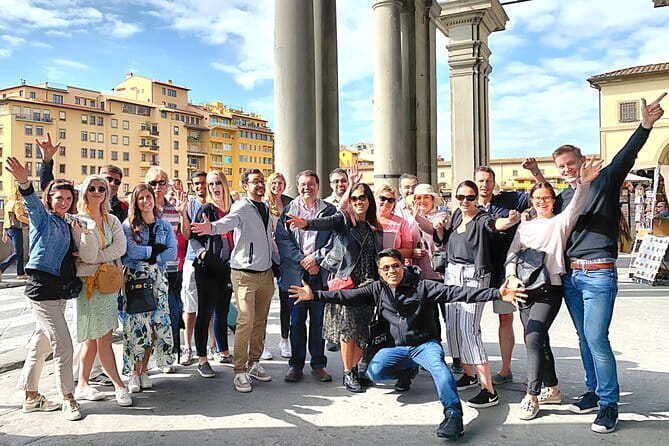
The tour is offered in English and is private, so only your group participates. That is useful in a busy center where a large group can easily block doorways or lose track of a guide. It also means the experience may feel more like a guided conversation than a standard lecture.
More Renaissance art days:
- Florence: Timed Entrance Ticket to Michelangelo’s David
★ 4.6 · 16,983 reviews - Florence: Michelangelo’s David Skip-the-Line Entry Ticket
★ 4.5 · 12,764 reviews - The Best tour in Florence: Renaissance & Medici Tales – guided by a STORYTELLER
★ 5.0 · 12,316 reviews
Starting at Piazza Strozzi and meeting Leonardo
The tour begins at Piazza degli Strozzi at 2:30 pm. This is a central starting point, and the first stop is Giunti Odeon, a bookshop and cinema with an internal visit dedicated to Leonardo da Vinci.
You spend about 20 minutes here. That is enough time for an introduction to Leonardo and the way Florence connects scientific thought, art, design, and observation. The setting adds a modern twist, since this is not simply a church or Renaissance palace. It shows how Leonardo’s ideas continue to shape the city’s cultural identity.
The stop also helps set the tour’s tone. Leonardo is not treated only as the painter of a few famous works. His curiosity crossed art, anatomy, engineering, and measurement. That broad curiosity fits well with a tour that later discusses perspective and the Vitruvian Man.
Because the visit is short, you should not expect a full museum-style treatment of Leonardo. Think of this as the opening chapter. It gives you a set of ideas that return later in the tour.
Orsanmichele and Florence’s first Renaissance statue
From there, you move to the Church and Museum of Orsanmichele for an exterior visit of about 15 minutes. The focus is the first Renaissance statue.
Orsanmichele is especially useful in a Renaissance tour because it connects art to Florence’s guilds and civic life. The building is not presented only as a religious site. Its exterior helps explain how public sculpture entered the city’s streets and how Florence began to place greater value on realistic human figures and independent artistic expression.
The word first is important here. This stop gives you a way to mark the change from medieval artistic traditions to the early Renaissance. You can look at the building and sculpture while the guide explains why the work mattered at the time.
This is an exterior stop, so the appeal lies in the explanation rather than access to the museum’s interior. If you want to study Orsanmichele’s sculptures closely, you will need a separate visit. On this tour, the building functions as a clear lesson in the new role of art in public Florence.
The route also includes one of Florence’s two main leather markets. The exact market is not specified, so you should treat this as a city-life stop rather than a dedicated shopping session. It adds a practical look at a traditional Florentine trade, but the information provided does not promise a set amount of time or a purchase opportunity.
Brunelleschi’s cathedral and the problem of the dome
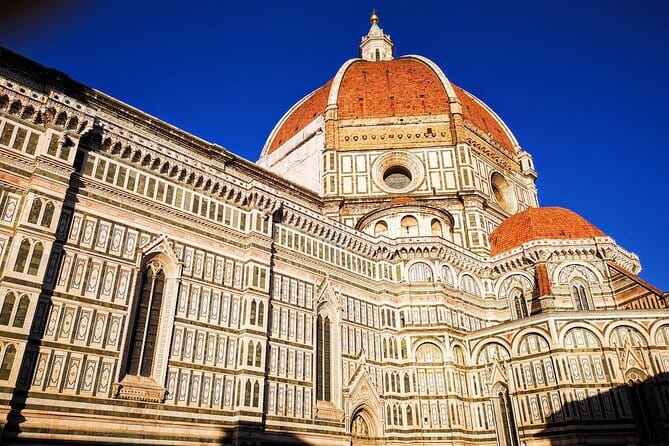
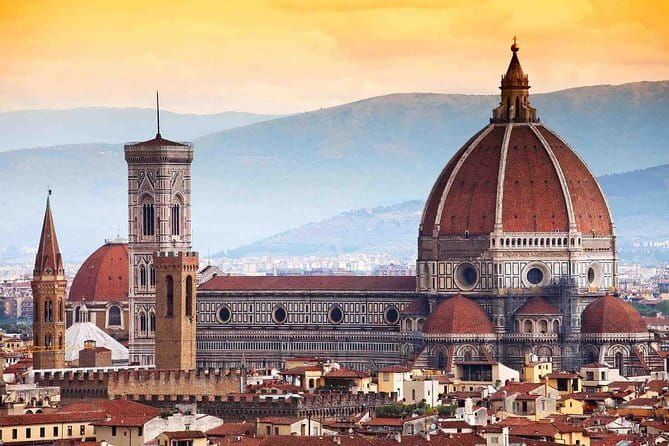
The next major stop is the Cathedral of Santa Maria del Fiore, known to most visitors as the Duomo. The visit is outdoors and lasts about 10 minutes.
That may sound brief for Florence’s most famous building, but the purpose is not to tour the interior. The guide tells the entertaining story of how the cathedral was built, with particular attention to the engineering challenge that made the dome famous.
This is where Aida’s interest in Brunelleschi becomes especially useful. The cathedral’s exterior is enormous and richly decorated, yet it can be hard to understand what made its construction such a turning point. A good explanation gives you a mental map: the size of the project, the difficulty of spanning the huge opening, and the role of new building ideas in Florence’s rise.
You should not book this experience expecting entry into the cathedral, dome, or bell tower. The stop is an outdoor overview, and admission is listed as free. If climbing the dome or exploring the cathedral interior is a priority, plan that separately.
Still, the short visit can be valuable. Once you understand the building challenge, later references to Brunelleschi’s methods and influence carry more weight. You are not just looking at a decorated church. You are looking at a problem that pushed architecture forward.
A different way to spend the same Florence day:
- Florence: Skip-The-Line Uffizi Gallery Timed Entry Ticket
★ 4.5 · 27,832 reviews - Tuscany Day Trip from Florence: Siena, San Gimignano, Pisa and Lunch at a Winery
★ 5.0 · 21,634 reviews - Florence: Leonardo Interactive Museum Entry Ticket
★ 4.5 · 11,763 reviews - The Best Tour in Florence: Renaissance and Medici Tales
★ 5.0 · 10,810 reviews
Piazza del Duomo and the perspective experiment
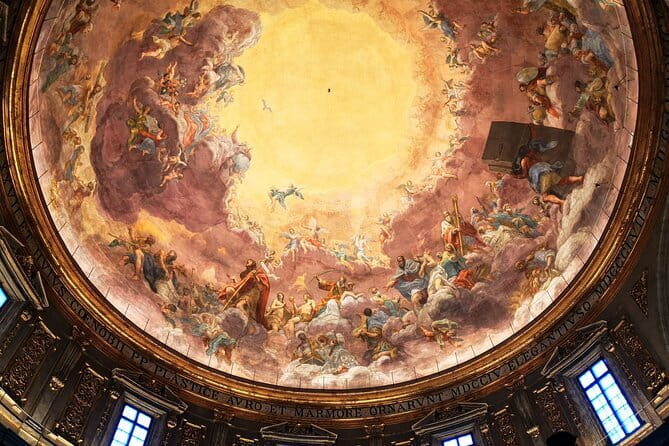
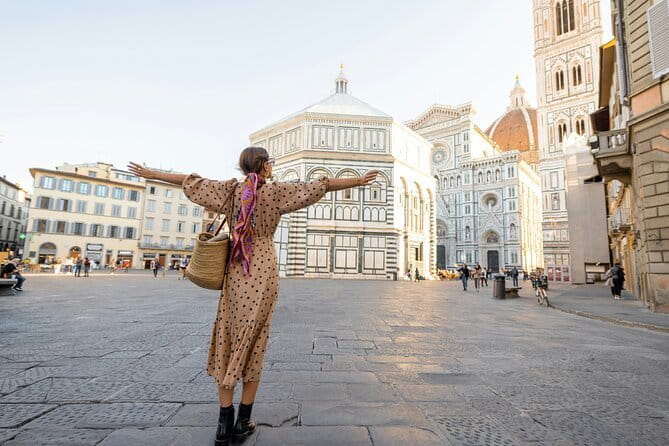
Piazza del Duomo receives about 20 minutes, making it one of the longer stops on the route. Here, the guide recreates an experiment that brought linear perspective to life.
This is one of the tour’s strongest features. Perspective can sound dry when explained with terms such as vanishing point and horizon line. A physical demonstration gives you a direct sense of how Renaissance artists made flat surfaces appear to contain real depth.
The square is also the right setting for the lesson. You are surrounded by strong architectural lines, repeated shapes, and buildings that can be viewed from different angles. That lets you connect the idea to the actual city rather than treating it as a classroom topic.
I like this part because it turns an art-history concept into something you can see and test. It may be particularly helpful if you appreciate art but have never understood why linear perspective mattered so much. The activity is not just about technique. It points to a wider change in how artists represented space and the human place within it.
The square can be busy, and the tour does not promise a quiet or controlled setting. Your ability to follow the demonstration may depend on where the group can pause. Even so, the private format gives the guide more freedom to adjust the explanation for your group.
The Baptistery and the Paradise Gates
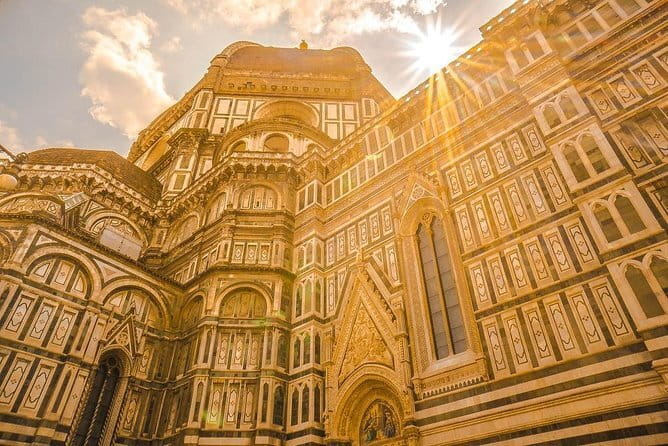
The exterior visit to the Baptistery of San Giovanni takes about eight minutes. The focus is the famous Paradise Gates.
This is a compact stop, but it serves an important purpose. The Baptistery is one of the key landmarks around the cathedral square, and its doors help show the growing ambition of Florentine sculpture. The reliefs are a useful bridge between medieval religious decoration and the Renaissance interest in depth, space, narrative, and human form.
Since the visit is outside, you will hear an overview rather than spend time inside the Baptistery. Eight minutes is enough to identify the gates and understand why they matter, but not enough for a close reading of every panel.
That limited time is typical of this tour. You get a strong sequence of ideas, but you will need to decide which places deserve a return visit. The Baptistery is a good example of the tour’s role as a first layer of understanding.
A hazelnut gelato pause at Piazza Duomo
A 20-minute stop at Edoardo il Gelato Biologico provides a welcome change of pace. The gelateria is known for its hazelnut flavor and also offers a broad choice of ice cream and affogato.
The listed admission cost is free, but the information does not state that gelato is included in the tour price. Plan on checking with the provider if you want to know how your purchase is handled. Either way, the pause gives you time to rest, cool down, and talk through what you have seen.
A scheduled food stop can make a short walking tour feel less rushed. It also fits Florence well, since gelato is part of the city’s daily rhythm. You are not being sent off for a full meal. This is a brief break placed between major sights.
If you do not want gelato, the stop may feel less useful. The experience details mention ice cream and affogato, but they do not list alternatives beyond the gelateria’s selection. For most people, though, 20 minutes is a sensible pause after the cathedral section.
Leonardo’s Vitruvian Man in five minutes
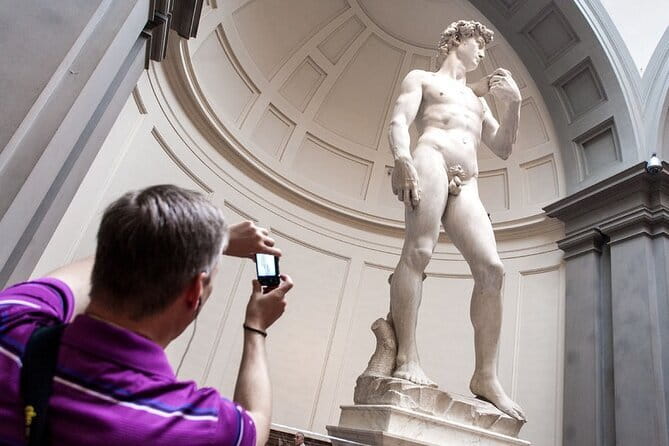
The tour then reaches the Leonardo da Vinci Museum for a five-minute explanation of the Vitruvian Man.
This is a very short visit, and you should read it as a focused interpretation rather than a museum tour. The Vitruvian Man is one of the clearest images of the Renaissance ideal: the human body examined through art, proportion, measurement, and science.
The stop connects back to the opening at Giunti Odeon and forward to the tour’s wider interest in perspective and architecture. Leonardo and Brunelleschi approached their work in different ways, but both represent the period’s drive to study the world carefully and represent it with greater precision.
The museum itself is not listed as an extended interior visit, and the schedule does not indicate that museum admission is included. The five-minute timing suggests that the guide is focusing on one idea rather than leading you through the full collection. If Leonardo is your main interest, allow separate time for a full museum visit.
Piazza Santissima Annunziata, Florence’s first Renaissance square
Piazza della Santissima Annunziata receives only two minutes, but its importance is much larger than the clock suggests. It is identified as Florence’s first Renaissance square.
That makes it a useful urban-planning lesson. The Renaissance did not change only paintings and statues. It changed how people imagined public space, symmetry, proportion, and the relationship between buildings.
You may find this stop especially helpful after seeing the cathedral complex. The tour shifts from individual works and construction problems to the shape of the city itself. Even a short pause can make you notice Florence as a planned visual experience rather than a random collection of old streets.
Two minutes allows only a quick explanation. Do not expect a full discussion of every building around the square. The value comes from placing the square into the larger story.
Museo degli Innocenti and the first Renaissance building
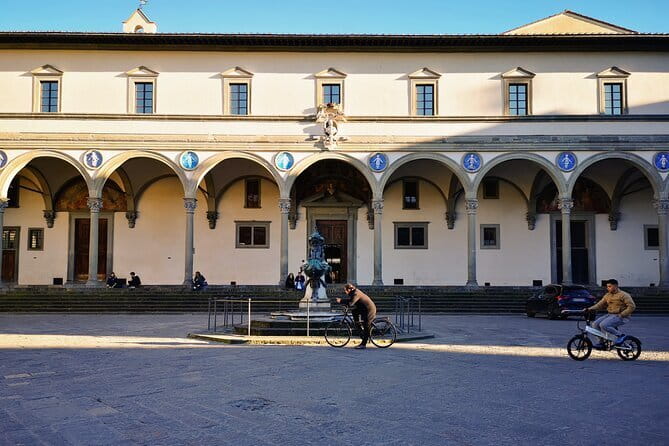
The Museo degli Innocenti is next, with about five minutes devoted to understanding Renaissance architecture beside what is described as the first Renaissance building.
This stop builds on the square. You are not only looking at a museum facade. You are learning how early Renaissance architecture used order, proportion, and repeated forms to create a new visual language.
The museum is treated as an exterior architectural reference, not as a full museum visit. That distinction matters if you are hoping to see the collections inside. The schedule allows enough time to identify the building’s importance and explain its place in Florence’s development, but not enough for an interior visit.
For me, this is a good example of why a guide can help in Florence. Many visitors pass these facades while heading toward larger sights. A short explanation changes what you notice. The stop does not need to be long to give the building a clear role in the city’s story.
Santissima Annunziata and the move into Baroque
The final stop is the Basilica della Santissima Annunziata, also called Chiesa di Santa Maria della Scala. Here, you make an interior visit lasting about 20 minutes.
This is the longest church visit on the tour and the place where the story moves from Renaissance into Baroque. The shift is useful because it prevents the Renaissance from being treated as a sealed period. Florence’s interiors changed, and later artistic styles brought different ideas about decoration, movement, emotion, and religious experience.
The basilica is presented as the most beautiful church in the city, but that is a matter of taste rather than a measurable fact. You can expect the guide to explain the interior and the transition in style, giving you a chance to compare what you have seen earlier with the more dramatic Baroque approach.
The tour ends at Piazza della Santissima Annunziata. From there, it is about a five-minute walk to the cathedral, which makes the finish convenient if you want to continue sightseeing in the Duomo area.
What the $93.62 price really buys you
At $93.62 per person, this is not a bargain walking tour. The value rests in the private guide, the English narration, and the way the stops form one argument about Florence.
You are not paying for a long list of admissions. The listed visits are free of charge, and most are outside or brief. You are paying for interpretation, route planning, and a guide who can connect Leonardo, Brunelleschi, sculpture, perspective, and architecture without making you assemble the pieces yourself.
The price makes more sense for a small private group with a strong interest in art, architecture, or history. It may also suit two or three people who want to ask questions and keep a flexible conversation going. For a solo visitor on a tight budget, it is harder to justify when many sights can be viewed from outside without a guide.
The current booking pattern is about 13 days ahead, so you should not leave it until the last minute if your Florence dates are fixed. Confirmation is provided at booking, and free cancellation is available up to 24 hours before the start time. Changes or cancellations inside that window are not accepted for a refund.
Who should book this Florence tour
I would choose this tour if you want to understand why Florence mattered, not simply photograph its famous buildings. It suits art, architecture, and history enthusiasts, along with first-time visitors who prefer a clear narrative to a long list of facts.
It is also a good match for anyone curious about Brunelleschi. Aida’s enthusiasm for him gives the tour an identifiable personality, and the cathedral story plus the perspective experiment make his influence easier to grasp.
You may want another option if your priority is entering major museums, climbing the Duomo, or spending an hour examining sculpture. The tour gives you short visits and focused explanations, not extended access.
Most people can participate, and the route is near public transportation. The tour starts at 2:30 pm, which leaves the morning free for another activity. Remember that the experience lasts about two and a half hours and ends away from the starting point, at Santissima Annunziata.
Should you book it?
Book this experience if you want a private, English-language introduction to Florence’s Renaissance through a connected story. The perspective demonstration, Brunelleschi focus, gelato pause, and final move into Baroque give the route more shape than a basic city walk.
Skip it if you need deep museum time or included access to Florence’s major paid sights. At $93.62 per person, the price is justified by the guide and the interpretation, not by admission tickets.
For the right audience, this is a lively way to get your bearings in Florence’s artistic center and learn what to look for when you return to the city’s museums and churches on your own.
FAQ
Where does the Renaissance Explained Tour begin?
It begins at Piazza degli Strozzi, 50123 Florence, Italy.
What time does the tour start?
The tour starts at 2:30 pm.
Where does the tour end?
It ends at the Basilica della Santissima Annunziata, at Piazza della Santissima Annunziata. The endpoint is about a five-minute walk from the cathedral.
How long does the tour last?
The experience lasts approximately two hours and 30 minutes.
Is the tour offered in English?
Yes. The tour includes an English-speaking guide.
Is this a private tour?
Yes. Only your group participates in the activity.
Does the tour include museum and church admission tickets?
The listed stops show free admission, but most visits are exterior or brief. The information does not state that paid museum entry or other admission fees are included.
Is gelato included in the price?
A 20-minute gelato stop is included in the route at Edoardo il Gelato Biologico, but the supplied details do not state that gelato itself is included in the tour price.
Can most people participate?
Yes. The activity information says most travelers can participate and notes that the tour is near public transportation.
What is the cancellation policy?
You can cancel up to 24 hours before the start time for a full refund. Cancellations or changes made less than 24 hours before the tour are not accepted for a refund. If the minimum number of participants is not met and the operator cancels, you will be offered another date or experience, or a full refund.
Latest additions around Florence
- Florence: Cathedral Tour & Brunelleschi’s Dome Climb Ticket★ 5.0 · 3 reviews
- Palatina Gallery and Pitti Guided Tour in Florence★ 5.0 · 3 reviews
- Florence Uffizi Gallery Skip-the-line Tour w Art Historian Guide★ 5.0 · 3 reviews
- Private Tour: Pisa and Lucca from Florence★ 5.0 · 3 reviews
- San Gimignano Bike Tour (SOFT)★ 4.5 · 3 reviews
- Florence: Tour of Florence by rickshaw★ 5.0 · 3 reviews
- Center of Florence by golf cart★ 5.0 · 3 reviews
- From Firenze | Chianti day tour in a classic car★ 5.0 · 3 reviews
Renaissance Art Tours, compared.

Timed Entrance Ticket to Michelangelo’s David
Read our review →
Michelangelo’s David Skip-the-Line Entry Ticket
Read our review →
The Best tour in Florence: Renaissance & Medici Tales – guided by a STORYTELLER
Read our review →
The Best Tour in Florence: Renaissance and Medici Tales
Read our review →
Timed Entry Ticket to Michelangelo’s David & eBook
Read our review →
Michelangelo’s David, Accademia & Uffizi Small Group Tour
Read our review →
Michelangelo’s David Entrance Ticket and Audio App
Read our review →
Renaissance and Medici Tales Guided Walking Tour
Read our review →Browse the lists this tour appears in