
Reviewed · FLORENCE CHURCHES & PALAZZOS
Private Guided Visit of Florence Santa Maria Novella Basilica and its Officina Profumo Farmaceutica
Santa Maria Novella gives you two very different Florentine sights in one compact visit: a grand Dominican church filled with major Renaissance art, followed by an old apothecary where monks once made rose water, balms, and herbal remedies. I especially like the chance to see Masaccio’s Trinity and Giotto’s Crucifix with a private guide, then step into the perfume workshop’s frescoed rooms. The Green Cloister adds a quiet pause away from the city streets.
I also like that the private format can suit your own questions. Andrea helped one solo participant take photos, and guides Andrea and Laura earned praise for their clear, attentive approach. The main caution is timing: the church can receive most of the explanation, leaving the pharmacy rushed or focused mainly on shopping.
In This Review
- Key points to know before booking
- Why Santa Maria Novella is worth your time
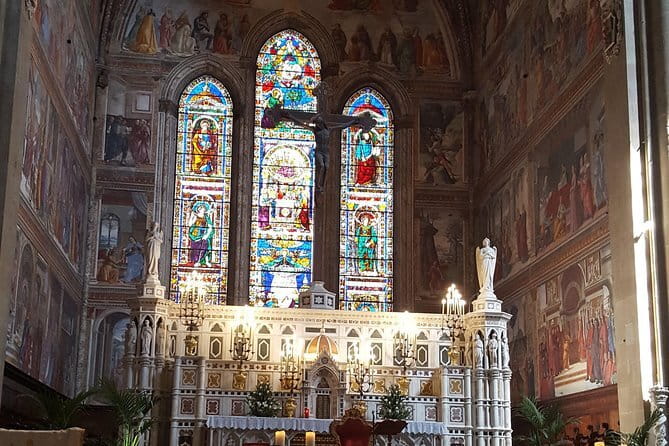
- Giotto, Masaccio, and the art inside the basilica
- The Green Cloister and Paolo Uccello’s unusual color
- Entering the 1612 Officina Profumo Farmaceutica
- How the private guide changes the visit
- Price, admission, and what the $124.96 covers
- Timing and meeting point in Florence
- What I like most, and what I would improve
- Who should book this Santa Maria Novella visit
- Should you book it?
- FAQ
- Where does the tour begin?
- Where does the tour end?
- How long does the experience last?
- Is the tour private?
- Is the tour offered in English?
- Which artworks can I see in the basilica?
- Is admission to the basilica included?
- Are earphones provided?
- Is hotel pickup included?
- Can I cancel for a full refund?
Key points to know before booking
- Two historic sites in 90 minutes: See the basilica, Green Cloister, and Officina Profumo Farmaceutica in one short tour.
- Major works of art: Look for Giotto, Masaccio, Filippino Lippi, Ghirlandaio, and Paolo Uccello.
- Private guiding: Only your group participates, so you can ask questions and request attention to particular works.
- Pharmacy admission is not included: The basilica ticket costs €7.50 for adults, €5 for ages 11 to 17, and is free for children 10 and under.
- Pharmacy expectations matter: The building and old rooms are fascinating, but the visit may feel brief and shop-like.
- English only: The experience is offered in English and includes earphones for groups larger than seven.
Why Santa Maria Novella is worth your time
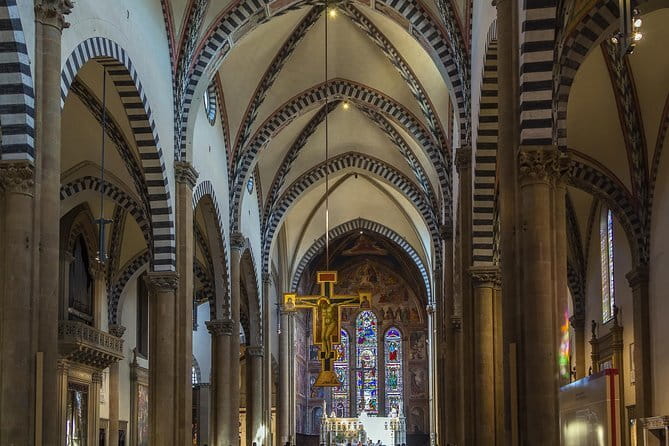
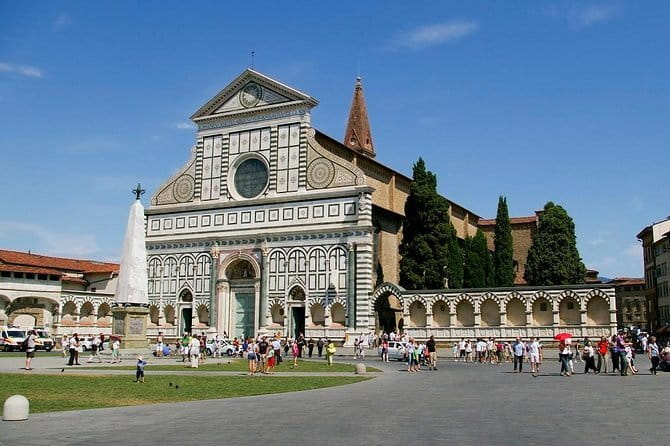
The Basilica of Santa Maria Novella is easy to reach in central Florence, right beside the station and the graceful piazza that carries its name. Its striped marble facade immediately catches your eye, but the real reward is inside, where the church connects Dominican religious life with some of Florence’s most important painting.
The Dominicans founded the church at the beginning of the 13th century. They belonged to a mendicant order, a religious movement whose friars depended on charity rather than owning large private estates. That background helps explain the church’s public role. This was not simply a private chapel for one wealthy family. It was a place of preaching, worship, learning, and daily contact with the people of Florence.
A guide adds useful shape to what could otherwise become a blur of chapels, altars, and painted walls. You can ask why a particular image matters, how the Dominicans used art, or where to look for a work that is easy to miss. The tour’s strongest moments come when the explanation stays tied to what you are seeing rather than becoming a long list of names.
More churches and palazzos worth an hour:
- Florence: Palazzo Vecchio Entrance Ticket & Audioguide
★ 4.4 · 4,822 reviews - Florence: Palazzo Vecchio Guided Tour
★ 4.8 · 1,260 reviews - Florence: Timed Entrance Ticket to San Marco Museum
★ 4.6 · 396 reviews
Giotto, Masaccio, and the art inside the basilica
Several major works are packed into this first part of the visit. Giotto’s Crucifix is an early highlight. It reflects the shift toward more human, emotionally direct religious art that helped prepare the way for the Renaissance. Your guide can point out details that are easy to overlook when you are also trying to take in the size of the church.
Masaccio’s Trinity is another reason to come. The fresco is famous for its convincing illusion of architectural depth. Painted figures appear within a carefully constructed space, creating the impression that the wall opens into a small chapel. Even if you are not an art specialist, the effect is clear when you know where to stand and what to notice.
The church also contains important fresco cycles by Filippino Lippi and Domenico Ghirlandaio. Ghirlandaio’s work is especially useful for understanding Florence in the late 15th century, since religious scenes often include contemporary clothing, faces, buildings, and social details. A good guide links the painted stories to the city around you instead of treating them as isolated decorations.
One especially useful detail is the chance to ask about Plautilla Nelli’s Last Supper. Laura helped a participant locate the newly restored work, which is not always the first piece people think of when they enter Santa Maria Novella. If this painting matters to you, mention it at the start of the visit so the guide can help you find it within the available time.
The Green Cloister and Paolo Uccello’s unusual color
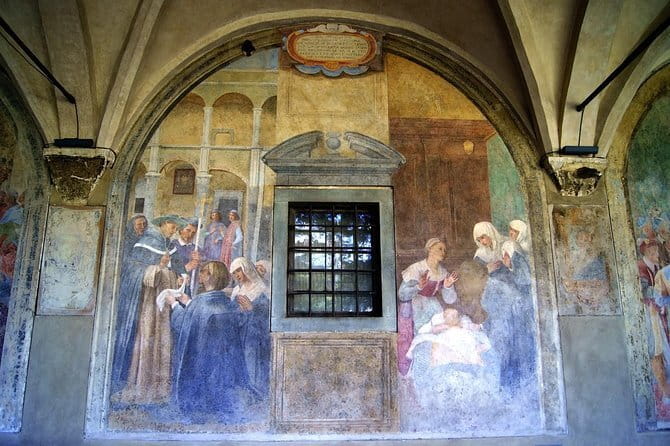
The tour usually moves from the basilica into the adjoining Green Cloister. Its name comes from the green earth pigment that dominates Paolo Uccello’s frescoes. After the church’s grand interior, the cloister offers a calmer setting and a chance to slow down.
The murals are not just a decorative stop. They show how a monastery used enclosed spaces to tell religious stories and shape the rhythm of daily life. The green tones give the paintings a distinct look, and the cloister’s quieter atmosphere helps you study the walls without the same visual pressure found in the main church.
This is also one of the tour’s practical strengths. You see a part of the Santa Maria Novella complex that you might skip if you were walking through Florence on your own. The cloister gives the visit a better balance: grand art in the basilica, then a more restrained architectural space before the change of mood at the pharmacy.
The limitation is the clock. The full experience lasts about an hour and a half, with roughly one hour assigned to the basilica and cloister and about 30 minutes for the Officina. If you want to linger over every fresco, this schedule will feel tight.
Entering the 1612 Officina Profumo Farmaceutica
The Officina Profumo Farmaceutica di Santa Maria Novella occupies part of the old Dominican monastery. The current workshop dates to 1612, though the monks’ work with plants and remedies began earlier. By the 14th century, they were selling rose water for use as a disinfectant, especially during epidemics.
Later, under the influence of Cosimo I de’ Medici and his successors, the monastery developed a stronger interest in natural science. The monks cultivated medicinal plants, distilled herbs and flowers, and prepared essences, ointments, and balms. That connection between religious life, gardening, medicine, and trade gives the pharmacy its real appeal.
Inside, you can expect vaulted ceilings, frescoed walls, and the scent of products made from traditional recipes. The building itself is the main attraction. It feels different from a modern perfume shop because the sales rooms occupy historic monastery spaces and retain their old architectural character.
The present-day business makes perfumes, soaps, and other cosmetic products. You may find the display of products attractive, but it is important to set your expectations. This is not necessarily a long technical demonstration of distilling or herbal preparation. It is a historic pharmacy that also operates as a shop.
That distinction matters. One participant felt the pharmacy visit was mostly a sales area and not what they had expected. Another found it fascinating and considered it the highlight of the tour. Both reactions make sense. If you care most about the architecture and the story of the Dominican apothecary, you will likely enjoy it. If you want a detailed behind-the-scenes workshop, the 30-minute stop may feel thin.
More Florence options worth a look before you decide
- Cinque Terre and Pisa Tower Tour from Florence Semi Private
★ 5.0 · 1,406 reviews - From Florence: Private Chianti Hills Tour with Tasting
★ 4.3 · 809 reviews - Private Self-Guided E-Bike Ride in Tuscany with Vineyard Visit
★ 5.0 · 775 reviews - Florence Private Transportation in Rickshaw
★ 5.0 · 730 reviews
How the private guide changes the visit
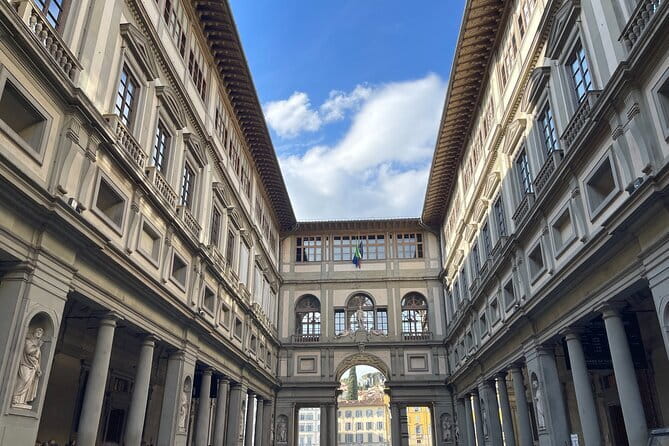
A private tour gives you your own guide and group rather than placing you in a large shared party. That makes it easier to ask about a particular painting, request help with photos, or adjust the conversation to your interests.
Andrea received especially strong praise for being attentive, punctual, and willing to answer questions. He also helped a solo participant with photographs. Laura was appreciated for bringing the basilica and pharmacy to life, including the search for Plautilla Nelli’s Last Supper. Marcello was praised for his explanation of the basilica, though the pharmacy portion felt too rushed for one participant.
Those different experiences point to the most important practical issue: the guide’s balance between the two stops. The basilica has more major art and more material to explain, so it is natural for the church to take center stage. Still, the pharmacy is a named part of the experience, and you should say clearly if you want its story treated in detail.
The private setting is particularly useful for people who do not want a fixed lecture. You can ask for a straightforward introduction to Renaissance painting, focus on Dominican life, or spend more time on the pharmacy’s medicinal past. Since the tour is offered in English, it is best suited to an English-speaking group.
Earphones are supplied for groups larger than seven. The experience is private, but the information provided does not specify the maximum group size. Most people can participate, and the meeting point is near public transportation.
Price, admission, and what the $124.96 covers
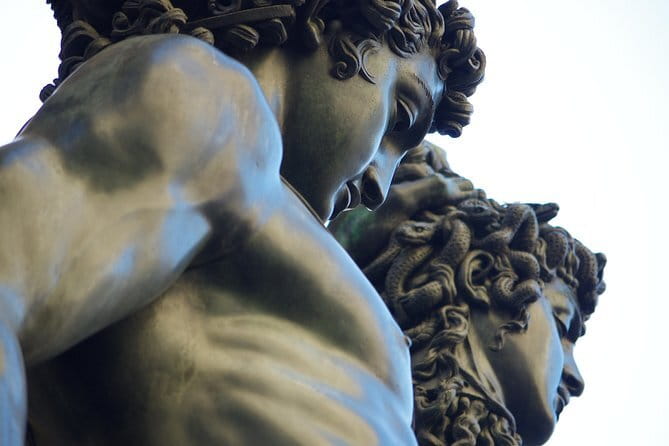
The listed price is $124.96 per person. That is a serious cost for a 90-minute visit, so the value depends on how much you want personal guiding and how well the two parts are handled.
The price covers a local professional guide and, for groups of more than seven, earphones. It does not cover admission to the basilica. You pay that separately on the spot: €7.50 for adults, €5 for ages 11 to 17, and free for children 10 and under. The supplied details do not list a separate pharmacy admission charge, so you should confirm any on-site requirements when booking or meeting your guide.
For a couple or small family, the private format can make sense if you want focused help with art rather than a general introduction to Florence. It is less compelling if you mainly want to enter the pharmacy, browse its products, and look around at your own pace. You would be paying largely for the guide’s interpretation and the convenience of combining both sites.
Group discounts are available, which may improve the price for a larger private party. Since the tour is often reserved about 40 days ahead, planning early is sensible if your Florence dates are fixed.
Timing and meeting point in Florence
Meet your guide outside the entrance of the Basilica of Santa Maria Novella at Piazza di Santa Maria Novella 18. The tour ends back at the meeting point, and hotel pickup or drop-off is not provided.
The central location makes this easy to pair with other sightseeing, but allow enough time to reach the exact entrance. Santa Maria Novella is near public transportation, including the main railway station area. A morning appointment may work well before other central Florence sights, while an afternoon tour can give you a useful art break after the Uffizi or Duomo area.
The advertised duration is approximately 1 hour and 30 minutes. Treat that as a guided introduction rather than a complete study visit. You will see important highlights, but you will not have time to examine every chapel, fresco, or pharmacy product at leisure.
If photography matters to you, ask about it at the beginning. Andrea’s willingness to help with photos was appreciated, but policies can vary by room and artwork. Do not assume every work can be photographed simply because a guide is present.
What I like most, and what I would improve
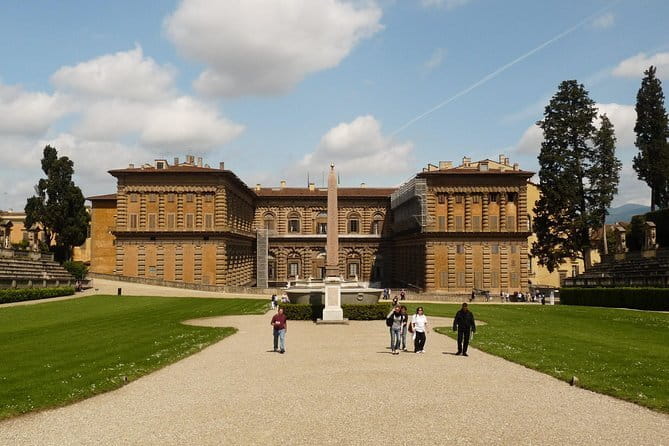
I like the range of the experience. In one short walk, you move from medieval Dominican foundations to Renaissance painting, a cloister decorated in green earth, and an apothecary connected with centuries of plant-based remedies.
I also like the contrast in mood. The basilica is visually demanding and full of famous names. The cloister quiets things down. The pharmacy then shifts from religious art to scent, craft, trade, and the everyday uses of plants.
The guides can make a major difference. Andrea and Laura were both singled out for personal attention, clear explanations, and professionalism. A private visit also lets you bring your own interests into the conversation instead of listening to a set speech that may not fit your group.
The weak spot is the pharmacy explanation. The experience promises a visit to an important historic workshop, but the stop can be brief. If your main goal is learning how the Officina developed and what the monks produced, tell the guide before the tour begins and protect enough time for that discussion.
The overall rating is 4.1 from 11 reviews, which suggests a good but not flawless experience. The pattern is clear: the basilica guiding is the dependable strength, while the pharmacy portion determines whether the tour feels complete.
Who should book this Santa Maria Novella visit
I would recommend it to first-time visitors who want a clear introduction to one of Florence’s major churches without spending half a day on a formal art tour. It also suits couples, families with older children, and small groups who prefer asking questions privately.
Art lovers should consider it if Giotto, Masaccio, Ghirlandaio, Filippino Lippi, Uccello, or Plautilla Nelli are on their list. The guide can help you locate works that you might otherwise miss, especially in a church where several important pieces compete for attention.
The tour is also a good fit if you are curious about Florence’s old pharmacies and perfume traditions. Just come for the building, atmosphere, and story, not a guaranteed extended workshop demonstration.
I would skip it if you have already studied Santa Maria Novella in depth and want plenty of quiet time for your own looking. You may get better value by visiting independently, provided you are comfortable arranging the basilica admission and finding the works yourself.
Free cancellation is available up to 24 hours before the start time. Changes or cancellations made less than 24 hours ahead are not refunded, and the cutoff uses local Florence time.
Should you book it?
Book this tour if you want a private English-speaking guide to connect Santa Maria Novella’s art, Dominican background, Green Cloister, and old pharmacy in a single visit. The basilica is the surest reason to go, and the pharmacy adds an unusual second chapter.
Before you start, tell the guide that the Officina matters to you. If the pharmacy is your top priority, ask for its full 30-minute portion rather than allowing the church discussion to run long. With that expectation set, this can be a smart, compact way to see a less ordinary side of Florence.
FAQ
Where does the tour begin?
Meet your guide outside the entrance of the Basilica of Santa Maria Novella at Piazza di Santa Maria Novella 18, Florence.
Where does the tour end?
The experience ends back at the meeting point at the basilica.
How long does the experience last?
The tour lasts approximately 1 hour and 30 minutes. About one hour is assigned to the basilica and Green Cloister, and about 30 minutes to the Officina Profumo Farmaceutica.
Is the tour private?
Yes. Only your group participates in the activity.
Is the tour offered in English?
Yes. The experience is offered in English.
Which artworks can I see in the basilica?
The visit includes works associated with Giotto, Masaccio, Filippino Lippi, and Ghirlandaio. It also includes frescoes by Paolo Uccello in the Green Cloister.
Is admission to the basilica included?
No. Admission is paid on the spot. Adults pay €7.50, ages 11 to 17 pay €5, and children 10 and under enter free.
Are earphones provided?
Earphones are provided for groups of more than seven participants.
Is hotel pickup included?
No. Hotel pickup and drop-off are not included.
Can I cancel for a full refund?
Yes, if you cancel at least 24 hours before the experience start time. Cancellations made less than 24 hours before the start time are not refunded.
Latest additions around Florence
- Florence: Cathedral Tour & Brunelleschi’s Dome Climb Ticket★ 5.0 · 3 reviews
- Palatina Gallery and Pitti Guided Tour in Florence★ 5.0 · 3 reviews
- Florence Uffizi Gallery Skip-the-line Tour w Art Historian Guide★ 5.0 · 3 reviews
- Private Tour: Pisa and Lucca from Florence★ 5.0 · 3 reviews
- San Gimignano Bike Tour (SOFT)★ 4.5 · 3 reviews
- Florence: Tour of Florence by rickshaw★ 5.0 · 3 reviews
- Center of Florence by golf cart★ 5.0 · 3 reviews
- From Florence: Tour to Siena and San Gimignano by Minivan★ 4.5 · 3 reviews
Florence Churches & Palazzos, compared.
Palazzo Vecchio guided experience with entrance ticket
Read our review →
Browse the lists this tour appears in