
Reviewed · RENAISSANCE ART TOURS
Michelangelo Sculpture Tour in Florence with Skip the Line Ticket
Michelangelo’s Florence is best understood by moving between his sculptures and the places that shaped him. This three-hour walking tour links his family story, Medici connections, rivalries, and unfinished works with four major museums, ending face to face with David at the Accademia Gallery.
I like the four included museum admissions, especially the chance to compare Michelangelo with Donatello and Verrocchio at the Bargello. I also like the clear finish inside the Accademia, since you can stay on after the guided portion instead of being ushered back onto the street.
The main consideration is pace. Four museums plus several outdoor landmarks in about three hours leaves little room for lingering, and the $172.86 price is high unless you place real value on a guide and skip-the-line access. The group is capped at 20, but the experience can also run with fewer people.
In This Review
- Key points about the Michelangelo tour
- Following Michelangelo through Florence at 9 a.m.
- Santa Croce and Michelangelo’s Florentine setting
- Four Michelangelo works at the Bargello
- Piazza della Signoria, Loggia dei Lanzi, and Palazzo Vecchio
- Orsanmichele and the guilds behind the art
- Opera del Duomo Museum and the Palestrina Pietà
- Medici Chapels and the New Sacristy
- Accademia Gallery and the final look at David
- Is $172.86 a fair price?
- Group size, weather, and cancellation details
- Who should book this Florence art tour?
- Should you book the Michelangelo Sculpture Tour?
- FAQ
- Where does the tour start?
- What time does the tour begin?
- Where does the tour end?
- How long does the experience last?
- Which museums are included?
- Is admission included?
- Will I see Michelangelo’s David?
- Can I stay at the Accademia after the tour?
- How many people can join the tour?
- Can I cancel for a refund?
Key points about the Michelangelo tour
- Four museums in three hours: Visit the Bargello, Opera del Duomo Museum, Medici Chapels, and Accademia Gallery with admission included.
- David is the grand finale: The tour ends inside the Accademia, giving you time to continue looking around afterward.
- A strong sculpture comparison: See Michelangelo’s works beside important sculptures by Donatello and Verrocchio at the Bargello.
- Medici influence comes into focus: The New Sacristy helps explain the family’s role in Michelangelo’s career.
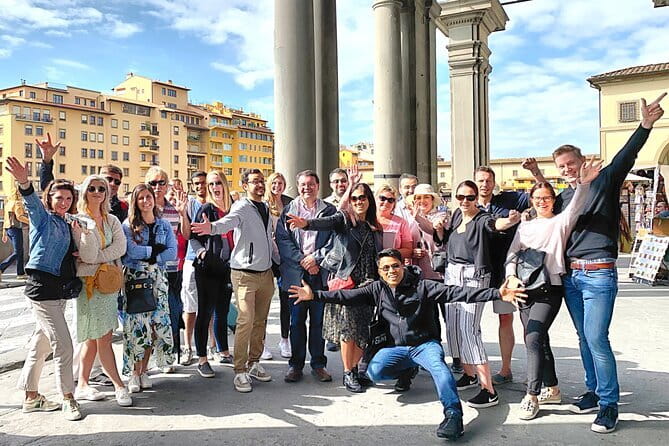
- The group can be small: The maximum group size is 20, and one booking with guide Becky became a private tour.
- A central Florence start: Meet at Via Vinegia 23R at 9:00 a.m., then walk through the historic center.
Following Michelangelo through Florence at 9 a.m.
The tour begins at Via Vinegia 23R, near Florence’s central sights and public transportation. From there, your guide leads you through streets connected to Michelangelo’s family, education, working life, and artistic circle.
This opening walk matters because Michelangelo was not simply a name attached to a statue. He grew up in the Florentine world shaped by guilds, religious institutions, wealthy patrons, and Medici power. As you move through the city, the guide adds the human details: his rivalries, his temperament, amusing episodes, and the circumstances behind several works.
Guide quality is especially important here. The supplied experience information identifies Becky as one guide, and a booking with her became a private tour when no other participant joined. Another booking praised the guide’s unusually strong knowledge and ability to explain it clearly. Since guides can vary, you should treat those comments as a reason to value the human side of the tour, not as a guarantee that Becky will lead every departure.
You should wear comfortable shoes. The route uses Florence’s cobblestone streets and connects several sites on foot. The morning start is useful because it gives you a fixed plan before the city becomes harder to navigate, though three hours is still a brisk window for so much art.
More Renaissance art days:
- Florence: Timed Entrance Ticket to Michelangelo’s David
★ 4.6 · 16,983 reviews - Florence: Michelangelo’s David Skip-the-Line Entry Ticket
★ 4.5 · 12,764 reviews - The Best tour in Florence: Renaissance & Medici Tales – guided by a STORYTELLER
★ 5.0 · 12,316 reviews
Santa Croce and Michelangelo’s Florentine setting
The route includes Santa Croce, one of Florence’s great Franciscan churches and a major Gothic building. Its importance is not limited to the architecture. The church became a gathering place for artists, theologians, humanists, political figures, and other people who helped shape Florentine public life.
Santa Croce also contains the tombs of major Italian artists. That makes it a fitting early stop for a Michelangelo-focused walk, even though the detailed museum visits come later. You get a sense of the city’s habit of placing art, faith, civic identity, and personal memory in the same buildings.
The supplied timing does not assign a separate admission period to Santa Croce, so do not assume you will receive an extended interior visit there. Think of it as part of the city walk and the story around Michelangelo rather than one of the four main museum sessions.
Four Michelangelo works at the Bargello
The first timed museum visit is the Museo Nazionale del Bargello, with about 40 minutes inside and admission included. This is a particularly good place to begin because the collection lets you see Michelangelo in conversation with earlier and competing sculptors.
The guide points out four important Michelangelo works:
- Tondo Pitti
- Bacchus
- Brutus
- David-Apollo
The Tondo Pitti is a useful introduction to Michelangelo’s non finito, or deliberately or naturally unfinished style. Its incomplete quality can make you look at the carving process itself, not just the finished image.
Bacchus shows a different side of the artist. Brutus and David-Apollo add further range, helping you see how Michelangelo handled ancient references, political meaning, the human body, and marble. With only 40 minutes, you will not cover every room, but a focused explanation can give the collection a strong shape.
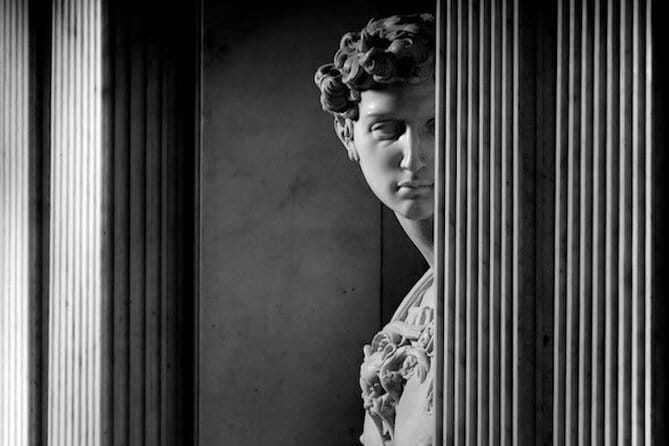
I especially like the comparisons with Donatello’s and Verrocchio’s bronze Davids. Seeing these works in the same museum turns a familiar name into an artistic argument. You can compare material, scale, pose, and the changing idea of what a David should express.
The drawback is the clock. The Bargello deserves more than 40 minutes if you want a broad look at its collection. On this tour, the point is not to see everything. It is to establish Michelangelo’s place within Florence’s sculpture tradition before moving on.
Piazza della Signoria, Loggia dei Lanzi, and Palazzo Vecchio
After the Bargello, the walk continues through Piazza della Signoria, Florence’s civic heart. This is where public power and public art meet, and it helps explain why sculpture mattered so much in the city.
The nearby Loggia dei Lanzi is an open-sided sculpture gallery beside the Uffizi. Its large arches face the street, making the works visible as part of daily city life rather than hidden behind museum walls. Michelangelo liked the form enough to suggest surrounding Piazza della Signoria with similar arches.
Palazzo Vecchio overlooks the square. It served Florence’s civic government and carried several names as its role changed over time. Later, when the Medici duke moved across the Arno to Palazzo Pitti, the old palace gained its current name.
These are exterior viewing stops, not extended palace visits. Their value is visual and political. You see the setting in which Florentine patrons used art to project authority, and you begin to understand the world in which Michelangelo worked.
More skip-the-line entries:
- Florence: Skip-The-Line Uffizi Gallery Timed Entry Ticket
★ 4.5 · 27,832 reviews - Florence: Leonardo Interactive Museum Entry Ticket
★ 4.5 · 11,763 reviews - Florence: Uffizi Priority Ticket & Masterpieces Audio App
★ 4.2 · 6,402 reviews - Florence: Hop-on Hop-off Bus Tour: 24, 48 or 72-Hour Ticket
★ 4.0 · 6,283 reviews
Orsanmichele and the guilds behind the art
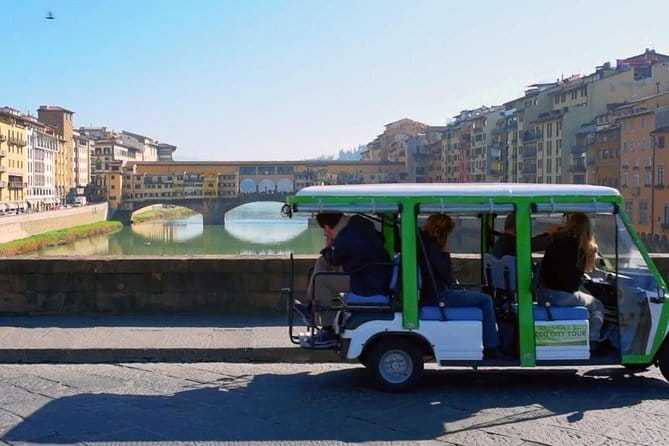
The church of Orsanmichele adds another useful piece to the story. The building began as a grain market and later became a church tied to Florence’s ancient guilds, known as the Arts.
The upper floors house a museum with original sculptures from the exterior niches, including works by Donatello and Ghiberti. Even if your visit focuses on the street-level building rather than a full museum session, Orsanmichele helps explain how guilds supported religious and civic art.
This stop also gives you a break from the museum interiors. Florence’s public sculptures were not random decoration. Guilds, churches, government, and wealthy families all had a hand in commissioning and displaying them. That context makes the later Medici Chapels and Accademia visits more meaningful.
Opera del Duomo Museum and the Palestrina Pietà
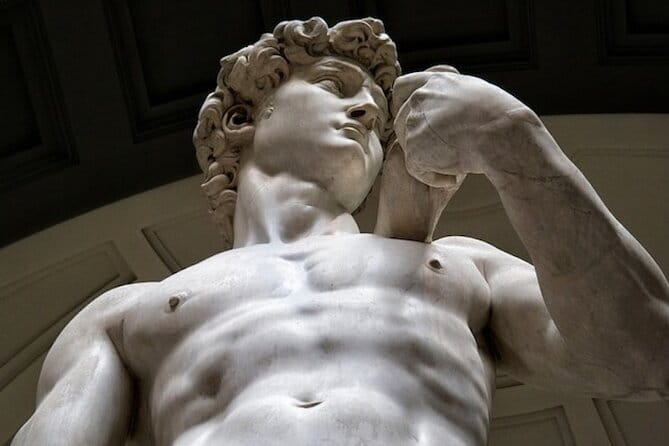
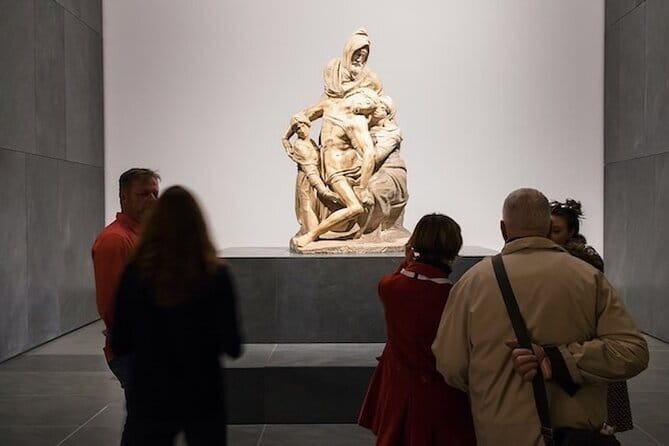
The second timed museum stop is the Opera del Duomo Museum, with about 40 minutes and admission included. The main Michelangelo focus is the Palestrina Pietà, one of his final creations.
The work carries a personal weight because Michelangelo carved it for his own tomb. Its treatment of suffering and physical strain reflects the concerns of his later years. You may find it more unsettling than the polished confidence of David, which is exactly why it deserves careful attention.
The museum also holds the original Gates of Paradise, created by Lorenzo Ghiberti between 1425 and 1452 for Florence’s Baptistery. These are not Michelangelo works, but they belong in this tour because they show the standard of Florentine sculpture against which later artists worked.
The 40-minute visit is enough for a guided look at the key pieces, but not for a full museum survey. The Opera del Duomo collection covers far more than the works named here. If you have a special interest in the cathedral complex, plan a separate visit rather than expecting this tour to cover every room.
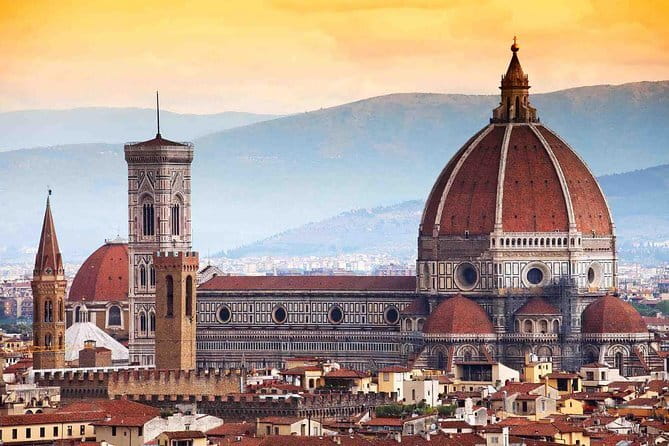
You will also pass Santa Maria del Fiore, Florence’s cathedral. Its huge dome dominates the city, and the building’s name, Our Lady of the Flower, connects to Florence’s name and its lily emblem. The cathedral exterior gives the walking route a strong visual center, though the tour information does not include a dedicated cathedral admission.
Medici Chapels and the New Sacristy
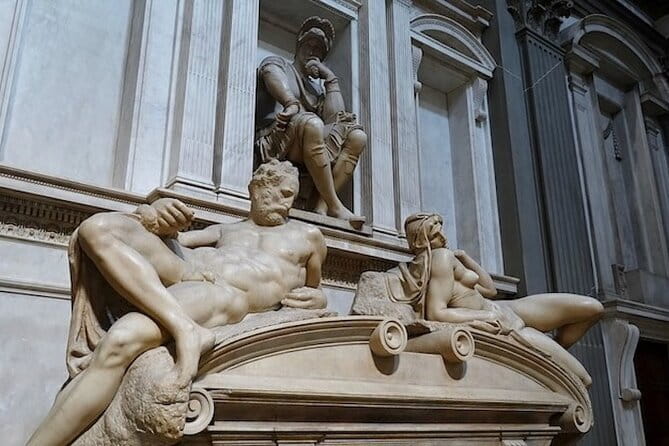
The third museum session takes you to the Cappelle Medicee, or Medici Chapels, for about 40 minutes. This is where Michelangelo’s relationship with the Medici family becomes most clear.
The New Sacristy contains the tombs of Medici family members, designed with the kind of architectural and sculptural unity that makes the room feel carefully controlled. Your guide explains how the family influenced Michelangelo and how their patronage shaped his work.
This stop is valuable because it moves beyond the famous single statue. Michelangelo was also an architect and a designer of complete spaces. In the New Sacristy, you can study how figures, tombs, walls, and light work together.
Again, time is the trade-off. Forty minutes gives you a focused visit, not a leisurely one. If you want to study every tomb and detail, you may need to return independently. The included ticket gets you through the door, but the tour’s schedule determines how long you initially spend inside.
Accademia Gallery and the final look at David
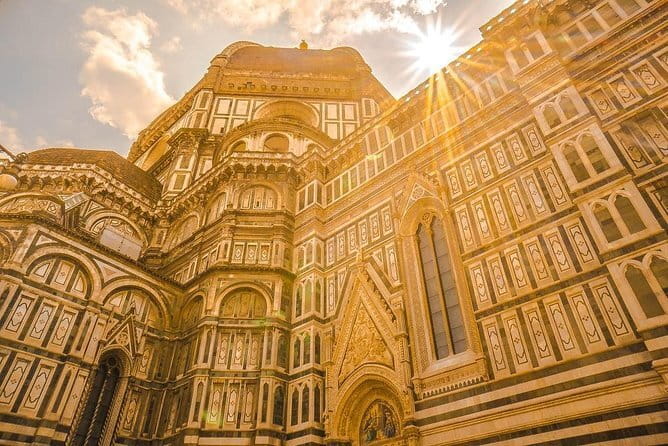
The Accademia is the last stop and the emotional center of the tour. Admission is included, and the tour ends inside the gallery rather than outside its entrance.
That ending is a practical advantage. Once the guided portion is over, you can continue exploring the museum if you wish. You are not forced to choose between keeping up with the group and seeing the rest of the collection at your own speed.
The main event is Michelangelo’s David, one of the world’s most recognized statues. A guide can help you slow down and notice details that a quick photo does not show: the body’s tension, the controlled stance, and the way the figure suggests thought before action.
You will also see the Prisoners, unfinished figures begun for Pope Julius II’s tomb. They offer a sharp contrast with David. Instead of a fully resolved form, you see bodies appearing to struggle out of the marble. This returns you to the idea of non finito introduced at the Bargello.
The Accademia visit is scheduled for about 40 minutes, but the tour ends there. That distinction matters. You can stay longer, making the final stop less rushed than the earlier museum visits. If David is your main reason for booking, this structure gives you both an explanation and extra time afterward.
Is $172.86 a fair price?
At $172.86 per person, this is not a budget Florence walk. You are paying for a guide-led route, included admission to four museums, and skip-the-line access, plus the convenience of connecting sites that you could otherwise visit separately.
The value improves if you have limited time in Florence and want a clear Michelangelo theme. Booking four major museums, finding the entrances, understanding the works, and moving between them would take planning. A strong guide can also connect the art to Florence’s guilds, churches, civic spaces, and Medici patrons.
The value is weaker if you prefer long museum visits or already know the city well. The 40-minute sessions are focused, and the total route is busy. You may prefer to buy individual admissions and spend half a day at the Bargello or Opera del Duomo Museum alone.
The booking pattern also tells you something useful: the experience is often reserved about 35 days ahead. If your Florence dates are fixed, planning early is sensible. A mobile ticket makes the booking easy to carry, and confirmation arrives at the time of booking.
Group size, weather, and cancellation details
The maximum group size is 20. That is small enough for a guide-led walk to remain manageable, though a full group can feel less personal than a private visit. The experience can also operate with fewer participants, and one reported departure became private when only one person booked.
Most people can take part, and the route is near public transportation. The tour requires good weather, so a poor-weather cancellation can lead to another date or a full refund. It also requires a minimum number of participants, with the same general choice of a different date or experience, or a refund, if that minimum is not met.
You can cancel for a full refund up to 24 hours before the 9 a.m. start time. Changes or cancellations inside that window are not accepted for a refund, and the cut-off uses Florence local time.
Who should book this Florence art tour?
I would choose this tour if you want Michelangelo to be the thread connecting your morning in Florence. It suits first-time visitors who want the major works explained in a sensible order, rather than approached as isolated sights.
It is also a good fit for anyone interested in how art comes out of patronage and city politics. The Medici Chapels, Piazza della Signoria, Orsanmichele, Santa Croce, and the museum collections give you much more than a single David photo.
You should think twice if your priority is slow, independent museum time. Four museums in three hours is efficient, but it is not leisurely. The price also asks you to value expert explanation and skip-the-line convenience.
Should you book the Michelangelo Sculpture Tour?
Book it if you want a tightly organized morning with four included museum admissions, a Michelangelo-centered story, and a final visit to David that does not end at the gallery door. The strongest features are the sculpture comparisons at the Bargello, the Medici connection in the New Sacristy, and the chance to stay inside the Accademia afterward.
Skip it if you want to explore each museum at length or if $172.86 feels too steep for a three-hour experience. For most art-focused visitors with limited time, the tour offers a useful framework. Just arrive ready to walk, accept the brisk pace, and keep the rest of your day flexible in case you want more time at the Accademia.
FAQ
Where does the tour start?
The tour starts at Via Vinegia, 23R, 50122 Florence, Italy.
What time does the tour begin?
The scheduled start time is 9:00 a.m.
Where does the tour end?
The tour ends inside the Accademia Gallery at Via Ricasoli, 58/60, Florence.
How long does the experience last?
The tour lasts approximately three hours.
Which museums are included?
The tour includes the Bargello Museum, Opera del Duomo Museum, Medici Chapels, and Accademia Gallery.
Is admission included?
Admission tickets are included for the Bargello, Opera del Duomo Museum, Medici Chapels, and Accademia Gallery.
Will I see Michelangelo’s David?
Yes. David is located in the Accademia Gallery, the final museum stop.
Can I stay at the Accademia after the tour?
Yes. The tour ends inside the Accademia, so you can continue exploring the museum afterward.
How many people can join the tour?
The maximum group size is 20 participants.
Can I cancel for a refund?
Yes. You can cancel up to 24 hours before the experience start time for a full refund. Cancellations or changes made less than 24 hours in advance are not accepted for a refund.
Latest additions around Florence
- Florence: Cathedral Tour & Brunelleschi’s Dome Climb Ticket★ 5.0 · 3 reviews
- Palatina Gallery and Pitti Guided Tour in Florence★ 5.0 · 3 reviews
- Florence Uffizi Gallery Skip-the-line Tour w Art Historian Guide★ 5.0 · 3 reviews
- Private Tour: Pisa and Lucca from Florence★ 5.0 · 3 reviews
- San Gimignano Bike Tour (SOFT)★ 4.5 · 3 reviews
- Florence: Tour of Florence by rickshaw★ 5.0 · 3 reviews
- Center of Florence by golf cart★ 5.0 · 3 reviews
- From Firenze | Chianti day tour in a classic car★ 5.0 · 3 reviews
Renaissance Art Tours, compared.

Timed Entrance Ticket to Michelangelo’s David
Read our review →
Michelangelo’s David Skip-the-Line Entry Ticket
Read our review →
The Best tour in Florence: Renaissance & Medici Tales – guided by a STORYTELLER
Read our review →
The Best Tour in Florence: Renaissance and Medici Tales
Read our review →
Timed Entry Ticket to Michelangelo’s David & eBook
Read our review →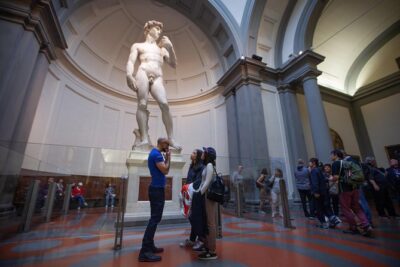
Michelangelo’s David, Accademia & Uffizi Small Group Tour
Read our review →
Michelangelo’s David Entrance Ticket and Audio App
Read our review →
Renaissance and Medici Tales Guided Walking Tour
Read our review →Browse the lists this tour appears in