
Reviewed · MEDICI TOURS
Medici Legends & Renaissance Wonders: Florence Small Group Tour
Florence makes more sense when you see its great buildings as chapters in one family’s rise from banking power to ruling dynasty. This walk links San Lorenzo, the Duomo, Palazzo Vecchio, Ponte Vecchio, Pitti Palace, and the Uffizi through the Medici story, giving you a fast first look at the city.
I like the small maximum of 15 people, which gives the guide a fair chance to answer questions. I also like the clear route through central Florence, especially the shift from Medici churches and palaces to the public spaces where the family displayed its power. The main caution is that nearly every stop lasts about five minutes and admission is not included, so this is an introduction from the street, not a museum tour.
In This Review
- Key points to know before booking
- Why the Medici make a good Florence introduction
- San Lorenzo, the Medici burial church
- The Laurentian Library and the Medici Chapels
- Palazzo Medici Riccardi and the family’s first great palace
- The Duomo complex, from the cathedral to Brunelleschi’s dome
- Palazzo Vecchio and Piazza della Signoria
- Ponte Vecchio, the Arno, and the Medici route across town
- Palazzo Pitti and the Uffizi connection
- What the guides add to the walk
- Price, timing, and who gets good value
- The practical call
- FAQ
- How long does the tour last?
- What time does the tour begin?
- Where does the tour meet?
- Where does the tour end?
- How many people can join the tour?
- Is the tour offered in English?
- Are museum and attraction tickets included?
- Is a guide included?
- Does the tour use audio equipment?
- Can I cancel for a full refund?
Key points to know before booking

- The Medici family provides the thread: You see how banking wealth, church patronage, political control, and art worked together in Florence.
- The route covers major sights quickly: San Lorenzo, the Duomo complex, Palazzo Vecchio, Ponte Vecchio, Pitti Palace, and the Uffizi all appear within about 1 hour 45 minutes.
- The group is capped at 15: That is small enough for a more personal walk, though street noise can still make listening difficult.
- Museum entry is not included: The listed stops are short, so plan separate visits to the Medici Chapels, Laurentian Library, Uffizi, or other interiors.
- The meeting point is central: You begin at Caffè Scudieri Firenze near the Baptistery at 12:15 pm and finish near Ponte Vecchio.
- Guide quality matters here: Guides including Manuel, Martina, Amanda, and Giacomo have led this experience, with particular praise for storytelling and local history.
Why the Medici make a good Florence introduction
The Medici were not simply wealthy patrons who happened to fund pretty buildings. Their money helped shape religious spaces, public architecture, art collections, and the political order of Florence. A good guide can show you how a family crest, a palace façade, or a church chapel carried a message about status and authority.
That is the real value of this walk. You are not just ticking off famous sights. You are learning to read Florence as a city where art and power were closely tied. The tour works best when the guide explains what you are seeing and why the Medici cared about it.
The experience lasts about 1 hour 45 minutes, with a 12:15 pm start. That timing can work well on your first day, since it gives you a basic map of central Florence before you choose which interiors deserve more of your time.
The pace is generally gentle, and most people can take part. Still, this is a walking tour in busy historic streets. Wear shoes you can comfortably use on stone paving, and keep your expectations clear: the attraction list is broad, but the time at each listed stop is short.
More Medici trails:
- The Best tour in Florence: Renaissance & Medici Tales – guided by a STORYTELLER
★ 5.0 · 12,316 reviews - The Best Tour in Florence: Renaissance and Medici Tales
★ 5.0 · 10,810 reviews - Florence: Renaissance and Medici Tales Guided Walking Tour
★ 4.8 · 1,549 reviews
San Lorenzo, the Medici burial church
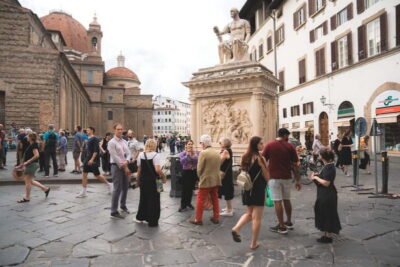
The walk begins with the Basilica di San Lorenzo, one of Florence’s major churches and the burial place of principal Medici family members from Cosimo il Vecchio through Cosimo III. This is a strong opening because it places the family at the center of Florentine religious and political life.
The guide can explain the difference between public worship and private family display. For the Medici, San Lorenzo was not only a church. It was also a family statement, a place where generations could be remembered and where their influence was made visible.
The scheduled stop is about five minutes, and admission is not included. You should think of this part as an exterior orientation unless the guide confirms otherwise. If the Medici Chapels or the church interiors are high on your list, plan a separate visit.
The nearby market district adds useful context. You are beginning in an area where everyday commerce and dynastic ambition existed side by side, a fitting setting for a story that starts with merchants and ends with grand-ducal power.
The Laurentian Library and the Medici Chapels
The Biblioteca Medicea Laurenziana brings a different side of the family into view. Its creation under the patronage of Medici pope Clement VII helped present the family as learned and ecclesiastical, not merely rich merchants.
Michelangelo designed the library, and its Mannerist architecture is one of the reasons it matters. The point is not just that the Medici owned books. Their library helped broadcast an image of intellectual authority and cultural seriousness.
The stop is again listed at about five minutes, with admission not included. That is enough for a clear explanation from outside, but not enough to study the staircase, reading room, or manuscripts. If you enjoy architecture, this is one place where a return visit will reward you.
Next comes the Cappelle Medicee, built in the 16th and 17th centuries as an extension to Brunelleschi’s earlier church. The New Sacristy was designed by Michelangelo, giving the tour another direct connection between Medici ambition and Renaissance art.
I find these two stops useful together. The library shows the family’s intellectual image, while the chapels show its desire for dynastic memory and visual grandeur. You get a compact lesson in how the Medici used both books and tombs to shape their public identity.
Palazzo Medici Riccardi and the family’s first great palace
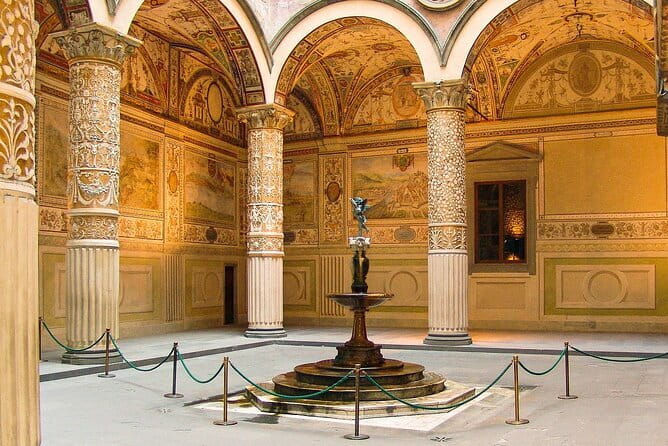
The Palazzo Medici Riccardi was designed for Cosimo de’ Medici and built between 1444 and 1484. This palace helps explain the family’s early method: power presented with confidence, but not always with obvious royal excess.
Cosimo was the head of a banking family, and the palace was designed to make that family look secure, respectable, and fit to guide Florence. The building’s presence near the center of the city tells you something about the family’s growing reach.
Five minutes is enough for the guide to point out the palace and tell its role in the Medici story. It is not enough for a full interior visit, and admission is not included. I would use the stop to note the building’s importance, then decide later if you want a dedicated palace visit.
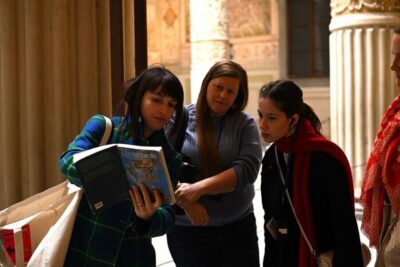
This is also where a strong storyteller can make a big difference. Guides such as Manuel have been praised for answering questions and explaining how Florence developed through its buildings. Martina has also been singled out for making the Medici story memorable through small details, including the changing family crest.
More Renaissance art days:
- Florence: Timed Entrance Ticket to Michelangelo’s David
★ 4.6 · 16,983 reviews - Florence: Michelangelo’s David Skip-the-Line Entry Ticket
★ 4.5 · 12,764 reviews - Florence: Timed Entry Ticket to Michelangelo’s David & eBook
★ 4.6 · 4,049 reviews - Michelangelo’s David, Accademia & Uffizi Small Group Tour
★ 4.5 · 1,986 reviews
The Duomo complex, from the cathedral to Brunelleschi’s dome
The route then reaches the Duomo, Florence’s cathedral, officially Santa Maria del Fiore. The cathedral began in 1296 in the Gothic style, and its white, green, and pink marble exterior remains one of the city’s great visual encounters.
The tour also covers the Baptistery of San Giovanni and Giotto’s Campanile. The Baptistery is one of Florence’s oldest buildings, constructed between 1059 and 1128 in the Florentine Romanesque style. The campanile is a major example of Florentine Gothic design, with sculptural decoration and colored marble.
The itinerary lists the cathedral twice, along with separate stops for the Baptistery, Brunelleschi’s Cupola, and the campanile. Read this as a close look at the Duomo complex from several angles, not as four long interior visits.
Brunelleschi’s dome is the engineering star. It was once the largest dome in the world and remains the largest brick dome ever built. Even from the piazza, it gives the guide a chance to explain why Florence became a center of invention as well as painting and sculpture.
No admission tickets are included for these attractions. If you want to climb the dome or campanile, enter the cathedral, or study the Baptistery properly, you will need separate arrangements. The tour’s role is to help you understand the group of buildings before you commit time to one of them.
Palazzo Vecchio and Piazza della Signoria
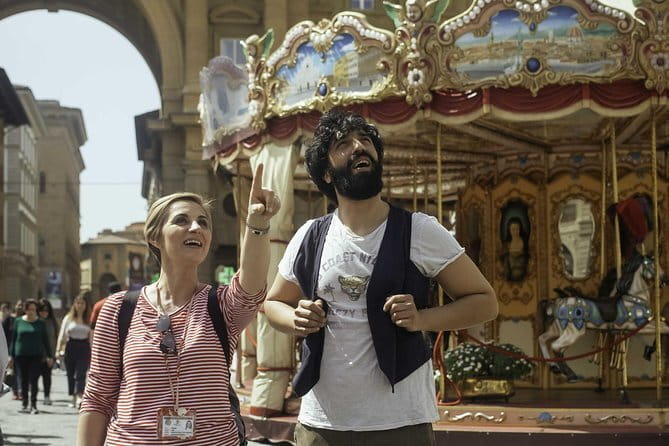
From the Duomo area, the walk continues toward Palazzo Vecchio, Florence’s fortress-like town hall. This is where the Medici story shifts from family patronage to public control.
Palazzo Vecchio overlooks Piazza della Signoria, an L-shaped square that has long served as a public meeting place. The square also contains the copy of Michelangelo’s David and the statues in the adjacent Loggia dei Lanzi.
I like this section because it shows the difference between a private palace and a public seat of government. The guide can point out how Florence’s civic spaces carried political messages, while the nearby statues turned the square into an open-air lesson in power, mythology, and civic pride.
The stop is brief and admission is not included. You will not have time to explore the palace museum during the walk, but the exterior setting is valuable on its own. This is also the gateway area for the Uffizi, so it is easy to return later when you have more time.
Ponte Vecchio, the Arno, and the Medici route across town
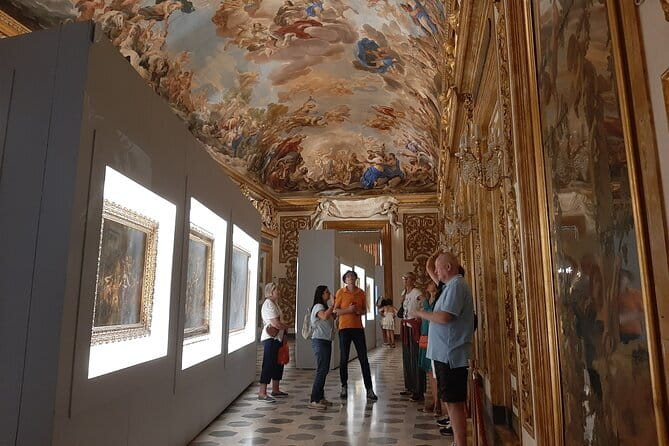
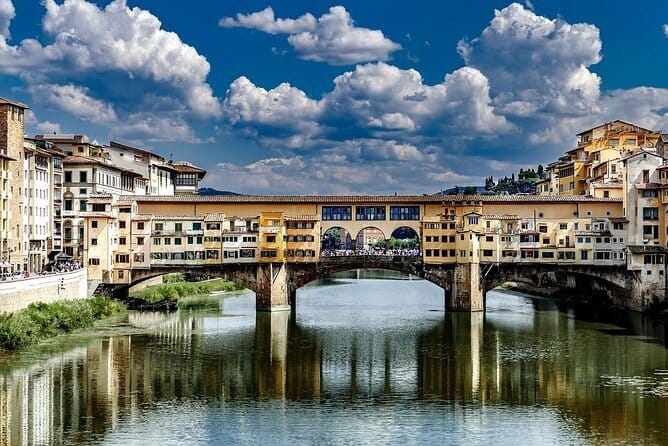
Ponte Vecchio is the only listed stop with free admission. It is the oldest bridge over the Arno in Florence and is famous for the shops built along its span.
The bridge once held butchers, tanners, and farmers. Today, jewelers and art dealers occupy the shops. That change neatly reflects Florence’s shift from medieval trade center to an international art destination.
The bridge is also a natural transition point in the route. The tour ends in the Ponte Vecchio area, which makes sense geographically and gives you a useful place to continue exploring on your own.
Because the endpoint is only indicative, you may finish slightly within the surrounding area rather than at one exact spot. From here, you can continue toward the Oltrarno side of the river, including Palazzo Pitti, or return toward the Uffizi and Piazza della Signoria.
Palazzo Pitti and the Uffizi connection
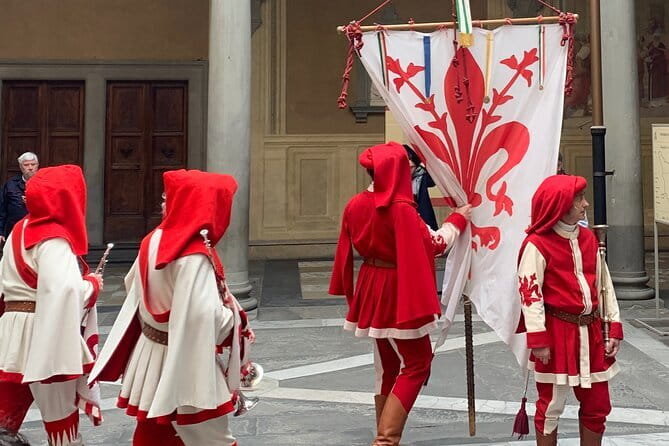
Palazzo Pitti was purchased by the Medici family in 1549 and became the main residence of the ruling families of the Grand Duchy of Tuscany. Over time, it grew into a vast storehouse for paintings, tableware, jewelry, and luxury possessions.
The palace gives the Medici story a later chapter. San Lorenzo and Palazzo Medici Riccardi show the family gaining influence. Pitti Palace shows that influence after it had become princely and official.
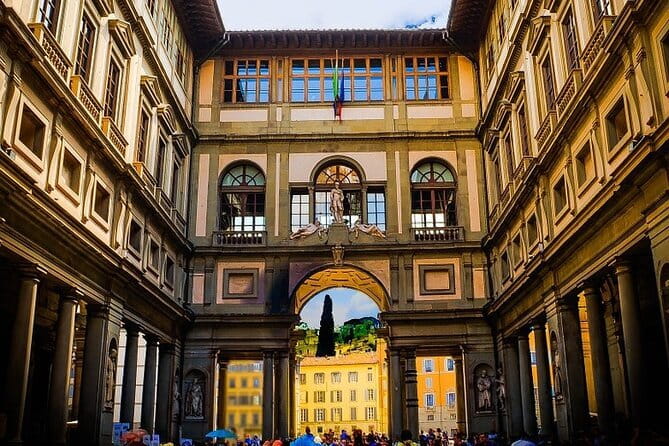
The Uffizi provides the final art connection. It is one of Italy’s major museums, with famous Renaissance works by Michelangelo, Leonardo da Vinci, Raphael, Botticelli, and other masters. The collection covers art from the 12th through the 16th centuries and occupies more than 80 halls.
There is an important practical point here: the Uffizi appears on the route, but museum admission is not included and the stop is listed at five minutes. You should not book this walk expecting a full Uffizi visit or a skip-the-line museum tour based on the published details alone.
One past experience included a guide who helped a group move past long waiting lines, but that should not be treated as a guaranteed feature of this product. The safest plan is to arrange any Uffizi visit separately and allow several hours if you want more than a quick look.
What the guides add to the walk
This experience depends heavily on the person leading it. Manuel has been especially praised for his passion for Florence, his ability to answer many questions, and his talent for pointing out details that are easy to miss. Martina has been praised for turning the Medici crest and family story into something you keep noticing after the tour.
Amanda has been described as smart, funny, and deeply familiar with the Medici family. Giacomo has led a particularly personal walk, answering questions and offering suggestions for later activities in Florence. The exact guide is not guaranteed, so book for the structure of the tour rather than one named individual.
The included whisper system is meant to help you hear the guide in the city center. It is a useful idea, though the equipment may not work equally well for everyone. Street noise can make a difference, especially when the guide speaks while walking. If you use hearing aids or have difficulty hearing in crowds, tell the guide early and ask for regular checks or a position close to the speaker.
The small group limit helps, but it cannot remove traffic, voices, and piazza noise. One practical advantage of a small group is that you can ask for clarification without holding up a large crowd.
Price, timing, and who gets good value
At $119.77 per person, this is not a cheap orientation walk. The value depends on what you want from it.
If you are short on time and want a guide to connect Florence’s main sights in one sitting, the price can make sense. You are paying for a licensed guide, a small group, a planned route, and a clear historical thread. You are not paying for museum tickets, dome access, or a long interior visit.
I would book it early in a Florence stay, as the experience is often reserved well in advance, with an average booking lead time of 58 days. Taking it near the start of your visit helps you decide how to use the rest of your time.
The tour also suits families with older children and teenagers. The Medici story includes rivalry, money, art, religion, and political maneuvering, which can hold the attention of children around age 10 and up when the guide tells it with energy.
It is less suited to someone who already knows Florence well and wants a specialist-level study of Medici politics or Renaissance architecture. The route favors a first visit and covers a lot of ground in a short time.
The practical call
Book this tour if you want a compact, story-led introduction to Florence and you value a guide who can connect buildings, art, and family power. It is especially useful on your first day, for a family group, or for anyone who wants the city to make more sense before visiting museums alone.
Skip it if your priority is extended time inside the Uffizi, Medici Chapels, Laurentian Library, Palazzo Vecchio, or the Duomo. Those places need separate visits, and this walk will only give you a brief exterior explanation.
The strongest reason to choose it is the guide. Manuel, Martina, Amanda, and Giacomo have each brought energy and personal knowledge to the route, but availability can vary. The main weakness is the sound system and the short stop times, so stay near the guide and speak up if you cannot hear.
With a 99 percent recommendation rate and a five-star rating based on 205 reviews, the experience has a strong record. I would call it a useful Florence primer, not a substitute for the city’s museums.
FAQ
How long does the tour last?
The tour lasts approximately 1 hour and 45 minutes.
What time does the tour begin?
The scheduled start time is 12:15 pm.
Where does the tour meet?
The meeting point is Caffè Scudieri Firenze, Piazza di San Giovanni, 19R, 50123 Florence, Italy.
Where does the tour end?
The tour ends near Ponte Vecchio. The endpoint is indicative and may vary slightly within the stated area.
How many people can join the tour?
The group has a maximum of 15 travelers.
Is the tour offered in English?
Yes. The experience is offered in English.
Are museum and attraction tickets included?
No. Admission tickets are not included for the listed attractions. Ponte Vecchio is free to visit.
Is a guide included?
Yes. A licensed tour guide is included.
Does the tour use audio equipment?
Yes. A whisper system is included to help you hear the guide.
Can I cancel for a full refund?
Yes. You can cancel at least 24 hours before the local start time for a full refund. Cancellations or changes made less than 24 hours in advance are not refunded. If poor weather or an insufficient number of participants causes cancellation, you will be offered another date or experience, or a full refund.
Latest additions around Florence
- Florence: Cathedral Tour & Brunelleschi’s Dome Climb Ticket★ 5.0 · 3 reviews
- Palatina Gallery and Pitti Guided Tour in Florence★ 5.0 · 3 reviews
- Florence Uffizi Gallery Skip-the-line Tour w Art Historian Guide★ 5.0 · 3 reviews
- Private Tour: Pisa and Lucca from Florence★ 5.0 · 3 reviews
- San Gimignano Bike Tour (SOFT)★ 4.5 · 3 reviews
- Florence: Tour of Florence by rickshaw★ 5.0 · 3 reviews
- Center of Florence by golf cart★ 5.0 · 3 reviews
- From Firenze | Chianti day tour in a classic car★ 5.0 · 3 reviews
Medici Tours, compared.

The Best tour in Florence: Renaissance & Medici Tales – guided by a STORYTELLER
Read our review →
The Best Tour in Florence: Renaissance and Medici Tales
Read our review →
Renaissance and Medici Tales Guided Walking Tour
Read our review →
Guided Tour of Medici Family Secrets and Chapels
Read our review →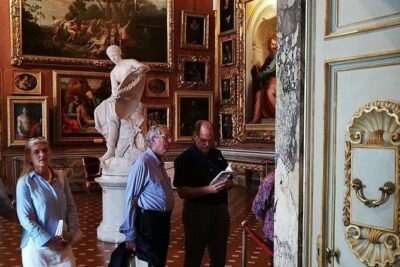
Pitti Palace, Palatina Gallery and the Medici: Arts and Power in Florence.
Read our review →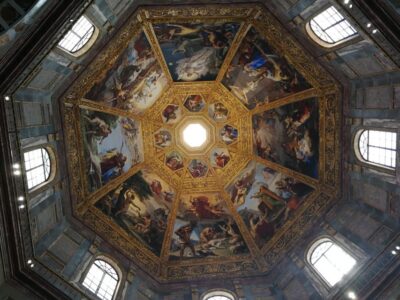
Browse the lists this tour appears in