
Reviewed · RENAISSANCE ART TOURS
Florence: Renaissance City Walking Tour
Florence reveals itself best on foot, where a palace wall, church square, and narrow lane can explain more than a museum label. This 1.5-hour Renaissance walk connects the Uffizi, Santa Croce, Ponte Vecchio, Oltrarno, and the Duomo in one compact route.
I like the way the tour links famous art to the people behind it, from the Medici family to Michelangelo, Leonardo da Vinci, and Dante Alighieri. I also like the switch from grand central sights to the artisan streets of Oltrarno, Santo Spirito, and San Frediano.
The trade-off is simple: you cover a fair amount of ground in a short time. Comfortable shoes are essential, refreshments are not included, and large bags or luggage are not allowed.
In This Review
- Key points at a glance
- Starting beside the Uffizi and Palazzo Vecchio
- Narrow lanes leading to Santa Croce
- Along the Vasari Corridor to Ponte Vecchio
- Seeing Oltrarno, Santo Spirito, and San Frediano
- From Ponte Santa Trinita to Via Tornabuoni
- Piazza della Repubblica and the Duomo finale
- What the guide and headset add
- Is $40 a fair price?
- Who should book this Florence walk?
- Should you book it?
- FAQ
- Where does the Florence Renaissance City Walking Tour begin?
- How long does the walking tour last?
- What language is the tour conducted in?
- Does the tour include an audio headset?
- Which main sights are included on the route?
- Does the tour enter the Uffizi Gallery or Florence Cathedral?
- Is the tour wheelchair accessible?
- Can I cancel the tour for a refund?
Key points at a glance
- Uffizi starting point: Begin in the gallery courtyard and Piazza della Signoria, with Palazzo Vecchio and the Loggia dei Lanzi setting the scene.
- Stories, not just snapshots: Follow the connections between Florence’s monuments, the Medici family, and Renaissance figures.
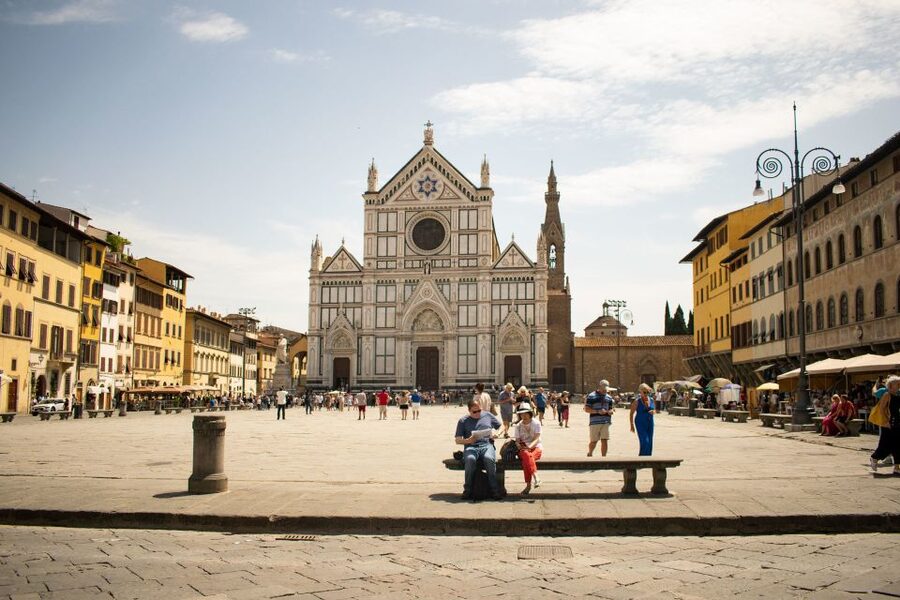
- Santa Croce stop: See the square and church associated with Dante Alighieri, Michelangelo, and other major Italian figures.
- Ponte Vecchio crossing: Walk beside the external route of the Vasari Corridor and see the bridge’s goldsmith shops.
- Local-side Florence: Continue through Oltrarno, Santo Spirito, and San Frediano, where artisan traditions meet an international feel.
- Final cathedral view: Finish near Santa Maria del Fiore after passing through Ponte Santa Trinita, Via Tornabuoni, and Piazza della Repubblica.
Starting beside the Uffizi and Palazzo Vecchio
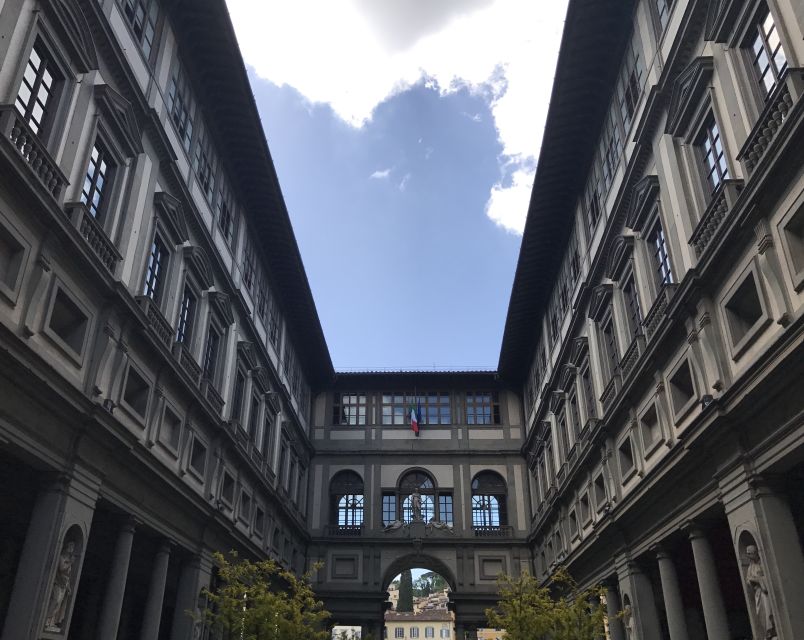
The walk begins in the courtyard of the Uffizi Gallery, one of the best places in Florence to start thinking about power and art together. You are not entering the gallery on this activity, but its courtyard gives you an immediate sense of the city’s scale and ambition.
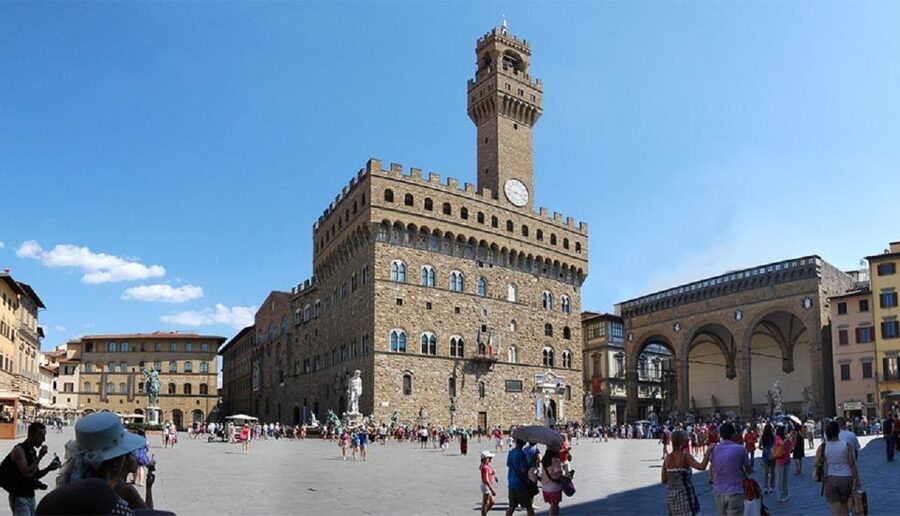
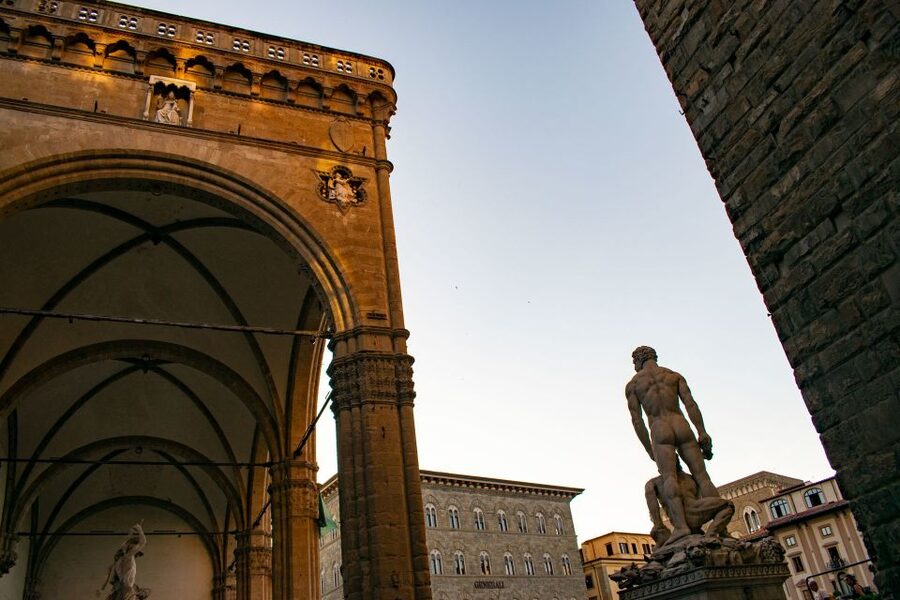
From there, the route moves into Piazza della Signoria, Florence’s great civic stage. Palazzo Vecchio dominates the square, while the Loggia dei Lanzi displays sculpture in an open-air setting. This is a useful opening because you can look at major works while hearing why they were placed here and how the square served Florence’s political life.
I find this first section especially helpful if you are new to Florence. The city can feel like one grand artwork after another, with little time to ask how the pieces fit together. A guide gives you a thread to follow, tying architecture, public sculpture, and Medici influence into one story.
The square is also a good reminder that Florence was not shaped by artists alone. The Medici family’s financial and political reach affected the city’s buildings, public spaces, and cultural life. You will hear about that influence as you move through the center, rather than treating the Renaissance as a parade of famous names without context.
More Renaissance art days:
- Florence: Timed Entrance Ticket to Michelangelo’s David
★ 4.6 · 16,983 reviews - Florence: Michelangelo’s David Skip-the-Line Entry Ticket
★ 4.5 · 12,764 reviews - The Best tour in Florence: Renaissance & Medici Tales – guided by a STORYTELLER
★ 5.0 · 12,316 reviews
Narrow lanes leading to Santa Croce
From Piazza della Signoria, the tour follows narrower streets toward Santa Croce. This change of scale matters. Florence’s broad civic spaces are impressive, but the side streets show how the city is built for walking, with old walls, tight passages, and sudden views into lively squares.
Santa Croce is one of the most meaningful stops on the route. The church and square are linked with many major Italian figures, including Dante Alighieri and Michelangelo. The stop gives your guide a natural opening to discuss the people who shaped Florence’s literature, art, and public identity.
You should be clear about what this experience includes. It is a walking tour, not a listed church entry or an interior visit to Santa Croce. The focus is on the exterior setting, the stories attached to it, and the place it holds in Florence’s cultural map.
That still gives the stop real value. A church can be more than a building to photograph. The names connected with Santa Croce help you understand why Florence attracts people interested in painting, sculpture, literature, politics, and architecture all at once.
The path also follows the trails associated with masters such as Leonardo da Vinci and Michelangelo. You will not be visiting every site linked to them, but the guide uses the streets and monuments to show how their work belongs to a wider Florentine story.
Along the Vasari Corridor to Ponte Vecchio
The walk then reaches the external path of the Vasari Corridor and continues toward Ponte Vecchio. The corridor is closely tied to Florence’s ruling Medici family and to the way power moved through the city. Even from outside, the route offers a useful glimpse into how architecture could serve both practical and political purposes.
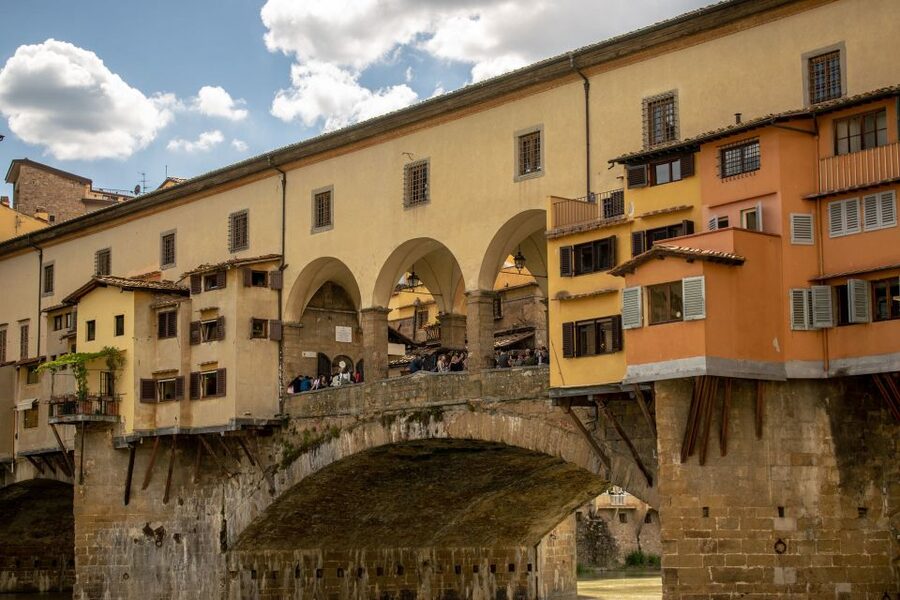
Ponte Vecchio is one of Florence’s most recognizable sights, with its line of goldsmith shops and compact bridge crossing the Arno. The shops give the bridge a very different character from a plain river crossing. You are walking through a working commercial setting as well as a historic landmark.
This part of the route is likely to be popular with photographers, but it is not only a picture stop. The bridge helps explain Florence as a city built around movement, trade, and river crossings. It also marks the transition from the central sights to the Oltrarno side of the river.
The route does not promise time for shopping or a leisurely stop at each storefront. If you want to browse jewelry shops or linger for river views, plan to return later. On the tour, the guide’s job is to keep the walk moving and connect this famous bridge with the neighborhoods beyond it.
Seeing Oltrarno, Santo Spirito, and San Frediano
Crossing into Oltrarno is one of the best features of this tour. Many first visits to Florence stay close to the Duomo, Uffizi, and Piazza della Signoria. This walk gives you a look at districts known for artisan shops, old tower houses, and local traditions.
Oltrarno is not presented as a separate village or a break from Florence. It is part of the city, but it offers a different feel from the main tourist route. Santo Spirito and San Frediano bring a more local side into the itinerary, with streets that show how people live, work, and shop beyond the headline monuments.
The information provided describes these districts as having an international feel mixed with local customs. That makes them useful for comparison. You can see how Florence supports both its historic crafts and its modern city life.
I especially like this section for visitors who want more than a checklist of central sights. You still see major monuments, but the tour also gives you a reason to look at shopfronts, old buildings, and neighborhood streets. It is a modest but worthwhile shift from Florence as an open-air museum to Florence as a lived-in city.
Keep your expectations sensible. A 1.5-hour tour cannot provide a full survey of every artisan business or neighborhood corner. You will get an introduction and a useful sense of direction, then you can return to the areas that interest you most.
More walking routes in Florence:
- Florence: Guided Walking Tour
★ 4.5 · 3,334 reviews - Skip the line: Uffizi and Accademia Small Group Walking Tour
★ 4.5 · 3,135 reviews - Florence: Guided Walking Tour
★ 4.6 · 1,602 reviews - Florence: Renaissance and Medici Tales Guided Walking Tour
★ 4.8 · 1,549 reviews
From Ponte Santa Trinita to Via Tornabuoni
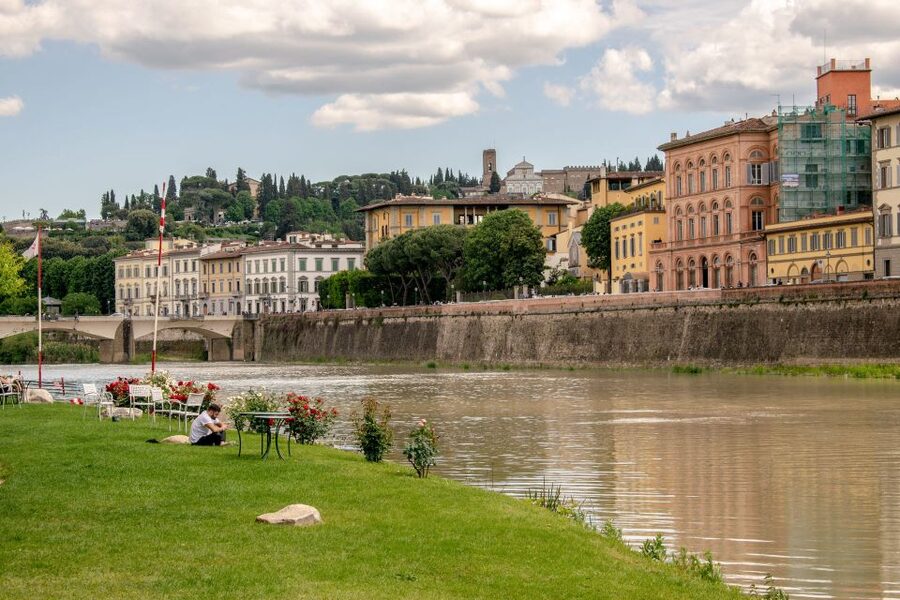
The route returns toward the central city by way of Ponte Santa Trinita. This bridge offers another crossing of the Arno and helps you see Florence from a different point along the river. Compared with Ponte Vecchio, it provides a change of angle and keeps the walk from feeling like a simple out-and-back route.
From there, the tour continues along Via Tornabuoni. This is one of Florence’s best-known elegant streets, and its place in the itinerary adds another layer to the city. After the artisan districts, you see a more polished central setting, with historic architecture and high-end shops shaping the street experience.
That contrast is useful. Florence is not just medieval lanes and Renaissance churches. It is also a modern city with fashion, commerce, and daily routines layered onto its older structure. The route lets you move between these sides without needing public transport or a complicated plan.
You may find that this part feels less intimate than Oltrarno. It is more formal and commercial, and the value comes mainly from seeing how the city changes as you move through it. The guide’s commentary helps prevent the walk from becoming a string of names with no connection.
Piazza della Repubblica and the Duomo finale
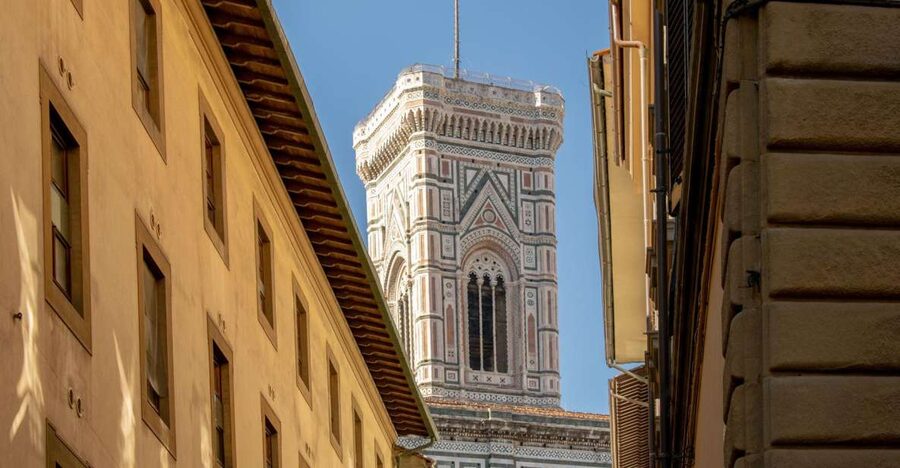
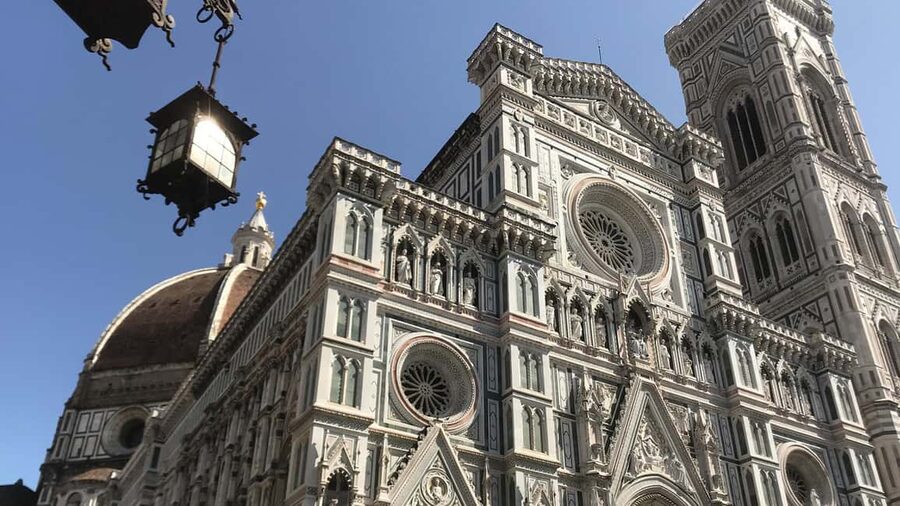
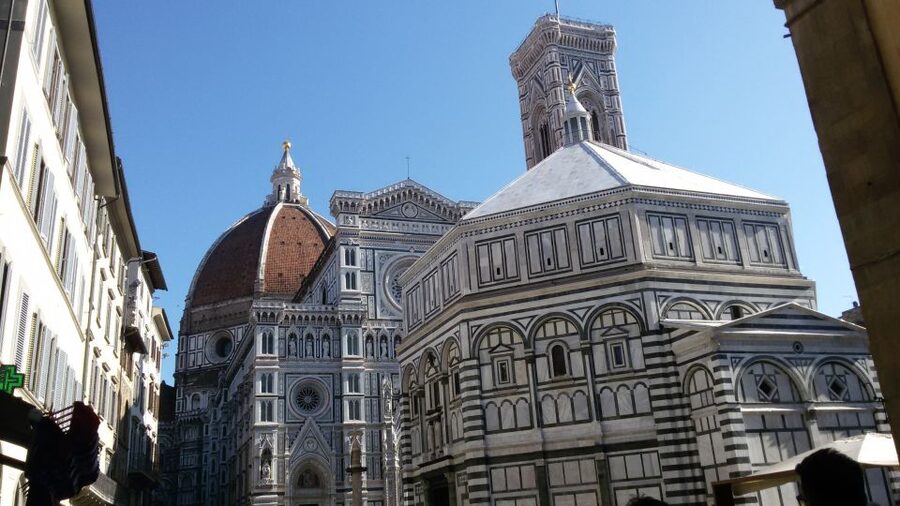
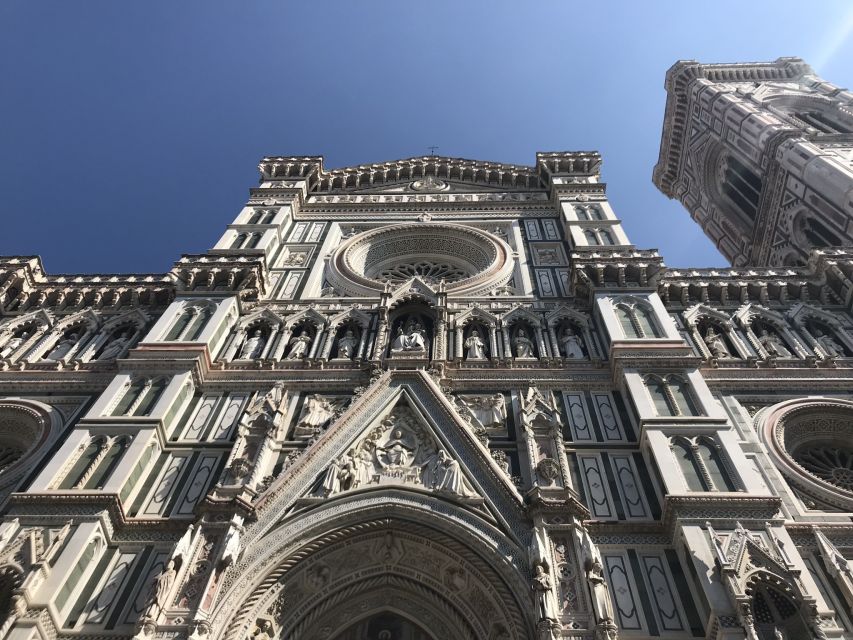
The walk passes through Piazza della Repubblica before ending face to face with Florence’s Cathedral of Santa Maria del Fiore. This is a strong finish because the cathedral is one of the city’s clearest visual symbols, and the route gives you a gradual approach rather than placing it at the very beginning.
Piazza della Repubblica is another central landmark with a different mood from Piazza della Signoria. Together, the two squares show how Florence’s public spaces have changed over time. You can compare civic power, urban redevelopment, shopping streets, and religious architecture within a short walk.
The final view of Santa Maria del Fiore gives the tour a satisfying endpoint. The cathedral is large, detailed, and difficult to take in quickly. A guided approach helps you notice how the building fits into the surrounding city, even if the tour does not include an interior visit or access to the dome.
If the cathedral is high on your list, treat this walk as an orientation rather than a substitute for a dedicated visit. You will reach the building and learn about its place in Florence, but entrance tickets and time inside are not part of the stated activity.
What the guide and headset add
The tour is led in English by a live guide and includes an audio headset. That combination matters in Florence, where streets can be noisy and groups may pause in open squares while other people pass through.
A headset can make it easier to hear the guide without everyone having to crowd together. It is especially useful at Piazza della Signoria and around Ponte Vecchio, where sound and foot traffic can compete with a spoken explanation.
Elisa is one guide associated with this experience. Her approach, as described, centers on answering questions and keeping the walk enjoyable enough that the distance does not dominate your attention. That is a valuable quality for a route with several stops and a fair amount of walking.
Guide quality always affects a walking tour, so it is wise to see the guide as part of the value rather than treating the route alone as the product. The best moments here are likely to come when the guide explains why a place matters, not simply when the group pauses for a photograph.
Is $40 a fair price?
At $40 per person, this is not the cheapest way to see Florence’s main streets. It is also not an unreasonable price for a live, English-language walk that lasts 1.5 hours and includes an audio headset.
The value depends on how much help you want making sense of the city. If you already know Florence well and prefer wandering alone, you may find the price harder to justify. You can walk past many of these sights without paying for a guide.
For a first visit, I think the price is easier to defend. In a short period, you get a guided route from the Uffizi to the Duomo, a crossing to Oltrarno, and context about the Medici family and Renaissance figures. You also save the time and effort of planning a route that links these districts logically.
The tour does not include refreshments, attraction entry, shopping time, or transport. Those exclusions are normal for a walking tour, but they matter when you compare the total cost of your day. Bring your own water if needed and plan separate visits for the Uffizi, Santa Croce, or the cathedral interiors.
The option to reserve now and pay later gives you some flexibility, and free cancellation is available up to 24 hours before the activity for a full refund. Check the available starting times before booking, since the schedule is not fixed in the information provided.
Who should book this Florence walk?
This tour suits first-time visitors who want a quick orientation with real historical context. It is also a good fit if you have only part of a day in Florence and want to connect the central sights with a taste of Oltrarno.
You will likely enjoy it if you like art, architecture, politics, and literary connections. The route follows the city’s major visual highlights while also pointing to Dante, Michelangelo, Leonardo, and the Medici family.
It can work well for visitors who want to ask questions. Elisa’s reported style includes answering questions directly, and the headset supports a guide-led format rather than a self-guided audio walk.
The tour is wheelchair accessible, but the route involves a fair amount of walking and includes narrow alleys. If you use a wheelchair or have limited stamina, confirm that the specific route and pace suit your needs before booking. The provided information does not give a group size or detailed surface conditions.
Families and casual sightseers should consider the pace. The walk is short enough to fit into a busy day, but it is not a quick photo loop. You will spend the time moving between districts and listening to explanations, so comfortable shoes are a must.
Leave luggage and large bags elsewhere. They are not allowed on the tour, and carrying a bulky bag would make narrow streets and crowded public spaces less pleasant in any case.
Should you book it?
Book this tour if you want Florence to make sense as a connected city, not just a list of famous buildings. The route brings together public sculpture, Medici power, Santa Croce, the Arno bridges, artisan neighborhoods, Via Tornabuoni, and the Duomo in 90 minutes.
Skip it if you strongly prefer independent wandering or plan to spend your time inside museums and churches. This activity offers exterior sightseeing and guided context, not attraction entry.
For most first-time visitors, $40 is a reasonable orientation cost, especially if you want an English-speaking guide and an audio headset. I would choose it near the start of a Florence stay, then use the route to decide which places deserve a slower return visit.
FAQ
Where does the Florence Renaissance City Walking Tour begin?
The tour begins in the courtyard of the Uffizi Gallery, near Piazza della Signoria.
How long does the walking tour last?
The activity lasts 1.5 hours.
What language is the tour conducted in?
The live tour guide speaks English.
Does the tour include an audio headset?
Yes. An audio headset is included with the walking tour.
Which main sights are included on the route?
The route includes the Uffizi courtyard, Piazza della Signoria, Palazzo Vecchio, the Loggia dei Lanzi, Santa Croce, the external path of the Vasari Corridor, Ponte Vecchio, Oltrarno, Santo Spirito, San Frediano, Ponte Santa Trinita, Via Tornabuoni, Piazza della Repubblica, and Florence Cathedral.
Does the tour enter the Uffizi Gallery or Florence Cathedral?
The provided activity details describe walking past and approaching these sights. They do not state that admission to the Uffizi Gallery or the cathedral is included.
Is the tour wheelchair accessible?
Yes, the activity is listed as wheelchair accessible. It also involves a fair amount of walking and includes narrow alleys.
Can I cancel the tour for a refund?
Yes. You can cancel up to 24 hours in advance for a full refund. You can also reserve now and pay later.
Latest additions around Florence
- Florence: Cathedral Tour & Brunelleschi’s Dome Climb Ticket★ 5.0 · 3 reviews
- Palatina Gallery and Pitti Guided Tour in Florence★ 5.0 · 3 reviews
- Florence Uffizi Gallery Skip-the-line Tour w Art Historian Guide★ 5.0 · 3 reviews
- Private Tour: Pisa and Lucca from Florence★ 5.0 · 3 reviews
- San Gimignano Bike Tour (SOFT)★ 4.5 · 3 reviews
- Florence: Tour of Florence by rickshaw★ 5.0 · 3 reviews
- Center of Florence by golf cart★ 5.0 · 3 reviews
- From Firenze | Chianti day tour in a classic car★ 5.0 · 3 reviews
Renaissance Art Tours, compared.

Timed Entrance Ticket to Michelangelo’s David
Read our review →
Michelangelo’s David Skip-the-Line Entry Ticket
Read our review →
The Best tour in Florence: Renaissance & Medici Tales – guided by a STORYTELLER
Read our review →
The Best Tour in Florence: Renaissance and Medici Tales
Read our review →
Timed Entry Ticket to Michelangelo’s David & eBook
Read our review →
Michelangelo’s David, Accademia & Uffizi Small Group Tour
Read our review →
Michelangelo’s David Entrance Ticket and Audio App
Read our review →
Renaissance and Medici Tales Guided Walking Tour
Read our review →Browse the lists this tour appears in