
Reviewed · RENAISSANCE ART TOURS
Bike Tour of Florence with Piazzale Michelangelo
Florence unfolds quickly from a bicycle. In about two hours, you can pedal from the Duomo to the Arno, cross into Oltrarno, reach Piazzale Michelangelo, and still return through the city center. It is an efficient first look at Florence, especially if you have only a couple of days.
I like the route’s variety and the guide’s local suggestions. You move from grand Medici squares to the small wine window at Finestra delle Belle Donne, then pause for the view above the city. I also like that guides such as Giulia, Lorenzo, Matteo, and Julia have been praised for lively history and useful tips on gelato, Florentine steak, and wine tasting.
The catch is the cycling itself. Florence’s center can be jammed with walkers, cars, taxis, and other bicycles. A large group can become hard to manage, and the ride to Piazzale Michelangelo includes a serious uphill stretch. You need to be a confident rider and pay close attention to the guide.
In This Review
- Key points to know before you pedal off
- Why a bicycle works well in Florence
- Starting at the Duomo and Roman heart of Florence
- Small details near Finestra delle Belle Donne
- Crossing the Arno by Ponte Santa Trinita
- Pitti Palace and the Medici connection
- Ponte Vecchio and the central river crossing
- The climb to Piazzale Michelangelo
- Santa Croce and the open-air museum of Signoria
- What the guides add to the ride
- Group size, traffic, and safety
- Is $42.34 good value for two hours?
- Who should book this Florence bike tour?
- Should you book it?
- FAQ
- How long does the bike tour last?
- What sights does the route include?
- Is Piazzale Michelangelo included?
- What is provided?
- Can children join the tour?
- Where does the tour begin and end?
Key points to know before you pedal off
- Piazzale Michelangelo is the payoff: The uphill ride is demanding, but the panorama over Florence is the tour’s big reward.
- You see both sides of the Arno: The route covers the Duomo area, central squares, Ponte Vecchio, Oltrarno, and Santa Croce.
- The tour is built for orientation: You get a useful first look at places to revisit on foot later.
- Guide quality matters: Giulia, Lorenzo, Matteo, Julia, and other guides have earned praise for clear, friendly storytelling, though communication and group control have not been equally strong on every departure.
- Crowds affect the ride: Morning departures may be easier, but busy streets remain part of the experience.
- The price is reasonable for the coverage: At $42.34 per person, the tour offers guided sightseeing, equipment, and a citywide route in a short time.
Why a bicycle works well in Florence
Florence is compact, but its sights do not all sit in one neat cluster. The Duomo, Santa Croce, the Uffizi area, Ponte Vecchio, Pitti Palace, and Piazzale Michelangelo cover enough ground to make walking between them tiring, especially in warm weather.
A bicycle gives you a quick sense of how the city fits together. You cross the Arno, see the old center from Oltrarno, and reach a hilltop view that takes more effort on foot. I would not use this ride as a replacement for visiting Florence’s museums and churches. I would use it to decide where you want to spend your time afterward.
The route lasts about 2 hours and 15 minutes, although some riders describe the actual riding time as close to two hours. The stops are short, often around five or ten minutes. That keeps the pace moving, but it also means you should not expect long visits inside monuments. Most sights are viewed from outside.
More Renaissance art days:
- Florence: Timed Entrance Ticket to Michelangelo’s David
★ 4.6 · 16,983 reviews - Florence: Michelangelo’s David Skip-the-Line Entry Ticket
★ 4.5 · 12,764 reviews - The Best tour in Florence: Renaissance & Medici Tales – guided by a STORYTELLER
★ 5.0 · 12,316 reviews
Starting at the Duomo and Roman heart of Florence
The meeting point is Florence Tours, at Via Camillo Cavour 21R. The tour begins with Piazza del Duomo, the city’s great architectural showpiece. From the bicycle, you can take in the Cathedral of Santa Maria del Fiore, the Baptistery, Giotto’s Bell Tower, and the wider cathedral complex.
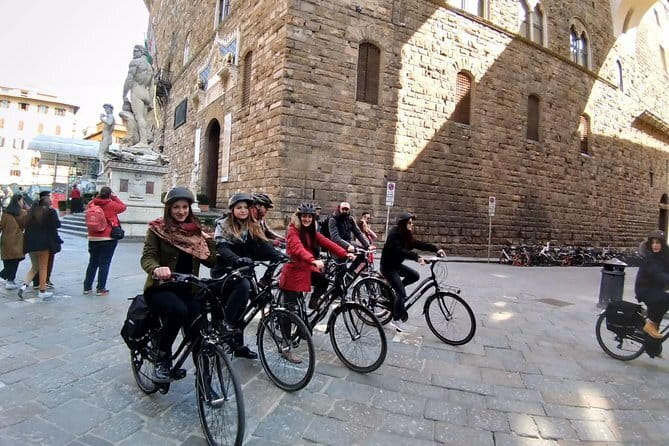
You receive a guide, bicycle, helmet, audio guide system, and guided commentary. Since the square is one of Florence’s most crowded areas, the first few minutes may feel more like careful maneuvering than relaxed sightseeing. Keep your eyes ahead and leave space around your bike.
From here, the route heads to Piazza della Repubblica. The square occupies the site of Florence’s former Roman forum, often described as the ancient center or belly button of the city. Today it is a broad urban space with a very different feel from the tight streets around the Duomo.
This is a useful early stop because your guide can connect modern Florence with its Roman beginnings. It also gives you a quick sense of the city’s central street plan before the route turns toward the river.
Small details near Finestra delle Belle Donne
The Finestra delle Belle Donne is a short photo stop at one of Florence’s wine windows. These tiny openings in old walls are a distinctive local feature, and this one offers a detail you could easily miss while walking between major monuments.
Do not expect a tasting to be included. The stop is listed for photographs, and the admission is free. Its value is not the length of the visit, but the change of scale. After the cathedral and a major square, you get a glimpse of a more intimate side of Florence.
Crossing the Arno by Ponte Santa Trinita
Ponte Santa Trinita is often called the Four Seasons Bridge because of the statues representing the seasons. It is one of the most graceful crossings on the Arno, with good views toward the Ponte Vecchio and the riverfront buildings.
A bicycle makes this section especially useful. You are not simply stopping at a bridge, you are using the river to understand the city. The bridge connects the central side of Florence with Oltrarno, the district south of the Arno.
The route then continues to Piazza Santo Spirito. This square gives you a break from the grand tourist circuit. Santo Spirito sits in Oltrarno, an area often associated with neighborhood life, workshops, food, and a less formal rhythm than the cathedral district.
The stop is brief, so I would mark it as a place to return to later rather than expect a full visit. One rider particularly liked seeing this residential part of the city. That is one of the tour’s strengths: you get beyond the standard postcard stops, even if only for a few minutes.
More bike days around Florence:
- Tuscany Bike Tours Through the Chianti Hills with Wine Tasting
★ 5.0 · 1,300 reviews - Florence: E-Bike Tour with Michelangelo Square
★ 4.5 · 1,035 reviews - Florence: 2-Hour Guided Sightseeing Bike Tour
★ 4.5 · 1,004 reviews - Private Self-Guided E-Bike Ride in Tuscany with Vineyard Visit
★ 5.0 · 775 reviews
Pitti Palace and the Medici connection
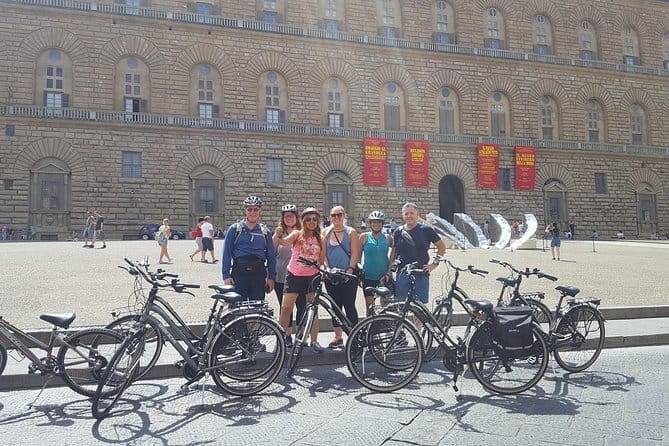
At Piazza de’ Pitti, you pause outside Pitti Palace. The palace was the final residence of the Medici family, and its enormous facade helps explain the scale and power of Florence’s ruling dynasty.
This is an exterior stop, with no museum entry included. If you want to see the palace collections, gardens, or the other museums connected with the complex, plan a separate visit. The bike tour gives you the setting and the historical frame, not enough time for an indoor tour.
The route’s historical thread is strongest when your guide links places like the Duomo, Pitti Palace, and Piazza della Signoria. Guides who bring Florence’s politics, art, and Medici family connections together can turn a fast ride into a useful introduction to the city.
Ponte Vecchio and the central river crossing
Ponte Vecchio is Florence’s famous Old Bridge, a medieval crossing lined with shops. Butchers once occupied its shops. Today, jewelers, art dealers, and souvenir sellers fill the bridge.
It is a memorable place, but it is also one of the hardest parts of Florence for a cyclist. Pedestrians gather, stop for photos, and move unpredictably. You may need to walk the bicycle briefly or follow at a very controlled pace. The guide’s ability to keep the group together matters here.
The nearby Ponte alle Grazie is another bridge on the route. It was reconstructed after 1945 and gives you a different angle on the Arno and the historic center. This part of the ride helps you see the famous bridges as working pieces of the city rather than isolated sights.
The climb to Piazzale Michelangelo
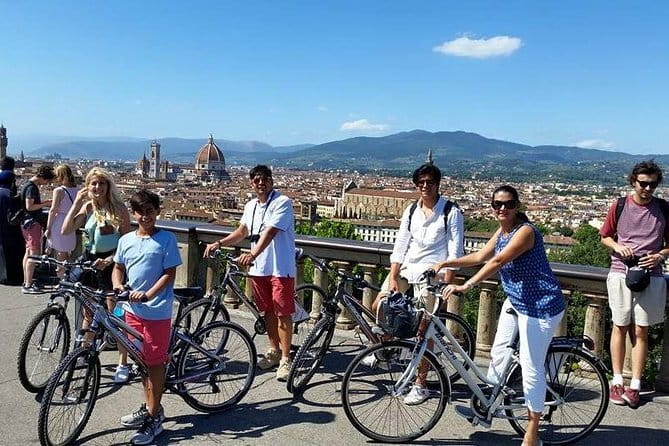
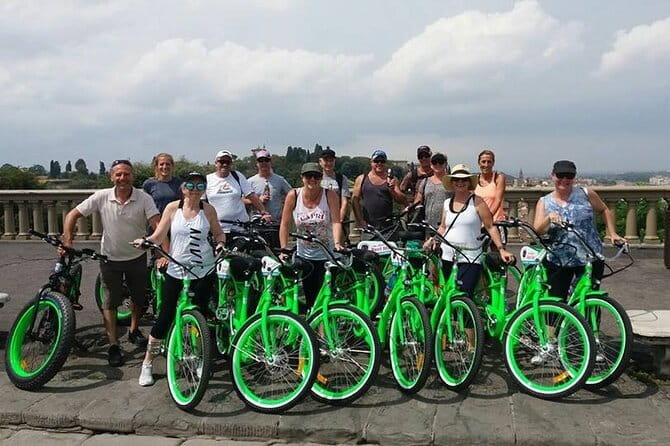
The ride to Piazzale Michelangelo is the tour’s most important practical warning. The route includes a substantial uphill section, and several riders describe walking their bikes part of the way. In hot weather, especially above 90 degrees Fahrenheit, this can be demanding.
The climb is not a minor detail. It should influence your booking decision if you have limited cycling experience, mobility concerns, or little tolerance for heat. Children must be accompanied by an adult, and younger riders need to handle crowded streets and the hill safely. Some family groups managed the ride well, but parents should not assume the route is flat or easy.
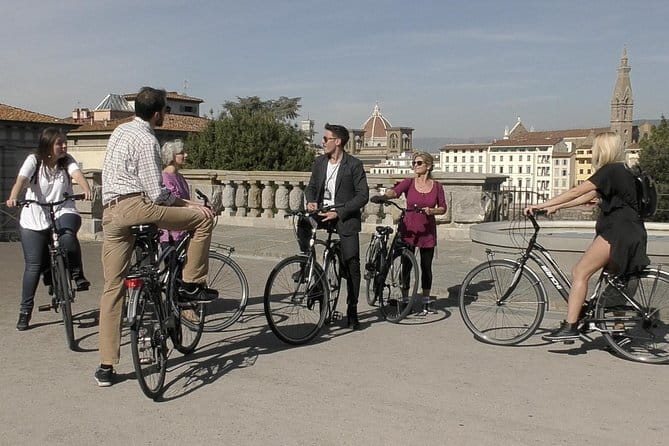
You can also visit the Rose Garden before reaching the viewpoint. The stated stop at Piazzale Michelangelo is about ten minutes, enough to pause, take photographs, and look across Florence.
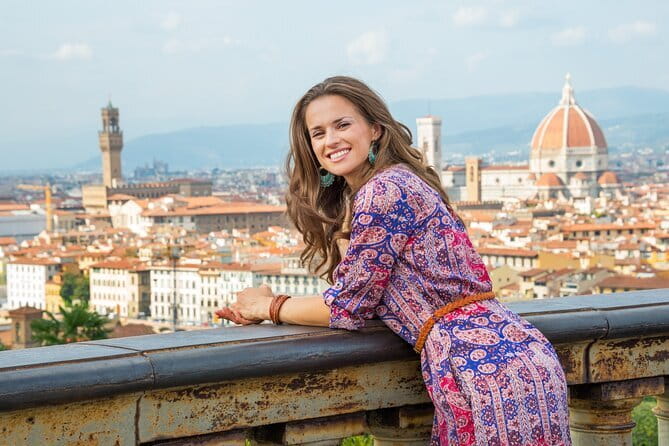
The view is the clear reward. From the terrace, you can see the Duomo dome, the Arno, bridges, towers, and the dense historic center spread below. I consider this the strongest reason to choose this specific bicycle tour over a standard central-city ride.
Some departures offer the Piazzale Michelangelo portion as an optional second part, and the guide or group setup may affect how it is handled. Confirm at the meeting point that the viewpoint is part of your planned route. One rider reported missing it, so it is worth clarifying before the group sets off.
Santa Croce and the open-air museum of Signoria
After returning from the hill, the route continues to Piazza Santa Croce. This is one of the main squares in central Florence, fronted by the Basilica of Santa Croce. The square gives you another broad urban space after the tighter streets and bridges.
The stop is short, but the guide can help you decide if the church deserves a longer visit later. The bike tour is best at giving you a map in your head. You can note the places that deserve your own time once you are no longer trying to keep up with a group.
Piazza della Signoria is the final major sight. It functions as an open-air museum in front of Palazzo Vecchio, with sculptures and monumental buildings creating one of Florence’s most striking public spaces.
This is one stop where the admission is included, though the itinerary mainly describes a guided visit to the square rather than a full museum entry. The palace and nearby art museums require more time than this tour allows. Think of the stop as an introduction to the outdoor sculpture and civic history.
The route also passes the Museo Casa di Dante, a small museum dedicated to Dante Alighieri, author of the Divine Comedy. Admission is not included, and the stop lasts only about five minutes. It is a quick literary marker in the city rather than a full museum visit.
What the guides add to the ride
The best part of this tour is often the guide. Giulia has been praised for energetic commentary, patience, and a strong command of Florence’s major sights. Lorenzo is frequently described as friendly, clear, and good at keeping the group together. Matteo has adjusted the route to suit physical limits when leading a very small group.
Julia has also led departures that included a separate ride to Piazzale Michelangelo. Other guides named in feedback include Lucca and Rafaelo. The experience can vary because the group, traffic, and guide all shape the ride.
You receive an audio guide system, but the live guide remains important. In a crowded street, it can be difficult to hear a detailed explanation while watching pedestrians and cars. I would treat the audio equipment as useful support, not a guarantee that every word will be easy to catch.
A good guide should signal turns, check the back of the group, manage crossings, and adjust the pace. Several riders praised guides for doing exactly this. Others described guides leaving the group behind, stopping suddenly, or failing to notice when someone fell back. Those are serious concerns on city streets.
Group size, traffic, and safety
The tour may have up to 50 participants. That is a large possible group for cycling through Florence’s historic center. A smaller group is likely to be easier to hear, easier to keep together, and less stressful at intersections.
The supplied equipment includes a helmet, but one rider said helmets were not provided. I would confirm helmet availability when you arrive and make sure the bicycle fits before leaving. Some riders found the regular bikes comfortable, while others specifically praised the ease of the e-bikes. The exact bicycle offered may depend on the departure, so ask if an e-bike matters to you.
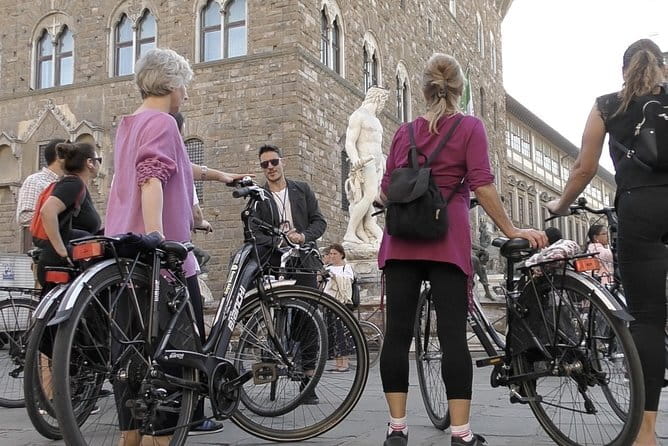
You should already know how to ride confidently. This is not a quiet cycle path. You may need to avoid pedestrians, cars, strollers, taxis, street lights, and other bikes while following the guide. Riders who take photographs while moving can create danger for the people behind them, so stop fully before using your phone.
The strongest safety advice is simple: choose a small group if possible, ride conservatively, and do not hesitate to tell the guide if you are falling behind. The tour provider has acknowledged concerns about pacing, safety instructions, helmets, and the hill, which makes it sensible to ask direct questions before starting.
Is $42.34 good value for two hours?
At $42.34 per person, the price is fair for a guided route that covers much of Florence, includes the bicycle and helmet, and reaches Piazzale Michelangelo. You are paying for speed, orientation, and live commentary rather than museum access.
The value is best if you are staying only two or three days. You can see the main sights early, then return to the Duomo, Santa Croce, Pitti Palace, or Piazza della Signoria on your own. A guide may also point you toward gelato, Florentine steak, and wine tasting.
The price is less attractive if you prefer slow sightseeing or plan to spend most of your time inside museums. Two hours passes quickly, and the short stops do not allow much unhurried exploration. You also need to supply your own hotel transportation because pickup is not included.
The meeting point is near public transportation, and the tour ends back there. Confirmation arrives when you book. Free cancellation is available up to 24 hours before the start time, but changes or cancellations inside that window are not accepted.
Who should book this Florence bike tour?
I would choose it early in a Florence stay, particularly for a first visit or a short trip. It gives you the city’s basic shape, covers both sides of the river, and ends with a view that is harder to reach efficiently on foot.
It suits adults, confident cyclists, and families with older children who can manage busy streets. Several family groups enjoyed the ride with children, but young riders need close adult supervision and suitable equipment. Ask about child seats or rear seats in advance rather than waiting until the bicycles are handed out.
I would skip it if crowded traffic makes you anxious, if you dislike hills, or if you want a quiet historical walk. Florence is wonderful on foot, and a bicycle can feel like extra work in the busiest squares.
Should you book it?
Book this tour if you want a fast, active introduction to Florence and the Piazzale Michelangelo view matters to you. The route is broad, the price is reasonable, and the best guides add real historical context and practical city advice.
For the smoothest experience, aim for a morning departure, request a small group if that option exists, confirm the helmet and bicycle type, and ask clearly about the uphill viewpoint. If the group is very large or the guide does not explain the safety plan, keep your expectations modest. This can be an excellent way to get your bearings, but it depends heavily on careful riding and attentive group management.
FAQ
How long does the bike tour last?
The tour lasts approximately 2 hours and 15 minutes. Some descriptions of the ride place the active tour closer to two hours, with short stops along the route.
What sights does the route include?
The route includes Piazza del Duomo, Piazza della Repubblica, Finestra delle Belle Donne, Ponte Santa Trinita, Piazza Santo Spirito, Piazza de’ Pitti, Ponte Vecchio, Piazzale Michelangelo, Ponte alle Grazie, Piazza Santa Croce, Piazza della Signoria, and Museo Casa di Dante.
Is Piazzale Michelangelo included?
Piazzale Michelangelo is part of the stated route, but some departures have handled the climb as an optional second section. Confirm the plan with your guide before leaving, especially if the viewpoint is a main reason for booking.
What is provided?
The experience includes use of a bicycle, a helmet, an audio guide system, an expert guide, and guided commentary. Hotel pickup is not included.
Can children join the tour?
Yes. Children must be accompanied by an adult, and the additional information says most participants can take part. The route includes crowded streets and an uphill ride, so children should be competent riders. Ask in advance about child bicycles or rear seats.
Where does the tour begin and end?
It begins at Florence Tours, Via Camillo Cavour 21R, 50129 Florence. The activity ends back at the meeting point.
Latest additions around Florence
- Florence: Cathedral Tour & Brunelleschi’s Dome Climb Ticket★ 5.0 · 3 reviews
- Palatina Gallery and Pitti Guided Tour in Florence★ 5.0 · 3 reviews
- Florence Uffizi Gallery Skip-the-line Tour w Art Historian Guide★ 5.0 · 3 reviews
- Private Tour: Pisa and Lucca from Florence★ 5.0 · 3 reviews
- San Gimignano Bike Tour (SOFT)★ 4.5 · 3 reviews
- Florence: Tour of Florence by rickshaw★ 5.0 · 3 reviews
- Center of Florence by golf cart★ 5.0 · 3 reviews
- The David from Michelangelo.★ 5.0 · 3 reviews
Renaissance Art Tours, compared.

Timed Entrance Ticket to Michelangelo’s David
Read our review →
Michelangelo’s David Skip-the-Line Entry Ticket
Read our review →
The Best tour in Florence: Renaissance & Medici Tales – guided by a STORYTELLER
Read our review →
The Best Tour in Florence: Renaissance and Medici Tales
Read our review →
Timed Entry Ticket to Michelangelo’s David & eBook
Read our review →
Michelangelo’s David, Accademia & Uffizi Small Group Tour
Read our review →
Michelangelo’s David Entrance Ticket and Audio App
Read our review →
Renaissance and Medici Tales Guided Walking Tour
Read our review →Browse the lists this tour appears in