
Reviewed · FLORENCE CHURCHES & PALAZZOS
Basilica of Santa Croce: Where Legends Rest in Florence
Santa Croce is Florence’s great church of famous names. Inside, you’ll find Michelangelo, Galileo, and Machiavelli, but the real prize is the art around them: Giotto’s frescoes, Donatello’s crucifix, and Brunelleschi’s elegant Pazzi Chapel. It is a powerful mix of worship, art, and civic memory.
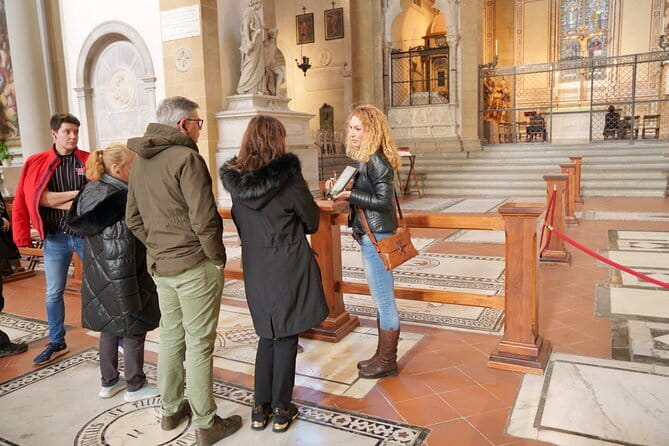
I like the one-hour format, which gives you a clear introduction without swallowing half your day. I also like the radio system, especially in a church where a quiet guide can otherwise be hard to hear. Silvia, Armida, and Guido have each been praised for bringing warmth, humor, and local knowledge to the visit.
The main drawback is its strict timing. Arrive late and you cannot join or receive a refund. The church can also cancel or change an outing if it closes unexpectedly, so this tour is best booked with some flexibility in your Florence schedule.
In This Review
- Key points to know before booking
- Why Santa Croce deserves a place on your Florence plan
- Piazza di Santa Croce and the start of the visit
- Giotto’s chapels and the first great works
- Niccolini’s memorial and the church’s civic memory
- Donatello’s crucifix and Brunelleschi’s Pazzi Chapel
- The tombs of Florence’s famous sons
- Restoration and the memory of Florence’s floods
- Adding the Tuscan wine tasting
- Is $56.48 a fair price for one hour?
- Guide style and the mixed reliability record
- Dress, weather, and who should book
- Should you book the Santa Croce tour?
- FAQ
- How long does the Santa Croce tour last?
- What is included in the basic tour?
- Are Michelangelo, Galileo, and Machiavelli buried at Santa Croce?
- Is the wine tasting included in every booking?
- What should I wear to enter the church?
- Can I join if I arrive after the start time?
- Can I cancel for a full refund?
Key points to know before booking
- Michelangelo, Galileo, and Machiavelli are buried here: Santa Croce works as Florence’s grand civic memorial as much as a church.
- Giotto’s Bardi and Peruzzi Chapels are the artistic heart of the visit: Their frescoes show why Giotto changed European painting.
- Brunelleschi’s Pazzi Chapel rewards careful looking: Its calm proportions and clean geometry offer a sharp contrast to the church’s more decorated spaces.
- The guide uses a radio system: You can follow the explanation without crowding around the guide.
- A Tuscan wine class can be added: The tasting follows the church visit and includes pairings when that option is selected.
- Dress rules are enforced: Men and women must cover shoulders and knees, with no shorts or sleeveless tops.
Why Santa Croce deserves a place on your Florence plan
Many visitors come to Florence for the Uffizi, the Duomo, and Michelangelo’s David. Santa Croce gives you something different: a single building where painting, sculpture, architecture, religion, and national memory all meet.
The church is one of Florence’s most important Franciscan foundations. You do not need a long lecture on church politics to appreciate it, but a guide helps you see how the building works. The chapels are not random rooms filled with old art. They were created, decorated, and supported by powerful Florentine families.
That context matters. A fresco showing the life of a saint also tells you who paid for the chapel, which religious order used it, and what Florentines thought worthy of remembrance. A guide can point out these links while you look at the art itself.
The experience lasts about one hour. I think that is a sensible length for a first visit. Santa Croce contains far more than can be covered in an hour, but the tour gives you a firm path through its most important works. You can return later on your own if one chapel catches your attention.
More churches and palazzos worth an hour:
- Florence: Palazzo Vecchio Entrance Ticket & Audioguide
★ 4.4 · 4,822 reviews - Florence: Palazzo Vecchio Guided Tour
★ 4.8 · 1,260 reviews - Florence: Timed Entrance Ticket to San Marco Museum
★ 4.6 · 396 reviews
Piazza di Santa Croce and the start of the visit
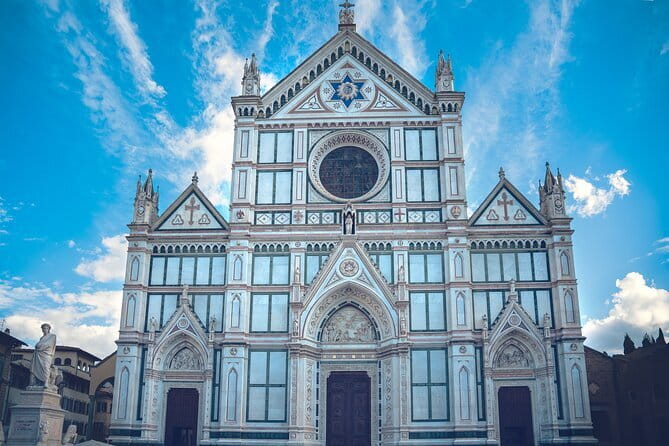
The tour begins in Piazza di Santa Croce, one of Florence’s memorable public squares. In June, the square becomes the setting for Calcio Storico, Florence’s rough-and-ready historic football match. That event is not part of the tour, but it gives the piazza a useful sense of place. This is not just a quiet church forecourt. It has long been part of the city’s public life.
You should arrive early. The start time is strict, and arriving after the guide leaves means you cannot join the group. There is no rescheduling or refund for a late arrival, so allow time to cross Florence on foot and locate the meeting point.
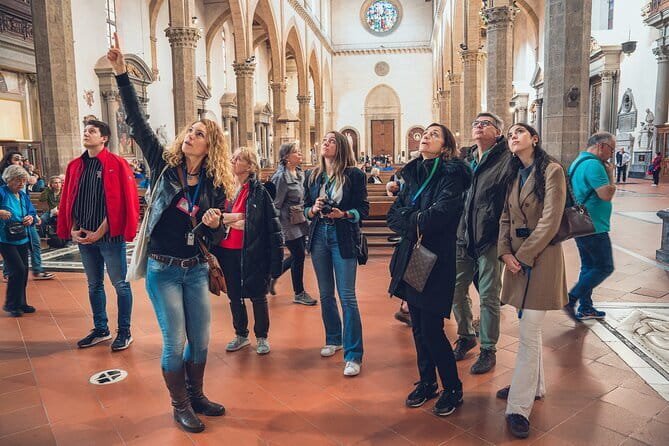
Once inside, the radio system becomes useful. A maximum of 20 people can join, which keeps the group from becoming enormous, but a church filled with visitors can still swallow a guide’s voice. The headset lets you look at the artwork while listening, rather than standing shoulder to shoulder near the guide.
Giotto’s chapels and the first great works
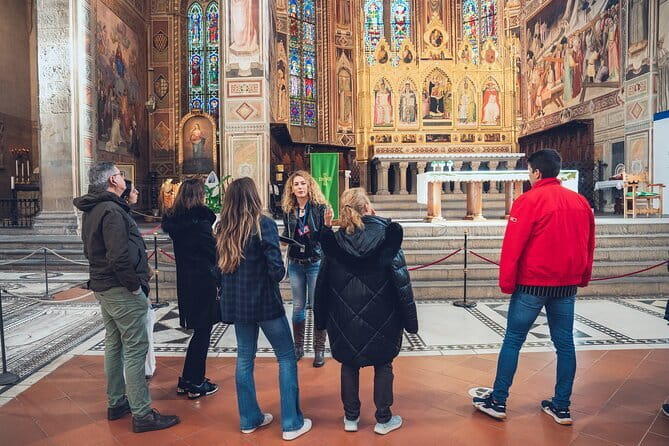
The Bardi and Peruzzi Chapels contain fresco cycles by Giotto, showing scenes from the lives of St. Francis and St. John. These paintings are among the main reasons to choose a guided visit.
Giotto’s work is important because his figures feel more solid and emotionally present than much earlier medieval painting. Look for gestures, faces, and the way scenes are arranged to tell a story. A guide can help you follow the sequence, especially when the paintings are high on the walls and the details are easy to miss.
The frescoes are not always easy to read at a glance. Time, restoration, lighting, and the height of the chapels can make individual scenes less clear than you expect. This is where a good explanation earns its keep. The guide can direct your eyes to the central action instead of leaving you to guess what each panel shows.
The main chapel, the Cappella Maggiore, features frescoes by Taddeo Gaddi depicting the story of Santa Croce. This adds another layer to the visit. You are not seeing only individual masterpieces. You are seeing a church presenting its own identity through painted stories.
Niccolini’s memorial and the church’s civic memory
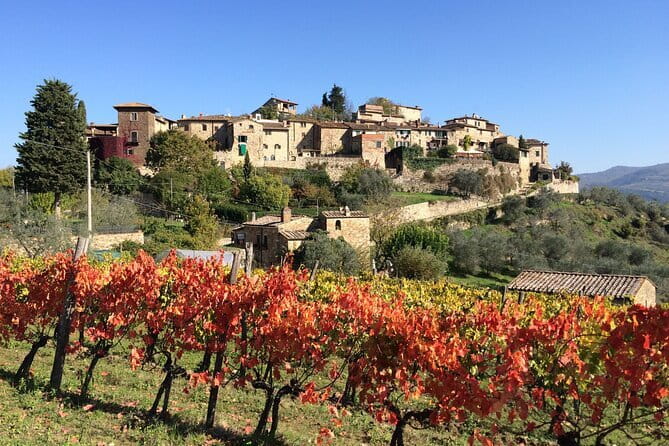
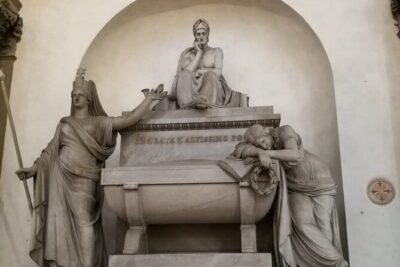
Near the entrance, look to the left for the memorial to playwright Giovanni Battista Niccolini. Its design has been compared to an early forerunner of the Statue of Liberty.
That detail is easy to miss if you walk straight toward the better-known tombs. It also helps explain why Santa Croce feels different from a church visited only for religious reasons. Over time, the building became a place where Florence remembered writers, artists, scientists, and political thinkers.
The memorial gives your guide a chance to connect the church with the wider story of Italian identity. Santa Croce is full of such small surprises. The headline names draw you inside, but the lesser-known monuments make the visit feel less like a checklist.
A different way to spend the same Florence day:
- Florence: Skip-The-Line Uffizi Gallery Timed Entry Ticket
★ 4.5 · 27,832 reviews - Tuscany Day Trip from Florence: Siena, San Gimignano, Pisa and Lunch at a Winery
★ 5.0 · 21,634 reviews - Florence: Timed Entrance Ticket to Michelangelo’s David
★ 4.6 · 16,983 reviews - Florence: Michelangelo’s David Skip-the-Line Entry Ticket
★ 4.5 · 12,764 reviews
Donatello’s crucifix and Brunelleschi’s Pazzi Chapel
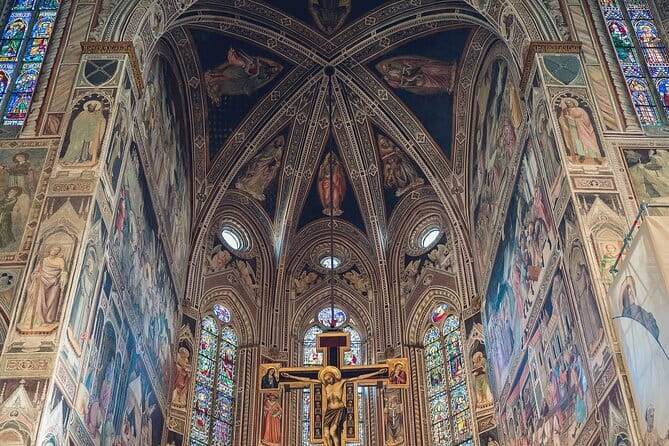
The tour also includes Donatello’s crucifix, described as a jewel-like Renaissance work. Donatello’s sculpture is a useful counterpoint to the wall paintings. Instead of reading a story across a sequence of frescoes, you focus on the shape and feeling of a single figure.
Then comes the Pazzi Chapel, designed by Filippo Brunelleschi. This is one of the tour’s most rewarding stops for anyone interested in architecture. Brunelleschi’s design is controlled, balanced, and calm. Its appeal comes less from an overload of decoration than from the relationship between space, proportion, and light.
I find the Pazzi Chapel especially valuable after the church’s larger frescoed spaces. The contrast is clear. The chapels by Giotto and Gaddi ask you to study painted stories. The Pazzi Chapel asks you to notice geometry and harmony.
Do not rush this part. You might find that the chapel looks simple at first, then becomes more impressive as you pay attention to its symmetry and details. A guide can show you what to look for, which is hard to do when you have only a few minutes and no background in Renaissance architecture.
The tombs of Florence’s famous sons
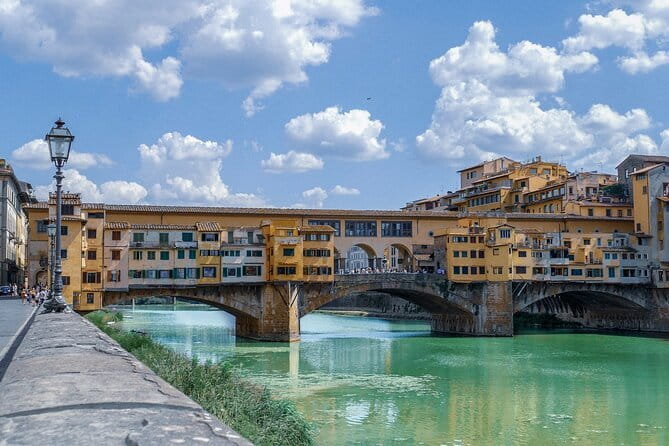
Santa Croce is often called a pantheon of Florentine greats, and the tombs are a central part of the experience. Michelangelo, Galileo, and Machiavelli are among the most famous figures remembered here.
Michelangelo’s monument brings the story of the artist back to Florence, even though he died in Rome. Galileo’s tomb recalls the scientist whose work changed how people understood the heavens. Machiavelli’s monument connects the church to political writing and the hard realities of Renaissance power.
These are not merely celebrity stops. Each name represents a different side of Florence: visual art, science, literature, and government. The guide’s job is to give each monument enough context without turning the hour into a long classroom talk.
You should also remember that the tombs can draw attention away from the church itself. It is tempting to hurry from one famous name to the next. Try to pause between them and notice the building’s chapels, floor, walls, and painted decoration. The famous burials are the hook, but they are not the whole visit.
Restoration and the memory of Florence’s floods

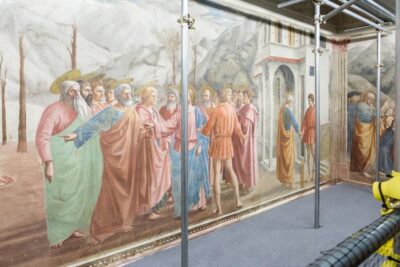
The tour includes the monumental cemetery area, where flood-damaged paintings have been restored. Florence suffered a devastating flood in 1966, and Santa Croce was among the places affected.
This part of the visit adds a modern chapter to the church’s long story. You see that historic art is not simply preserved behind glass forever. It can be damaged, cleaned, repaired, and sometimes left with visible signs of what happened.
For me, this is one of the more meaningful details because it connects the church to the living city. Restoration takes time, money, and skilled work. It also changes how you look at old paintings. You begin to notice not only the original artist’s hand, but the effort required to keep the work in public view.
Adding the Tuscan wine tasting
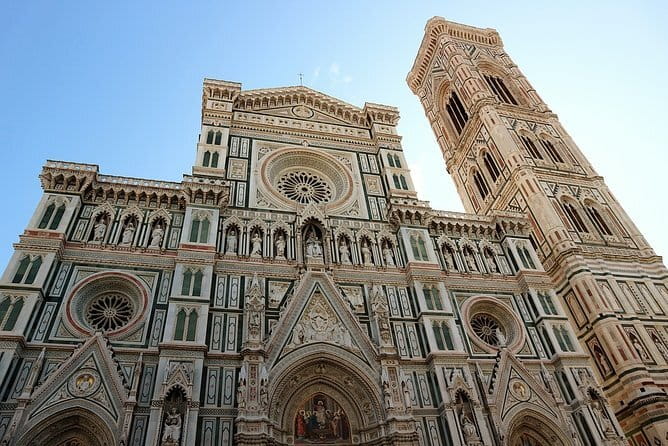
You can select an added Tuscan wine tasting and pairing class. This is not part of the basic one-hour church visit. The wine option changes the schedule, with the Santa Croce tour operating at 10:30 a.m. or 3 p.m. and the tasting taking place afterward at a second meeting point.
Check the exact timing when you book. The church portion starts later than the listed tour time when the wine option is selected, followed by the tasting at Meeting Point 02. This matters if you have a timed museum entry, a dinner booking, or a train to catch.
The wine class may suit you if you want a cultural activity after the church and prefer an organized introduction to Tuscan wine. The pairings make it more than a quick drink, but food and drinks are not included unless the wine option is selected.
Tell the operator about allergies or intolerances both when booking and before the tour. If wine is not a priority, the basic church visit is the cleaner choice and leaves you free to choose your own café or wine bar later.
Is $56.48 a fair price for one hour?
At $56.48 per person, this is not a cheap walk-in church visit. You are paying for admission, an official certified guide, a radio system, and a planned route through a major Florence monument.
The value depends on how much help you want. If you already know Giotto, Donatello, Brunelleschi, and the church’s major tombs, you may prefer to enter independently and set your own pace. If these names are familiar but their work is not, the guided format can make the hour far more rewarding.
The price also buys structure. You do not have to decide which chapel matters most or search for the tombs of Michelangelo and Galileo. A good guide can turn a large, visually crowded church into a manageable story.
The one-hour limit keeps the cost from becoming a full-day commitment. I would see it as a focused orientation, not a complete study of Santa Croce. You are paying for a strong introduction, then you can decide if you want to stay longer.
Guide style and the mixed reliability record
The best part of this experience depends heavily on the guide. Silvia has been praised for her warm personality and ability to make the visit memorable. Armida brings a personal Florentine connection and strong feeling for the city’s art. Guido has led the tour in Spanish and is described as engaging and pleasant.
Those details suggest that the experience can feel lively rather than dry. The guide is expected to tell stories, explain artistic details, and keep the one-hour route moving.
There is also a practical warning. The experience has a 3.7 rating from 11 reviews, with several very positive accounts but also complaints about cancellations, postponements, and poor communication. One reported closure involved Santa Croce shutting without advance notice. Another complaint may have involved a different booking, according to the operator’s response.
The provider says the tour requires at least two people and may cancel if that minimum is not met. If that happens, you should be offered another date or experience, or a full refund. Still, I would avoid placing this tour immediately before an important departure or nonrefundable reservation.
Dress, weather, and who should book
This is a place of worship, so clothing rules are firm. Men and women must cover knees and shoulders. No shorts or sleeveless tops are allowed, and inappropriate clothing can lead to refused entry without a refund or rescheduling.
The tour runs in all weather. Dress for Florence’s conditions on the day, but make sure your church outfit meets the rules. A light layer can help you stay comfortable while still covering your shoulders.
I would recommend this tour to:
- First-time visitors who want a clear introduction to Santa Croce
- Art lovers who want help reading Giotto’s frescoes
- Architecture fans interested in Brunelleschi’s Pazzi Chapel
- Visitors who want to see Michelangelo, Galileo, and Machiavelli in one place
- Anyone who prefers a short, structured visit with a real guide
I would skip it if you dislike fixed schedules, want a silent visit, or already have enough background to explore the church alone. I would also avoid the wine add-on if your Florence day is tightly timed.
Should you book the Santa Croce tour?
Book it if you want a focused, guided hour that connects Santa Croce’s art with the people buried there. The combination of Giotto’s frescoes, Donatello’s crucifix, Brunelleschi’s chapel, and the tombs of Florence’s famous figures gives you plenty to see in a short visit.
The strongest reason to choose this tour is the guide. Silvia, Armida, and Guido have each been singled out for warmth, storytelling, and local feeling. The radio headset is another practical plus.
Just plan carefully. Arrive early, dress correctly, and leave room for a schedule change. At $56.48, this is best for you if interpretation matters more than the lowest possible entry price. Add the wine class only if you have time for the separate tasting and want to continue the Florentine experience after the church.
FAQ
How long does the Santa Croce tour last?
The guided visit lasts approximately one hour.
What is included in the basic tour?
The basic tour includes entrance tickets, an official certified guide, and a radio system so you can hear the guide clearly.
Are Michelangelo, Galileo, and Machiavelli buried at Santa Croce?
Yes. The church contains the final resting places or memorials of famous figures including Michelangelo, Galileo, and Machiavelli.
Is the wine tasting included in every booking?
No. Tuscan wine tasting and pairing are included only if you select the wine tasting option.
What should I wear to enter the church?
You must cover your knees and shoulders. Shorts and sleeveless tops are not allowed for men or women.
Can I join if I arrive after the start time?
No. Late arrivals cannot join the tour, and the tour will not be rescheduled or refunded.
Can I cancel for a full refund?
Yes, if you cancel at least 24 hours before the experience start time. Cancellations or changes made less than 24 hours in advance are not refunded or accepted.
Latest additions around Florence
- Florence: Cathedral Tour & Brunelleschi’s Dome Climb Ticket★ 5.0 · 3 reviews
- Palatina Gallery and Pitti Guided Tour in Florence★ 5.0 · 3 reviews
- Florence Uffizi Gallery Skip-the-line Tour w Art Historian Guide★ 5.0 · 3 reviews
- Private Tour: Pisa and Lucca from Florence★ 5.0 · 3 reviews
- San Gimignano Bike Tour (SOFT)★ 4.5 · 3 reviews
- Florence: Tour of Florence by rickshaw★ 5.0 · 3 reviews
- Center of Florence by golf cart★ 5.0 · 3 reviews
- From Firenze | Chianti day tour in a classic car★ 5.0 · 3 reviews
Florence Churches & Palazzos, compared.
Palazzo Vecchio guided experience with entrance ticket
Read our review →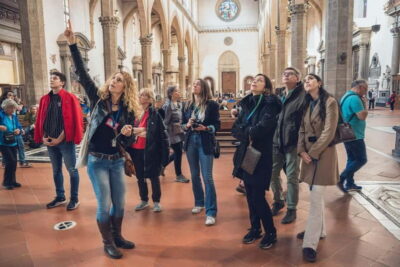
Browse the lists this tour appears in