
Reviewed · RENAISSANCE ART TOURS
Art, Medicis and Renaissance. Explore Florence with Vincenzo
Florence comes into sharper focus when you connect its art to the people who paid for it, ruled through it, and used it to shape the city. This tour follows that thread through Cosimo I de’ Medici, Brunelleschi’s dome, the medieval Ponte Vecchio, and Santa Maria Novella.
I like the way this tour links major sights instead of treating them as separate photo stops. I also like the personal touch Vincenzo Manole brings, with practical advice about Florentine dishes and ideas for planning the rest of your stay. The main consideration is time: 90 minutes gives you a useful introduction, not a full visit inside every monument.
The group can include up to 20 people, and the tour is offered in English with a mobile ticket. The cathedral admission is not included, so think of this as a guided look at Florence’s key sights from the outside, with the context you need before deciding where to spend more time.
In This Review
- Key points at a glance
- Why this Florence tour works as a first introduction
- Starting near Santa Maria Novella
- Palazzo Vecchio and Cosimo I de’ Medici
- The Duomo and Brunelleschi’s dome
- Ponte Vecchio and the mystery of the jewelers
- Santa Maria Novella and Florence’s Roman-style spectacle
- What the guide adds to the walk
- Price, timing, and what you receive
- Who should book this experience?
- Should you book the Florence Medici and Renaissance tour?
- FAQ
- How long does the tour last?
- Which language is the tour offered in?
- Is admission to the Duomo included?
- Where does the tour start and end?
- How many people can join the tour?
- Can I cancel for a full refund?
Key points at a glance
- Follow Cosimo I de’ Medici at Palazzo Vecchio: Learn how statues and wedding frescoes helped present Medici power.
- Understand Brunelleschi’s famous dome: The Duomo receives about 20 minutes of focused attention, with no cathedral admission included.
- Find out why jewelers line Ponte Vecchio: The bridge’s shops are not there by accident.
- See Santa Maria Novella beyond its facade: Its square once hosted chariot races modeled on Roman contests.
- Get a useful first orientation: The tour begins near Santa Maria Novella and ends at Ponte Vecchio, close to many central sights.
- Meet Vincenzo Manole: His approach combines art, politics, architecture, legends, and suggestions for Florentine dishes.
Why this Florence tour works as a first introduction
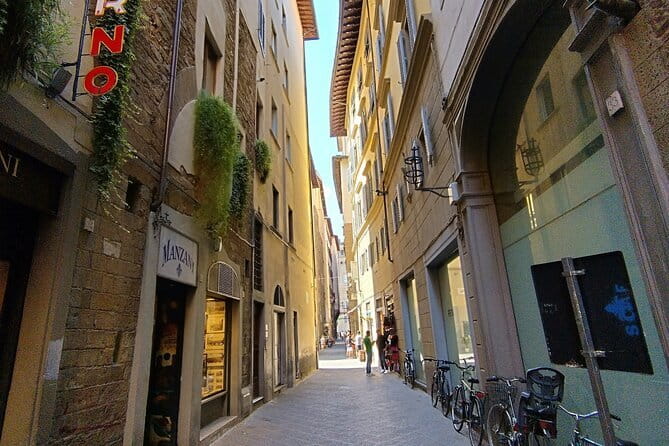
Florence can feel like a museum without walls. Around nearly every corner, you face a church, palace, statue, or painted facade tied to another chapter of the city’s past. That is exciting, but it can also leave you with a pile of names and no clear sense of how they fit together.
Vincenzo’s tour gives you a framework. The focus on the Medici family helps explain why Florence looks the way it does, while the stops at the Duomo, Ponte Vecchio, and Santa Maria Novella widen the story beyond one dynasty.
I especially like that the tour covers art, architecture, politics, and everyday culture. One especially useful part is the attention to Florentine food. Vincenzo has offered advice on dishes to try, rather than simply handing out restaurant names, which is the sort of help you can use after the walk.
The pace also suits a first morning or early afternoon in the city. The listed stop times add up to about 70 minutes, while the full experience lasts roughly 90 minutes. That leaves room for walking between sights and short explanations along the way.
You should not expect a slow, detailed museum visit. This is an orientation walk through central Florence. It works best if you want the larger picture first, then plan to return to the places that catch your interest.
More Renaissance art days:
- Florence: Timed Entrance Ticket to Michelangelo’s David
★ 4.6 · 16,983 reviews - Florence: Michelangelo’s David Skip-the-Line Entry Ticket
★ 4.5 · 12,764 reviews - The Best tour in Florence: Renaissance & Medici Tales – guided by a STORYTELLER
★ 5.0 · 12,316 reviews
Starting near Santa Maria Novella
The meeting point is the Grand Hotel Minerva at Piazza di Santa Maria Novella, 16. This places you in one of Florence’s most convenient central areas, near the railway station and public transportation.
The tour’s listed route includes Palazzo Vecchio, the Duomo, Ponte Vecchio, and Santa Maria Novella, with Ponte Vecchio given as the final meeting-point destination. Since the route covers several central landmarks, wear comfortable shoes and expect to walk between stops.
A mobile ticket keeps the arrival simple. You receive confirmation when booking, and the experience is offered in English. The group limit is 20 people, which is small enough for a more personal walk, though the feel can vary depending on how many people actually book that time.
If you have mobility concerns, the available information says most people can participate and that service animals are allowed. The tour is also near public transportation. Specific route details about stairs or pavement are not provided, so you may want to ask the provider if you need that information before booking.
Palazzo Vecchio and Cosimo I de’ Medici
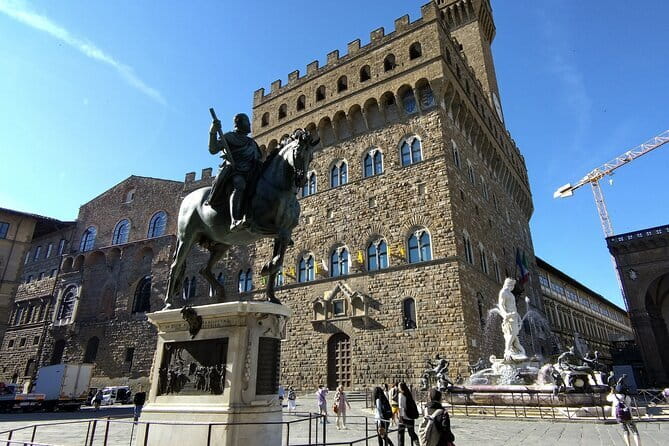
The first major subject is Palazzo Vecchio and the square around it. You could spend days examining the statues and buildings here, but this tour uses the space to tell the story of Cosimo I de’ Medici, the first Grand Duke of Tuscany.
That focus gives the square a human center. Rather than simply listing the names of statues, Vincenzo explains how they relate to Cosimo’s public image and political authority. Florence’s art was not only decoration. It could announce power, celebrate a victory, honor a marriage, or remind people who ruled them.
The tour also points out frescoes commissioned for the wedding of Cosimo’s son. This is a useful detail because it connects grand public art with family politics. A wedding could be a private celebration, but for a ruling family it also helped display status, alliances, and continuity.
The stop lasts about 15 minutes, and admission is free. You will be looking at the exterior square and its works rather than taking a full interior tour of Palazzo Vecchio.
That limitation matters. If you want the building’s rooms, sculptures, and painted ceilings, you will need to arrange a separate visit. Still, the outdoor setting is a sensible choice for a short walking tour because it lets Vincenzo place the Medici story in the middle of Florence’s civic heart.
I find this an effective opening because it starts with the city’s political power before moving to religious architecture and trade. You get a sense of how Florence was shaped not just by artists, but also by rulers who understood the force of public images.
The Duomo and Brunelleschi’s dome
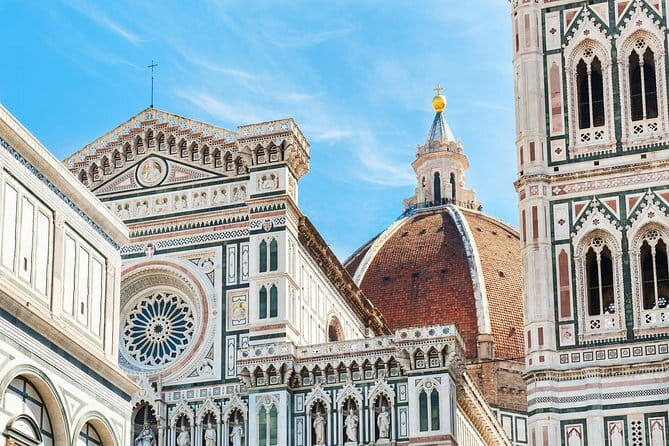
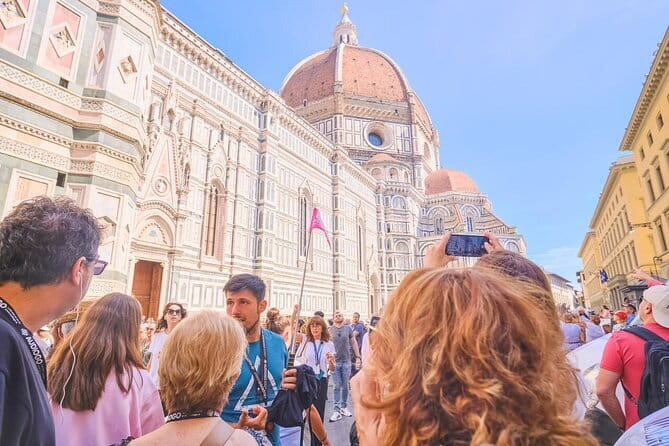
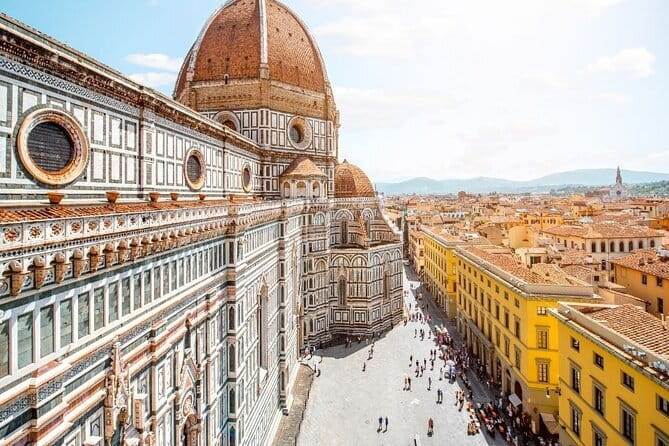
The Cathedral of Santa Maria del Fiore is treated as Florence’s central landmark, and the tour gives it about 20 minutes. The focus is on how the cathedral was made, with particular attention to Filippo Brunelleschi’s dome.
Even from outside, the Duomo raises useful questions. How did such a large structure take shape? Why was the dome so important? What made Brunelleschi’s work such a major achievement? A good explanation turns the building from a famous backdrop into a record of engineering, ambition, and civic pride.
This is likely the most useful stop for anyone seeing Florence for the first time. The cathedral complex can be confusing because it includes several separate sights, and the dome itself is often treated as if it were simply part of the church roof. Vincenzo’s explanation helps you understand what you are looking at before you decide if you want to return for a longer visit.
Admission to the cathedral is not included. That is clearly worth noting when you compare this tour with a ticketed interior visit. The price covers the guided walk, not entry to the Duomo.
The 20-minute stop is enough for an overview, but not for a full examination of the cathedral or a climb. You should book this with the expectation of learning the story from the outside. If your main aim is to enter the cathedral, climb the dome, or spend time inside the complex, you will need a separate ticket and more time.
I like the balance here. Brunelleschi’s dome is famous enough to invite a quick photograph and little else. A focused explanation gives you a reason to look upward and notice the structure rather than simply checking it off your list.
A different way to spend the same Florence day:
- Florence: Skip-The-Line Uffizi Gallery Timed Entry Ticket
★ 4.5 · 27,832 reviews - Tuscany Day Trip from Florence: Siena, San Gimignano, Pisa and Lunch at a Winery
★ 5.0 · 21,634 reviews - Florence: Leonardo Interactive Museum Entry Ticket
★ 4.5 · 11,763 reviews - The Best Tour in Florence: Renaissance and Medici Tales
★ 5.0 · 10,810 reviews
Ponte Vecchio and the mystery of the jewelers
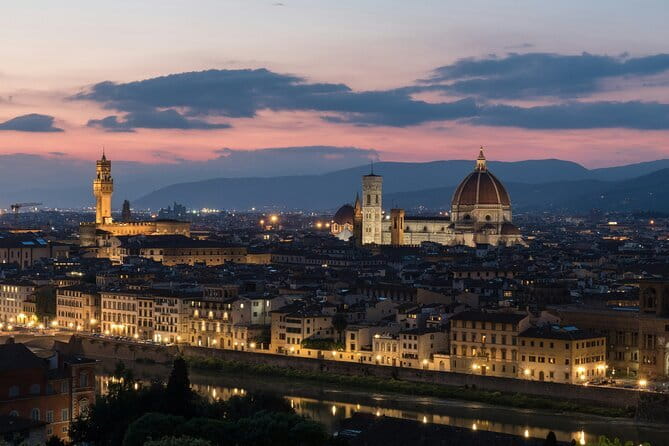
Ponte Vecchio is the final stop and one of the most recognizable sights in Florence. The bridge has stood for about 800 years, and its medieval character remains the main attraction.
The key question here is simple: why are there so many jewelers on the bridge? That detail makes the stop more than a scenic pause. Vincenzo explains how the shops came to be associated with jewelry, giving you a practical bit of local history to carry with you as you cross.
The bridge is free to visit, so there is no admission charge at this stop. Its central position also makes the ending useful. From Ponte Vecchio, you are close to other major sights and can continue exploring on your own.
Keep in mind that Ponte Vecchio is also a busy public crossing. The tour may not feel as quiet or controlled as a museum visit, and the number of people on the bridge can affect how easily you hear every word. Staying close to the guide will matter, especially if the group reaches its maximum of 20.
The bridge is a strong final stop because it combines views, shopping, architecture, and an easy transition to the rest of your day. It also gives you a clear sense of Florence as a working city, not only a collection of grand monuments.
Santa Maria Novella and Florence’s Roman-style spectacle
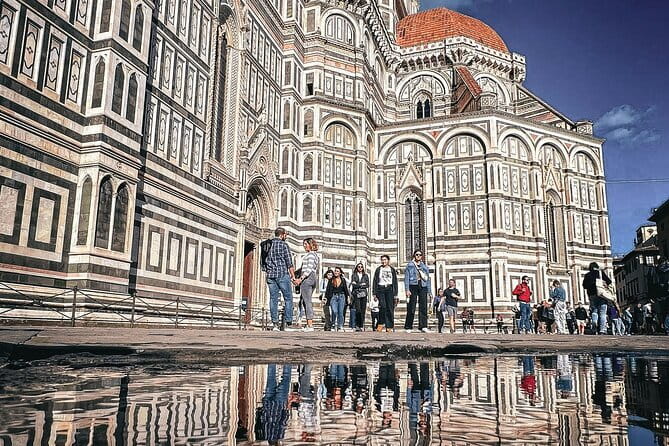
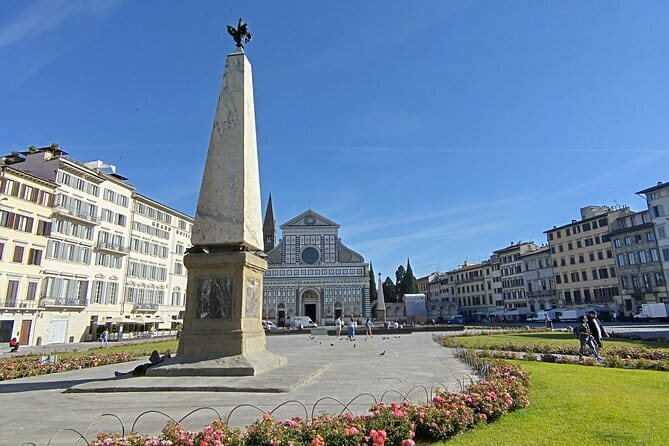
Santa Maria Novella brings the tour back to one of Florence’s important public squares. The square once hosted chariot races modeled on contests in Rome, and the tour explains why Florence staged such events.
This is the sort of detail that can change how you see a familiar place. A church square may look calm today, but it once served as a setting for public entertainment and competition. The question of why Florence adopted a Roman-style race opens a window onto the city’s links with classical culture and its desire to present itself as an important European center.
The stop lasts about 20 minutes and admission is free. As with the other outdoor stops, the emphasis is on the square, its use, and its place in Florence’s story rather than on a full interior visit.
Santa Maria Novella is also a practical starting-area landmark because the meeting point is at the Grand Hotel Minerva nearby. The supplied route information places the square among the tour’s featured stops, while the stated end point is Ponte Vecchio. Since the order of the listed stops and the meeting information do not perfectly match, check the exact route details with the provider when booking.
That small point is worth clarifying, especially if you are planning train connections, timed museum tickets, or a meeting elsewhere. The tour itself is short, but Florence’s pedestrian streets and crowded squares can make timing less predictable.
What the guide adds to the walk
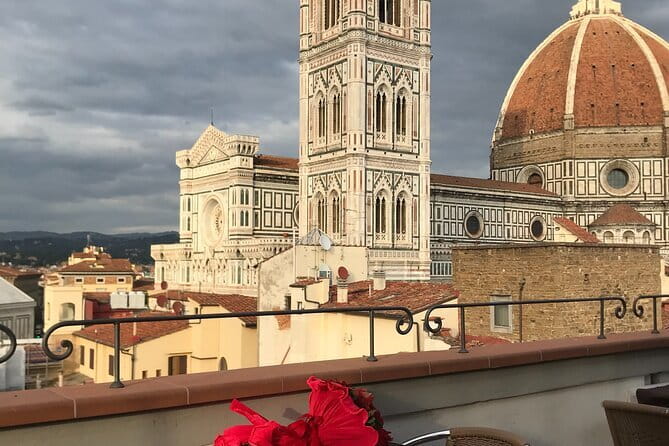
Vincenzo Manole is the central part of the experience. The tour depends on his ability to connect facts rather than simply recite them, and the available feedback points to a friendly, energetic style that works for both adults and children.
That family appeal matters. Florence’s art can feel dry to younger visitors if every stop turns into a list of dates and names. Stories about Medici power, wedding celebrations, bridge shops, legends, and city traditions give the material more movement.
The tour also appears to adapt well to group size. If few people book a particular departure, you may receive a more direct conversation with Vincenzo. One past departure was described as feeling like a private walk with a well-informed friend, though you should not assume every group will be that small.
You can also ask questions about more than the formal subjects. Vincenzo has discussed art, architecture, politics, and local dishes, so the experience can help you plan what to see and eat after the walk.
That breadth is valuable, but it has a tradeoff. Covering four major places in 90 minutes means no single topic can receive a long scholarly treatment. If you already know Florence well, you may prefer a specialist tour centered only on Medici art, the Duomo, or Renaissance painting.
Price, timing, and what you receive
At $29.79 per person, the tour sits at a reasonable price for a 90-minute guided introduction to central Florence. The value comes from the interpretation and orientation, not from included admissions.
That distinction is important. Palazzo Vecchio, Ponte Vecchio, and Santa Maria Novella are listed with free admission for the stops, while Duomo admission is not included. You are paying for Vincenzo’s time, the organized route, and the explanations that help you make sense of the sights.
I would consider the price worthwhile if this is your first visit, if you have only a short time in Florence, or if you want help deciding which monuments deserve a longer return visit. It is less compelling if you are seeking interior access or a specialist art lecture.
The tour is offered in English, uses a mobile ticket, and allows a maximum of 20 people. Most people can participate, service animals are allowed, and the meeting area is near public transportation.
Free cancellation is available up to 24 hours before the start time for a full refund. Cancellations or changes made less than 24 hours before the start are not refunded or accepted. The experience also depends on good weather and a minimum number of participants. If poor weather or low enrollment causes cancellation, you can receive a different date or experience, or a full refund.
Who should book this experience?
I would recommend it to first-time visitors who want Florence explained in plain terms before tackling museums and ticketed monuments on their own. Families may also like the mix of stories, statues, political drama, and unusual details such as the chariot races at Santa Maria Novella.
It is a good match for anyone who enjoys learning how a city works. The Medici connection links public art with politics, Brunelleschi’s dome connects design with engineering, and Ponte Vecchio connects medieval commerce with today’s jewelry shops.
You should also consider it if you want food guidance that goes beyond restaurant lists. Vincenzo’s suggestions about Florentine dishes can help you make better choices during the rest of your stay.
I would be more cautious if your main goal is to enter every major building. The tour does not include Duomo admission, and the short stop times do not allow for full interior visits. In that case, use this walk as a starting point, then book the individual sites separately.
Should you book the Florence Medici and Renaissance tour?
Book it if you want a compact, human introduction to Florence led by Vincenzo Manole. The strongest reasons are the clear Medici focus, the explanation of Brunelleschi’s dome, the story behind Ponte Vecchio’s jewelers, and the unusual look at chariot racing in Santa Maria Novella.
At $29.79, it offers good value for an English-language orientation walk, especially early in a longer stay. Just remember that it is not an admission package or a full museum tour. Arrive ready to walk, stay close to the guide in crowded areas, and keep time afterward to revisit the sights that interest you most.
FAQ
How long does the tour last?
The experience lasts approximately 1 hour and 30 minutes.
Which language is the tour offered in?
The tour is offered in English.
Is admission to the Duomo included?
No. Admission to the Cathedral of Santa Maria del Fiore is not included.
Where does the tour start and end?
The meeting point is the Grand Hotel Minerva at Piazza di Santa Maria Novella, 16, in Florence. The stated end point is Ponte Vecchio.
How many people can join the tour?
The activity allows a maximum of 20 participants.
Can I cancel for a full refund?
Yes. You can cancel at least 24 hours before the start time for a full refund. Poor weather or failure to meet the minimum number of participants may also lead to a different date, a different experience, or a full refund.
Latest additions around Florence
- Florence: Cathedral Tour & Brunelleschi’s Dome Climb Ticket★ 5.0 · 3 reviews
- Palatina Gallery and Pitti Guided Tour in Florence★ 5.0 · 3 reviews
- Florence Uffizi Gallery Skip-the-line Tour w Art Historian Guide★ 5.0 · 3 reviews
- Private Tour: Pisa and Lucca from Florence★ 5.0 · 3 reviews
- San Gimignano Bike Tour (SOFT)★ 4.5 · 3 reviews
- Florence: Tour of Florence by rickshaw★ 5.0 · 3 reviews
- Center of Florence by golf cart★ 5.0 · 3 reviews
- From Firenze | Chianti day tour in a classic car★ 5.0 · 3 reviews
Renaissance Art Tours, compared.

Timed Entrance Ticket to Michelangelo’s David
Read our review →
Michelangelo’s David Skip-the-Line Entry Ticket
Read our review →
The Best tour in Florence: Renaissance & Medici Tales – guided by a STORYTELLER
Read our review →
The Best Tour in Florence: Renaissance and Medici Tales
Read our review →
Timed Entry Ticket to Michelangelo’s David & eBook
Read our review →
Michelangelo’s David, Accademia & Uffizi Small Group Tour
Read our review →
Michelangelo’s David Entrance Ticket and Audio App
Read our review →
Renaissance and Medici Tales Guided Walking Tour
Read our review →Browse the lists this tour appears in