
Reviewed · UFFIZI GALLERY TOURS
Uffizi Gallery Guided Tour: Masterpieces of the Renaissance
The Uffizi is not just a room full of famous paintings. It is the former Medici office complex turned museum, and this tour gives you the backstory that makes Florence’s art easier to understand. In about 90 minutes, you’ll see Botticelli, Leonardo, Michelangelo, Raphael, and Caravaggio with an official certified guide leading the way.
I like the timed admission, which saves you from joining the longest entry line, and I like the small maximum of 15 people. The focus on who paid for the art, why it was made, and how styles changed gives the paintings a human shape instead of leaving you to stare at rows of gold frames.
The main concern is the audio equipment. One family found several headsets failed early, while another person had trouble hearing a guide using a handheld microphone. Arrive early, bring your identification and full booking details, and do not treat the 90-minute start time as flexible.
In This Review
- Key points to know before booking
- Why the Uffizi works better with a guide
- Meeting beneath Leonardo’s statue
- From Medici offices to a public art collection
- Botticelli and the fame of The Birth of Venus
- Leonardo’s Annunciation and the rise of observation
- Michelangelo’s rare panel painting
- Giotto, Filippo Lippi, Raphael, and Caravaggio
- What the 90-minute route feels like
- The guide and headset matter
- Is $90.50 a fair price?
- Who should book this Uffizi tour?
- Booking details that can save your visit
- Should you book it?
- FAQ
- Where does the Uffizi guided tour begin?
- Where does the activity end?
- How long does the guided tour last?
- Is admission to the Uffizi included?
- Is the tour offered in English?
- What identification do I need?
- Do all names need to be on the booking?
- How many people can join the tour?
- What happens if I arrive late?
- Can I cancel for a refund?
Key points to know before booking
- The Medici story anchors the visit: You learn how Florence’s ruling family helped shape the collection and the city’s artistic identity.
- Major works appear in a short route: Expect Botticelli’s The Birth of Venus, Leonardo’s Annunciation, Michelangelo’s only panel painting, and works linked to Giotto, Filippo Lippi, Raphael, and Caravaggio.
- A certified English-speaking guide leads the tour: Guides such as Hilaria and Marie have been praised for bringing context and artistic change to life.
- Timed entry is included: Your reserved admission is intended to reduce waiting at the museum entrance.
- The group is capped at 15 people: That is more personal than a large coach-style tour, though the galleries can still be crowded.
- You may return to favorite works afterward: The guided portion ends back at the meeting point, but you are free to revisit pieces that caught your eye.
Why the Uffizi works better with a guide
The Uffizi can be hard to read on your own. You move through rooms filled with saints, Madonnas, princes, mythological figures, and severe-looking men in black robes. Without context, the collection can blur into one long parade of old paintings.
A good guide gives you a system. Instead of asking only whether you like a painting, you start noticing who commissioned it, what its symbols mean, and how artists changed the way they showed bodies, space, light, and emotion.
That is the real value here. You are not simply being pointed toward famous works. You are being shown how Florence moved from the flat, formal style of the Middle Ages toward the more natural figures and convincing space of the Renaissance.
The Medici connection makes the opening especially useful. Their power came from banking, politics, and patronage. By supporting artists, collecting antiquities, and placing art in public and private settings, they helped turn Florence into one of Europe’s great art centers.
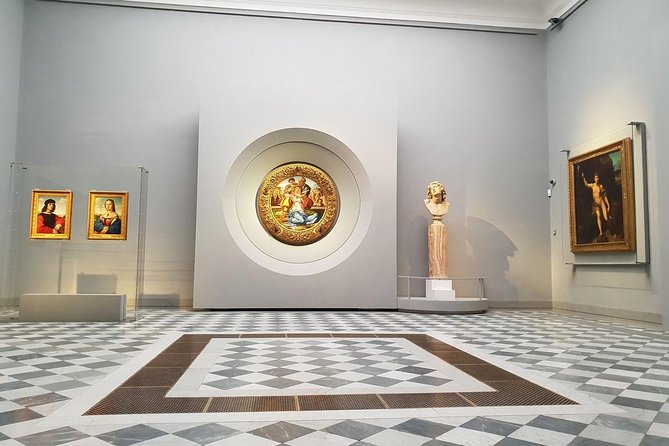
The portrait of Anna Maria Luisa de’ Medici provides a fitting entry point. She was the last Medici heir and gave the family collection to Florence, helping keep these works in the city rather than allowing them to be scattered elsewhere. That small piece of civic history adds meaning to the museum you are about to enter.
More ways into the Uffizi:
- Florence: Skip-The-Line Uffizi Gallery Timed Entry Ticket
★ 4.5 · 27,832 reviews - Florence: Uffizi Priority Ticket & Masterpieces Audio App
★ 4.2 · 6,402 reviews - Florence: Skip-the-Line Uffizi Small Group Tour
★ 4.6 · 5,926 reviews
Meeting beneath Leonardo’s statue
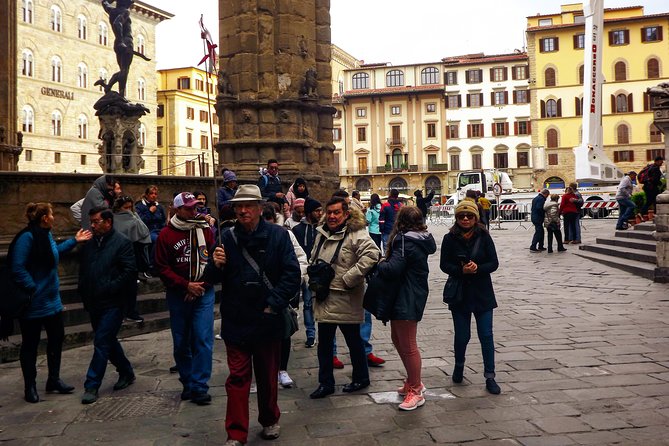
The meeting point is the statue of Leonardo da Vinci at Piazzale degli Uffizi, 209. This is in the Uffizi courtyard, a central spot but one where you should still give yourself time to identify the correct guide and group.
The tour requires at least two people to operate, and the maximum group size is 15. That limit matters inside a museum where a large group can easily clog a doorway or lose sight of the guide.
Bring the passport or identity document used for the booking. The name must match the reservation, and the full names of everyone in your party must appear on the voucher. Missing names or mismatched identification can cause the museum to deny entry, with no refund.
The start time is strict. If you arrive after the tour begins, you cannot join later, receive a rescheduled tour, or recover the payment. I would arrive well before the requested meeting time, particularly if you are crossing Florence on foot or are unfamiliar with the Uffizi courtyard.
From Medici offices to a public art collection
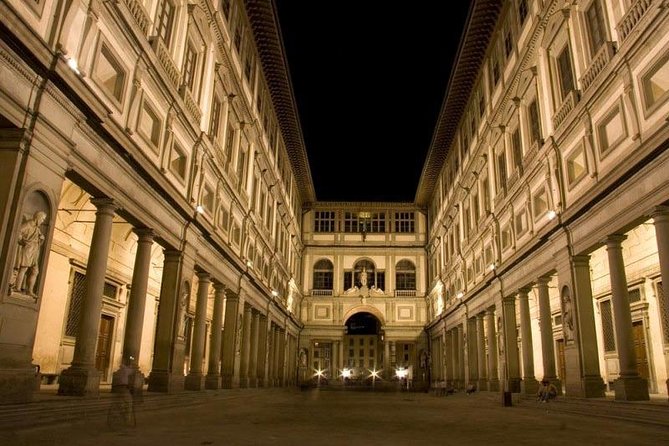
The Uffizi began as a Medici administrative building. The name itself relates to offices, not originally to a museum. Over time, the family’s collection grew, and the building became a place where art, politics, dynastic memory, and public identity met.
Your guide begins with this transformation before taking you up the grand staircase. That architectural route helps set the scene: you are not entering a purpose-built modern gallery, but a historic palace complex shaped by the family that ruled Florence for generations.
This opening also explains why the museum feels so broad. The collection includes medieval religious painting, Renaissance masterpieces, ancient Greek and Roman sculpture, portraits, and later works. The tour does not attempt to cover everything. It gives you a selected route through the works that best explain the collection and the development of Italian art.
That is a wise approach for a first visit. You will not leave knowing every room, but you should leave with a clearer sense of what deserves your time if you stay longer.
Botticelli and the fame of The Birth of Venus
Botticelli is one of the main reasons many people book the Uffizi. His The Birth of Venus is among the museum’s best-known works, and the tour makes a point of bringing you to it.
A useful correction before you go: the famous shell-borne goddess is not Venus de Milo. That statue is in the Louvre. The Uffizi painting is The Birth of Venus, a large, graceful image of Venus arriving on shore.
The pleasure of seeing it in person is not only its fame. The painting has a strange, weightless beauty. The figures do not behave like ordinary people standing in a real beach scene. Their long forms, flowing hair, and pale colors create a poetic world shaped by classical ideas and Medici taste.
Your guide can help connect the painting to the intellectual culture of Florence. Mythological subjects were becoming important beside religious images, and the choice of Venus reflects an interest in ancient Greek and Roman stories, beauty, and humanist learning.
The Uffizi also holds Botticelli works beyond the one everyone knows. If the room is crowded, the guided explanation may be your best chance to understand what to look for before you return on your own.
More Renaissance art days:
- Florence: Timed Entrance Ticket to Michelangelo’s David
★ 4.6 · 16,983 reviews - Florence: Michelangelo’s David Skip-the-Line Entry Ticket
★ 4.5 · 12,764 reviews - The Best tour in Florence: Renaissance & Medici Tales – guided by a STORYTELLER
★ 5.0 · 12,316 reviews - The Best Tour in Florence: Renaissance and Medici Tales
★ 5.0 · 10,810 reviews
Leonardo’s Annunciation and the rise of observation
Leonardo’s Annunciation is another essential stop. It shows the angel Gabriel approaching Mary, but the details are as important as the religious subject. Landscape, plants, architecture, and the careful arrangement of bodies all show an artist looking closely at the visible world.
Leonardo’s work can reward slow viewing, yet a first visit often gives you only a few minutes before the group moves on. Listen for the guide’s explanation of composition and symbolism, then return to the painting after the tour if it holds your attention.
The chance to revisit your favorite works is one of the strongest features of this format. You receive an organized introduction, then you can spend extra time with the pieces that matter most to you.
Michelangelo’s rare panel painting
The itinerary includes the only panel painting in the world by Michelangelo. That is a strong reason to pay attention during the tour, since the artist is often associated more with sculpture, the Sistine Chapel, and monumental frescoes.
A panel painting is a work made on a wooden panel rather than directly on a wall or on canvas. Seeing Michelangelo in this form gives you a different angle on his approach to figures, movement, and human anatomy.
The work is not just another famous name on a checklist. It shows how an artist known for powerful sculptural bodies handled a more intimate painted surface. Your guide’s explanation is especially useful here because the broader reputation of Michelangelo can overshadow the particular qualities of the painting in front of you.
Giotto, Filippo Lippi, Raphael, and Caravaggio
The route also includes works by Giotto, Filippo Lippi, Raphael, and Caravaggio. Together, these artists help you see that the Renaissance was not one sudden event. It was a long sequence of changes in technique, subject, patronage, and taste.
Giotto is associated with an earlier move toward more solid, emotionally readable figures. Filippo Lippi helps show the refinement of Florentine painting and the continued importance of religious imagery. Raphael brings balance, grace, and a polished sense of composition.
Caravaggio then offers a sharper break in mood. His figures and lighting can feel direct and dramatic, with ordinary human presence replacing idealized calm. Placing these artists within one museum gives you a chance to compare them rather than treating each as an isolated masterpiece.
The guide’s role is important here. The Uffizi is too large for a quick label-reading visit to explain these shifts clearly. A strong guide can give you a few visual clues that stay useful through the rest of your Italy trip.
What the 90-minute route feels like
The advertised duration is about 1 hour and 30 minutes. One part of the description refers to a two-hour visit, so allow extra time in your day rather than planning a hard connection immediately afterward.
The guided portion is selective. You will see major works and hear the stories behind them, but you will not inspect every gallery. That is a good trade for most first-time visitors who want structure without spending half a day trying to decide where to begin.
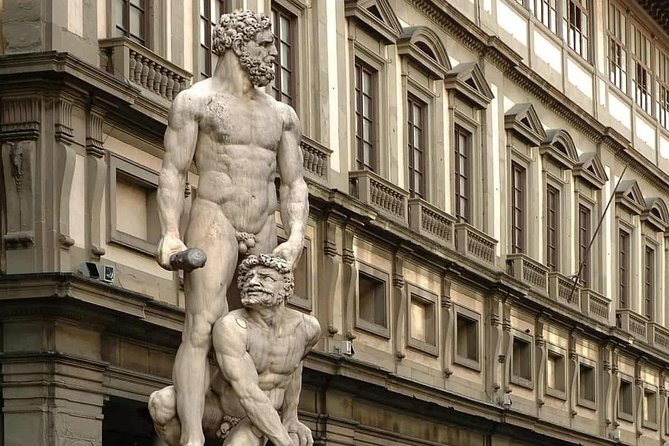
After the tour, you can revisit paintings that interested you. You may also want to spend extra time with the ancient Greek and Roman statuary, which can be easy to overlook when the Botticelli rooms receive so much attention.
Crowds are the unpredictable part. Timed admission helps with entry, but it does not guarantee quiet galleries. At busy times, you may have trouble reaching the front of a room or standing directly before a popular painting. Keep your expectations practical: this is a guided introduction, not a private viewing.
The guide and headset matter
The strongest part of the experience is the human commentary. Hilaria has been singled out for bringing paintings to life with historical context, while Marie has been praised for explaining the change from medieval religious art to Renaissance and secular subjects. Those details suggest that the quality of the tour depends greatly on the guide assigned that day.
The supplied radio system is meant to solve a real museum problem. With up to 15 people and other groups nearby, you need to hear the guide without standing shoulder to shoulder.
The equipment has not always worked well. A family reported several dead headsets at the beginning, and another person found a handheld microphone difficult to follow when it was not held close to the guide’s mouth. Check your headset as soon as it is handed to you. If the sound is weak, speak up immediately rather than trying to follow silently for 90 minutes.
Is $90.50 a fair price?
At $90.50 per person, this is not the cheapest way into the Uffizi. The direct ticket is described as roughly €29, so much of the extra cost pays for the guide, reservation handling, and the convenience of a planned route.
I think the price makes the most sense if you have limited time, want help reading Renaissance art, or feel uneasy about navigating a major museum alone. A strong guide can save you from wandering through rooms without understanding why the works matter.
The value is less clear if you already know the Uffizi well or prefer to move at your own pace. You will still have to work around gallery crowds, and a faulty headset can weaken the experience. The ability to revisit works afterward helps, but you should think of this as an orientation tour rather than a private museum experience.
Who should book this Uffizi tour?
I would choose this tour for a first visit to Florence, especially if Botticelli, Leonardo, and Michelangelo are high on your list. It also suits anyone who wants art history explained in plain language rather than relying on wall labels.
The short format works well for people combining the Uffizi with other Florence sights. Families and mixed-interest groups may also benefit, since the guide gives the visit a clear beginning and end.
You might choose a different option if you need a highly flexible schedule, dislike group tours, or want to study individual paintings for long periods. The strict start time and fixed route reward careful planning.
Booking details that can save your visit
You can cancel for a full refund up to 24 hours before the start time. Changes or cancellations inside that window are not accepted, and late arrival brings no refund or rescheduled visit.
The tour is offered in English. Food, drinks, hotel pickup, drop-off, and transport to or from the Uffizi are not included, so you need to reach the meeting point yourself.
The operator can cancel if too few people book or if poor weather affects the activity. In those cases, you are offered another date or experience, or a full refund. Confirmation is provided at booking, but you should still check the exact meeting time and ensure every name on the booking is correct.
Should you book it?
Book this experience if you want the Uffizi’s biggest names placed into a clear story, and if timed admission plus a 15-person limit is worth paying for. The best guides, including Hilaria and Marie, appear to make the paintings far more approachable.
I would not book it casually and then arrive at the last minute. Bring matching identification, check every name on the voucher, test the headset, and reserve extra time after the tour for a second look at your favorite works. With those precautions, this is a useful, focused way to meet Florence’s great Renaissance collection.
FAQ
Where does the Uffizi guided tour begin?
The meeting point is at the Statue of Leonardo da Vinci, Piazzale degli Uffizi, 209, 50122 Firenze FI, Italy.
Where does the activity end?
The activity ends back at the meeting point.
How long does the guided tour last?
The listed duration is approximately 1 hour and 30 minutes. Allow additional time if you plan to revisit artworks afterward.
Is admission to the Uffizi included?
Yes. The package includes the Uffizi Gallery ticket and reservation with timed entry.
Is the tour offered in English?
Yes. English is the listed tour language.
What identification do I need?
Each person must present a valid passport or identity document matching the name provided at booking.
Do all names need to be on the booking?
Yes. You must provide the full names of all people in your party, and those names must appear on the voucher for successful entry.
How many people can join the tour?
The group has a maximum of 15 people. The tour also requires a minimum of two people to operate.
What happens if I arrive late?
You will not be allowed to join after the tour start time, and you will not receive a refund or a rescheduled tour.
Can I cancel for a refund?
You can cancel up to 24 hours before the start time for a full refund. Cancellations or changes made less than 24 hours before the activity are not refunded or accepted.
More Museums Worth an Hour
- Florence: Leonardo Interactive Museum Entry Ticket
★ 4.5 · 11,763 reviews - Florence Accademia Gallery Tour with Entrance Ticket Included
★ 4.5 · 6,148 reviews - Uffizi Gallery Small Group Tour with Guide
★ 4.5 · 4,923 reviews - Florence: Accademia Gallery Guided Tour
★ 4.6 · 4,156 reviews
Latest additions around Florence
- Florence: Cathedral Tour & Brunelleschi’s Dome Climb Ticket★ 5.0 · 3 reviews
- Palatina Gallery and Pitti Guided Tour in Florence★ 5.0 · 3 reviews
- Florence Uffizi Gallery Skip-the-line Tour w Art Historian Guide★ 5.0 · 3 reviews
- Private Tour: Pisa and Lucca from Florence★ 5.0 · 3 reviews
- San Gimignano Bike Tour (SOFT)★ 4.5 · 3 reviews
- Florence: Tour of Florence by rickshaw★ 5.0 · 3 reviews
- Center of Florence by golf cart★ 5.0 · 3 reviews
- From Firenze | Chianti day tour in a classic car★ 5.0 · 3 reviews
Uffizi Gallery Tours, compared.
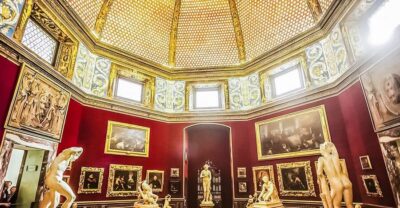
Skip-The-Line Uffizi Gallery Timed Entry Ticket
Read our review →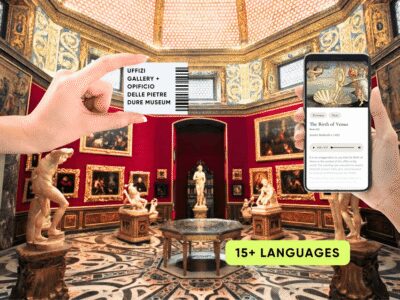
Uffizi Priority Ticket & Masterpieces Audio App
Read our review →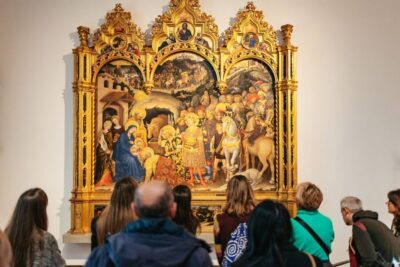
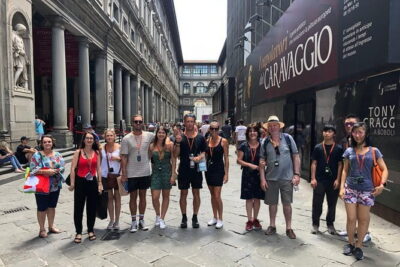

Skip the line: Uffizi and Accademia Small Group Walking Tour
Read our review →
Uffizi Gallery and Accademia Gallery Guided Tour
Read our review →
Uffizi Gallery Small-Group Guided Tour with Ticket
Read our review →
Michelangelo’s David, Accademia & Uffizi Small Group Tour
Read our review →Browse the lists this tour appears in