
Reviewed · ACCADEMIA GALLERY TOURS
Florence: Tour for Kids w/ Michelangelo Statue of David
Michelangelo’s David is the star here, but the real idea is to turn Florence into a city-sized lesson for children. You walk from famous square to famous square, then enter the Academy Gallery with a skip-the-line ticket to see the marble giant in person. The private format lets the guide adjust the pace and attention to your family.
I like the way the tour links major sights instead of treating the David as an isolated museum stop. I also like the child-focused approach: guides such as Martina and Berna have used games, questions, challenges, and small prizes to keep children involved. The main caution is that the experience depends heavily on the guide. One family found the talk too much like a long monologue, so this works best if you confirm that your guide plans active games for your children.
In This Review
- Key points at a glance
- Why David works as the grand finale
- Starting near Neptune in Piazza della Signoria
- Santa Croce and Michelangelo’s tomb
- Ponte Vecchio and the view toward the hills
- The political heart, the old market, and Porcellino
- Piazza della Repubblica and the cathedral
- Entering the Academy Gallery for David
- How well does the tour engage children?
- The $259 price and what you receive
- Who should book this Florence family tour?
- Should you book it?
- FAQ
- How long does the Florence family tour last?
- Where is the meeting point?
- Is Michelangelo’s David included?
- What languages are available?
- Is this a private tour?
- What should I bring?
Key points at a glance
- Michelangelo’s David: Enter the Academy Gallery with skip-the-line admission to see Florence’s most famous statue.
- A private family route: Walk with your own group rather than joining a large public tour.
- Kid-friendly challenges: The strongest guides have used games, curiosities, questions, and small rewards.
- Florence’s greatest hits: Cover Santa Croce, Ponte Vecchio, Piazza della Signoria, the old market, Piazza della Repubblica, and the cathedral area.
- A manageable 2.5 hours: Long enough for a useful introduction, short enough for many school-age children.
- A high but explainable price: At $259 per person, the value rests on private guiding, skip-the-line access, and a family-centered approach.
Why David works as the grand finale
Florence can be a tough sell to children. Adults see the political drama, church art, and Renaissance ideas. Children often see another square, another statue, and another long explanation.
This tour has a clear payoff. You move through the center of Florence, hear the stories behind its buildings, and finish with Michelangelo’s David at the Academy Gallery. The statue gives the walk a purpose, and the guide has a natural question to return to: how did Florence produce a sculpture this large, detailed, and famous?
You should not expect a full museum tour. The activity lasts 2.5 hours and combines outdoor walking with indoor visits, so the Academy Gallery is one part of a broader introduction to the city. That balance is useful for families. You get art, architecture, public squares, and city views without spending the whole morning inside a museum.
The private setting is another real advantage. Your children can ask basic questions without feeling shy, and you can ask the guide to slow down, repeat a point, or move on. One family with two boys, ages 8 and 6, found the pace comfortable, while another guide was praised for resting when older family members needed a break. Those details matter more than a packed list of sights.
More Accademia and David visits:
- Florence: Timed Entrance Ticket to Michelangelo’s David
★ 4.6 · 16,983 reviews - Florence: Michelangelo’s David Skip-the-Line Entry Ticket
★ 4.5 · 12,764 reviews - Florence Accademia Gallery Tour with Entrance Ticket Included
★ 4.5 · 6,148 reviews
Starting near Neptune in Piazza della Signoria
The stated meeting point is Piazza della Signoria, behind the Fountain of Neptune. This is one of Florence’s best starting places because the square gives you an immediate lesson in power, sculpture, and public space.
The tour information also describes Santa Croce as an opening point, with Michelangelo’s tomb inside the church. Because the exact route and meeting details appear in more than one place, confirm the start point when you book. The practical meeting instruction provided for this experience is behind Neptune in Piazza della Signoria.
Piazza della Signoria was the political heart of Florence. Here you see Palazzo Vecchio, the historic seat of Florentine government, and the Loggia, an open arcade filled with sculpture. The Uffizi Gallery occupies the side of the square toward the Arno. The guide can use these buildings to explain how Florence was governed and how art served public life.
This is a good place for a child-focused guide to begin. The square has large visual details, statues, towers, and stories about rulers and artists. A guide who uses a treasure hunt or a short challenge can turn the first stop into a game rather than a lecture.
The experience is offered in English or Italian. The exact guide is not guaranteed, but past family bookings have included Martina, Berna, Emilia, Rachele, and Ila. Martina was praised for keeping children aged 10 and 7 involved throughout. Berna used stories, curiosities, challenges, sweets, and prizes. Emilia was praised for making Florence’s history interesting. These examples show the intended tone, but you should still ask for a playful, interactive approach when arranging the tour.
Santa Croce and Michelangelo’s tomb
Santa Croce is described as part of the route, with Michelangelo’s tomb inside the church. This gives the guide a useful way to connect the living city with the artist whose David you will see later.
Michelangelo’s tomb is not the same thing as seeing David, of course. The tomb provides context, while the Academy Gallery provides the main artistic encounter. A child may understand the connection more easily when the guide presents Michelangelo first as a person buried in Florence, then as the sculptor behind the enormous marble figure.
The church itself is also important for architecture and decoration. Still, this stop may work better as a short story than as a long interior explanation. Young children can follow a simple thread: Florence honored its artists, Michelangelo worked in marble, and one of his most famous works waits later in the tour.
The supplied details do not make clear whether Santa Croce is visited inside on every version of the route or simply used as a meeting or reference point. Ask the guide at the start if entering the church is essential to your plan, especially if your family has limited patience for interiors.
Ponte Vecchio and the view toward the hills
The walk continues through central Florence toward Ponte Vecchio. The bridge crosses the Arno and provides the tour’s main open-air view, with hills surrounding the city.
For children, the bridge is a welcome change from churches and government buildings. You get movement, water, changing views, and a clear sense of Florence as a real city rather than a string of museum rooms. The guide can point out how the bridge fits into the city’s street plan and why it remains one of Florence’s most recognizable sights.
Do not expect a long photo stop unless your private guide chooses to allow one. The tour has several major stops packed into 2.5 hours, including the Academy Gallery. If your family likes taking its time for photographs, tell the guide early. A private tour gives you some flexibility, but it does not create unlimited time.
Comfortable shoes are essential. You will walk between squares and sights, and the experience is partly outdoors. A sun hat is also recommended, especially for a midday departure. There is no hotel pickup or drop-off, so you must reach the city-center meeting point on your own.
More Renaissance art days:
- The Best tour in Florence: Renaissance & Medici Tales – guided by a STORYTELLER
★ 5.0 · 12,316 reviews - The Best Tour in Florence: Renaissance and Medici Tales
★ 5.0 · 10,810 reviews - Florence: Timed Entry Ticket to Michelangelo’s David & eBook
★ 4.6 · 4,049 reviews - Michelangelo’s David, Accademia & Uffizi Small Group Tour
★ 4.5 · 1,986 reviews
The political heart, the old market, and Porcellino
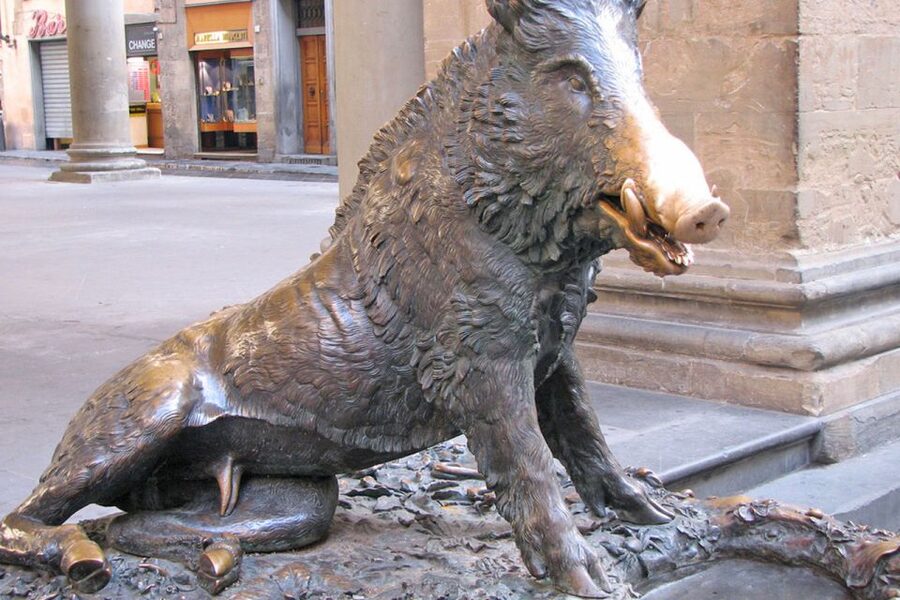
After the major squares, the route includes the old market and the Porcellino. The Porcellino is the famous bronze boar near the market, a small stop with an obvious appeal for children.
The tour description says you will play with good fortune at Porcellino. That is the sort of simple physical ritual that can break up a history talk. Children may not remember every date or architectural term, but they are more likely to remember a statue, a lucky gesture, and a challenge from the guide.
This part of Florence also helps you see the city at street level. The market area feels less formal than Palazzo Vecchio or the cathedral. It gives the guide a chance to explain how people shopped, met, and moved through the center.
The risk is time. The route covers many places, and each stop cannot receive a full explanation. I would treat the old market and Porcellino as short, lively moments rather than major visits. If your children are tiring, this is a good place to let the guide shorten the talk and keep everyone moving toward the Academy Gallery.
Piazza della Repubblica and the cathedral
Piazza della Repubblica brings another change of scale. The square is broad and open, and it can help children understand how Florence’s center developed around public spaces.
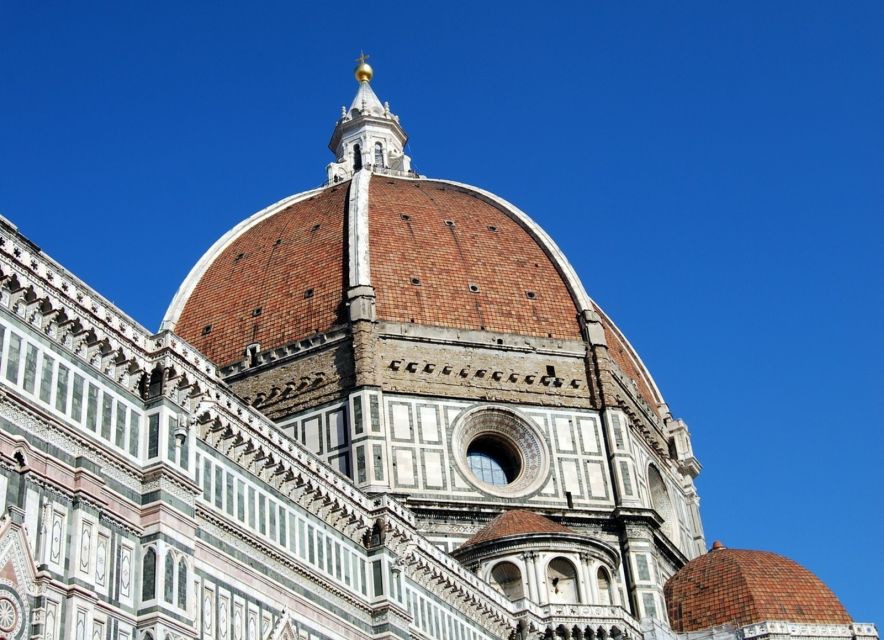
The route then reaches the great cathedral, officially known as Santa Maria del Fiore. The tour highlights its carefully preserved marble decoration and Brunelleschi’s dome, one of the defining works of Renaissance Florence.
The dome is especially useful for a family tour because its basic story is easy to grasp. Florence wanted a huge dome, Brunelleschi proposed a daring plan, and building it was difficult. The result became a symbol of the city and of Renaissance ambition.
Be clear about what is included. The supplied information says you will visit the cathedral, but it does not promise entry to the dome, the bell tower, or the cathedral museum. This is a walking tour with a cathedral stop, not a dome-climbing experience. If climbing Brunelleschi’s dome is a priority, you will need to arrange that separately.
The cathedral area can also be crowded and visually overwhelming. A good guide will give your children one or two things to look for, such as the marble patterns, the dome’s size, or a particular architectural detail. That is more effective than trying to explain every part of the building.
Entering the Academy Gallery for David
The Academy Gallery is the indoor anchor of the tour. Skip-the-line admission is included, which can be a major help in Florence, where museum queues can eat into a family’s limited sightseeing time.
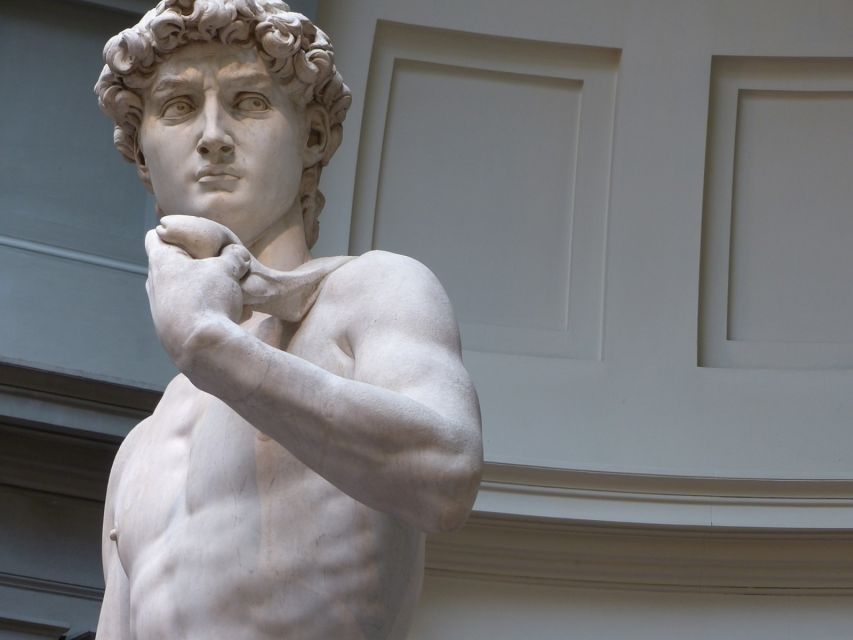
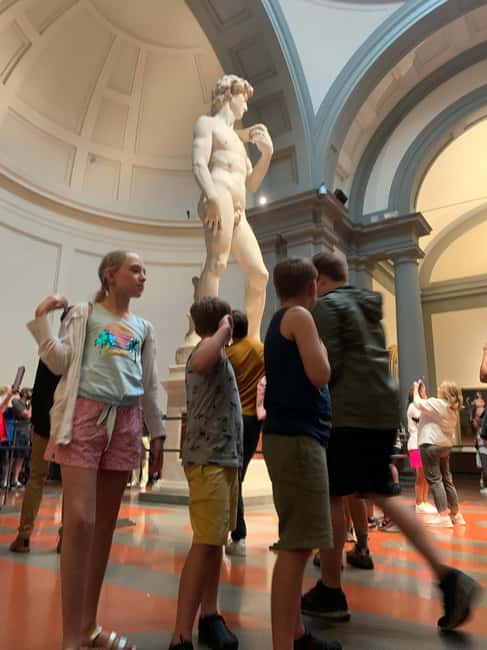
The Academy is famous for David, but the statue’s scale is what makes the visit work so well for children. Photographs do not fully prepare you for the height, the posture, and the amount of detail in the marble. The guide can point out the sculpture’s physical features and connect them to the stories you heard while walking through Florence.
The tour does not promise an extended examination of every work in the gallery. That is probably a benefit for younger children. You get the main artistic experience without turning the morning into a museum marathon.
The skip-the-line benefit also has a practical value beyond convenience. Children often cope poorly with standing in a slow queue, especially after walking through the city. Moving more directly inside helps preserve their attention for David, which is the moment you are paying to reach.
Bring a passport or ID card. Full names and dates of birth for everyone in the party must be sent immediately after booking, so do not leave that task until the day before the tour. The skip-the-line entrance is included, but food and drinks are not, so carry water and plan any snack stop yourself.
How well does the tour engage children?
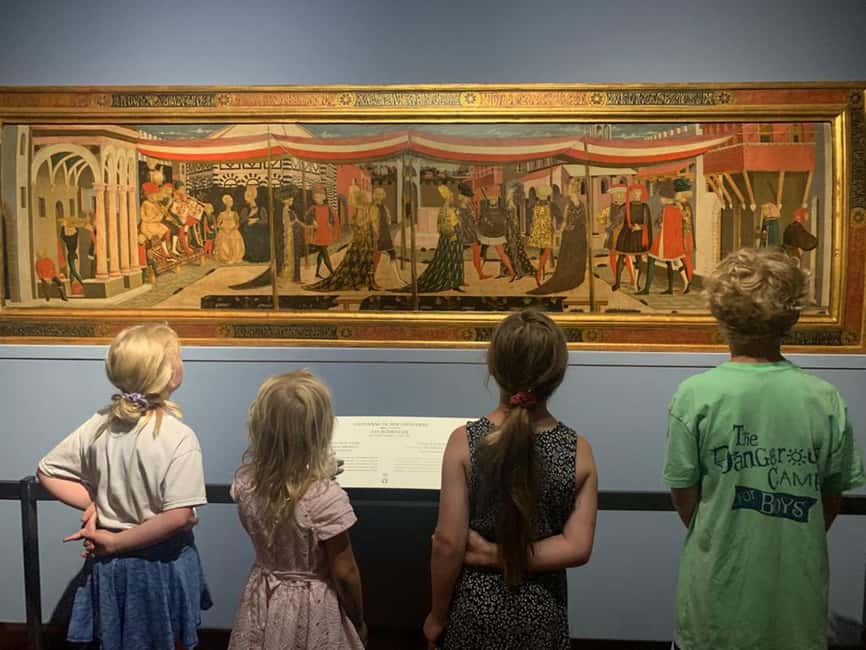
The best evidence comes from the guide style. Martina kept a 10-year-old and a 7-year-old involved with a game. Berna used curiosities, challenges, and small prizes with children aged 8 and 6. Another family traveling with a 4-year-old called it the child’s favorite tour in Italy.
That points to a tour designed for a wide age range, from preschool age through early school years and beyond. Younger children may respond to lucky rituals and prizes. Older children may enjoy the political stories, the engineering challenge of the dome, and the question of how David was carved.
Still, the format is not automatically playful. One French-speaking family expected games, visual exercises, and interaction but received what felt like two hours of talking. That is the clearest warning in the available feedback.
I would send a direct request before the tour: ask the guide to use games, questions, and short challenges, and say how old your children are. If your children need constant activity, this step is important. The private format gives you a chance to shape the tone, but you should not assume every guide will use the same methods.
The $259 price and what you receive
At $259 per person, this is not a budget walking tour. The price needs to be judged against what you receive: a private group, a local guide, a 2.5-hour route, and skip-the-line entry to the Academy Gallery.
For a family of four, the total cost becomes substantial. The private format can still make sense if your children would struggle in a large group, if you want to set the pace, or if avoiding the Academy queue matters to you. It is also useful when grandparents or a younger child are joining, since the group can pause or adjust its walking speed.
The value is weaker if you mainly want a quick visit to David and already know Florence well. In that case, a less expensive museum ticket and self-guided walk may be enough. You are paying here for the guide’s ability to connect the city’s major sights and present them in a way children can follow.
The past guide experiences suggest the price is best justified when you get an energetic guide. Martina, Berna, Emilia, and Ila were all specifically praised for their work, while one family felt the format was too talk-heavy. The guide is the central variable.
Free cancellation up to 24 hours before the start and reserve-now, pay-later booking add useful flexibility. The tour is wheelchair accessible, although the amount of city walking and the exact indoor route are still worth confirming for your group.
Who should book this Florence family tour?
I would choose it for families who want a private introduction to Florence and who do not want to plan a separate city walk and Academy visit. It suits children who can manage 2.5 hours of walking with regular changes of scene.
It is particularly appealing for families with children around 6 to 10, based on the ages that responded well to the games and challenges. A 4-year-old may also enjoy it, but you should make your child’s age and attention span clear to the guide.
I would be more cautious if your family wants a quiet, detailed art lecture. The tour is built around movement and child-friendly storytelling, not a specialist study of Michelangelo. I would also think twice if the price is difficult to absorb or if you already have Academy tickets and a good plan for seeing Florence independently.
Should you book it?
Book this tour if David is important, you want a private guide, and keeping children interested matters more than finding the cheapest possible route. The combination of Florence’s main squares, the cathedral area, Ponte Vecchio, and the Academy Gallery gives you a useful first look at the city.
Before paying, confirm the meeting point behind Neptune, tell the provider your children’s ages, and request an interactive guide. If you receive the kind of guide described in the strongest experiences, the games and challenges can turn a standard sightseeing walk into a family highlight. If the guide relies on a long lecture, the same itinerary may feel tiring, especially for younger children.
FAQ
How long does the Florence family tour last?
The tour lasts 2.5 hours.
Where is the meeting point?
The stated meeting point is Piazza della Signoria, behind the Fountain of Neptune. The tour information also refers to Santa Croce, so confirm the exact starting arrangement when booking.
Is Michelangelo’s David included?
Yes. The tour includes a visit to the Academy Gallery to see Michelangelo’s David, with skip-the-line entrance fees included.
What languages are available?
The live guide is available in English or Italian.
Is this a private tour?
Yes. It is described as a private walking tour for a private group.
What should I bring?
Bring a passport or ID card, comfortable shoes, and a sun hat. You must also provide the full names and dates of birth of everyone in your party immediately after booking.
Latest additions around Florence
- Florence: Cathedral Tour & Brunelleschi’s Dome Climb Ticket★ 5.0 · 3 reviews
- Palatina Gallery and Pitti Guided Tour in Florence★ 5.0 · 3 reviews
- Florence Uffizi Gallery Skip-the-line Tour w Art Historian Guide★ 5.0 · 3 reviews
- Private Tour: Pisa and Lucca from Florence★ 5.0 · 3 reviews
- San Gimignano Bike Tour (SOFT)★ 4.5 · 3 reviews
- Florence: Tour of Florence by rickshaw★ 5.0 · 3 reviews
- Center of Florence by golf cart★ 5.0 · 3 reviews
- From Firenze | Chianti day tour in a classic car★ 5.0 · 3 reviews
Accademia Gallery Tours, compared.

Timed Entrance Ticket to Michelangelo’s David
Read our review →
Michelangelo’s David Skip-the-Line Entry Ticket
Read our review →
Florence Accademia Gallery Tour with Entrance Ticket Included
Read our review →

Timed Entry Ticket to Michelangelo’s David & eBook
Read our review →
Skip the line: Uffizi and Accademia Small Group Walking Tour
Read our review →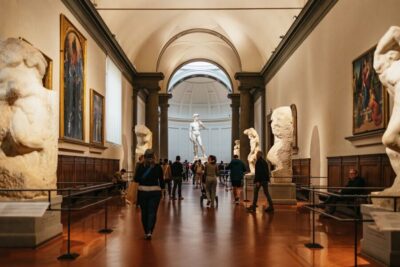

Accademia Gallery Guided Tour with Entry Ticket
Read our review →Browse the lists this tour appears in