
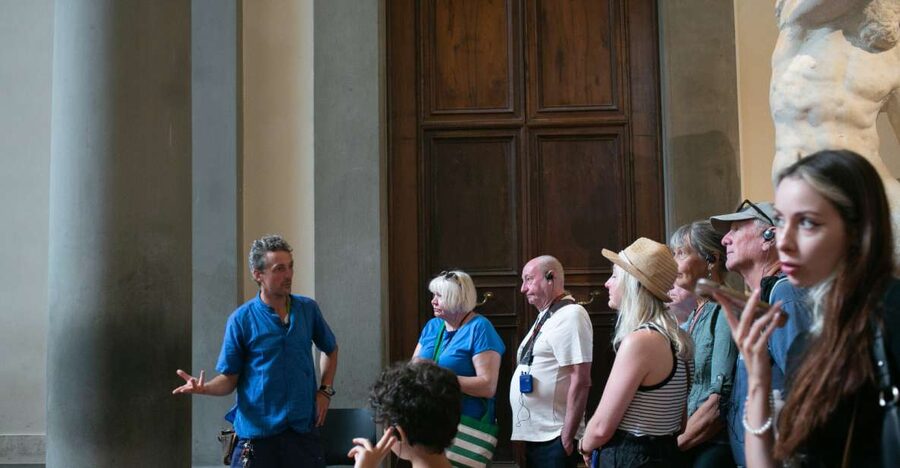
Reviewed · ACCADEMIA GALLERY TOURS
Florence: Michelangelo’s David and Accademia Gallery Tour
Michelangelo’s David is easy to admire and surprisingly easy to misunderstand. This tour uses David, the Prisoners, and the Sistine Chapel as parts of one larger idea, presented by native Florentine guide Mario Gesu, a historical researcher and performer of Dante’s Divine Comedy. I like the clear link between Michelangelo’s young and mature work, and I like that the discussion invites you to think rather than simply memorize dates. The main consideration is that Mario’s approach can feel philosophical and abstract if you want only a traditional art-history tour.
I also like the 75-minute length. You get a focused look at the Accademia’s essential works, then remain in the museum to continue on your own. The one point I would check carefully before paying is the ticket arrangement: the activity details say museum tickets are included, but one booking account reported paying an additional entrance charge. Confirm exactly what your final price covers.
In This Review
- Key points to know before booking
- Why this Accademia tour is different from a standard David visit
- Meeting Mario outside the Accademia
- Entering the Accademia and seeing David
- David as the high point of Michelangelo’s early style
- The Prisoners and Michelangelo’s mature style
- The red thread to the Sistine Chapel
- An interactive tour for different ages
- What the 75-minute schedule gives you
- Is $57 a fair price?
- Who should book this experience?
- Practical details that make the visit easier
- Should you book Mario Gesu’s David tour?
- FAQ
- How long does the Accademia Gallery tour last?
- What language is the tour offered in?
- Who is the guide?
- Where is the meeting point?
- How early should I arrive?
- Does the tour include skip-the-line entry?
- Are museum tickets included?
- Can I stay in the museum after the guided tour?
- Is the tour wheelchair accessible?
- What can I cancel or change after booking?
Key points to know before booking
- David is only the beginning: The tour treats the famous statue as the peak of Michelangelo’s early style, not the whole story.
- The Prisoners show a later Michelangelo: You compare the finished David with sculptures that seem to struggle out of the marble.
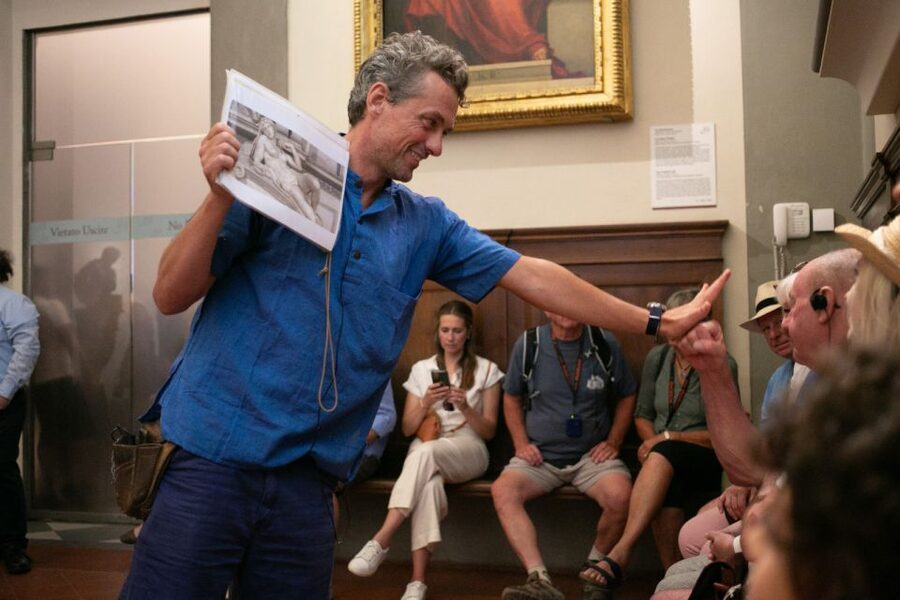
- A Florentine guide leads the way: Mario Gesu brings local knowledge, theatrical energy, and a personal theory about Michelangelo’s work.
- The Sistine Chapel connection matters: You examine the artistic thread linking David with The Creation of Man.
- Questions are part of the method: You are encouraged to offer ideas and test the guide’s interpretation.
- You can stay after the tour: The guided portion ends after about 75 minutes, but the gallery visit can continue independently.
Why this Accademia tour is different from a standard David visit
Many people enter the Accademia with one goal: see David, take a photo, and move on. That is perfectly reasonable. David is one of the world’s most famous sculptures, and the first view of him in the Tribune is powerful even if you know very little about art.
This experience takes a different path. Mario begins with David as the high point of Michelangelo’s early career, then asks you to look nearby at the Prisoners as evidence of a later, more mature style. The contrast gives the visit a useful shape. Instead of hearing disconnected facts about separate sculptures, you follow an argument about how Michelangelo’s creative thinking changed.
The tour also connects sculpture with painting. Its central idea is a red thread running from David to the Sistine Chapel, particularly to The Creation of Man. You do not need to have visited the Vatican Museums to follow the discussion, though the connection may mean more if you have seen the Sistine ceiling or plan to see it later.
I find this format valuable because it gives you a way to look at Michelangelo after you leave the gallery. You are not just told that David is important. You are given a framework for considering ambition, creation, struggle, and spiritual purpose in the artist’s work.
More Accademia and David visits:
- Florence: Timed Entrance Ticket to Michelangelo’s David
★ 4.6 · 16,983 reviews - Florence: Michelangelo’s David Skip-the-Line Entry Ticket
★ 4.5 · 12,764 reviews - Florence Accademia Gallery Tour with Entrance Ticket Included
★ 4.5 · 6,148 reviews
Meeting Mario outside the Accademia
The meeting point is the ATM machine at the Libreria evangelica, directly in front of the Accademia entrance. Arrive 15 minutes early. Florence’s museum entrance area can be busy, and the guide needs time to gather the group before the scheduled entry.
Mario is described as a native Florentine, but his background also shapes the tone of the tour. He performs Dante’s Divine Comedy at restaurants and city events, so expect a guide who uses voice, gesture, stories, and questions rather than a flat recitation.
That theatrical side will appeal to families, couples, and friends who want a lively presentation. It also helps with mixed-age groups. Children may not follow every spiritual or artistic point, but the use of images and metaphors is intended to make the ideas understandable to younger visitors.
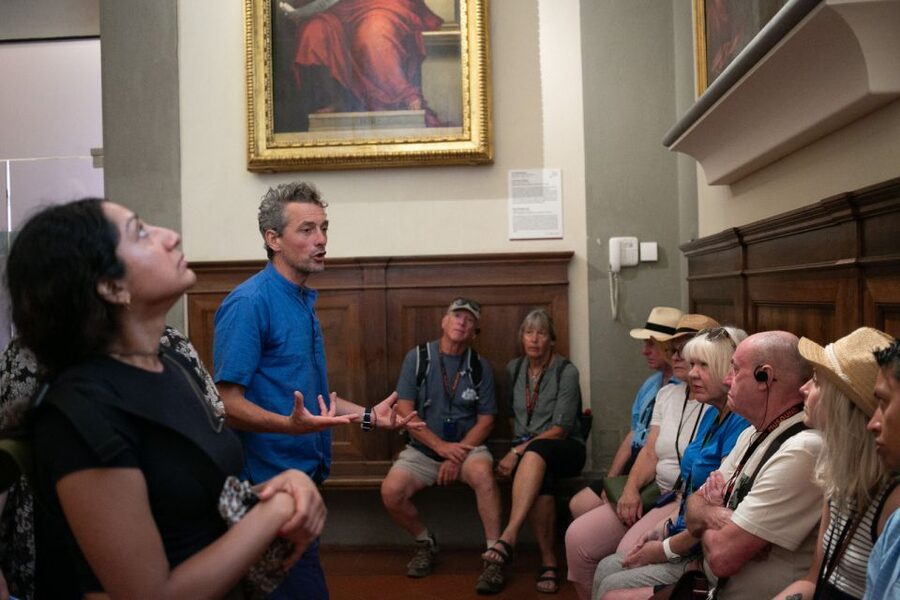
You will receive headsets so you can hear the guide inside the museum. Bring your own headphones as requested in the practical information, along with cash and any required identification for children. The instructions also ask you to carry a disability card if relevant.
Entering the Accademia and seeing David
The tour includes skip-the-ticket-line entry, but do not read that as a promise of walking straight into the museum with no waiting at all. The Accademia uses timed or grouped admission, so you may still queue after bypassing the main ticket line. One detailed account specifically praised the skip-the-line arrangement while explaining that a short queue remained for the scheduled entry.
Mario may begin explaining David while the group waits. That is a sensible use of time, especially in a city where a few minutes outside a museum can otherwise feel wasted. Keep your group together and be punctual. Late arrivals can disrupt a small guided group, and the instructions ask you to be available by phone and email the day before in case of last-minute messages.
Inside, the first major stop is David. The statue is more than a quick photo opportunity here. Mario’s discussion asks you to consider what the sculpture meant to Michelangelo and how its design reflects the artist’s early style.
The experience is not presented as a list of measurements, dates, and technical labels. Instead, Mario builds a discussion around the act of creation. He uses questions to draw you into the subject, so you may be asked to look closely, form an opinion, and then compare your response with his interpretation.
That format has a clear benefit: you remember an idea you have helped examine more easily than a paragraph you simply heard. It also has a limit. If you prefer a tightly organized lecture with settled conclusions, the open-ended method may feel less direct.
David as the high point of Michelangelo’s early style
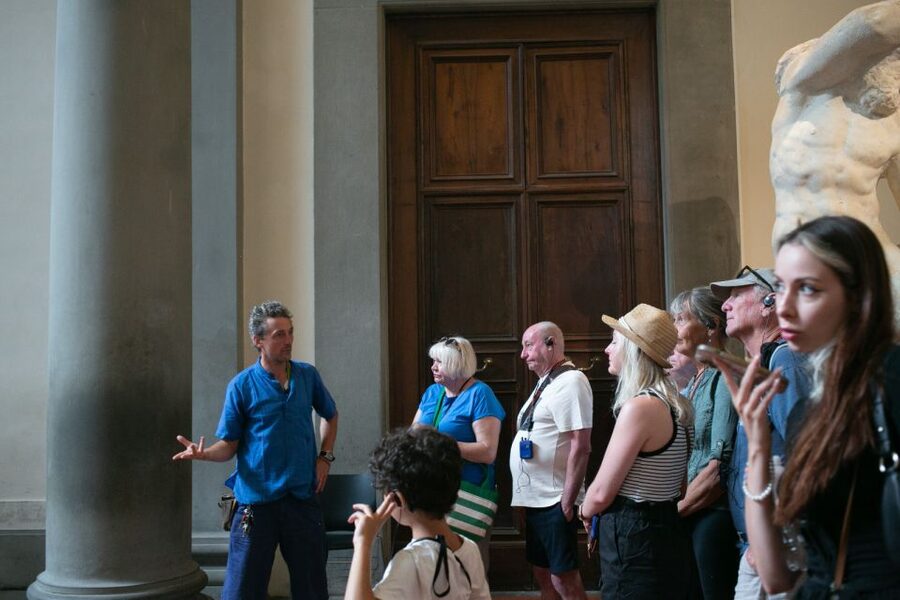
The tour treats David as the pinnacle of Michelangelo’s early work. That gives the statue a place in a larger career rather than presenting it as an isolated masterpiece.
You examine the young Michelangelo’s style and the qualities that make David so memorable. The guide then prepares you to look beyond the finished surface. The point is not simply that David is beautiful, but that it represents one stage in the artist’s development.
This is where the tour’s spiritual reading enters the conversation. Mario presents a message behind the work, using metaphors and broader comparisons across Michelangelo’s art. You may find his interpretation moving, especially if you like art approached through ideas about human purpose and inner life.
At the same time, you should understand that this is an interpretation, not a standard audio-guide script. The tour is built around Mario’s research and theory, including material connected with a book he is writing. Some people will find the originality refreshing. Others may want more conventional background on patronage, politics, or workshop practice.
The best way to approach David here is with curiosity. You do not need an art degree, and you do not need to agree with every conclusion. Listen for the links between the visual details and the larger message, then decide what makes sense to you.
More Renaissance art days:
- The Best tour in Florence: Renaissance & Medici Tales – guided by a STORYTELLER
★ 5.0 · 12,316 reviews - The Best Tour in Florence: Renaissance and Medici Tales
★ 5.0 · 10,810 reviews - Florence: Timed Entry Ticket to Michelangelo’s David & eBook
★ 4.6 · 4,049 reviews - Michelangelo’s David, Accademia & Uffizi Small Group Tour
★ 4.5 · 1,986 reviews
The Prisoners and Michelangelo’s mature style
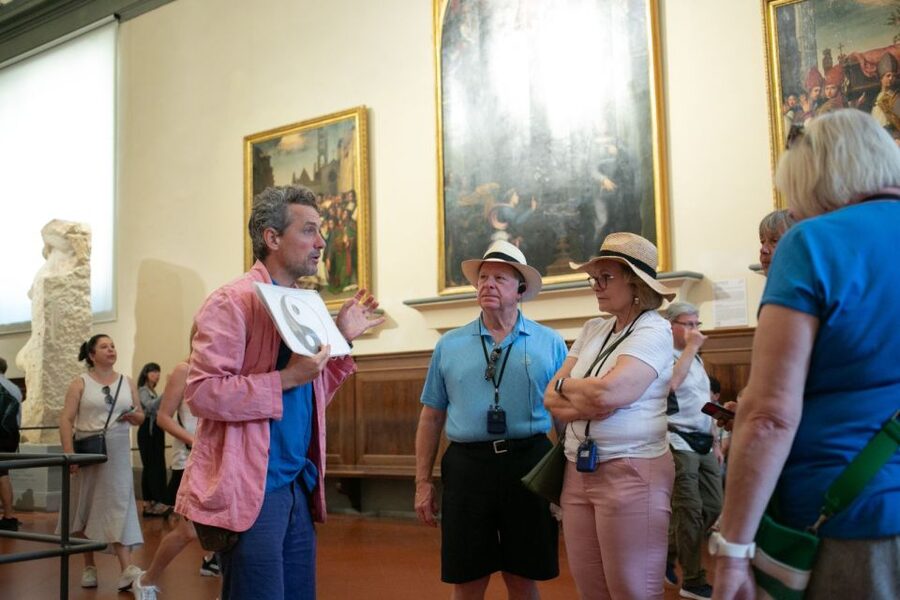
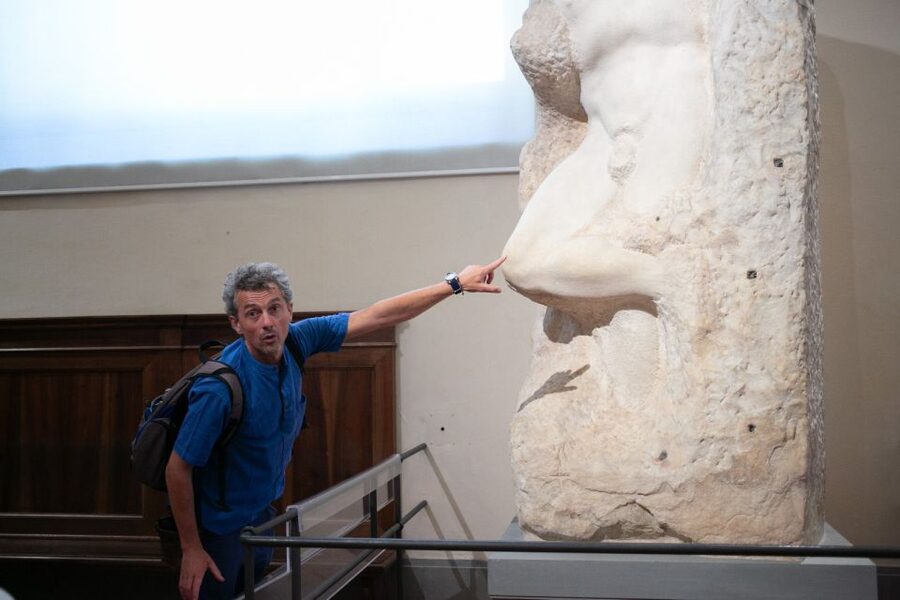
A few meters away, the Prisoners change the mood. These sculptures are associated with Michelangelo’s unfinished method, with figures that appear to be emerging from the stone rather than fully separated from it.
The tour uses them as a counterpoint to David. David represents the confident young style. The Prisoners point toward a mature artistic language, one that leaves the struggle between stone and figure visible.
This comparison is one of the strongest parts of the experience because you can make it in person, without crossing the city or relying on reproductions. Look first at David, then at the Prisoners, and you can see why the guide presents them as stages in one creative journey.
Mario’s method asks you to think about the process rather than only the finished result. The Prisoners become more than incomplete sculptures. They support the tour’s larger discussion of creation, limitation, and the spiritual meaning of bringing form out of matter.
This is also the point at which the tour may become less literal. The guide’s conclusions can feel expansive, and one detailed assessment described the approach as academic and occasionally abstract. I would not book this experience expecting a simple explanation of every gallery object. Book it if you want to consider what Michelangelo may have been saying through the way he worked.
The red thread to the Sistine Chapel
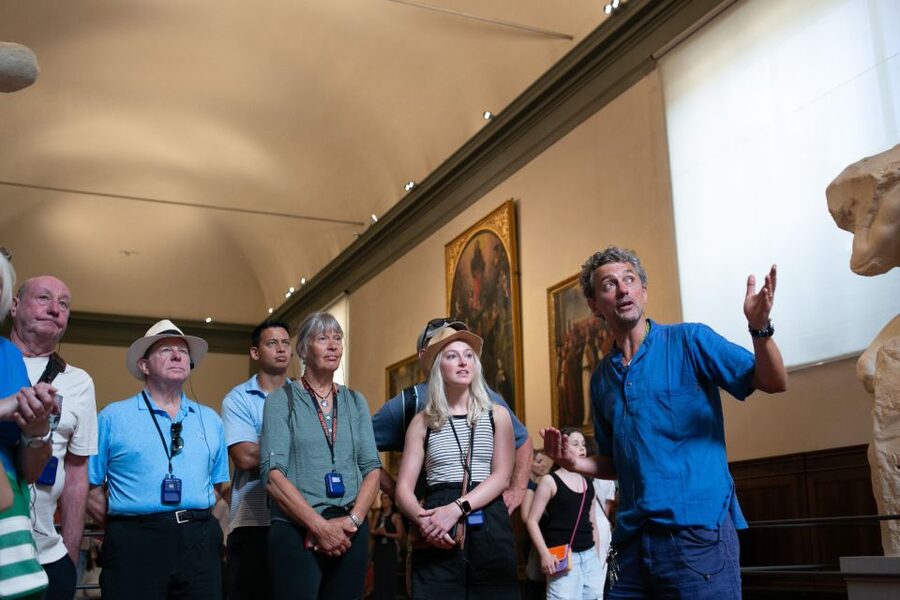
The promised connection between David and the Sistine Chapel gives the tour its wider reach. You remain in the Accademia, but the conversation moves beyond the two main sculptural stops.
The link concerns Michelangelo’s creative world and the way his ideas appear across different types of work. The Creation of Man becomes part of the discussion, allowing you to compare the physical language of sculpture with the grand painted scenes of the Sistine ceiling.
This is especially useful if you have already visited the chapel. You may recognize images and themes from Rome and view them from a new angle in Florence. If the chapel is still ahead in your itinerary, the discussion can prepare you to look for connections rather than treating the ceiling as a separate event.
Do not expect a full tour of the Sistine Chapel. You are not seeing those works during this activity, and the focus remains on David, the Prisoners, and Michelangelo’s creative process. The value is the connection, not a substitute for a visit to Rome.
An interactive tour for different ages
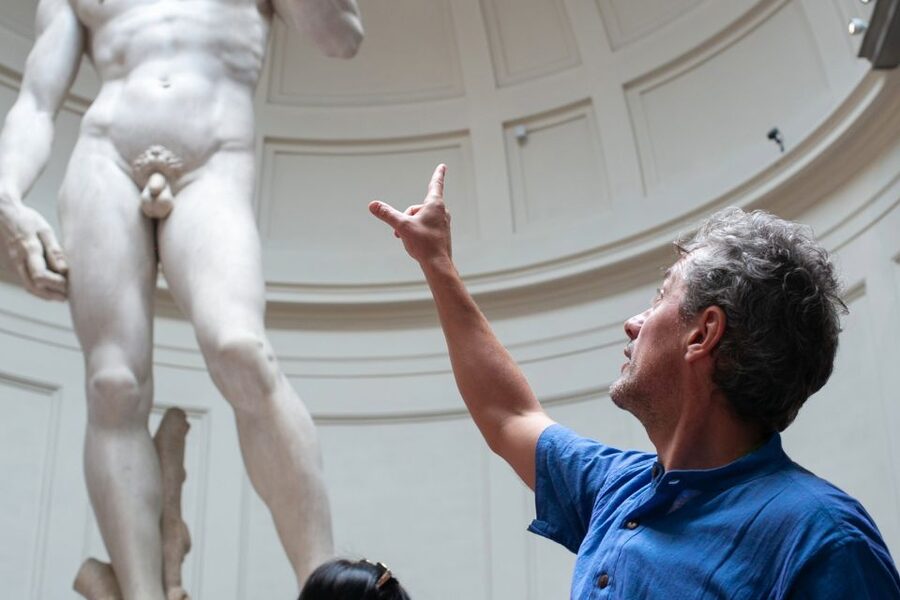
The tour is designed around questions. Mario encourages participation, asks for reactions, and uses simple metaphors to explain ideas that could otherwise become heavy.
This worked well for groups with different ages and levels of art experience. Families can follow the broad story without already knowing Renaissance terminology. Adults who have read about Michelangelo can engage with the more unusual theory and spiritual reading.
I would still set expectations carefully. Interactive does not mean a hands-on activity with the sculptures. You look, listen, discuss, and respond. The group format also means you will not receive the same level of personal attention as on a private tour.
The group can be as large as 19 people, based on one detailed account. That is still manageable with headsets, but it is not an intimate private visit. Mario’s energy appears to be important here. His presentation style helps keep a larger group involved, though anyone seeking quiet, contemplative museum time may find the commentary demanding.
What the 75-minute schedule gives you
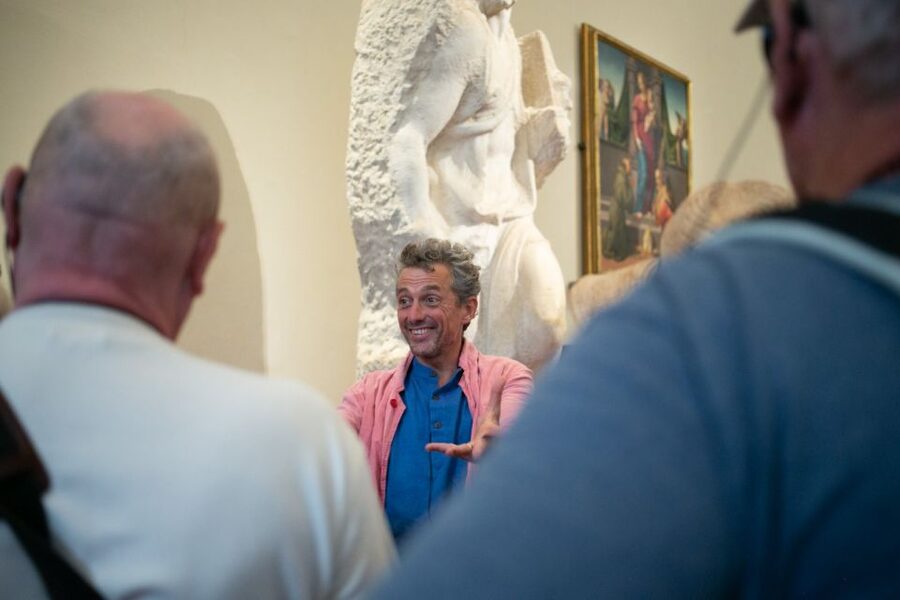
Seventy-five minutes is enough for a concentrated Accademia visit. You focus on the museum’s headline Michelangelo works instead of trying to cover every room at speed.
The likely rhythm is simple:
- Meet outside 15 minutes before the start.
- Join the timed entry process and hear an introduction while waiting.
- Examine David as Michelangelo’s early masterpiece.
- Compare David with the Prisoners and the unfinished technique.
- Discuss the spiritual message and the connection to the Sistine Chapel.
- End the guided portion and continue through the museum independently.
The final point matters. You are not rushed out when Mario finishes. You can remain inside and explore the Accademia at your own pace, provided the museum’s entry rules allow it at that time.
I like this combination because the guide gives you structure, then leaves room for personal discovery. You can revisit David, spend longer with the Prisoners, or look at other parts of the museum without paying for another guided hour.
Do not schedule another close activity afterward. The practical advice recommends leaving at least two hours between experiences. That gives you time for entry delays, the guided visit, independent viewing, and a relaxed walk through Florence.
Is $57 a fair price?
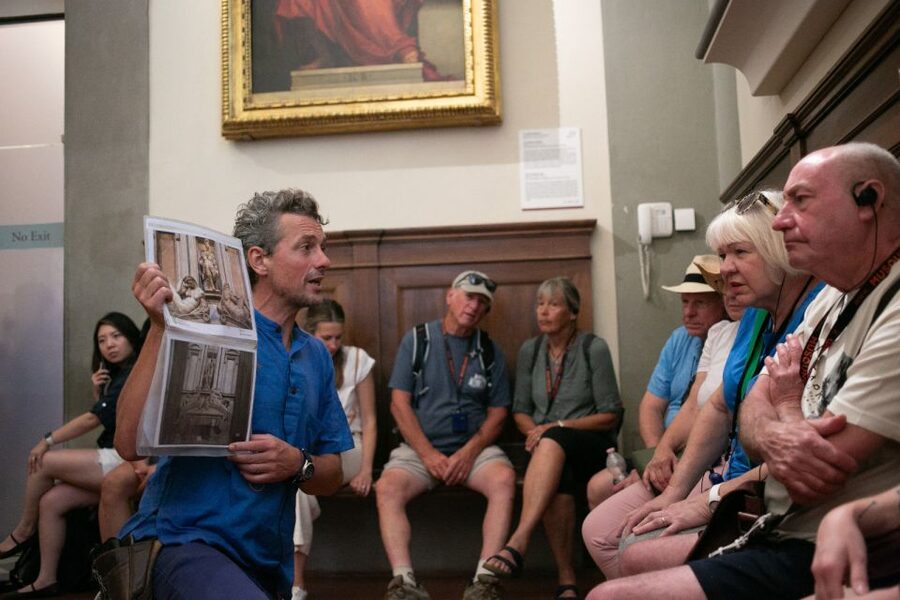
At $57 per person, this is not the cheapest way to enter the Accademia. You are paying for more than a museum admission, though. The price covers a live English guide, headsets, the guided visit, and the chance to hear a specific interpretation of Michelangelo’s work from a native Florentine researcher.
The value depends on your preferred travel style. If you already have strong art-history knowledge and enjoy reading wall labels alone, a regular admission may be enough. If you want help seeing relationships between David, the Prisoners, and the Sistine Chapel, the added cost can make sense.
The guide’s personal presentation is central to the value. The strongest praise focuses on Mario’s passion, warmth, clear explanations, and ability to involve people of different ages. Several detailed accounts describe the visit as more thoughtful than a standard tour, with an emphasis on meaning rather than facts and figures.
Before booking, confirm the ticket terms. The supplied activity details list museum tickets as included, but one account says the entrance fee was charged separately and notes that the booking information had disclosed this elsewhere. Check the final reservation page so the $57 price does not surprise you.
Free cancellation up to 24 hours before the start and reserve-now, pay-later booking add useful flexibility. The experience is wheelchair accessible, and the available language is English.
Who should book this experience?
I would choose this tour for:
- Couples who want an art visit with room for reflection.
- Families looking for a guide who can explain difficult ideas through stories and images.
- First-time art visitors who want more than a quick look at David.
- People interested in spirituality, symbolism, anthropology, or the creative process.
- Repeat museum visitors who want a fresh argument about Michelangelo.
- Anyone who enjoys a guide with a strong personality and theatrical delivery.
I would choose a different format if you want a broad tour of the entire Accademia, detailed coverage of every artist, or a quiet visit with minimal commentary. This experience is tightly focused and shaped by Mario’s personal interpretation.
Also think about your group. A family or group of friends can enjoy the questions and discussion. A visitor who dislikes guided tours may find the format more engaging than expected, but the abstract sections can still feel outside the usual museum routine.
Practical details that make the visit easier
Meet at the ATM machine beside the Libreria evangelica, directly opposite the Accademia entrance, 15 minutes early. Keep your phone and email available the day before for possible updates.
The activity is in English and lasts 75 minutes. Headsets are supplied, and you should bring headphones as requested. Bring identification for children, cash, and a disability card if applicable.
Punctuality matters. Even if a late arrival has occasionally been accommodated, you should not count on that. Florence has plenty to see after the tour, so leave a generous gap before your next booking rather than trying to connect two timed activities.
The tour includes skip-the-ticket-line access, but timed museum entry can still involve a queue. That is normal for a popular museum and does not cancel the benefit of avoiding the main ticket line.
Should you book Mario Gesu’s David tour?
Book it if you want David to become the starting point for a larger conversation about Michelangelo’s art and spiritual ideas. Mario’s Florentine background, theatrical skill, and interactive method make this more personal than a basic explanation of the statue.
Skip it if you want only independent viewing, a strictly factual lecture, or a complete tour of every Accademia room. At $57, the experience earns its price through the guide’s interpretation, not through the museum ticket alone.
For the right audience, this is a thoughtful way to meet David. You see the famous sculpture, compare it with the Prisoners, and leave with a question to carry into the Sistine Chapel or your next Michelangelo visit.
FAQ
How long does the Accademia Gallery tour last?
The guided tour lasts 75 minutes.
What language is the tour offered in?
The live tour guide speaks English.
Who is the guide?
The guide is Mario Gesu, a native Florentine guide, historical researcher, and performer of Dante’s Divine Comedy at restaurants and city events.
Where is the meeting point?
Meet at the ATM machine of the Libreria evangelica, directly in front of the Accademia museum entrance.
How early should I arrive?
Arrive 15 minutes before the scheduled start time.
Does the tour include skip-the-line entry?
Yes. The activity includes skip-the-ticket-line access, although timed or grouped museum entry can still involve a queue.
Are museum tickets included?
The activity information lists museum tickets as included. However, one booking account reported paying an additional entrance charge, so confirm the exact ticket terms before completing your reservation.
Can I stay in the museum after the guided tour?
Yes. You can continue visiting the museum independently at the end of the guided portion.
Is the tour wheelchair accessible?
Yes, the activity is listed as wheelchair accessible.
What can I cancel or change after booking?
You can cancel up to 24 hours in advance for a full refund. The reserve-now, pay-later option lets you hold your plans without paying immediately.
More Museums Worth an Hour
- Florence: Skip-The-Line Uffizi Gallery Timed Entry Ticket
★ 4.5 · 27,832 reviews - Florence: Leonardo Interactive Museum Entry Ticket
★ 4.5 · 11,763 reviews - Uffizi Gallery Small Group Tour with Guide
★ 4.5 · 4,923 reviews - Florence: Accademia Gallery Guided Tour
★ 4.6 · 4,156 reviews
Latest additions around Florence
- Florence: Cathedral Tour & Brunelleschi’s Dome Climb Ticket★ 5.0 · 3 reviews
- Palatina Gallery and Pitti Guided Tour in Florence★ 5.0 · 3 reviews
- Florence Uffizi Gallery Skip-the-line Tour w Art Historian Guide★ 5.0 · 3 reviews
- Private Tour: Pisa and Lucca from Florence★ 5.0 · 3 reviews
- San Gimignano Bike Tour (SOFT)★ 4.5 · 3 reviews
- Center of Florence by golf cart★ 5.0 · 3 reviews
- Florence: Tour of Florence by rickshaw★ 5.0 · 3 reviews
- From Firenze | Chianti day tour in a classic car★ 5.0 · 3 reviews
Accademia Gallery Tours, compared.

Timed Entrance Ticket to Michelangelo’s David
Read our review →
Michelangelo’s David Skip-the-Line Entry Ticket
Read our review →
Florence Accademia Gallery Tour with Entrance Ticket Included
Read our review →

Timed Entry Ticket to Michelangelo’s David & eBook
Read our review →
Skip the line: Uffizi and Accademia Small Group Walking Tour
Read our review →

Accademia Gallery Guided Tour with Entry Ticket
Read our review →Browse the lists this tour appears in