
Reviewed · FLORENCE WALKING TOURS
Essential Florence Walking Tour with an Expert Local Guide
Florence reveals itself best at street level, where a palace façade, church doorway, or narrow lane can open onto a story about Medici power, artistic rivalry, murder, or betrayal. This three-hour walk links 12 major sights, from Orsanmichele and the Duomo to Palazzo Pitti and the Vasari Corridor, giving you a useful first map of the city.
I like the way the tour mixes famous landmarks with less obvious stops such as Palazzo Rucellai and Santa Felicita. I also like the practical pace, with time for bathroom breaks, a short rest or coffee stop, and local gelato along the way. The main consideration is that most stops last about 15 minutes, so you’ll usually hear the story and see the exterior rather than tour every interior in detail.
In This Review
- Key points to know before you book
- Why this Florence walk works as a first introduction
- Starting at Piazza della Repubblica
- Orsanmichele and Florence’s guild power
- Dante, the Duomo, and the Baptistery
- Santa Maria Novella and Renaissance design
- Palazzo Strozzi and Santa Trinita
- Crossing into Oltrarno at Palazzo Pitti
- What three hours really gets you
- Price, group size, and overall value
- Who will enjoy this walk most
- Booking, weather, and cancellation details
- Should you book the Essential Florence Walking Tour?
- FAQ
- Where does the tour start?
- What time does the tour begin?
- Where does the tour end?
- How long does the walking tour last?
- How many people can join the tour?
- Are admission tickets included?
- Can I cancel for a full refund?
Key points to know before you book

- Twelve historic stops in about three hours: You cover Florence’s central sights without spending a full day on one museum.
- Guides with strong personalities: Becky, Andrea, and Lisa have been singled out for warmth, storytelling, and clear explanations, though your assigned guide may differ.
- A useful first-day orientation: The route helps you decide which churches, palaces, and museums deserve a longer return visit.
- Gelato and rest time included: The walk is not a nonstop march, and bathroom breaks are built into the route.
- Mostly an outside look: Admission is free at the listed stops, but this is not a ticketed tour of the Duomo, Uffizi, or Palazzo Pitti interiors.
- Small groups are possible: The maximum is 20 people, while some departures have been much smaller.
Why this Florence walk works as a first introduction
Florence can feel compact on a map, but its landmarks pack in centuries of political, religious, and artistic change. A short walk across the historic center gives you much more than a checklist if someone explains why a façade looks the way it does, who paid for it, and what happened nearby.
That is the strength of this experience. You move from medieval guild culture to Dante, from the cathedral complex to Renaissance palaces, and then across the Arno into the former grand-ducal quarter. The guide supplies the links between the buildings, so the city begins to feel like one connected story rather than a row of unrelated photo stops.
The guides most often praised by name are Becky, Andrea, and Lisa. Becky is described as warm, funny, patient with questions, and especially good at making Florentine history easy to follow for both adults and younger people. Andrea has been praised for her command of the city, her willingness to answer questions, and her ability to adjust the walk when a group has particular interests. Lisa brings a personal connection to Italy and a playful storytelling style.
You should not assume you can choose one of these guides, but these names give you a good sense of the style to expect: personal, story-led, and more relaxed than a formal lecture. Headsets have also been useful on some departures, especially when the group is standing near traffic or a crowded piazza.
More walking routes in Florence:
- Florence: Guided Walking Tour
★ 4.5 · 3,334 reviews - Skip the line: Uffizi and Accademia Small Group Walking Tour
★ 4.5 · 3,135 reviews - Florence: Guided Walking Tour
★ 4.6 · 1,602 reviews
Starting at Piazza della Repubblica
The meeting point is Piazza della Repubblica at 9:00 a.m., a central location that makes sense for an early orientation walk. From here, the route heads into the historic heart of Florence, where grand cafés and broad urban space give way quickly to medieval streets.
A morning start is helpful. Florence’s main squares become busy, and narrow streets can be harder to manage later in the day. The early hour also gives you a chance to use the tour as a planning session for the rest of your stay.
The walk ends in Piazza della Signoria. Since the route includes sights on both sides of the Arno, the exact order and street connections may depend on the guide and the group. You should think of the experience as a guided city circuit rather than a straight line from one building to the next.
Orsanmichele and Florence’s guild power
The first stop, the Church and Museum of Orsanmichele, offers an excellent lesson in how commerce shaped Florence. The building began as a loggia used for storing and selling grain. It later became a church connected to the city’s powerful guilds, the trade associations that helped run Florentine public life.
The exterior niches once held a famous cycle of sculptures commissioned by those guilds. The originals, including works linked to Donatello and Ghiberti, are now housed in the museum on the upper floors. The stop is listed as free admission, but the 15-minute visit means you should not expect a full museum tour.
Even from the street, Orsanmichele helps explain why Florence’s art is so closely tied to money, trade, civic pride, and competition. I consider it one of the most useful early stops because it gives context for the grander buildings that follow.
Dante, the Duomo, and the Baptistery
At Museo Casa di Dante, you pass the house associated with Dante’s life and learn about the poet, his work, and his relationship with Florence. This is a brief stop, but it adds a human and political angle to the city. Dante was not simply a literary figure. His life was bound up with Florence’s rival factions and the sharp divisions of medieval civic life.
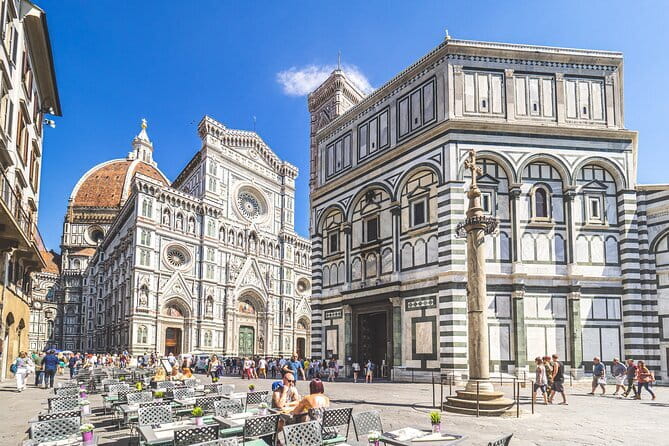
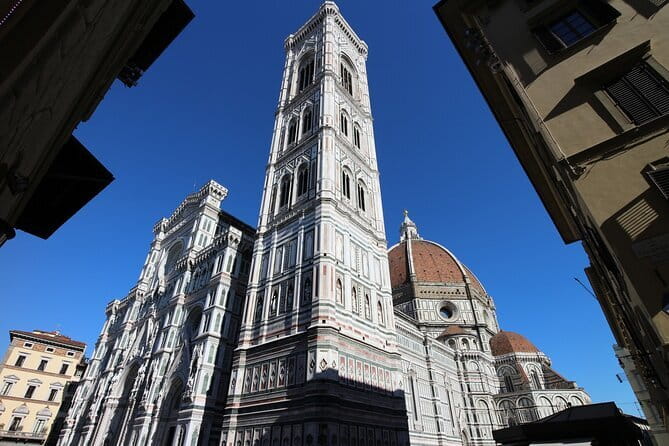
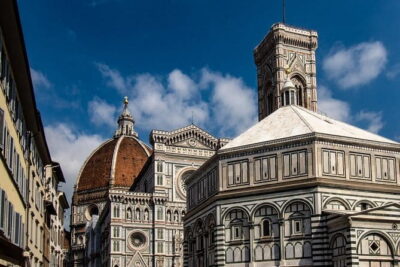
The Duomo follows, with Santa Maria del Fiore dominating the skyline. The cathedral’s enormous masonry dome remains the city’s defining architectural achievement. Your guide can explain how the building grew from earlier religious foundations and why its scale mattered so much in the 15th century.
The 15-minute stop is enough to appreciate the cathedral from the outside and understand its place in Florentine identity. It is not enough for a full visit inside, a dome climb, or a close look at the cathedral complex’s museums. If those are priorities, reserve separate time and tickets.
Across from the cathedral, the Baptistery of St. John supplies an older and more intimate counterpoint. It was where generations of Florentines were baptized, including Dante, and it served as a place connected with the investiture of knights and poets. The famous doors and geometric exterior make it one of the most recognizable buildings in the square.
Giotto’s Campanile completes this cluster. The bell tower belongs to the cathedral complex and gives the piazza its layered vertical profile. Seeing the Duomo, Baptistery, and Campanile together is valuable because each building has a distinct role, yet all three work as one civic and religious ensemble.
More Florence options worth a look before you decide
- The Best tour in Florence: Renaissance & Medici Tales – guided by a STORYTELLER
★ 5.0 · 12,316 reviews - Florence: Duomo Cathedral Guided Tour
★ 3.9 · 5,970 reviews - Uffizi Gallery Small Group Tour with Guide
★ 4.5 · 4,923 reviews - Florence: Accademia Gallery Guided Tour
★ 4.6 · 4,156 reviews
Santa Maria Novella and Renaissance design
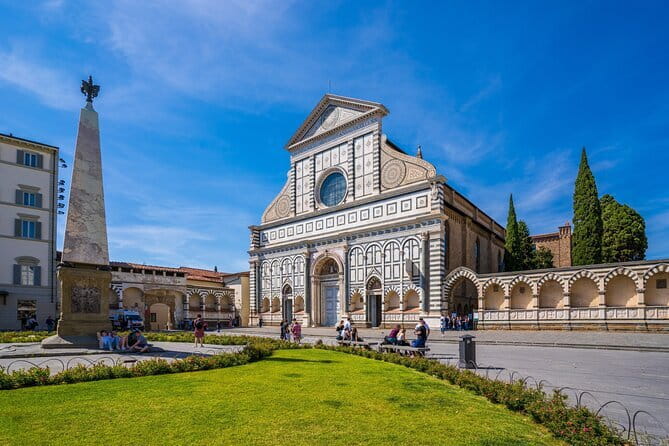
The route continues to the Basilica of Santa Maria Novella, one of Florence’s major churches and the historic base of the Dominican order. The stop gives the guide another chance to show how religious institutions shaped the city’s art, learning, and public image.
Santa Maria Novella is also a helpful reminder that Florence’s beauty is not confined to one square. Its façade, church interior, and nearby piazza reward a return visit, especially if you enjoy architecture and religious art. On the walking tour, you receive an introduction rather than a full examination of every chapel and artwork.
At Palazzo Rucellai, the subject shifts from religious buildings to Renaissance domestic architecture. The palace is associated with Giovanni di Paolo Rucellai and is generally attributed to Leon Battista Alberti, with work also carried out by Bernardo Rossellino.
The façade is important because it applies classical ideas of pilasters, horizontal bands, and proportion to a Renaissance city palace. Your guide can point out how the design borrows from antiquity without simply copying it. That is the sort of detail easy to miss when walking alone.
Palazzo Strozzi and Santa Trinita
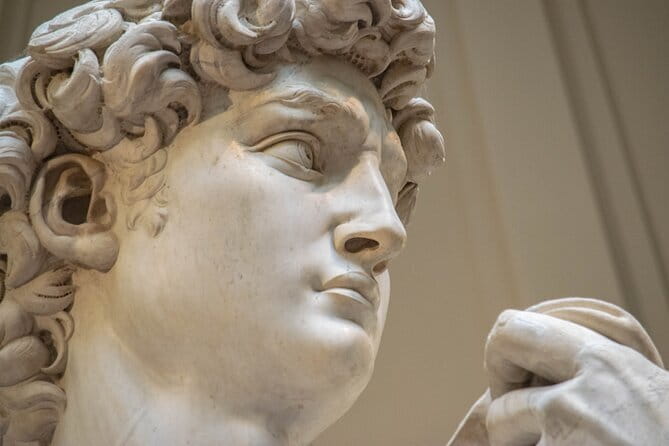
Palazzo Strozzi is one of Florence’s most imposing Renaissance palaces. Its construction required the removal of 15 earlier buildings, a blunt reminder that elite families could reshape entire sections of the city to display wealth and influence.
The palace’s repeated portals and strong geometric façade make it easy to read from the street. A 15-minute stop works well here because the building’s scale and design are best understood from the surrounding streets and square. If an exhibition is running inside, you would need separate admission and extra time.
The Basilica of Santa Trinita adds one of the tour’s most worthwhile interior visits. The church is tied to the artistic development of Florence, and the walk includes entry to see impressive frescoes by Ghirlandaio.
This stop gives the experience more depth than an exterior-only city walk. You can connect the guide’s explanation of patronage and Renaissance art with an actual church interior. Still, the visit is brief, so anyone with a serious interest in Ghirlandaio should return later with more time.
Crossing into Oltrarno at Palazzo Pitti
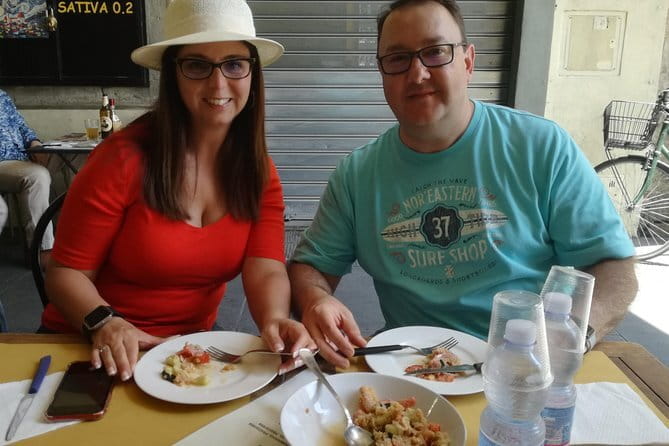
Palazzo Pitti introduces the Medici story at full scale. The palace began as the home of banker Luca Pitti in 1458, then passed to the Medici family in 1549. It later housed the Habsburg-Lorraine rulers and served as a royal palace after Italian unification, when Florence was briefly the capital of Italy.
That succession tells you a great deal about Florence. A single residence can carry the city from merchant wealth to dynastic rule, foreign administration, and modern national politics. The building’s large façade makes its political ambition plain.
The tour does not include a full interior visit to Palazzo Pitti. The 15-minute stop is best understood as a guided introduction to its history and position in the Oltrarno district. If you want the palace museums or Boboli Gardens, plan a separate visit.
Nearby, the Church of Santa Felicita is one of Florence’s oldest churches. Its location between Ponte Vecchio and Palazzo Pitti makes it part of the same power corridor, but its age and quieter scale offer a different mood.
Santa Felicita is also linked to the Vasari Corridor, the raised passage that allowed the grand dukes to travel from Palazzo Vecchio to Palazzo Pitti without moving through the streets. The corridor passes over the Uffizi and Ponte Vecchio, creating a physical map of private power above the public city.
The route’s stop at the Vasari Corridor is an exterior and historical viewing point, not a promise of access through the passage. That distinction matters. The corridor’s story is fascinating, but you should not book this walk expecting a corridor ticket or a specialist interior tour.
What three hours really gets you
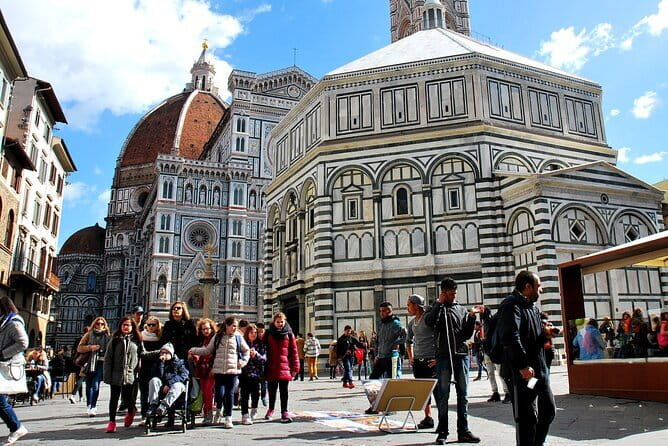
Fifteen minutes at each of 12 stops adds up to three hours, so the advertised duration is realistic. You spend enough time at each landmark to hear the main story, ask a few questions, and take photographs, but not enough to study every detail.
I like this format for a first morning in Florence. It gives you the broad structure of the city, then leaves the afternoon free for a museum or a longer church visit. It also prevents the common first-visit mistake of spending all day in one square without understanding how the surrounding districts fit together.
The tradeoff is depth. You will not receive a full tour of the Duomo complex, Palazzo Pitti, or every church interior. This is a walking orientation with strong historical content, not an all-access art tour.
The pace appears manageable for most people, but Florence’s cobblestones are hard on thin soles. Wear comfortable walking shoes, and expect to be on your feet for most of the morning. The route includes bathroom breaks, and a brief coffee or rest stop has been part of some departures.
A group can include up to 20 people. Some departures have been much smaller, including groups of around seven or ten, and a low booking count can occasionally create a private experience at the group price. That is a pleasant possibility, not something to count on.
Price, group size, and overall value
At $40.12 per person, the tour is priced as an affordable guided introduction rather than a premium private experience. The value comes from the amount of ground covered and the guide’s ability to turn façades and piazzas into a connected story.
You are paying for three hours of explanation, route planning, local orientation, and the chance to ask questions. You are not paying for major museum entry, a dome climb, or a long art lecture inside each church.
I think the price makes the most sense if you are new to Florence and want to use your time well. A strong guide can help you decide which places deserve your own return visit, which is particularly useful when your stay is short.
The experience is booked, on average, about 60 days ahead, so advance planning is sensible during busy periods. Confirmation arrives at booking, the ticket is mobile, and the meeting point is near public transportation.
Who will enjoy this walk most
I would choose this tour for a first visit, a short stay, or the first morning of a longer Florence trip. It suits anyone who wants the city’s political, religious, artistic, and architectural stories explained in plain language.
Families can benefit from the storytelling approach, especially with a guide who is good at adjusting explanations and answering questions. The walk can also work well for people who prefer a broad overview before committing time to museums.
It is less suitable if you want a slow photography walk, a focused study of Renaissance painting, or guaranteed entry to the Duomo and Palazzo Pitti. Those goals call for specialized visits with more time at fewer sites.
Service animals are allowed, and most people can participate. Because this is a three-hour city walk over cobblestones, you should consider your own comfort with sustained walking before booking.
Booking, weather, and cancellation details
Free cancellation is available up to 24 hours before the 9:00 a.m. start time for a full refund. Changes or cancellations inside that 24-hour window are not accepted for a refund.
The experience requires good weather and a minimum number of participants. If poor weather or low enrollment causes cancellation, you are offered another date or experience, or a full refund.
Should you book the Essential Florence Walking Tour?
Book it if you want a smart first look at Florence, a guide-led route through the central sights, and stories that connect guilds, poets, churches, Renaissance families, and Medici rulers. The included gelato, rest breaks, and manageable three-hour length make it practical rather than exhausting.
Skip it if your main goal is extensive time inside museums or a detailed visit to the Duomo complex. In that case, spend the $40.12 on a focused entry tour instead.
For most first-time visitors, I would put this walk near the start of the trip. Ask about the day’s guide, bring good shoes, keep your schedule flexible after the finish, and use the final stop in Piazza della Signoria as a springboard for exploring Florence on your own.
FAQ
Where does the tour start?
The tour starts at Piazza della Repubblica in Florence.
What time does the tour begin?
The scheduled start time is 9:00 a.m.
Where does the tour end?
The tour ends in Piazza della Signoria.
How long does the walking tour last?
The experience lasts approximately three hours.
How many people can join the tour?
The maximum group size is 20 participants. Some departures may be smaller.
Are admission tickets included?
The listed stops show free admission, but the experience does not provide ticketed entry to major attractions such as the Duomo complex, Palazzo Pitti, or other museums. Santa Trinita is visited to see Ghirlandaio’s frescoes.
Can I cancel for a full refund?
Yes. You can cancel at least 24 hours before the local start time for a full refund. Poor weather or failure to meet the minimum group size may also result in an alternative date or a full refund.
Latest additions around Florence
- Florence: Cathedral Tour & Brunelleschi’s Dome Climb Ticket★ 5.0 · 3 reviews
- Palatina Gallery and Pitti Guided Tour in Florence★ 5.0 · 3 reviews
- Florence Uffizi Gallery Skip-the-line Tour w Art Historian Guide★ 5.0 · 3 reviews
- Private Tour: Pisa and Lucca from Florence★ 5.0 · 3 reviews
- San Gimignano Bike Tour (SOFT)★ 4.5 · 3 reviews
- Florence: Tour of Florence by rickshaw★ 5.0 · 3 reviews
- Center of Florence by golf cart★ 5.0 · 3 reviews
- From Firenze | Chianti day tour in a classic car★ 5.0 · 3 reviews
Florence Walking Tours, compared.

Skip the line: Uffizi and Accademia Small Group Walking Tour
Read our review →
Renaissance and Medici Tales Guided Walking Tour
Read our review →
Skip-the-Line Florence Highlights and David Walking Tour
Read our review →
Dark Mysteries and Legends Guided Walking Tour
Read our review →
Florence in a Day: Michelangelo’s David, Uffizi and Guided City Walking Tour
Read our review →Browse the lists this tour appears in