
Reviewed · ACCADEMIA GALLERY TOURS
Best of Florence walking tour & Accademia Gallery- monolingual small group tour
Michelangelo’s David is the star here, but the best part is having a guide explain what you are seeing before you face the famous statue. The tour combines Florence’s main squares with priority entry to the Accademia, making it a useful first look at the city.
I like the small group limit of 15 and the way the guide links the unfinished Prisoners to Michelangelo’s working methods. I also like finishing near the Duomo, where you can continue exploring on your own. The main caution is that crowded galleries and weak microphone use can make it hard to hear every word.
In This Review
- Key points to know before booking
- Why David makes this Florence tour worth considering
- Starting on Via Camillo Cavour
- Piazza della Repubblica and the feel of central Florence
- Piazza della Signoria, Florence’s open-air sculpture room
- Walking to the Duomo complex
- Entering the Accademia without the regular line
- The Hall of Prisoners and Michelangelo’s unfinished marble
- Meeting David face to face
- Other Accademia works after David
- Small-group size, guide quality, and sound
- Is $80.60 good value?
- Who should book this experience?
- My recommendation
- FAQ
- How long does the tour last?
- Is the tour offered in English?
- How large is the group?
- Is Accademia Gallery admission included?
- Does the tour enter the Cathedral of Florence?
- Where does the tour begin?
- Where does the tour finish?
Key points to know before booking
- David with context: Spend focused time with Michelangelo’s 17-foot marble masterpiece, rather than simply walking in, taking a photograph, and moving on.
- Priority Accademia access: Pre-booked entry helps you avoid the regular entrance line, though short delays can still occur on the busiest days.
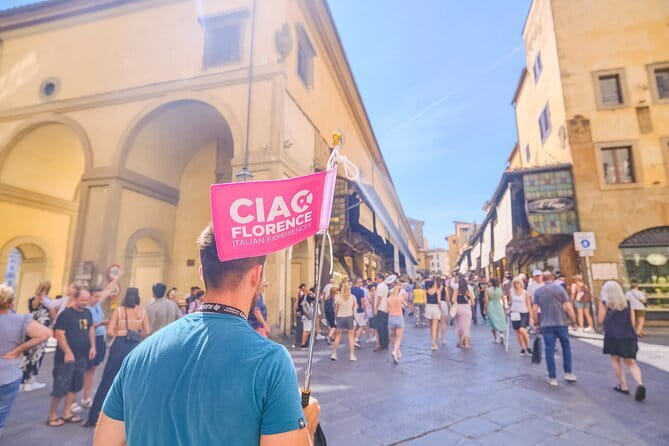
- Florence in one walk: See Piazza della Repubblica, Piazza della Signoria, the Baptistery, Giotto’s Bell Tower, and the Duomo from outside.
- English only: This is a monolingual English tour, with a maximum of 15 people.
- Three to four hours: The pace suits a first morning in Florence, but comfortable shoes are important.
- Flexible finish: Depending on the option selected, you may finish inside the Accademia or in Florence’s historic center.
Why David makes this Florence tour worth considering
The Accademia is not Florence’s largest museum, but it contains one of the world’s most famous sculptures. David measures about 17 feet tall and weighs more than 12,000 pounds. Seeing it in person gives the work a force that photographs cannot match.
A guide adds useful perspective. Michelangelo completed David at about age 26, carving a heroic figure from a single block of marble. Your guide can point out the statue’s pose, expression, hands, and physical tension, then explain why the sculpture became a symbol of Florentine strength and independence.
I especially like the decision to include the Hall of Prisoners before David. The unfinished figures appear to struggle out of their marble blocks. This is a fine place to learn about Michelangelo’s non-finito, or unfinished art, and to think about the difference between a completed statue and a work that still shows the artist’s tools and process.
The Accademia visit also includes Giambologna’s Rape of the Sabines and works linked to artists such as Sandro Botticelli, Jacopo di Cione, and Pacino di Buonaguida. You will not see every corner of the museum in the time available, but the selected works give you a sound introduction.
More Accademia and David visits:
- Florence: Timed Entrance Ticket to Michelangelo’s David
★ 4.6 · 16,983 reviews - Florence: Michelangelo’s David Skip-the-Line Entry Ticket
★ 4.5 · 12,764 reviews - Florence Accademia Gallery Tour with Entrance Ticket Included
★ 4.5 · 6,148 reviews
Starting on Via Camillo Cavour
The meeting point is at Via Camillo Cavour 18 in central Florence. Check the address carefully before setting out, since one family missed the start and later found the group at the Accademia. A map link or saved directions on your phone is a wise precaution.
The tour begins with a walk through Florence’s historic center. The opening portion is not a formal museum visit. Instead, your guide uses the streets and squares to explain how the city grew from its ancient roots into the center of Renaissance art.
That short introduction matters because Florence can feel like a string of beautiful buildings without a clear story. A good guide helps you connect the civic center, the church complex, the Medici-era streets, and the artists who worked here.
The tour lasts about three to four hours. Expect to be on your feet for most of that time, with roughly an hour and a quarter inside the Accademia. Wear shoes that can handle stone streets and a steady walking pace.
Piazza della Repubblica and the feel of central Florence
Piazza della Repubblica is one of Florence’s grand urban spaces. Elegant cafes, luxury shops, and Liberty-style architecture give it a polished look that differs from the medieval streets nearby.
Your stop here is brief, about 10 minutes, so think of it as an orientation point rather than time for a long coffee break. The square helps you see how Florence changed over time, from an older city center to a more modern commercial setting.
I like this stop because it gives the walk some variety. Florence is not only narrow lanes and old stone. This open square shows a later version of the city and makes the next stop, Piazza della Signoria, feel even more dramatic.
Piazza della Signoria, Florence’s open-air sculpture room
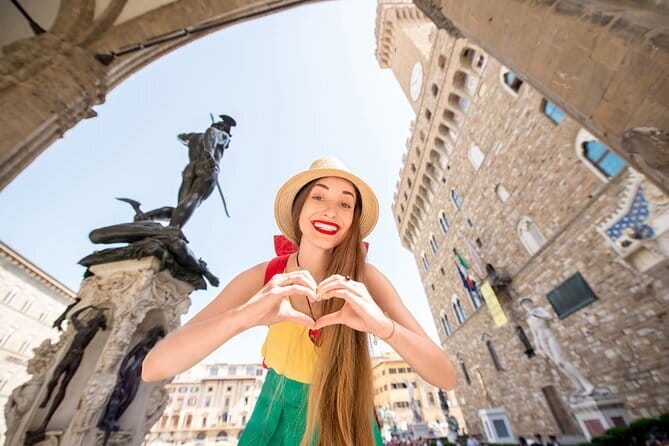
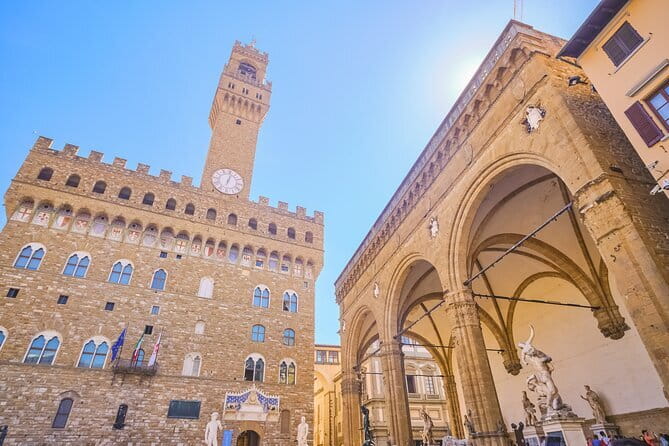
Piazza della Signoria is the civic heart of Florence and one of the strongest parts of the walking section. The square contains major works of sculpture, including Cellini’s bronze Perseus and Giambologna’s Rape of the Sabine Women.
Palazzo Vecchio anchors the square, while the long colonnade of the Loggia dei Lanzi leads your eye toward the Uffizi area. Even if you do not enter the palace or the Uffizi on this tour, your guide can show you how politics, public art, and the Medici family shaped this part of town.
Allow about 15 minutes here. That is enough for an explanation and a look at the principal monuments, but not enough for a slow study of every sculpture. If this square catches your interest, return later when you have more time.
One point is worth keeping in mind: Florence’s outdoor sights can be noisy. The walking group may pause among other tour groups, street sounds, and passing crowds. The quality of your experience depends partly on how clearly your guide speaks and whether you can remain close enough to hear.
More walking routes in Florence:
- Florence: Guided Walking Tour
★ 4.5 · 3,334 reviews - Skip the line: Uffizi and Accademia Small Group Walking Tour
★ 4.5 · 3,135 reviews - Florence: Guided Walking Tour
★ 4.6 · 1,602 reviews - Florence: Renaissance and Medici Tales Guided Walking Tour
★ 4.8 · 1,549 reviews
Walking to the Duomo complex
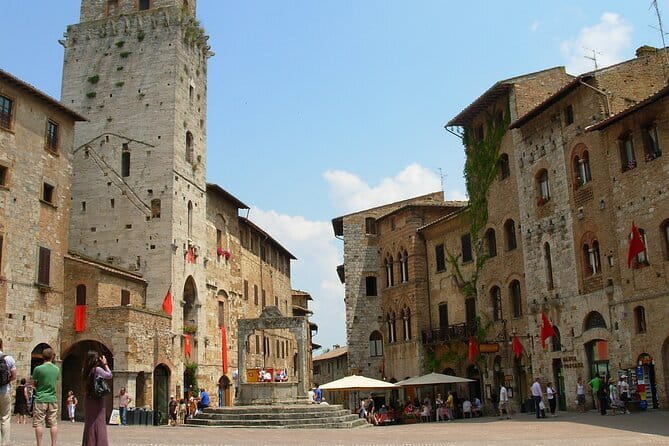
The route continues through Florence’s winding medieval streets toward Cathedral Square. This change of setting is one of the tour’s pleasures. You move from the political and sculptural center of the city to its great religious complex.
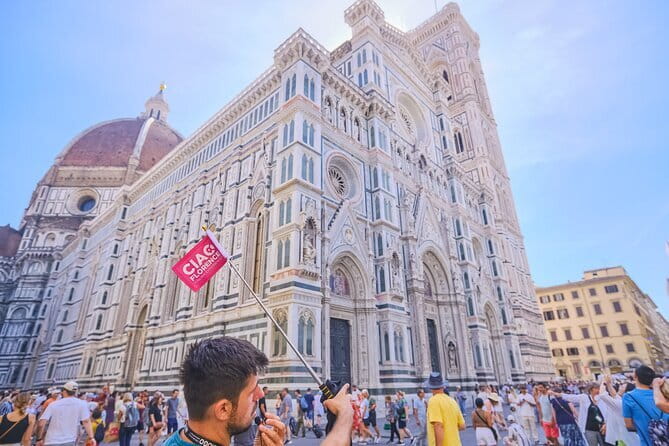
In the square, you will see the Baptistery, including its famous Gates of Paradise, Giotto’s Bell Tower, and Santa Maria dei Fiori, usually called the Duomo. Brunelleschi’s dome crowns the cathedral and gives Florence its most recognizable profile.
The tour provides an external explanation only. Entry into the cathedral is optional and is not included in the price. That makes the tour efficient, but you should not book it expecting to climb the dome, enter the cathedral, or visit the Baptistery interiors as part of the guided program.
The Duomo stop lasts about 15 minutes. Your guide answers final questions before leaving, giving you a useful chance to ask what deserves more of your time later. From here, you are well placed to continue around the cathedral complex or walk toward other central sights.
Entering the Accademia without the regular line
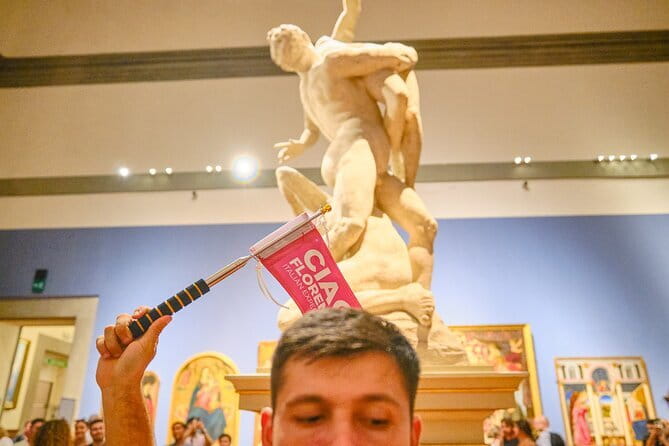
The tour then takes you to the Galleria dell’Accademia at Via Ricasoli 58/60. A pre-booked, skip-the-line ticket is included, which is the clearest practical benefit of booking this experience instead of arriving independently.
Priority access does not mean instant entry in every case. The tour information warns that short delays can occur on the busiest days. Still, avoiding the normal long entrance line can save valuable time, especially if you have only one or two days in Florence.
The order of visits may change. You might see the city sights before the museum, or the museum before the final Duomo stop. Stay flexible, since the sequence can depend on timed entry and daily conditions.
The gallery portion is guided and focused. You are not simply handed a ticket and sent inside. The guide brings the group to the Prisoners, then to David, and finally to selected works by other Renaissance artists.
The Hall of Prisoners and Michelangelo’s unfinished marble
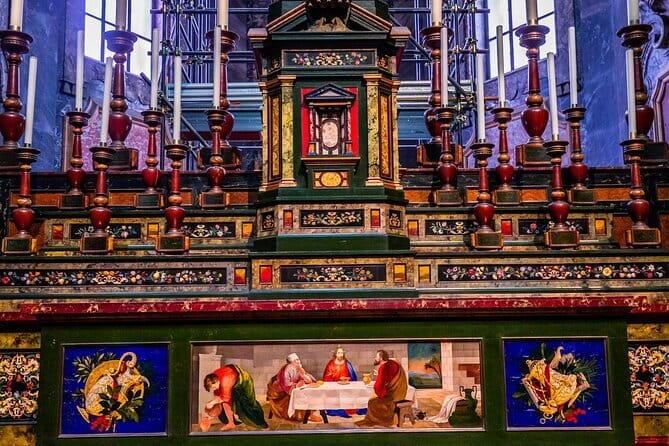
The Hall of Prisoners gives the museum visit a strong beginning. These unfinished sculptures remain partly trapped in their blocks of marble, allowing you to see places where Michelangelo’s chisel and hammer shaped the stone.
This is a good lesson in how art can show its own making. The figures are not polished objects removed from all evidence of labor. Their unfinished surfaces reveal the tension between the human form and the stone around it.
Your guide can also introduce the stories behind the individual figures and explain the idea of non-finito. That background changes how you look at the work. Instead of seeing incomplete statues as failed projects, you begin to notice their emotional force and the choices suggested by the rough marble.
The group spends about 35 minutes in this part of the gallery. That is enough time for a structured explanation, but you should not expect long periods of quiet individual study.
Meeting David face to face

The next 35 minutes focus on David. The statue dominates its room, and the guide typically builds up to the reveal after explaining the Prisoners and Michelangelo’s career.
A guide can direct your attention to details that are easy to miss when you are absorbed by the statue’s size. You may look at the turn of the head, the alert expression, the oversized hands, and the balance of the body before discussing the story of David and Goliath.
This is also the moment to ask questions. The strongest feedback about this tour centers on guides who made Michelangelo’s life and work understandable. Patricia, Debora, and another guide whose name was not recorded were singled out for clear explanations, strong enthusiasm, and memorable stories about David.
The experience is not perfect for every group. One guide’s microphone was clipped to her clothing, and background noise in the Accademia and around the Baptistery made her difficult to hear. Some people drifted away from the group. If you are interested in the art, stay near the guide and say something promptly if the sound is poor.
Other Accademia works after David
After David, the guide points out additional works in the collection. Giambologna’s Rape of the Sabines is a complex sculpture that rewards a slow look, especially from different angles.
You will also see paintings and works associated with Botticelli, Jacopo di Cione, and Pacino di Buonaguida. These pieces broaden the visit beyond one famous statue and help you understand the range of Florentine art.
The museum visit is carefully selected rather than exhaustive. That suits a first visit, a family with limited patience, or anyone trying to fit Florence into a busy schedule. If you already have a serious interest in the Accademia, you may want more independent time afterward, depending on where the tour ends and the museum’s rules that day.
Small-group size, guide quality, and sound
The advertised maximum is 15 people, which is a useful compromise between price and personal attention. A group this size can move through the city without the unwieldy feel of a large coach tour, and you have a reasonable chance to ask questions.
Guide quality matters a great deal here. Patricia and Debora received especially strong praise for making the art easier to understand and for giving David a human story rather than a list of dates. Another guide was described as very enthusiastic and able to make Michelangelo come alive.
The feedback is not uniformly positive. One larger group began with a guide who was difficult to understand and gave information that did not feel relevant. The group was split before entering the gallery, and the replacement guide was much stronger.
That tells you two things. First, the guide can make or break this experience. Second, the operator may adjust groups and guides during the morning. Earphones are supplied for bigger groups, but the equipment may not work equally well in every setting.
Is $80.60 good value?
At $80.60 per person, this is not the cheapest way to see Florence. You are paying for the English-speaking guide, a walking orientation, the Accademia admission, and the convenience of priority access.
The value is strongest if you are visiting Florence for the first time, have limited time, or do not want to prepare your own museum visit. A guide can help you understand David and the Prisoners in about an hour, then point you toward the city sights worth returning to.
The value is weaker if you are comfortable using a museum ticket on your own, want a long independent visit, or already know Florence’s historic center. You are also paying for a combined city walk, so someone interested only in the Accademia may prefer a shorter museum-focused option.
For many first-time visitors, the price can make sense on the first full day. One useful plan is to take this tour in the morning, then spend the afternoon at the cathedral, Uffizi, Ponte Vecchio, or another church at your own pace.
Who should book this experience?
I would choose this tour if you want a clear introduction without spending an entire day in museums. Families can benefit from the short explanations and the change between outdoor sights and the gallery.
It also suits time-pressed visitors who want to see David without gambling on a long ticket line. The English-only format is useful if you want the guide’s full explanation in one language rather than a multilingual tour.
You should think twice if you dislike group touring or need a quiet museum experience. The Accademia can be crowded, and the audio setup has not always been ideal. You may also prefer another option if entering the Duomo is central to your plans, since cathedral admission is not included.
Book at least a little ahead if possible. This tour is often reserved around 56 days before the visit, which suggests that popular time slots can fill early. Free cancellation is available until 24 hours before the start time, but changes or cancellations inside that window are not accepted.
My recommendation
Book this tour if you want David explained by an English-speaking guide, priority Accademia entry, and a quick but useful walk through central Florence. Its strongest points are the small group, the Prisoners before David, and the chance to ask questions while the art is directly in front of you.
Skip it if you want a deep museum session, guaranteed perfect audio, or an included cathedral visit. For the right visitor, especially on a first morning in Florence, $80.60 buys a practical introduction and a better understanding of why the city’s art matters.
FAQ
How long does the tour last?
The experience lasts approximately three to four hours, including the Florence walking tour and the Accademia Gallery visit.
Is the tour offered in English?
Yes. It is a monolingual English-speaking tour.
How large is the group?
The group has a maximum of 15 people. Earphones are provided for larger groups.
Is Accademia Gallery admission included?
Yes. A skip-the-line Accademia Gallery ticket is included.
Does the tour enter the Cathedral of Florence?
No. The tour provides an external explanation of Cathedral Square. Entry into the cathedral is optional and the entrance fee is not included.
Where does the tour begin?
The meeting point is Via Camillo Cavour 18, 50122 Florence, Italy.
Where does the tour finish?
Depending on the option selected, the tour may finish inside the Accademia Gallery or in Florence’s historic center.
More Museums Worth an Hour
- Florence: Skip-The-Line Uffizi Gallery Timed Entry Ticket
★ 4.5 · 27,832 reviews - Florence: Leonardo Interactive Museum Entry Ticket
★ 4.5 · 11,763 reviews - Uffizi Gallery Small Group Tour with Guide
★ 4.5 · 4,923 reviews - Florence: Accademia Gallery Guided Tour
★ 4.6 · 4,156 reviews
Latest additions around Florence
- Florence: Cathedral Tour & Brunelleschi’s Dome Climb Ticket★ 5.0 · 3 reviews
- Palatina Gallery and Pitti Guided Tour in Florence★ 5.0 · 3 reviews
- Florence Uffizi Gallery Skip-the-line Tour w Art Historian Guide★ 5.0 · 3 reviews
- Private Tour: Pisa and Lucca from Florence★ 5.0 · 3 reviews
- San Gimignano Bike Tour (SOFT)★ 4.5 · 3 reviews
- Florence: Tour of Florence by rickshaw★ 5.0 · 3 reviews
- Center of Florence by golf cart★ 5.0 · 3 reviews
- From Firenze | Chianti day tour in a classic car★ 5.0 · 3 reviews
Accademia Gallery Tours, compared.

Timed Entrance Ticket to Michelangelo’s David
Read our review →
Michelangelo’s David Skip-the-Line Entry Ticket
Read our review →
Florence Accademia Gallery Tour with Entrance Ticket Included
Read our review →

Timed Entry Ticket to Michelangelo’s David & eBook
Read our review →
Skip the line: Uffizi and Accademia Small Group Walking Tour
Read our review →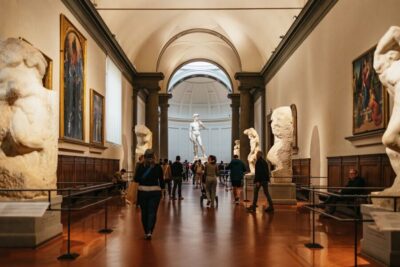

Accademia Gallery Guided Tour with Entry Ticket
Read our review →Browse the lists this tour appears in