
Reviewed · ACCADEMIA GALLERY TOURS
Accademia & Michelangelo’s David Private Tour
Michelangelo’s David is the star here, and you see it without spending your precious Florence time wandering through a large museum alone. The statue fills the Tribuna, where its scale, detail, and calm expression make more sense when a guide points out what to notice.
I like the tour’s tight focus and the chance to see more than the famous marble figure. The Hall of Plaster Casts, rare musical instruments, three Stradivari violins, and Lorenzo Monaco’s gold-and-lapis paintings give the visit much more range. The main consideration is timing: the tour is sold as 1.5 hours, but one verified booking reported a visit of less than an hour, so ask your guide how much time remains if the pace feels rushed.
In This Review
- Key points at a glance
- Meeting Your Guide on Via Ricasoli
- David, Seen Up Close in the Tribuna
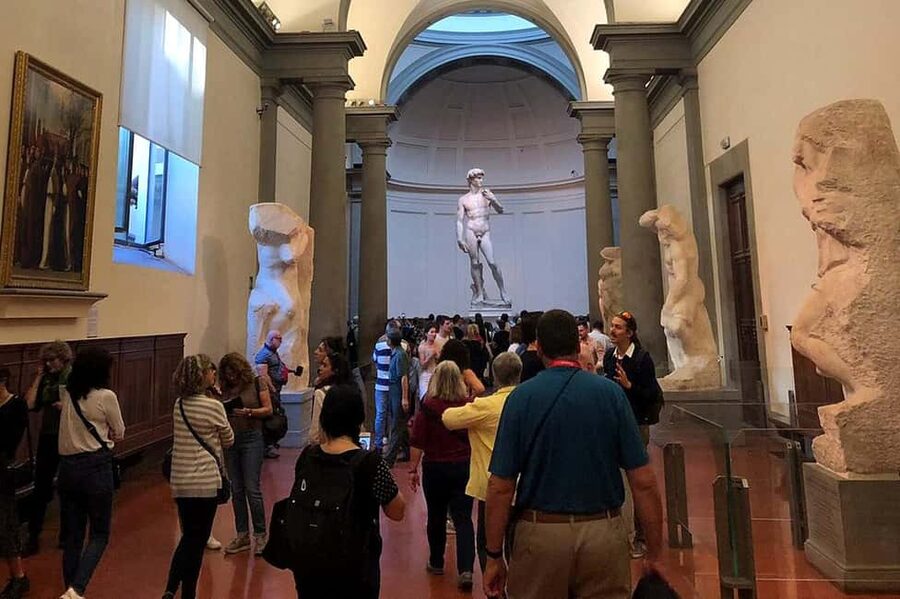
- Michelangelo’s Prisoners and Unfinished Marble
- Paintings from Botticelli to Giambologna
- Lorenzo Monaco and Florence’s Medieval Gold
- Giotto Frescoes on the Upper Level
- Plaster Casts and Sculptural Practice
- Stradivari Violins and the World’s First Piano
- Is $110 Worth It for 90 Minutes?
- Practical Details for a Smooth Visit
- Who Should Book This Accademia Tour?
- Should You Book It?
- FAQ
- Where does the Accademia tour meet?
- How early should I arrive?
- How long does the tour last?
- Is admission to the Accademia included?
- Which languages are available?
- Is the tour wheelchair accessible?
- Can I cancel or pay later?
Key points at a glance
- Michelangelo’s David in the Tribuna: See Florence’s most famous sculpture with a guide who can explain its pose, scale, and place in Renaissance art.
- More Michelangelo beyond David: Look for the Prisoners, St. Matthew, and La Pietà.
- Rare musical treasures: Visit the Music Instruments Collection, including three Stradivari violins and the world’s first piano.
- A private group with language choice: Tours are offered in English, Italian, or Spanish.
- A short, focused museum visit: The planned duration is 1.5 hours, useful for a busy Florence schedule.
- Easy central meeting point: Meet at the Carrefour Supermarket at Via Ricasoli 115, 15 minutes before departure.
Meeting Your Guide on Via Ricasoli
Your tour begins outside the Carrefour Supermarket at Via Ricasoli 115, near the Accademia Gallery. Look for a representative holding a purple Florence With Locals sign. This is a small but important detail, since Via Ricasoli can be busy with people heading toward the museum and you do not want to join the wrong queue.
Arrive 15 minutes early. The tour includes admission and an express security check, but it does not promise instant entry. Everyone still passes through metal detector controls, and a short wait can happen even with skip-the-line access.
There is no hotel pickup or drop-off, so plan your route to the meeting point yourself. Food and drinks are also not included, which makes sense for a short museum visit. Have water or a snack before you arrive if you need one, since the time inside is meant for art.
The tour is private, and the available guide languages are English, Italian, and Spanish. That private format should appeal to families, couples, and small groups who want to ask questions without keeping pace with a large crowd.
More Accademia and David visits:
- Florence: Timed Entrance Ticket to Michelangelo’s David
★ 4.6 · 16,983 reviews - Florence: Michelangelo’s David Skip-the-Line Entry Ticket
★ 4.5 · 12,764 reviews - Florence Accademia Gallery Tour with Entrance Ticket Included
★ 4.5 · 6,148 reviews
David, Seen Up Close in the Tribuna
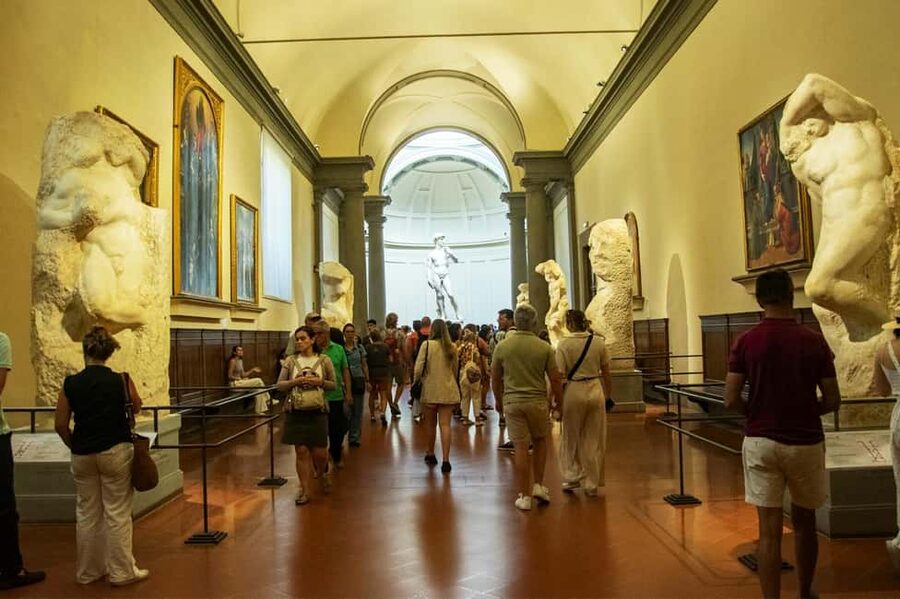
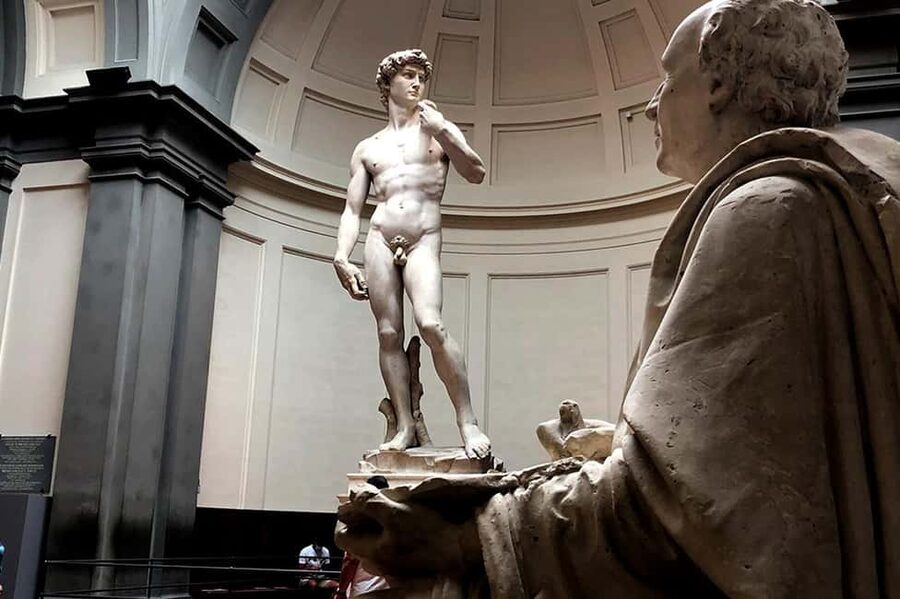
The Accademia’s central moment comes when you enter the Tribuna and meet Michelangelo’s David. The sculpture is familiar from photographs, but the original has a different force. Its height, the tension in the hands, and the carefully balanced stance are difficult to grasp on a screen.
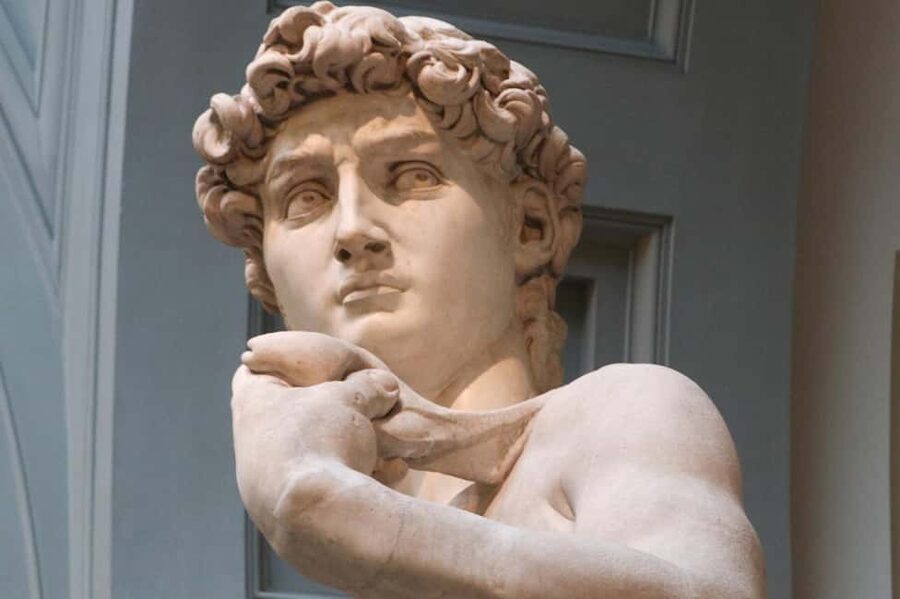
A guide can help you look past the usual postcard view. Pay attention to David’s oversized hands and head, details often linked to the image of a young hero ready for action. The expression is not triumphant. It is alert, watchful, and controlled.
The sculpture also carries Florence’s civic story. David was connected with the city’s identity as a small but self-confident republic. The tour places the statue within the Renaissance world that produced it, rather than treating it as an isolated celebrity object.
This is where the guide matters most. Elaine is one guide associated with this experience, and her work received especially warm praise for being friendly and informative. The available feedback also points to excellent guiding in general, so you can expect the explanation to be a major part of the visit, not just a way to get through the door.
Give yourself a moment to look before listening. First notice the whole figure. Then let the guide direct your attention to the face, hands, muscles, and marble surface. That pattern makes the visit more rewarding than simply taking a photograph and moving on.
Michelangelo’s Prisoners and Unfinished Marble
David gets the crowd, but the other Michelangelo sculptures may give you the clearest view of the artist at work. The Prisoners appear to struggle out of blocks of marble, while St. Matthew also retains an unfinished quality.
These works are valuable because you can see the difference between a finished figure and one still partly held by stone. The rough surfaces and incomplete forms let you think about Michelangelo’s method, even during a brief visit. His sculpture becomes less about polished perfection and more about the struggle between material and human form.
La Pietà adds another part of the story. Together, these works show the range of Michelangelo’s subjects and the gallery’s strong connection to him. The collection is not limited to one famous statue placed in an otherwise ordinary room.
Do not assume every work receives equal time. With only 90 minutes planned, David will naturally take the largest share of attention. If Michelangelo is your main reason for booking, tell the guide early that you want time for the Prisoners, St. Matthew, and La Pietà as well.
Paintings from Botticelli to Giambologna
The Accademia also holds paintings and sculptures by major Italian artists, including Sandro Botticelli, Domenico Ghirlandaio, Pontormo, Andrea del Sarto, and Giambologna. Many works were commissioned by the Medici family, whose money and political reach helped shape Florence’s artistic life.
For you, this means the gallery offers more than a single sculptor. A guide can connect these works to changing tastes, powerful patrons, and the artistic culture of Florence. The Medici connection is especially useful because it explains why religious images, portraits, sculpture, and decorative works appear together in a museum tied so closely to the city’s elite.
The paintings require a different kind of attention from David. Look at composition, color, and the treatment of figures. Gold details and careful fabrics can tell you as much about status and devotion as the subject itself.
The tour’s short length is both a strength and a limit here. You get a guided introduction to several important names, but you will not examine every room at length. If your priority is seeing a broad selection with context, the tour works well. If you want quiet time with individual paintings, you may need a separate museum visit.
More Renaissance art days:
- The Best tour in Florence: Renaissance & Medici Tales – guided by a STORYTELLER
★ 5.0 · 12,316 reviews - The Best Tour in Florence: Renaissance and Medici Tales
★ 5.0 · 10,810 reviews - Florence: Timed Entry Ticket to Michelangelo’s David & eBook
★ 4.6 · 4,049 reviews - Michelangelo’s David, Accademia & Uffizi Small Group Tour
★ 4.5 · 1,986 reviews
Lorenzo Monaco and Florence’s Medieval Gold
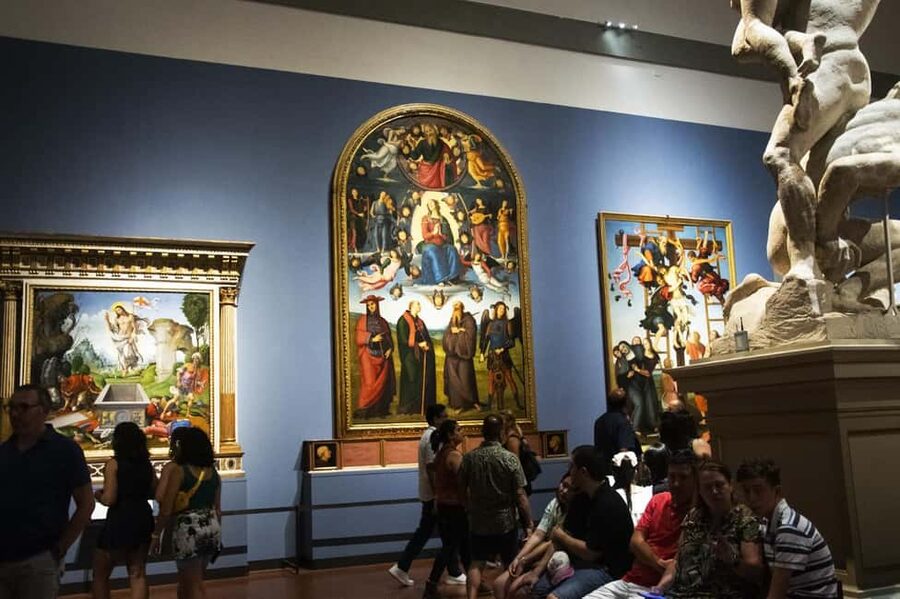
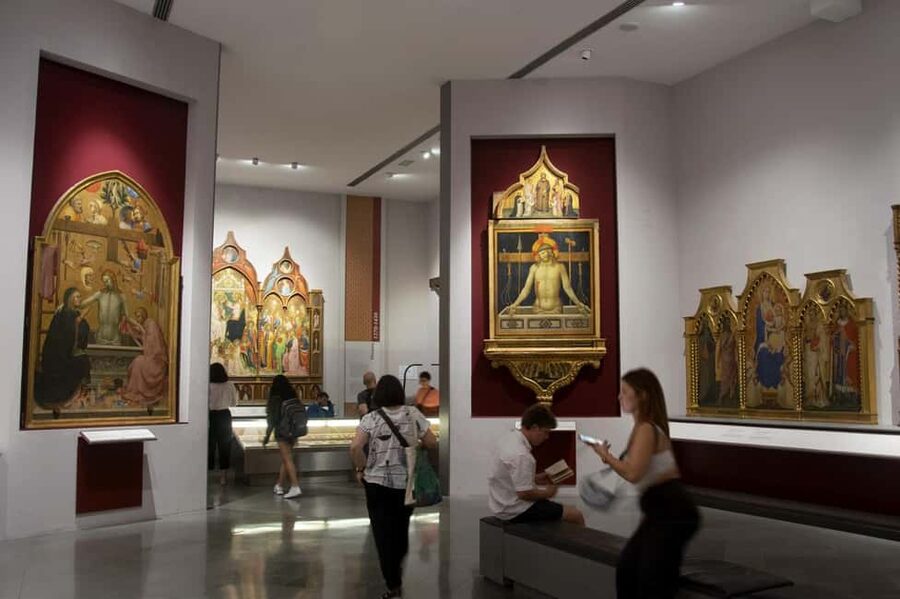
One of the more unusual parts of the collection is its large group of paintings by Lorenzo Monaco, a 14th-century artist. These works use gold leaf and lapis lazuli, materials that gave Florentine medieval art a luxurious, luminous look.
This section helps you see that Florence’s artistic story did not begin with Michelangelo. The Renaissance grew out of earlier traditions, and Lorenzo Monaco’s paintings provide a useful comparison. The flat, precious surfaces and formal religious imagery differ sharply from the physical realism you see in David.
I would pay attention to the materials as much as the figures. Gold leaf catches light in a way that paint cannot, while lapis lazuli was a costly blue pigment. Those choices tell you that the works were made for patrons willing to spend heavily on religious art.
This stop may be easy to skip if you arrive thinking only about Michelangelo. Do not rush past it. It gives the gallery chronological breadth and helps you understand why Florence became such an important center of art.
Giotto Frescoes on the Upper Level
On the upper level, you can find frescoes by Giotto, an early master who helped move Italian painting toward more convincing space and human expression. The tour description identifies him as a pioneer of perspective painting, so this is another chance to see the transition from medieval forms toward the Renaissance.
You might find the upper-level works less immediately dramatic than David. That is normal. Their value comes from comparison. After seeing Michelangelo’s solid, muscular figures, look at how earlier artists suggested depth, gesture, and emotion with different tools.
Ask your guide to explain what makes Giotto important. The answer can turn a quick look at a fresco into a better understanding of how Italian painting changed over time. This is one reason a guided visit is useful in a museum that contains works from several periods.
Plaster Casts and Sculptural Practice
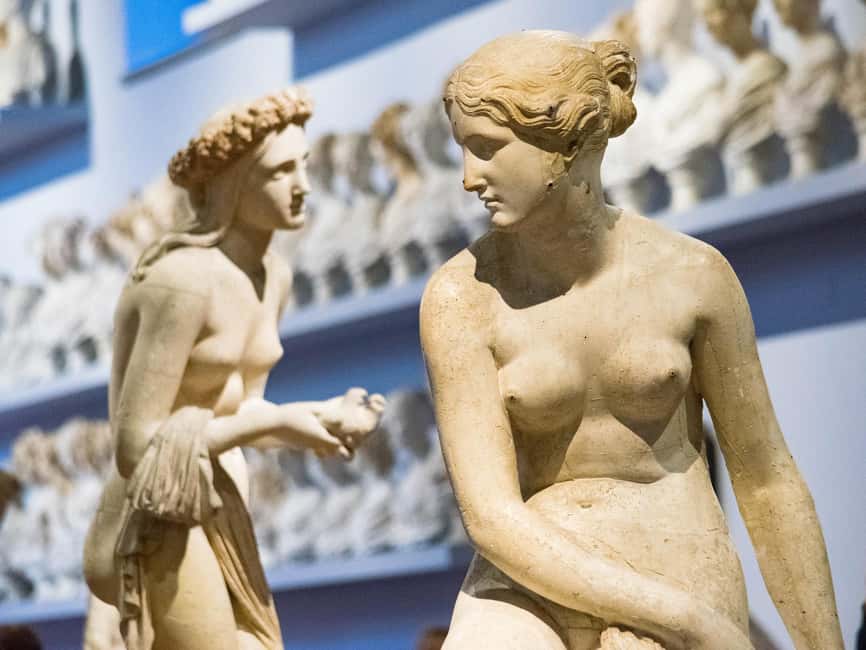
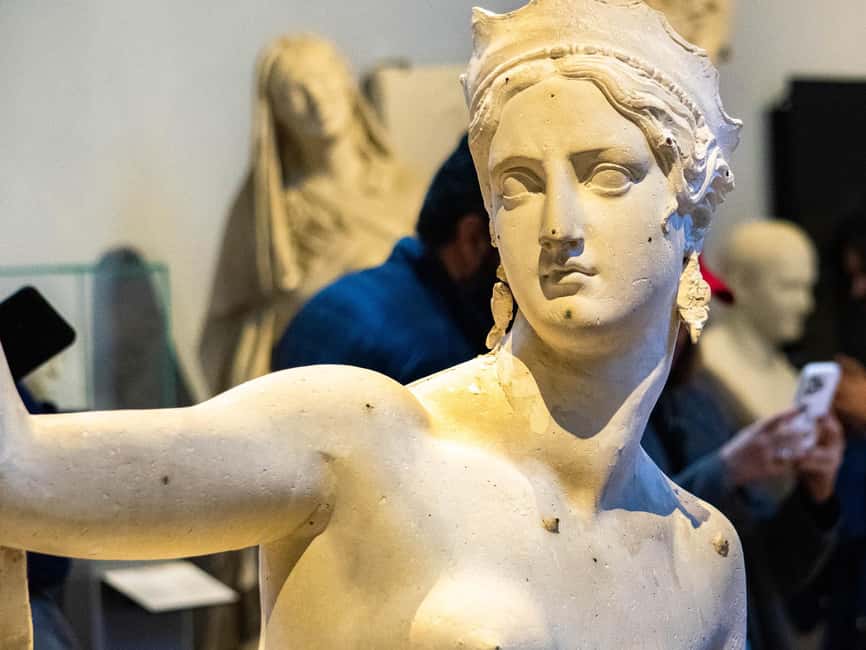
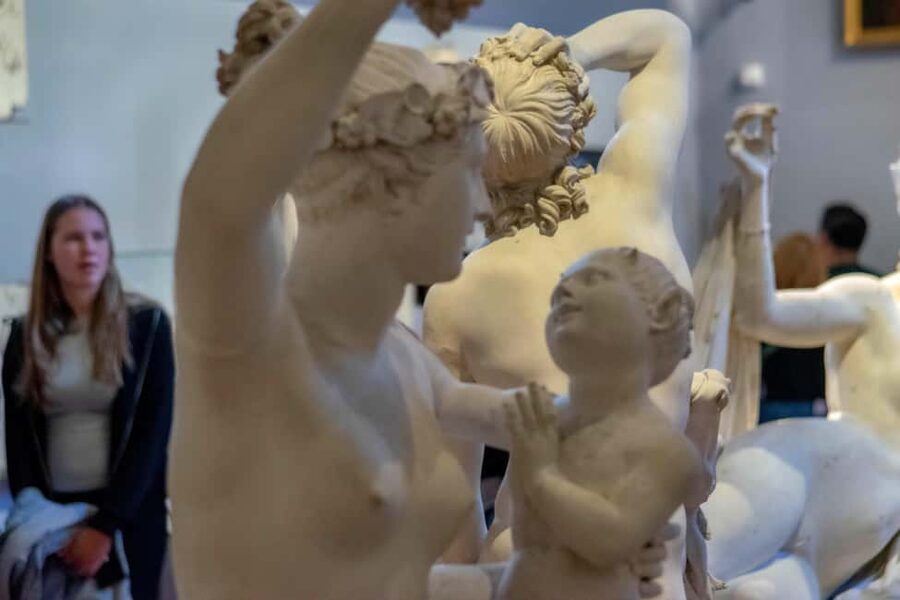
The Hall of Plaster Casts presents 18th-century works by Lorenzo Bartolini. It offers a change of pace after Michelangelo’s marble and the gallery’s medieval paintings.
Plaster casts can seem less glamorous than original marble, but they reveal an important side of sculpture. They show how artists and studios worked with models and forms before a final work reached its finished state. Bartolini’s presence also widens the museum’s timeline beyond the Renaissance.
This room may be especially interesting if you enjoy technique and the working process behind sculpture. If your group is focused only on David, it may receive less attention. Tell the guide what interests you, since the private format gives you a better chance of shaping the visit.
Stradivari Violins and the World’s First Piano
The Music Instruments Collection is an unexpected reward. It includes three Stradivari violins and the world’s first piano, adding sound and craftsmanship to a museum best known for stone and paint.
These objects help you see Florence’s cultural life in a broader way. The Accademia is not only about large religious and civic artworks. It also preserves the design, materials, and technical skill found in musical instruments.
The first piano is the obvious draw, but the Stradivari violins deserve attention too. Even if you are not a musician, their presence gives the gallery a fresh angle. Ask the guide to explain what makes the instruments important if that information is part of the planned route.
Because the tour lasts only 1.5 hours, you may not receive a long specialist talk about music. Still, this collection is one of the experience’s most distinctive features. It helps the visit feel less predictable than a David-only outing.
Is $110 Worth It for 90 Minutes?
At $110 per person, this is not the cheapest way to enter the Accademia. The price includes museum admission, a local expert guide, and a private group, so you are paying for interpretation and a more personal format rather than entry alone.
The value depends on your plans. If you want David explained clearly, have limited time, and prefer to ask questions as you go, the price can make sense. A good guide helps you connect Michelangelo, the Medici commissions, Lorenzo Monaco, Giotto, music, and later sculpture into one readable visit.
The value is weaker if you mainly want a quick photograph of David. You could spend less on admission and explore at your own pace, though you would lose the guide’s historical framing and the convenience of a planned route.
I would also factor in the private format. Families with children may appreciate not having to match the pace of a large group. Art students and first-time Florence visitors may want the chance to ask about specific works. For a group splitting the cost across several people, the private arrangement may feel more reasonable than it does for one person.
Keep the duration in mind. The scheduled length is 1.5 hours, but one verified booking reported that the visit lasted less than an hour. That does not establish a normal duration, but it is a fair reason to confirm the timing at the start and mention your priorities to the guide.
Practical Details for a Smooth Visit
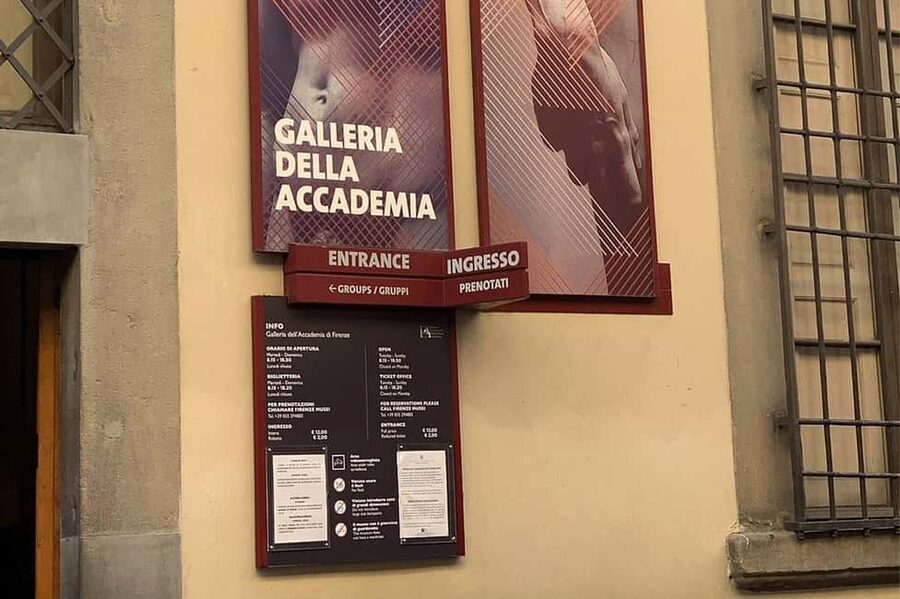
The tour is wheelchair accessible, which makes it a useful option for visitors who need an accessible experience. Pets are not allowed. Children may need a passport or ID card, so bring the required identification rather than assuming a family ticket or verbal age proof will be enough.
You can cancel up to 24 hours before the tour for a full refund, and the reserve-now, pay-later option keeps your schedule flexible. These terms are useful in Florence, where museum plans can change quickly, but check the exact booking conditions when selecting your time.
The express security check reduces the usual entry hassle, not the security process itself. Metal detector controls can still create a short wait. Arriving early gives you a better chance of starting calmly.
Wear something suitable for a museum visit and keep your attention on the guide during the first minutes inside. The most important works are not all in one room, so the route matters. If you want extra time for one section, say so before the group moves on.
Who Should Book This Accademia Tour?
I would recommend this experience to a first-time Florence visitor who wants a clear introduction to Michelangelo and the Accademia without spending half a day in the museum. It also suits couples and families who prefer a private group and a guide who can adjust explanations to their interests.
It is a good choice for anyone who likes connections between different art forms. David is the main event, but the musical instruments, medieval paintings, plaster casts, and upper-level frescoes give the visit more variety than the title suggests.
I would hesitate to book it if you want a slow, independent study of the entire collection. The short schedule favors highlights, and the reported visit of less than an hour makes it wise to manage expectations. You may need another visit if you want extended time with Botticelli, Lorenzo Monaco, Giotto, or every Michelangelo work.
Should You Book It?
Book this tour if David is a priority, you want a guide’s explanation, and $110 fits your Florence budget. The combination of private access, museum admission, a central meeting point, and a focused route gives you a practical introduction to one of the city’s essential museums.
Before the tour begins, tell the guide which works matter most to you. Ask for time with the Prisoners and St. Matthew, not only David, and make sure the Music Instruments Collection and upper level fit into the plan if they are important to you.
Skip it if your only goal is a fast look at the statue or if you prefer to set your own pace. For everyone else, especially visitors who want context without a long museum lecture, this is a sensible and art-filled 90 minutes, provided the actual timing is confirmed on arrival.
FAQ
Where does the Accademia tour meet?
Meet at the Carrefour Supermarket at Via Ricasoli 115 RED NO, 50121 Firenze FI. A Florence With Locals representative will hold a purple sign with Florence With Locals written on it.
How early should I arrive?
Arrive 15 minutes before the tour starts.
How long does the tour last?
The planned duration is 1.5 hours. One verified booking reported a visit lasting less than an hour, so confirm the timing with your guide when the tour begins.
Is admission to the Accademia included?
Yes. The price includes admission to the Accademia Gallery and access to David and the other featured works.
Which languages are available?
The live guide is available in English, Italian, or Spanish.
Is the tour wheelchair accessible?
Yes, the activity is listed as wheelchair accessible.
Can I cancel or pay later?
You can cancel up to 24 hours in advance for a full refund. A reserve-now, pay-later option is also available.
Latest additions around Florence
- Florence: Cathedral Tour & Brunelleschi’s Dome Climb Ticket★ 5.0 · 3 reviews
- Palatina Gallery and Pitti Guided Tour in Florence★ 5.0 · 3 reviews
- Private Tour: Pisa and Lucca from Florence★ 5.0 · 3 reviews
- San Gimignano Bike Tour (SOFT)★ 4.5 · 3 reviews
- Florence Uffizi Gallery Skip-the-line Tour w Art Historian Guide★ 5.0 · 3 reviews
- Florence: Tour of Florence by rickshaw★ 5.0 · 3 reviews
- Center of Florence by golf cart★ 5.0 · 3 reviews
- From Firenze | Chianti day tour in a classic car★ 5.0 · 3 reviews
Accademia Gallery Tours, compared.

Timed Entrance Ticket to Michelangelo’s David
Read our review →
Michelangelo’s David Skip-the-Line Entry Ticket
Read our review →
Florence Accademia Gallery Tour with Entrance Ticket Included
Read our review →

Timed Entry Ticket to Michelangelo’s David & eBook
Read our review →
Skip the line: Uffizi and Accademia Small Group Walking Tour
Read our review →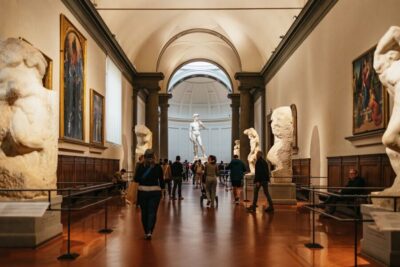

Accademia Gallery Guided Tour with Entry Ticket
Read our review →Browse the lists this tour appears in