
Reviewed · FLORENCE WALKING TOURS
Walking tour of Florence with a private Florentine Tourist Guide
Florence makes a fine walking tour, but this one adds a local storyteller to the familiar sights. With Francesco Casalini, you move from Piazza San Marco to Piazza Santo Spirito, hearing about Renaissance buildings, Dante’s Florence, Medici power, local habits, food, wine, and old city gossip along the way.
I like two things here: the private format for up to eight people, which lets you ask questions and set the pace, and the outdoor route, which links Florence’s major monuments without spending the whole morning inside one museum. The headsets should also help you hear Francesco on crowded streets.
The trade-off is simple: this is a sightseeing walk, not an admission tour. You do not enter the Duomo, Uffizi, or other attractions, and the three-hour route demands steady walking. If you want art interiors and long gallery time, you will need to arrange those separately.
In This Review
- Key points to know before you book
- A strong first look at Florence, without museum lines
- Starting at Piazza San Marco
- Piazza della Santissima Annunziata and the first Renaissance lesson
- The marble spectacle of Piazza del Duomo
- Dante’s streets and the open-air museum of Piazza della Signoria
- Passing the Uffizi without going inside
- Crossing the Arno on Ponte Vecchio
- Ending in Oltrarno and Piazza Santo Spirito
- What Francesco adds to the standard Florence route
- Is $242.24 good value for a private group?
- Who should book this Florence walk?
- My verdict on the Francesco Casalini experience
- FAQ
- How long is the walking tour?
- Where does the tour begin?
- Where does the tour end?
- Does the tour include entrance to the Duomo or Uffizi Gallery?
- How many people can join the private tour?
- Is the tour suitable for anyone with limited walking ability?
Key points to know before you book
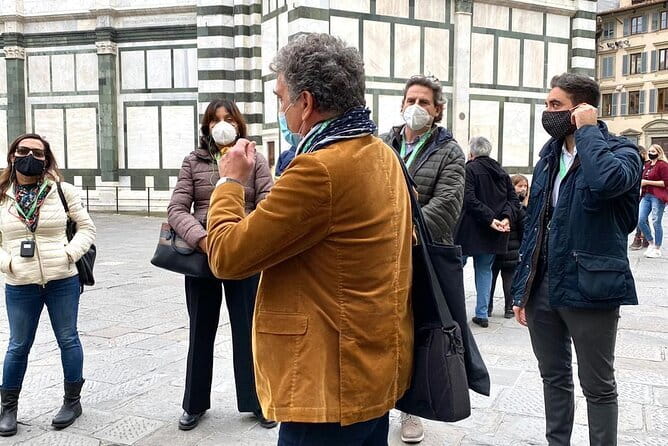
- Francesco Casalini leads the walk: Expect art, history, city legends, Dante stories, local humor, and practical suggestions for food, shopping, and further sightseeing.
- The route crosses Florence from north to south: You begin at Piazza San Marco and finish in Oltrarno, near Piazza Santo Spirito.
- The major sights are viewed from outside: The Duomo, Uffizi Gallery, Palazzo Vecchio area, and Ponte Vecchio are part of the walk, but entrance tickets are not.
- The group is private: Your party alone takes part, with a maximum of eight people.
- The price works best for a small group: At $242.24 total, two people pay much more per person than a group of six or eight.
- Plan for a real city walk: The tour is not suited to anyone who has trouble walking for a long time.
A strong first look at Florence, without museum lines
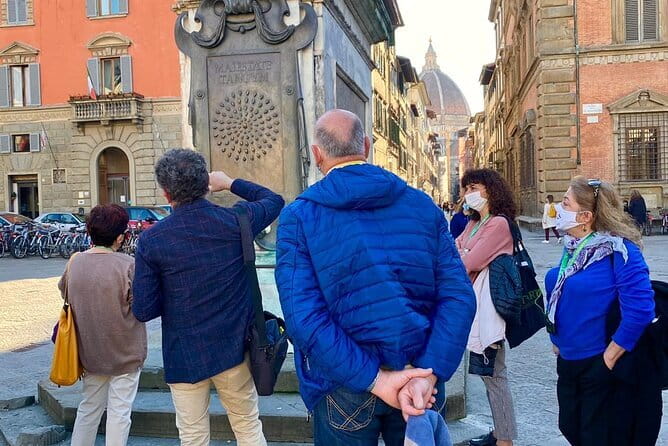
I see this tour as an orientation walk with personality. It covers the city center’s essential sights, but Francesco’s approach goes beyond dates and names. His stories include the people behind Florence’s buildings, old intrigues, daily customs, artistic rivalries, food, wine, and tales connected with Dante.
That mix matters in Florence. The city center is compact, yet every square carries several layers of meaning. A quick look at the Duomo can leave you with a photograph and little else. A guide can point out how the buildings relate to one another, explain why a square mattered, and connect a grand monument with ordinary Florentine life.
The private setup makes the format more flexible than a large group walk. You can ask about a particular artist, request more detail on Dante, or steer the conversation toward restaurants and shops. The experience is also described as using headsets, a helpful touch when the streets fill with voices and traffic.
You should set the right expectation. This is not a Florence museum tour. The walk does not include entry to the Uffizi, the cathedral complex, or any other indoor attraction. It is best used as a first or second activity in the city, followed by self-guided visits to the interiors that interest you most.
More walking routes in Florence:
- Florence: Guided Walking Tour
★ 4.5 · 3,334 reviews - Skip the line: Uffizi and Accademia Small Group Walking Tour
★ 4.5 · 3,135 reviews - Florence: Guided Walking Tour
★ 4.6 · 1,602 reviews
Starting at Piazza San Marco
The walk begins in Piazza San Marco, a useful northern starting point for central Florence. The first stop is short, about 10 minutes, and admission is free because the experience stays outdoors.
From here, Francesco can begin building the city’s story before the famous sights arrive. That is one of the better features of the route. You do not start by being dropped directly into the packed area around the Duomo. Instead, you begin with a square and then move gradually toward Florence’s monumental center.
The practical point is to arrive ready to walk. The tour is not designed for a slow café break at the start, and coffee or tea is not included. Wear shoes that can handle historic paving and keep your hands free for photos or notes.
Piazza della Santissima Annunziata and the first Renaissance lesson
The next stop is Piazza della Santissima Annunziata, roughly 10 minutes. Here, you see the Ospedale degli Innocenti, a building described as an important marker in the beginning of Renaissance architecture.
This is a good place for a guide to explain how Florence’s Renaissance style developed in public spaces, not just in famous paintings. The square gives you a chance to look at architecture as a planned civic statement, with buildings designed to work together rather than appearing as unrelated monuments.
I especially like this stop because it adds a little shape to the standard Florence route. Many first-time visitors rush from the Accademia area toward the Duomo. A pause here gives you another architectural reference before the city’s biggest religious complex takes over the view.
The stop itself is brief. If you want a long architectural discussion or an interior visit, ask Francesco how to continue your exploration after the tour.
The marble spectacle of Piazza del Duomo
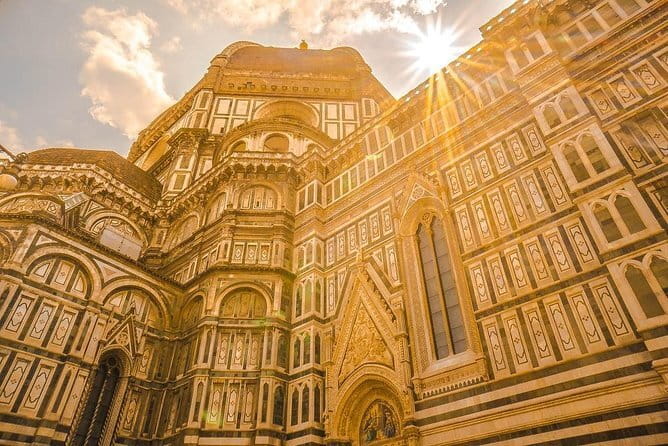
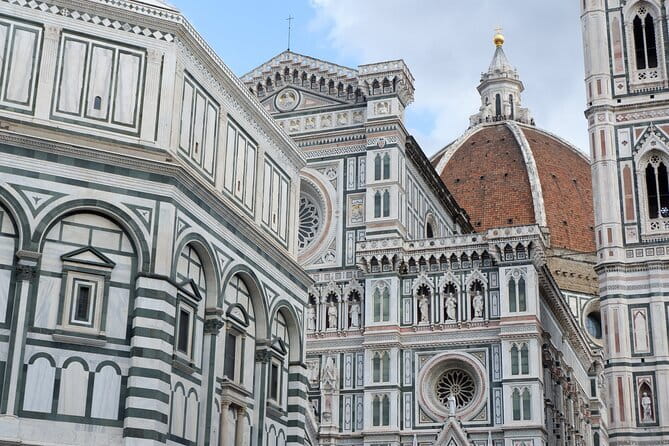
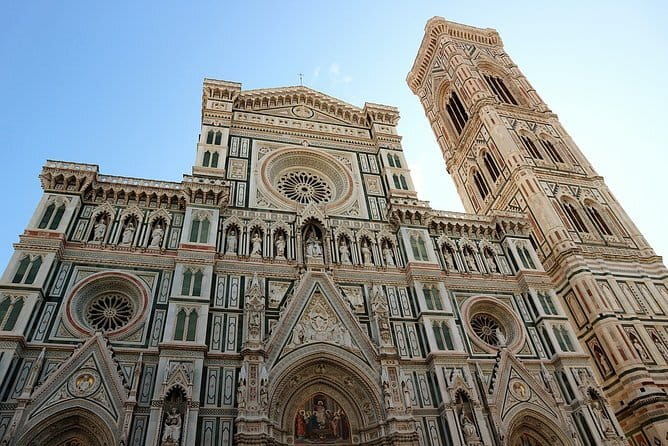
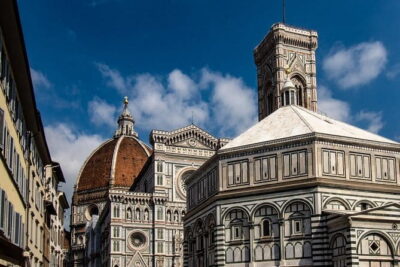
The route then reaches Piazza del Duomo for about 25 minutes, the longest single stop. This is Florence’s visual knockout: the cathedral, Baptistery, and campanile form a group of religious buildings covered in colored marble.
You will have time to take in the complex from outside and hear how its parts fit together. The value of a guide here is not simply identifying the buildings. Francesco’s stories about art, history, and Florentine ambition can help explain why this square became such a powerful statement of civic and religious identity.
The drawback is crowd pressure. Piazza del Duomo is one of the busiest places in Florence, and even a private guide cannot make the crowds disappear. Headsets should make the commentary easier to follow, but you may still need to concentrate while crossing and gathering around the buildings.
There is no interior admission on this walk. If you want to climb the dome, enter the cathedral, visit the Baptistery, or see the cathedral museum, those plans and tickets are separate. The outdoor stop is still useful because it gives you the overall view before you commit time to one of the interiors.
More Florence options worth a look before you decide
- Cinque Terre and Pisa Tower Tour from Florence Semi Private
★ 5.0 · 1,406 reviews - From Florence: Private Chianti Hills Tour with Tasting
★ 4.3 · 809 reviews - Private Self-Guided E-Bike Ride in Tuscany with Vineyard Visit
★ 5.0 · 775 reviews - Florence Private Transportation in Rickshaw
★ 5.0 · 730 reviews
Dante’s streets and the open-air museum of Piazza della Signoria
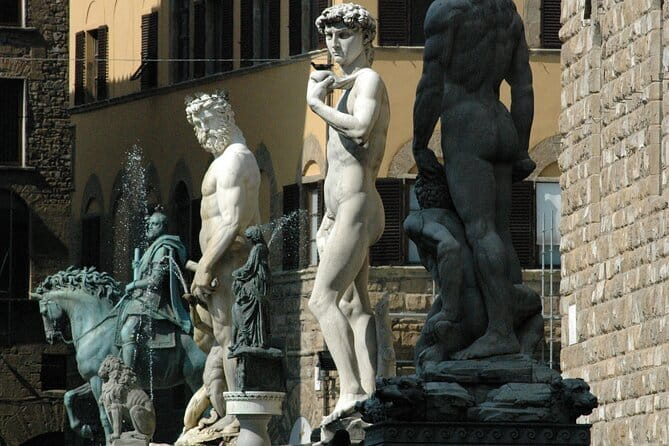
After the Duomo, you cross the medieval district associated with Dante. The tour uses fragments of Dante’s memories and the people connected with his world as a way to read the streets.
This part may appeal most to anyone who likes history with a human edge. Florence can feel like a parade of masterpieces, but Dante’s story brings in family ties, political conflict, personal loyalties, and exile. The route is not just about the poet’s writing. It is about the city that shaped him.
The walk then reaches Piazza della Signoria, with about 20 minutes to look around. This square works like an outdoor museum, with sculpture and architecture placed in the middle of everyday city life. You can see the Palazzo Vecchio area and the public art around it without paying an entrance fee.
Here, Francesco’s style appears to be at its best: stories mixed with art, politics, local humor, and the less polished side of Florence. The supplied comments describe him as clear, patient, entertaining, and able to explain both famous events and obscure city tales. That is useful in a square where a guide can easily overwhelm you with names and dates.
You will not get the same close study as a dedicated sculpture tour. The stop is a broad introduction, not a detailed examination of every statue. Still, it gives you the context needed to return later with a sharper eye.
Passing the Uffizi without going inside
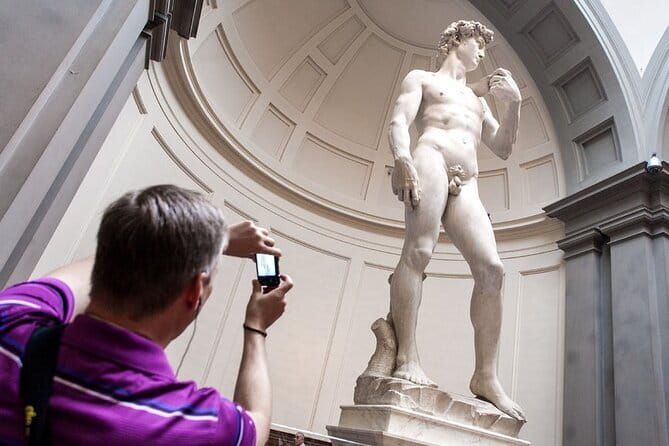
The next section takes about 20 minutes and passes the Palazzo degli Uffizi, home of the Uffizi Gallery. The museum is one of the world’s major collections, but this walk only views it from outside.
That may sound like a limitation, and it is one. If the Uffizi is your main reason for coming to Florence, you need a separate ticket and enough time for the galleries. This tour cannot replace an art museum visit.
At the same time, an exterior stop has a clear use. Francesco can explain the building’s place in Florence, the role of its surrounding public spaces, and the connection between government, art, and the Medici world. You get a preview rather than a substitute.
I would plan this tour before an Uffizi visit if you are staying in Florence for at least a day or two. The walk can supply a framework, then the museum gives you the paintings and sculpture in detail. If you have only a few hours in town, the outdoor format may be more efficient than spending the entire visit indoors.
Crossing the Arno on Ponte Vecchio

The group then crosses the Arno via Ponte Vecchio, with about 20 minutes devoted to the bridge. Ponte Vecchio is Florence’s oldest surviving bridge and the only ancient bridge in the city to survive World War II.
The bridge is famous for its shops and river views, but a guide can give the crossing more meaning. You hear about the bridge as part of Florence’s changing city life rather than treating it as a photo stop alone. Look down toward the water, then back toward the dense line of buildings that makes the bridge so recognizable.
This is also one of the tour’s most practical transitions. You are not simply being driven from one sight to another. The route shows how Florence’s two sides connect on foot and leads naturally into Oltrarno.
Expect the bridge to be crowded. It can be hard to walk shoulder to shoulder while listening, taking photos, and avoiding stops in front of shop windows. Stay close to the group and use the headset rather than trying to stand directly beside Francesco at every moment.
Ending in Oltrarno and Piazza Santo Spirito
The walk ends in Oltrarno, around Piazza Santo Spirito, after roughly 20 minutes in the neighborhood. Oltrarno is a useful finish because it feels different from the monument-heavy center. The stop gives Francesco room to talk about local life, artisans, food, wine, and the less formal side of Florence.
The exact appeal of Oltrarno depends on what you want from Florence. If your priority is another grand church or museum, the center may hold more obvious targets. If you want a neighborhood where you can continue walking, eat, shop, and watch city life, ending here works well.
This is also where the guide’s local recommendations can pay off. Francesco is described as offering advice on where to eat lunch, shop, and continue sightseeing. Because the tour ends near Piazza Santo Spirito, you can ask for suggestions suited to the rest of your day, though meals and drinks are not included.
Alcoholic drinks, coffee, and tea are outside the tour price. That keeps the basic cost clear, but you should budget for your own refreshment after the walk.
What Francesco adds to the standard Florence route
The route itself includes Florence’s essential landmarks. The special element is the storytelling. Francesco Casalini is presented as a Florentine guide who can shift between art, architecture, political history, food, wine, urban legends, and local humor.
The strongest praise centers on his ability to explain a lot without making the walk feel stiff. His manner is described as personable, patient, organized, and entertaining. Several comments also point to an encyclopedic grasp of Florence, though the real benefit for you is not a pile of facts. It is the ability to ask a question and receive an answer tied to the street in front of you.
His other strength is range. He has led walks focused on Dante, lesser-known Florence, Oltrarno, and unusual stories about the city. That suggests you can ask for more than the usual Renaissance outline, even though this particular three-hour route follows the major center-city sights.
The Italian-language comments also make clear that his appeal is not limited to international visitors. He is described as someone who helped local participants see their own city differently. For you, that points to a guide who pays attention to small details and local stories, not only the landmarks printed in a guidebook.
Is $242.24 good value for a private group?
The price is $242.24 per group of up to eight people. That is not a cheap walking tour for one person, but it can be fair for a full small group.
For two people, the cost is about $121.12 each. For four, it is about $60.56 each. For eight, it works out to about $30.28 per person. The value improves sharply as your group grows.
You are paying for a private guide, not entrance tickets. That means the comparison should be with a private orientation walk, not with a large pay-per-person group tour. If you want personal questions, a group-only pace, and a guide who can adjust the conversation, the price may make sense.
If you are traveling alone or as a couple on a tight budget, the cost is harder to justify. You may prefer a shared walk or a self-guided route, then spend the savings on a museum ticket. The private format is most attractive for families, friends, or a small group who will actually ask questions and use Francesco’s local advice.
Who should book this Florence walk?
I would recommend it to first-time visitors who want the city’s main sights connected by a clear story. It also suits returning visitors who have seen the Duomo and Ponte Vecchio but want more about Dante, local customs, old scandals, and Oltrarno.
Families and mixed-interest groups may find the private setup especially useful. One person can ask about art, another about food, and another about Florence’s political past without forcing the whole group into a fixed lecture.
You should think twice if you have difficulty walking for a long time. The tour is entirely on foot and crosses a large portion of central Florence. It is also not the right choice if your main goal is to spend hours inside the Uffizi or cathedral complex.
The tour is near public transportation, and service animals are allowed. Most people can participate, but the walking requirement is the key practical issue.
My verdict on the Francesco Casalini experience
Book this walk if you want a private introduction to Florence that combines the big sights with stories about the people and places behind them. Francesco Casalini’s strongest appeal is his range, from Renaissance buildings and Dante to food, wine, city legends, and local humor.
Do not book it expecting museum entry or a slow, seated experience. You will see the Duomo, Signoria, Uffizi exterior, Ponte Vecchio, and Oltrarno from the street, then need separate plans for interiors.
For a group of four to eight, the price is much easier to defend. For a couple, book it only if a personal guide and a flexible conversation matter more to you than admission tickets. Used as your first major walk in Florence, it should help you understand where you are, what deserves a return visit, and why this compact city has so many stories packed into its streets.
FAQ
How long is the walking tour?
The tour lasts approximately three hours.
Where does the tour begin?
It begins at Piazza San Marco in Florence.
Where does the tour end?
It ends in the Oltrarno district, near Piazza Santo Spirito.
Does the tour include entrance to the Duomo or Uffizi Gallery?
No. The tour is conducted outdoors, so the Duomo, Uffizi Gallery, and other attractions are viewed from outside. Admission tickets are not included.
How many people can join the private tour?
The private activity is for your group only and allows up to eight people.
Is the tour suitable for anyone with limited walking ability?
No. The tour is not suitable for people who have difficulty walking for a long time.
Latest additions around Florence
- Florence: Cathedral Tour & Brunelleschi’s Dome Climb Ticket★ 5.0 · 3 reviews
- Palatina Gallery and Pitti Guided Tour in Florence★ 5.0 · 3 reviews
- Florence Uffizi Gallery Skip-the-line Tour w Art Historian Guide★ 5.0 · 3 reviews
- Private Tour: Pisa and Lucca from Florence★ 5.0 · 3 reviews
- San Gimignano Bike Tour (SOFT)★ 4.5 · 3 reviews
- Florence: Tour of Florence by rickshaw★ 5.0 · 3 reviews
- Center of Florence by golf cart★ 5.0 · 3 reviews
- From Firenze | Chianti day tour in a classic car★ 5.0 · 3 reviews
Florence Walking Tours, compared.

Skip the line: Uffizi and Accademia Small Group Walking Tour
Read our review →
Renaissance and Medici Tales Guided Walking Tour
Read our review →
Skip-the-Line Florence Highlights and David Walking Tour
Read our review →
Dark Mysteries and Legends Guided Walking Tour
Read our review →
Florence in a Day: Michelangelo’s David, Uffizi and Guided City Walking Tour
Read our review →Browse the lists this tour appears in