
Reviewed · FLORENCE
The not-touristy Florence with Camilla, local art historian
Florence’s best moments are not always inside its famous museums. This walk with Camilla, a local art historian, crosses the old center from Santa Croce to Santa Trinita, using medieval streets, religious sites, Dante’s neighborhood, and lesser-known corners to explain how art, faith, politics, and daily life shaped the city.
I like two things right away: the route keeps you moving through the city instead of parking you in one crowded square, and Camilla brings an art historian’s eye to subjects that often get brushed aside, including Dante’s love for Beatrice and the role of women in the Middle Ages. The main consideration is the price: at $610, this is a serious splurge for about two hours, especially if your group is small.
In This Review
- Key points at a glance
- Why this Florence walk feels different
- Starting in Piazza Santa Croce
- Finding lesser-known corners around San Firenze
- Crossing Dante’s medieval Florence
- Ending in the quiet of Santa Trinita
- What the two-hour format means
- Is $610 good value?
- Who will enjoy Camilla’s approach most
- Practical details before you book
- Should you book this Florence experience?
- FAQ
- Where does the tour begin?
- Where does the tour finish?
- How long does the experience last?
- Who leads the tour?
- What places are included?
- Does the tour discuss Dante?
- How many people can join?
- Is a mobile ticket provided?
- Can I cancel for a full refund?
- What happens if bad weather cancels the tour?
Key points at a glance
- A clear cross-town route: Begin at Piazza Santa Croce and finish at Basilica di Santa Trinita.
- Camilla’s art-history focus: Expect Florence explained through art, religion, literature, and city life.
- Dante’s district included: The walk passes his house and discusses Beatrice and medieval women.
- Four meaningful stops: Santa Croce, San Firenze, Piazza della Repubblica, and Santa Trinita shape the route.
- A small-group setting: The maximum is 15 people, allowing more room for questions than a large city tour.
- Useful flexibility: You receive a mobile ticket, and cancellation is free up to 24 hours before the start.
Why this Florence walk feels different
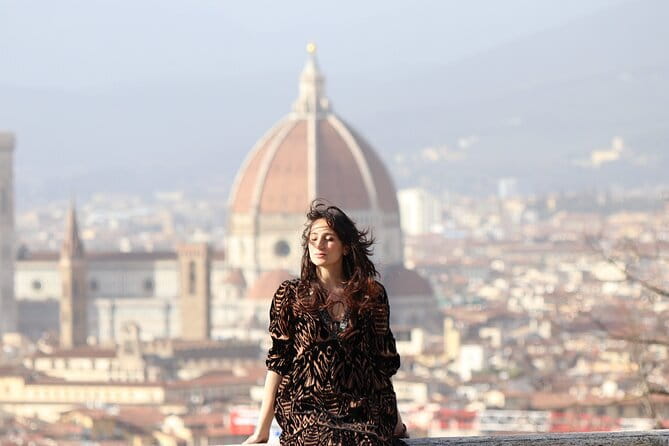
Many first visits to Florence follow a familiar line from the Duomo to the Uffizi and across the Ponte Vecchio. This experience takes another route. You start in the eastern center at Piazza Santa Croce, cross the medieval core, pass through Dante’s district, and finish near the Arno at Basilica di Santa Trinita.
That route matters. Florence can feel like a museum from a distance, but its story makes more sense when you walk the streets between the major sights. A square may look simple until you hear why it mattered. A church may seem modest beside the Duomo until you learn how faith, banking families, art, and civic power met inside its walls.
Camilla’s background is the main reason to choose this walk. You are not simply following a guide from one photo stop to another. The stated focus is art history, with Florence connected to beauty, religion, literature, and the city’s medieval past. That gives the tour a wider frame than a standard list of buildings.
The experience is described as private, but the maximum group size is 15. If you book it just for your own party, you should have a more personal outing. If others join, it remains a small group by city-tour standards, though it is not an entirely one-to-one experience unless your booking confirms that arrangement.
Other Florence outings people weigh against this one:
- Florence: Skip-The-Line Uffizi Gallery Timed Entry Ticket
★ 4.5 · 27,832 reviews - Tuscany Day Trip from Florence: Siena, San Gimignano, Pisa and Lunch at a Winery
★ 5.0 · 21,634 reviews - Florence: Timed Entrance Ticket to Michelangelo’s David
★ 4.6 · 16,983 reviews
Starting in Piazza Santa Croce
The meeting point is Piazza di Santa Croce, at number 13. This is a practical place to begin because the square gives Camilla a broad opening for Florence’s story. The first ten minutes focus on the city’s connection to art, beauty, and flowers.
That may sound light, but it sets the tone. Florence is often presented as a city of masterpieces, yet its identity also comes from symbols, public spaces, religion, and the way residents understood beauty. Starting with a major square lets you get your bearings before the walk turns into a closer look at the medieval center.
You should expect an introduction rather than a long interior visit at this point. Admission is included in the listed stop, but the tour description does not promise a full guided visit through every church or museum. If entering Santa Croce is a priority, confirm exactly what access is planned before booking.
Santa Croce also gives you a sense of the route’s balance. You begin at a famous site, but the purpose is not to linger only at the postcard view. Camilla uses it as a doorway into the city’s artistic and religious character, then moves you toward less familiar places.
Finding lesser-known corners around San Firenze
The second stop is Piazza San Firenze, about ten minutes into the walk. Here, the focus shifts to smaller and less obvious features in the surrounding area.
This is where the tour’s promise of a less touristy Florence becomes most useful. The city center is compact, but it is easy to hurry through it while looking only for the Duomo or Palazzo Vecchio. A guide who knows the side streets can help you notice details that you might otherwise pass without a thought.
The information provided does not name each building or artwork discussed in Piazza San Firenze. That is worth keeping in mind. You should book this part for the way Camilla interprets the neighborhood, not for a guaranteed checklist of particular rooms, chapels, or monuments.
The stop lasts about ten minutes, so the rhythm is brisk. You will hear an explanation, look around, and continue. That pace works well if you prefer a walking introduction to Florence rather than a long lecture at one location. It may feel too quick if you want detailed architectural study at every stop.
Crossing Dante’s medieval Florence
The walk reaches Piazza della Repubblica after crossing the medieval city. Along the way, you pass through Dante’s district and see his house. The stop itself lasts about 15 minutes, making it the longest listed pause on the route.
This is the most distinctive part of the experience. Dante is not treated only as a famous poet from a textbook. The tour connects him with Florence, his relationship with Beatrice, and the idea of platonic love. It also brings in the role of women in the Middle Ages, a subject that can add needed social context to the city’s grand artistic story.
You should expect interpretation rather than a literary performance. The point is to understand how personal devotion, medieval customs, and the city’s culture fit together. If you enjoy seeing Florence through literature as well as art, this section may be the strongest reason to choose Camilla.
Seeing Dante’s house also gives the walk a useful physical anchor. It is easier to picture a person’s connection to Florence when you stand near the place associated with him, then continue through the streets that shaped the city he knew.
Piazza della Repubblica marks a change in scale. After the tighter medieval lanes, you arrive at one of Florence’s more open central squares. The contrast helps you see that Florence was not frozen in one period. The city has changed, expanded, and rebuilt itself, even as traces of its medieval core remain nearby.
A different way to spend the same Florence day:
- Florence: Michelangelo’s David Skip-the-Line Entry Ticket
★ 4.5 · 12,764 reviews - The Best tour in Florence: Renaissance & Medici Tales – guided by a STORYTELLER
★ 5.0 · 12,316 reviews - Florence: Leonardo Interactive Museum Entry Ticket
★ 4.5 · 11,763 reviews - The Best Tour in Florence: Renaissance and Medici Tales
★ 5.0 · 10,810 reviews
Ending in the quiet of Santa Trinita
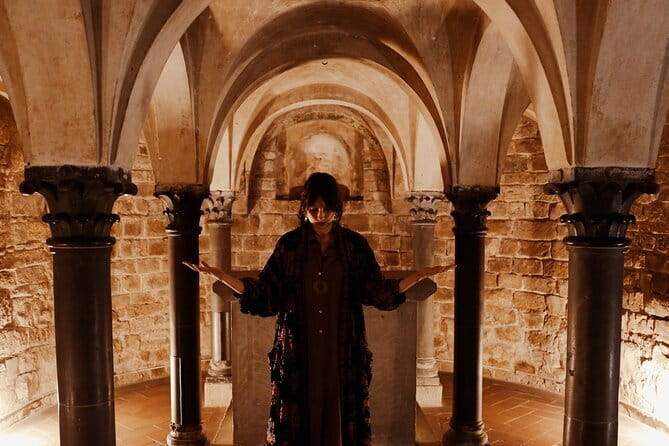
The final stop is Basilica di Santa Trinita, on Piazza di Santa Trinita. The walk takes about ten minutes inside the church, ending in a quieter setting connected to medieval religious life and scriptural tradition.
This ending makes good practical sense. After a route through public squares and streets, the church offers a pause. The tour description places emphasis on silence and the medieval script, so the conclusion is meant to feel reflective rather than rushed.
Santa Trinita is also a fitting place to tie the themes together. Florence’s art cannot be separated from its religious institutions, and a church interior can show how belief shaped painting, architecture, patronage, and public life. Camilla’s art-history training should be especially useful here, though the exact works or chapels covered are not specified.
The short duration is both a strength and a limit. Ten minutes is enough for a focused explanation and a final look, but not enough for an exhaustive church tour. If you want a detailed study of Santa Trinita, you will need more time on your own or a separate visit.
What the two-hour format means
The full experience lasts approximately two hours. That makes it easy to fit into a busy Florence day. You could schedule it near the start of your stay to learn the shape of the center, or use it later to connect places you have already seen in a more meaningful way.
The route includes four listed stops, but much of its value comes between them. You are crossing the city on foot, hearing about the medieval center, and moving from a major square to smaller streets and religious spaces. Wear comfortable shoes and expect a steady urban walk, even though the precise distance is not provided.
A short tour also forces choices. You will not get a full survey of Florentine art, and the walk cannot replace visits to the Uffizi, Accademia, or major church interiors. Instead, it gives you a framework. Afterward, you may understand why certain places deserve a closer look.
The pace should suit you if you want strong context without giving up half a day. It may not suit you if you prefer to stop often for long photographs, browse shops, or study each artwork in detail.
Is $610 good value?

At $610, this is expensive for a two-hour walk. The value depends heavily on how many people are in your booking and how much you want a private or small-group conversation with an art historian.
For a larger party splitting the cost, the price may make more sense. You are paying for a focused route, a local specialist, and the chance to ask questions in a group capped at 15. If your group is small, the cost per person rises quickly, so compare it with longer group walks and museum tours before committing.
I would not choose this experience simply because it promises to avoid crowds. Florence’s center can still be busy, and the itinerary includes well-known areas such as Santa Croce and Piazza della Repubblica. The stronger value is the interpretation: Camilla connects places, people, and ideas that are easy to miss when you explore alone.
The high rating, 5 out of 5 from 35 reviews with 100 percent recommending it, supports the idea that the guide is the central strength. One detailed review praises Camilla’s clear passion and says she helped make Florence’s art feel more meaningful. That is useful evidence, but it does not remove the basic price question. You should book for her approach, not for a bargain.
Who will enjoy Camilla’s approach most

This tour fits you best if you like art, history, and literature but do not want a formal museum-only experience. It is also a good choice if you have already seen Florence’s headline sights and want a better understanding of the streets connecting them.
First-time visitors can benefit, too. The walk introduces the city without demanding a full day. Starting at Santa Croce and ending at Santa Trinita gives you a useful east-to-west orientation of the center.
I would especially consider it if you enjoy asking questions. A capped group of 15 is small enough for some exchange, though the actual level of personal attention depends on the number booked for your date.
This is less suitable if you want extensive church access, a long museum visit, or a tour built around food and shopping. No meals, museum entries, or shopping stops are listed. The focus is walking, explanation, medieval Florence, and religious art.
Practical details before you book
The start point is Piazza di Santa Croce, 13, in Florence. The end point is Basilica di Santa Trinita on Piazza di Santa Trinita, so you do not return to the starting point. That matters if you have a timed reservation, luggage, or another appointment afterward.
The tour is near public transportation, and most people can participate. The information does not give a precise accessibility assessment, route length, or details about steps inside the churches, so ask the provider if those points matter to you.
You receive confirmation at booking, and the ticket is mobile. That keeps the meeting process simple, but arrive with your phone charged and the meeting details easy to open.
Good weather is required. If poor weather causes a cancellation, you receive the choice of another date or a full refund. The same options apply if the minimum number of participants is not reached.
You can cancel for a full refund up to 24 hours before the local start time. Inside that 24-hour window, the payment is not refunded, and changes are not accepted. Florence’s weather can shift, so check the forecast before the deadline rather than waiting until the morning of the walk.
Should you book this Florence experience?
Book it if you want Florence explained by a local art historian rather than simply pointed out. Camilla’s focus on Dante, Beatrice, medieval women, religious spaces, and the city’s artistic ideals gives the walk a clear personality.
The price is the deciding factor. At $610 for about two hours, it is best for a private party that values specialist guidance and can divide the cost. If you are watching your budget, look for a longer group tour. If you want a thoughtful introduction to Florence’s medieval heart and a quieter finish inside Santa Trinita, this one earns serious consideration.
FAQ
Where does the tour begin?
The tour begins at Piazza di Santa Croce, 13, 50122 Florence, Italy.
Where does the tour finish?
The tour ends at Basilica di Santa Trinita, Piazza di Santa Trinita, 50123 Florence, Italy.
How long does the experience last?
The walking tour lasts approximately two hours.
Who leads the tour?
Camilla, a local art historian, leads the experience.
What places are included?
The route includes Piazza Santa Croce, Piazza San Firenze, Piazza della Repubblica, and Basilica di Santa Trinita.
Does the tour discuss Dante?
Yes. The walk passes through Dante’s district, includes a view of his house, and discusses his platonic love for Beatrice and the role of women in the Middle Ages.
How many people can join?
The maximum group size is 15 people.
Is a mobile ticket provided?
Yes. The experience includes a mobile ticket, and confirmation is received at the time of booking.
Can I cancel for a full refund?
Yes. You can cancel at least 24 hours before the local start time for a full refund.
What happens if bad weather cancels the tour?
You are offered a different date or a full refund if poor weather causes the experience to be canceled.
Latest additions around Florence
- Florence: Cathedral Tour & Brunelleschi’s Dome Climb Ticket★ 5.0 · 3 reviews
- Palatina Gallery and Pitti Guided Tour in Florence★ 5.0 · 3 reviews
- Florence Uffizi Gallery Skip-the-line Tour w Art Historian Guide★ 5.0 · 3 reviews
- Private Tour: Pisa and Lucca from Florence★ 5.0 · 3 reviews
- San Gimignano Bike Tour (SOFT)★ 4.5 · 3 reviews
- Florence: Tour of Florence by rickshaw★ 5.0 · 3 reviews
- Center of Florence by golf cart★ 5.0 · 3 reviews
- From Firenze | Chianti day tour in a classic car★ 5.0 · 3 reviews