
Reviewed · UFFIZI GALLERY TOURS
Skip the Line: Florence’s Uffizi Gallery Guided Tour
The Uffizi is not a museum you want to attack without a plan. Its halls hold nearly 2,000 works, and this small-group guided tour gives you a clear path through Florence’s greatest art, from gold-ground Madonnas to Botticelli’s Birth of Venus. Skip-the-line entry also saves you from the ticket queue outside.
I especially like the chronological route, which shows how painting changed over the centuries, and the included headsets, which help you follow the guide in crowded rooms. The main drawback is time: 1 hour 45 minutes is enough for the major works, but not enough for every room, and one guide may give more attention to Florentine history than to the art itself.
In This Review
- Key points at a glance
- Why the Uffizi works best with a guide
- Meeting near Via Cavour, then walking to the Uffizi
- Entering the Uffizi without buying a ticket on site
- From gold-ground Madonnas to Giotto
- Gothic drama and the first experiments with space
- Botticelli and the Medici rooms
- Leonardo and Michelangelo in smaller doses
- Raphael, Titian, Caravaggio, and the tour’s limits
- The views and the building itself
- How the small group affects the visit
- Who should book this Uffizi tour
- Practical details before you go
- Should you book it?
- FAQ
- How long does the Uffizi guided tour last?
- What works of art are included?
- Can I stay in the Uffizi after the guided tour?
- Is museum admission included?
- Are audio headsets provided?
- How large is the group?
- Where does the tour meet?
- Does the tour include hotel pickup?
- Which languages are confirmed?
- What is the cancellation policy?
Key points at a glance
- See Botticelli’s Florence: Spend time with The Birth of Venus and Primavera, plus the Medici story behind them.
- Follow art as it changes: The route moves from the 13th century through the 18th century in roughly chronological order.
- Skip the ticket-buying queue: Your admission is arranged in advance, though short entry delays can still occur on the busiest days.
- Stay after the tour: The guided portion ends inside the Uffizi, so you can continue looking on your own.
- Keep the group small: The maximum is nine people, making it easier to hear the guide and ask questions.
- Book an early start: An 8:30 a.m. visit can mean fewer people in the galleries before the day fills up.
Why the Uffizi works best with a guide
The Uffizi is famous for its names, but the real pleasure is seeing the steps between them. Giotto did not simply appear out of nowhere. You can trace the slow shift from flat, symbolic images toward figures with weight, emotion, and a sense of space.
That is where this tour earns its fee. A licensed guide leads you through the rooms in sequence rather than leaving you to wander from one celebrated painting to the next. You get the broad story of Renaissance art, then stop for the works that make the Uffizi essential.
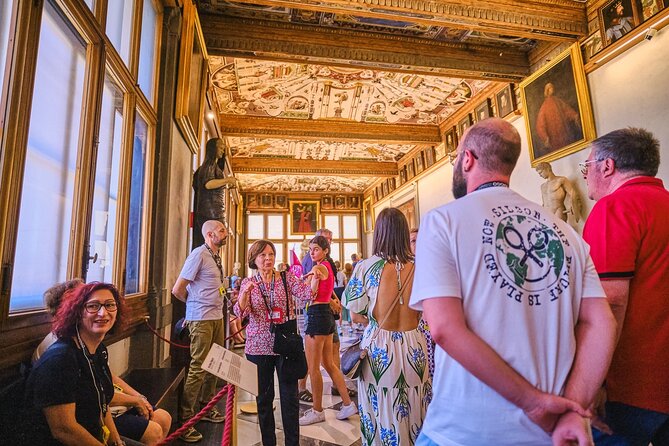
The museum is also physically large. There are ancient Greek and Roman sculptures, painted ceilings, long corridors, and rooms with views over Florence. Without a plan, it is easy to spend too much time early on and rush the Botticelli rooms later.
The tour uses headsets when the group is large enough to need them. That is useful in crowded galleries, though one person had trouble hearing during a Spanish visit and wished the audio equipment had been used with a very small group. Ask the guide if you cannot hear clearly. The tour works only when the explanation reaches everyone.
More ways into the Uffizi:
- Florence: Skip-The-Line Uffizi Gallery Timed Entry Ticket
★ 4.5 · 27,832 reviews - Florence: Uffizi Priority Ticket & Masterpieces Audio App
★ 4.2 · 6,402 reviews - Florence: Skip-the-Line Uffizi Small Group Tour
★ 4.6 · 5,926 reviews
Meeting near Via Cavour, then walking to the Uffizi
You meet your guide near Via Camillo Cavour before heading to the museum. The supplied meeting information gives Via Cavour 18, while the route details list Via Cavour 36 Red, so check the exact confirmation carefully before setting out. That small detail matters in Florence, where a wrong turn can cost you the start of a timed entrance.
From there, the group walks about 15 minutes to the Uffizi. Hotel pickup is not included, and you make your own way to the meeting point. The area is near public transportation, but arriving early remains wise, especially for a morning departure.
This walk is part of the practical setup rather than a sightseeing stop. Your guide brings the group to the museum and handles the arranged entry. Wear comfortable shoes. You will spend the visit on your feet, moving through rooms and corridors rather than sitting through a formal lecture.
Entering the Uffizi without buying a ticket on site
The skip-the-line ticket lets you bypass the ordinary ticket-buying queue. That is a useful benefit at the Uffizi, particularly during Florence’s high season from April through October.
Do not read skip-the-line as a guarantee of instant entry. Security checks and crowd control can still create short delays on the busiest days. You are skipping the ticket purchase line, not every possible line in the building.
The admission fee is included, as are the professional guide and group earphones. At $58.52 per person, this is not the cheapest way into the museum. The value comes from combining entry, a route through the major rooms, and live interpretation in a small group.
If you only want to enter and look alone, a guided tour costs more than a basic museum ticket would. If you want help making sense of Giotto, Uccello, Botticelli, Leonardo, and Michelangelo in one visit, the price is easier to justify. You also avoid spending part of your Florence day working out where to go next.
From gold-ground Madonnas to Giotto
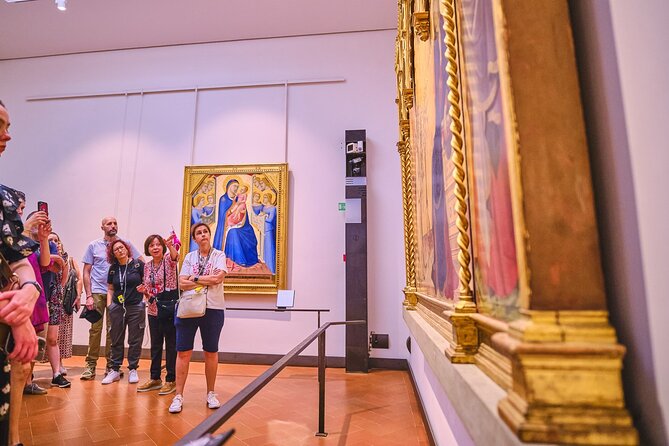
The first art section begins in the 13th century, when many paintings showed the Madonna and Child against gold backgrounds. These works can look formal and distant at first, but they establish the visual language that later artists would change.
Your guide points to Giotto as a major shift. His figures have more weight and occupy a more convincing space. The progress is not only technical. Art begins to feel more human, and religious scenes become easier to read as events involving real people.
This early section is valuable because it gives you a measuring stick. When you later reach Leonardo and Michelangelo, you can see more clearly how far artists had moved in anatomy, space, gesture, and storytelling.
The risk is that the early rooms may feel slow if you came only for Botticelli. Try not to hurry through them. A few minutes here makes the later masterpieces more meaningful.
More skip-the-line entries:
- Florence: Timed Entrance Ticket to Michelangelo’s David
★ 4.6 · 16,983 reviews - Florence: Michelangelo’s David Skip-the-Line Entry Ticket
★ 4.5 · 12,764 reviews - Florence: Leonardo Interactive Museum Entry Ticket
★ 4.5 · 11,763 reviews - Florence: Hop-on Hop-off Bus Tour: 24, 48 or 72-Hour Ticket
★ 4.0 · 6,283 reviews
Gothic drama and the first experiments with space
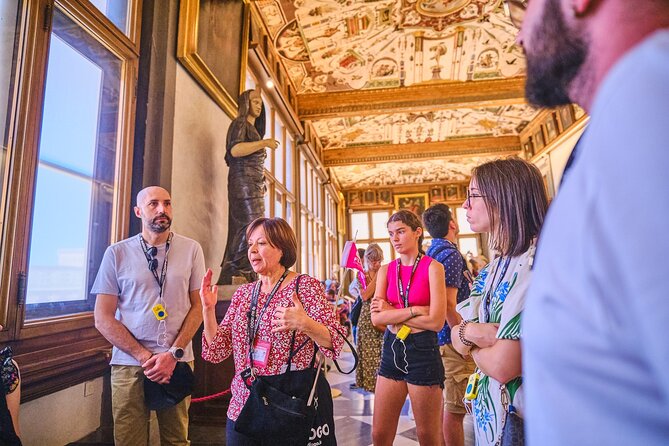
The route then moves through International Gothic art, including Gentile da Fabriano’s Adoration of the Magi. The work is known for its lavish surface and detailed storytelling. Your guide explains how paintings began to communicate a fuller scene rather than simply presenting sacred figures.
Next comes Paolo Uccello’s Battle of San Romano. This is a good place to watch artists test three-dimensional space. The battle has an almost diagram-like quality, with weapons, horses, and figures arranged to create depth and movement.
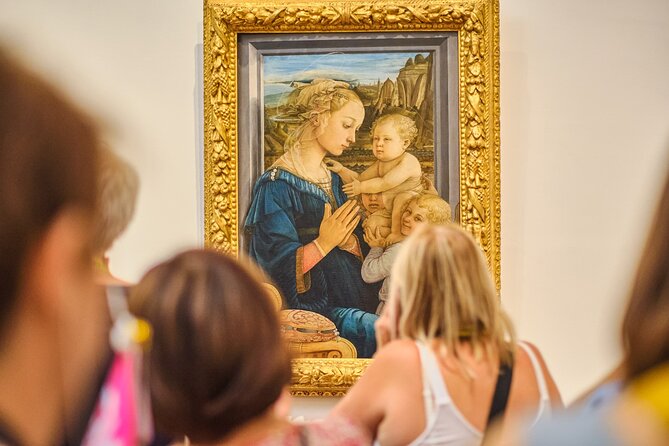
You also see Filippo Lippi’s Madonna with Child and Two Angels and Piero della Francesca’s Dukes of Urbino. Here, faces become more individual and the figures feel less like symbols. The presentation of men and women grows more idealized, a change that influenced Leonardo and Raphael.
The guide’s chronological approach helps you connect these works. You are not just collecting famous paintings. You are watching artists solve one problem after another: How do I show space? How do I make a person seem alive? How do I tell a story in a single image?
Botticelli and the Medici rooms
For many people, Botticelli is the emotional center of the Uffizi. The tour gives special attention to The Birth of Venus and Primavera, two paintings that have become symbols of Florence.
It is worth looking beyond the familiar images. Botticelli’s figures have an unusual, dreamlike quality, and their meaning is tied to the culture of the Medici family. Your guide discusses that connection and adds the social and political setting around the paintings.
This is also where a good guide can make a major difference. One guide, Chiara, was especially praised for combining academic facts with stories and personal details about the artists and their world. That balance is what you want in a museum tour: enough information to understand the picture, but not so much technical language that you stop looking at it.
The Botticelli rooms can be crowded. Stand where you can see the whole painting, then move closer if the group allows it. The guided visit gives you a first look, but staying afterward lets you return when you are less concerned with keeping up.
Leonardo and Michelangelo in smaller doses
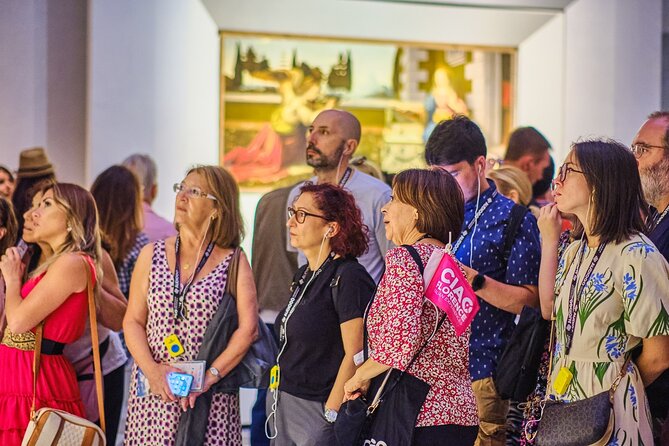
The Uffizi’s Leonardo and Michelangelo paintings are not always the works people know best, but seeing them here still matters. The tour includes Leonardo’s Annunciation and Baptism of Christ, along with Michelangelo’s Tondo Doni.
The Annunciation gives you a chance to consider Leonardo’s careful observation of nature, space, and gesture. The Baptism of Christ also helps place Leonardo within the workshop tradition of his time.
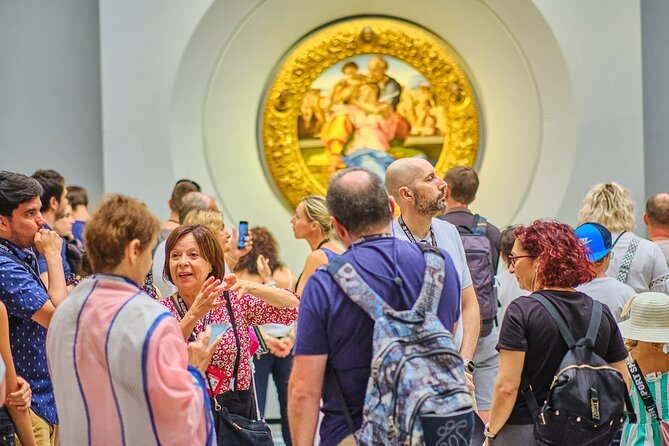
Michelangelo’s Tondo Doni is a different experience. Its circular format and forceful figures show the artist’s interest in sculpture-like bodies and strong movement. It is not the same as standing before the Sistine Chapel ceiling, but it shows the intensity that made Michelangelo famous.
These stops are brief by necessity. The Uffizi contains too much to give every major artist a long lecture in a 1-hour-45-minute route. If Leonardo or Michelangelo is your main reason for coming, plan to stay afterward and return to these works.
Raphael, Titian, Caravaggio, and the tour’s limits
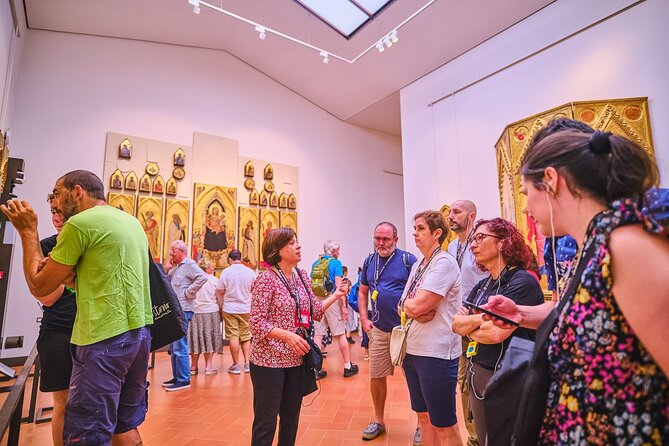
The final part moves into rooms devoted to Raphael, Titian, and Caravaggio. This broadens the visit beyond the early Renaissance and shows how painters kept changing color, composition, light, and emotional force.
The supplied route includes these artists, but the amount of attention can vary. One concern is that Caravaggio and Rembrandt may not receive the focus some art lovers expect. Rembrandt is especially important to note because he is not among the main works named in the route description.
That does not make the tour poor. It simply tells you what kind of visit this is. You are getting an organized introduction to the museum’s major periods, not a specialist tour of every school and artist.
If you want a close reading of Caravaggio, Rembrandt, or less famous works, use the remaining museum time for that purpose. Ask the guide where to find the paintings you care about, then continue alone after the formal tour ends.
The views and the building itself
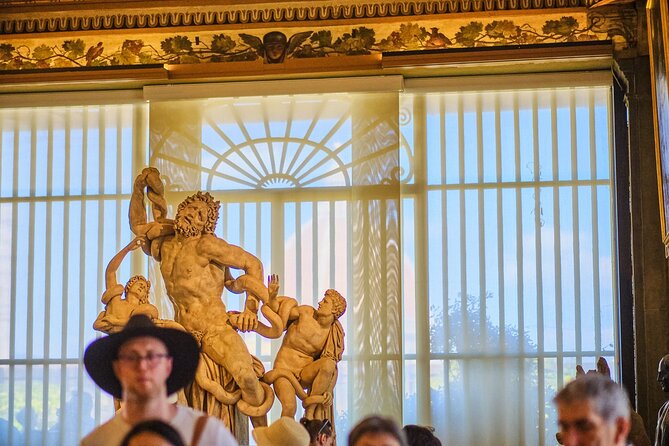
The Uffizi is more than a container for paintings. Between rooms, you see ancient sculpture, frescoed ceilings, and Florence through the large windows. Those moments give your eyes a rest and remind you that the museum occupies a historic building in the center of the city.
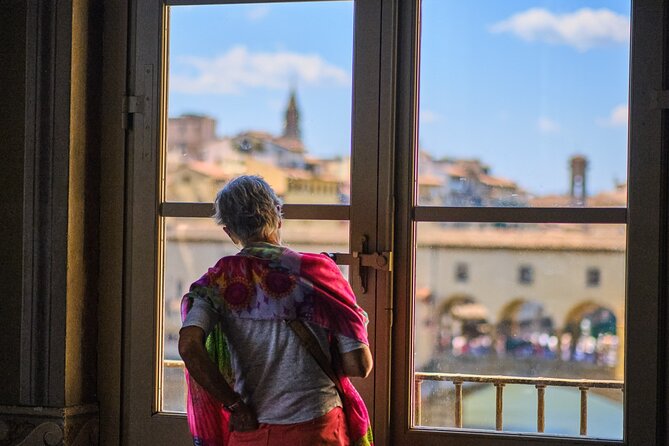
The views toward Florence are a welcome part of the visit. You may catch sight of the city center as you move along the corridors, and the architecture helps explain the museum’s grand scale.
Do not rush these sections simply because the famous paintings are waiting. The building shapes the experience. Its long galleries and open views make the Uffizi feel connected to Florence rather than isolated from it.
How the small group affects the visit
The group maximum is nine people. That is small enough for questions and far easier to manage than a large walking tour. A four-person group can feel especially personal, and an early start may help you enjoy that advantage before the museum becomes crowded.
A small group does not solve every sound problem. Some rooms are noisy, and the guide’s accent or speaking style may be difficult for you to follow. One English-language visit was disappointing because the guide’s very heavy accent made the commentary hard to understand and placed too much weight on Florence’s general history instead of the paintings.
That is the main variable in this experience. The strongest guide can make familiar works feel fresh. A weaker match can leave you wishing for more art and less background. The small group gives you a chance to ask for clarification, so use it.
Language arrangements change by season. From November through March, English and Spanish tours are always confirmed, while Italian, French, and German require at least four people. From April through October, the tour is monolingual and held in a small group.
Who should book this Uffizi tour
I would choose this tour if you are visiting the Uffizi for the first time and want a clear introduction without spending hours planning your route. It suits you especially well if Botticelli, Leonardo, Michelangelo, and the development of Renaissance painting are your priorities.
It also works for someone who wants to remain in the museum afterward. The tour does not force you out when the guide finishes. Since the ending is inside the Uffizi, you can revisit the major works or seek out rooms the group passed quickly.
You may want another option if you already know the museum well, want a specialist art lecture, or care most about Rembrandt and Caravaggio. The 1-hour-45-minute format cannot cover every important painting, and the guide’s focus may lean toward Florence’s history.
Book as early as you can if your dates are fixed. The experience is booked an average of 41 days ahead, which suggests that popular times can fill well before arrival. Free cancellation is available until 24 hours before the start time.
Practical details before you go
The tour includes a mobile ticket, museum admission, a licensed guide, and earphones for larger groups. You do not receive hotel pickup or drop-off.
Most people can participate, and the meeting area is near public transportation. Comfortable walking shoes are a good idea because the visit includes the walk from Via Cavour and plenty of standing inside the museum.
The supplied conditions also state that participants over age 12 must present proof of full vaccination, proof of a first vaccination at least 15 days earlier, proof of a Covid-19 infection within the previous six months, or a negative test taken within 48 hours of the activity. Requirements can change, so check the current confirmation before you go.
Should you book it?
Book this tour if you want the Uffizi’s big story, the famous Botticelli paintings, and a guide to point out the artistic turning points. The early meeting time, small group, included admission, and freedom to stay inside afterward make it a practical choice for a first visit.
Skip it if you prefer to move slowly through every room or already have a detailed list of lesser-known works. At $58.52, the tour is worthwhile when the guide is engaging and clear, but the limited time means you should treat it as an introduction, then use the rest of your visit to follow your own interests.
FAQ
How long does the Uffizi guided tour last?
The experience lasts about 1 hour and 45 minutes, including the guided visit and the walk from the meeting point to the museum.
What works of art are included?
The route includes Botticelli’s The Birth of Venus and Primavera, Leonardo’s Annunciation and Baptism of Christ, Michelangelo’s Tondo Doni, Giotto, Gentile da Fabriano, Paolo Uccello, Filippo Lippi, Piero della Francesca, Raphael, Titian, and Caravaggio.
Can I stay in the Uffizi after the guided tour?
Yes. The guided portion ends inside the Uffizi, and you can continue exploring the museum on your own.
Is museum admission included?
Yes. The Uffizi skip-the-line admission ticket is included in the tour price.
Are audio headsets provided?
Earphones are included for larger groups. If you have trouble hearing, tell your guide during the visit.
How large is the group?
The tour has a maximum of nine participants.
Where does the tour meet?
The meeting point is near Via Camillo Cavour in Florence. The supplied details list Via Cavour 18 and also Via Cavour 36 Red, so check your confirmation for the exact location.
Does the tour include hotel pickup?
No. Hotel pickup and drop-off are not included.
Which languages are confirmed?
From November through March, English and Spanish are always confirmed. Italian, French, and German require at least four participants. From April through October, the tour is monolingual and held in a small group.
What is the cancellation policy?
You can cancel up to 24 hours before the start time for a full refund. Cancellations or changes made less than 24 hours before the experience are not accepted for a refund.
More Museums Worth an Hour
- Florence Accademia Gallery Tour with Entrance Ticket Included
★ 4.5 · 6,148 reviews - Uffizi Gallery Small Group Tour with Guide
★ 4.5 · 4,923 reviews - Florence: Accademia Gallery Guided Tour
★ 4.6 · 4,156 reviews - Florence: Accademia Gallery Guided Tour with Entry Ticket
★ 4.6 · 2,253 reviews
Latest additions around Florence
- Florence: Cathedral Tour & Brunelleschi’s Dome Climb Ticket★ 5.0 · 3 reviews
- Palatina Gallery and Pitti Guided Tour in Florence★ 5.0 · 3 reviews
- Florence Uffizi Gallery Skip-the-line Tour w Art Historian Guide★ 5.0 · 3 reviews
- Private Tour: Pisa and Lucca from Florence★ 5.0 · 3 reviews
- San Gimignano Bike Tour (SOFT)★ 4.5 · 3 reviews
- Florence: Tour of Florence by rickshaw★ 5.0 · 3 reviews
- Center of Florence by golf cart★ 5.0 · 3 reviews
- From Firenze | Chianti day tour in a classic car★ 5.0 · 3 reviews
Uffizi Gallery Tours, compared.
Skip-The-Line Uffizi Gallery Timed Entry Ticket
Read our review →
Uffizi Priority Ticket & Masterpieces Audio App
Read our review →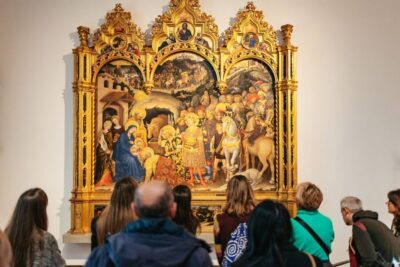

Skip the line: Uffizi and Accademia Small Group Walking Tour
Read our review →
Uffizi Gallery and Accademia Gallery Guided Tour
Read our review →
Uffizi Gallery Small-Group Guided Tour with Ticket
Read our review →
Michelangelo’s David, Accademia & Uffizi Small Group Tour
Read our review →Browse the lists this tour appears in