
Reviewed · UFFIZI GALLERY TOURS
Semi Private Uffizi Gallery Guided Tour in Florence
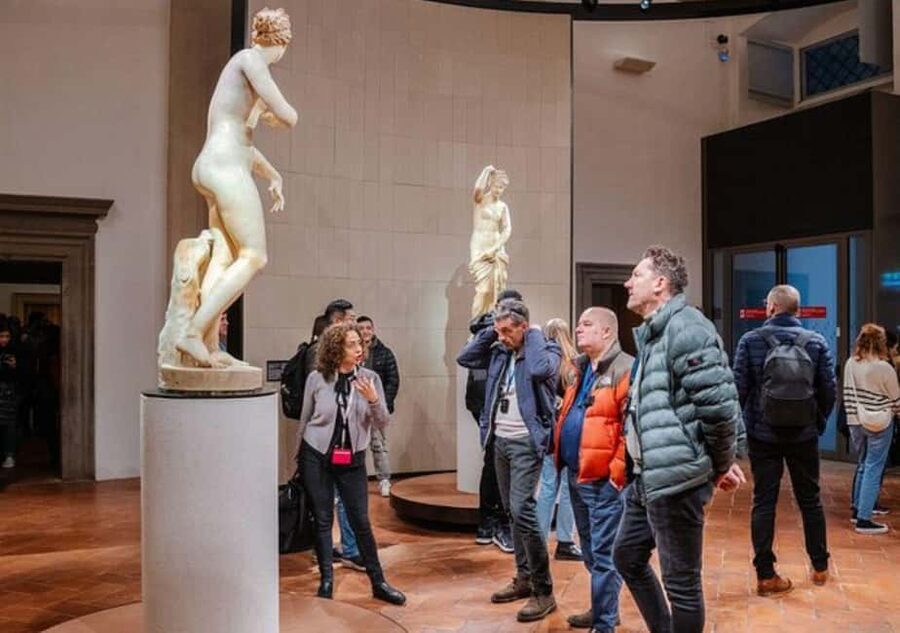
The best part of this Uffizi tour is the story behind the pictures. You do not simply walk past Giotto, Botticelli, Leonardo, and Michelangelo. Your guide connects the art to the Medici family, the building’s former role, and Anna Maria Luisa de’ Medici, whose gift kept the family collection in Florence. That context makes the paintings easier to understand.
I like the skip-the-line entry and the focused route through the gallery. I also like the radio system, since you can hear the guide without crowding around one person. The main concern is timing: the advertised visit lasts 1.5 hours, but one group found that the tour ran close to twice that length. If you have lunch, a museum, or a train booked afterward, leave plenty of space.
In This Review
- Key points at a glance
- Starting at Leonardo’s statue in Piazzale degli Uffizi
- The Uffizi began as a Medici office building
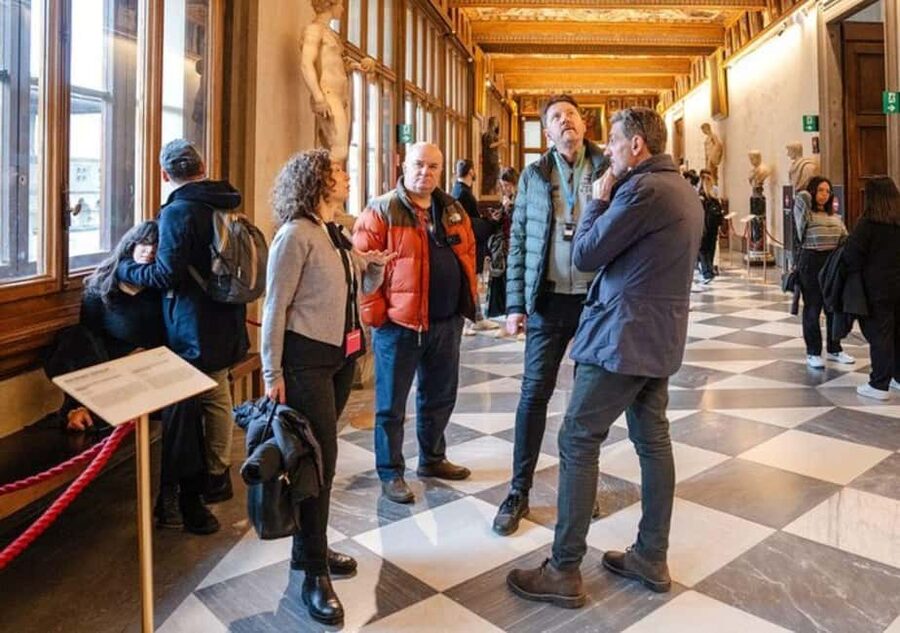
- Climbing the grand staircase with a guide
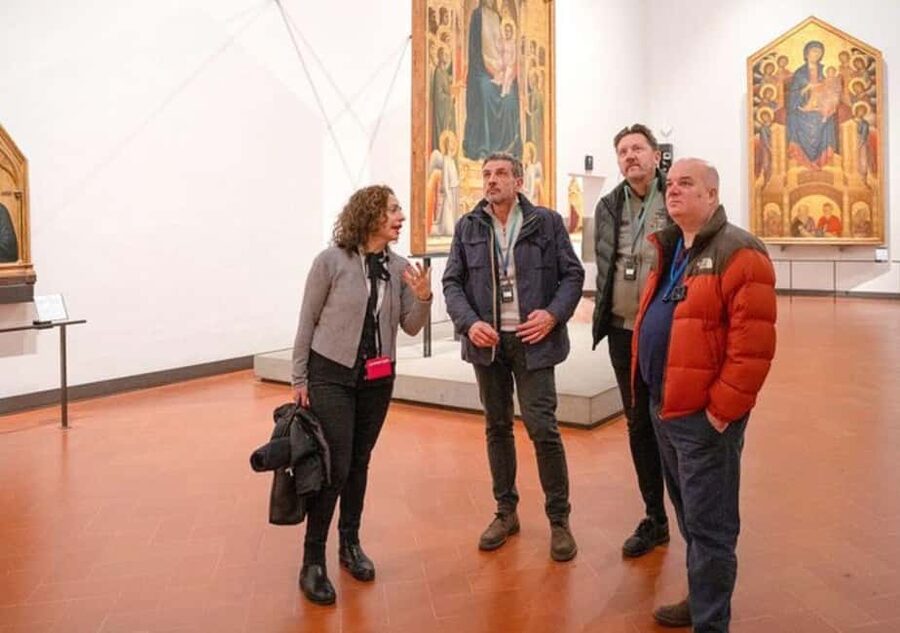
- Giotto’s Madonna di Ognissanti and the move toward naturalism
- Brunelleschi and the changing language of Florentine art
- Botticelli’s The Birth of Venus, not Venus de Milo
- Leonardo’s Annunciation and the value of close looking
- Michelangelo’s only panel painting
- A short visit with a serious amount of art
- What the $104 price gets you
- The optional wine tasting and pairing class
- Languages, access, and practical limits
- Who should book this Uffizi visit?
- Should you book the Semi Private Uffizi Gallery Guided Tour?
- FAQ
- Where does the tour meet?
- How long is the Uffizi guided tour?
- Is the Uffizi ticket included?
- Does the tour skip the ticket line?
- Which artists and works are included?
- Is the wine tasting included?
- Which languages are available?
- Is the tour wheelchair and stroller accessible?
- What happens if not enough people book?
Key points at a glance
- Medici stories frame the visit: Learn how Florence’s ruling family assembled and protected its art collection.
- Major Renaissance works come first: See Giotto’s Madonna di Ognissanti, Botticelli’s The Birth of Venus, Leonardo’s Annunciation, and Michelangelo’s panel painting.
- Meet at Leonardo’s statue: Arrive 15 minutes early at the statue in Piazzale degli Uffizi.
- A radio system helps: You can follow the guide’s explanations more easily in busy rooms.
- The timing needs care: The official duration is 1.5 hours, but the tour can run longer.
- Wine tasting is optional: A separate 1.5-hour wine tasting and pairing class is included only if you choose that option.
Starting at Leonardo’s statue in Piazzale degli Uffizi
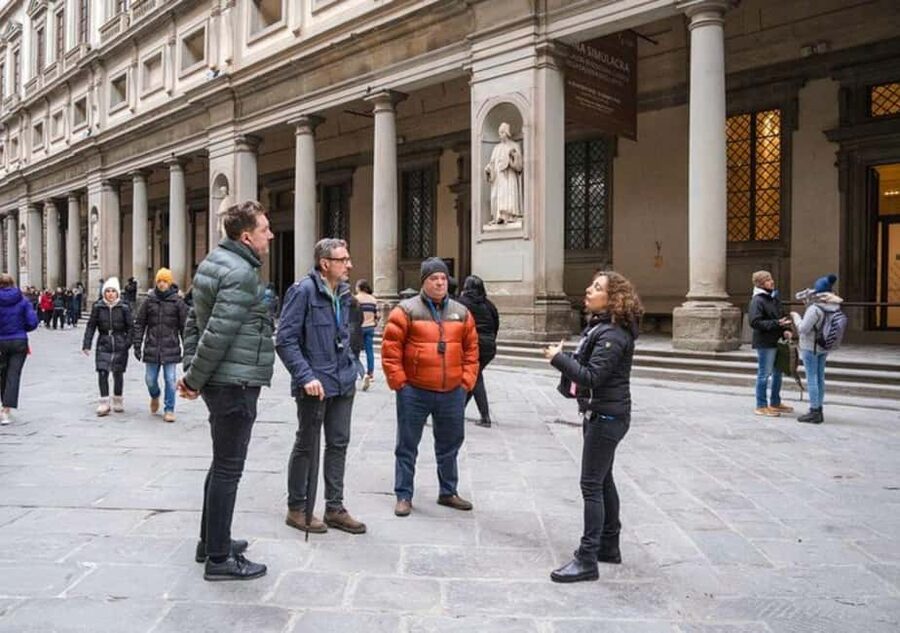
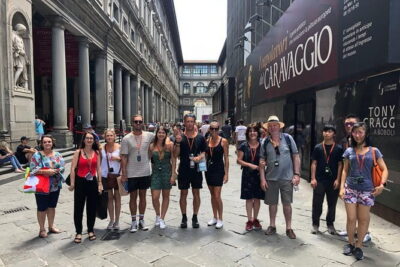
Your meeting point is the statue of Leonardo da Vinci in Piazzale degli Uffizi, outside the gallery. Plan to arrive 15 minutes before the scheduled departure. This is not a place to cut things close. If you arrive after the tour begins, you cannot join, and the booking will not be refunded or moved to another time.
You will need a passport or identity card, and comfortable shoes are a good idea. Large bags and oversize luggage are not allowed, so leave your suitcase at your hotel or another permitted storage point before coming to the museum.
The starting point is useful because you can get oriented before entering the gallery. The Uffizi sits in the heart of Florence, and the outdoor piazzale can be busy with people heading toward the museum, the Arno, and nearby historic sights. Look for the Leonardo statue rather than assuming every group gathers at the ticket entrance.
More ways into the Uffizi:
- Florence: Skip-The-Line Uffizi Gallery Timed Entry Ticket
★ 4.5 · 27,832 reviews - Florence: Uffizi Priority Ticket & Masterpieces Audio App
★ 4.2 · 6,402 reviews - Florence: Skip-the-Line Uffizi Small Group Tour
★ 4.6 · 5,926 reviews
The Uffizi began as a Medici office building
The Uffizi is easier to appreciate when you know that it was not built simply as an art museum. Its name comes from the Italian word for offices, and the building began as a place for Florentine government administration under the Medici. Over time, the family’s art holdings became central to the building’s identity.
Your guide begins with this background before leading you through the collection. That opening matters because the Uffizi is not just a line of famous rooms. It reflects the ambitions, tastes, rivalries, and public image of the Medici family. Art here was often a sign of power, religious devotion, civic pride, or political connection.
You also learn about Anna Maria Luisa de’ Medici. She was the last direct member of the Medici line, and she arranged for the family’s collection to remain in Florence rather than leave the city. Her portrait greets you near the entrance, giving the tour a clear human focus. Without her decision, many works associated with Florence might have ended up elsewhere.
Climbing the grand staircase with a guide
After the entrance, the route takes you up the grand staircase. This can be more than a simple climb when your guide explains the building’s design and points out details you might otherwise pass without noticing.
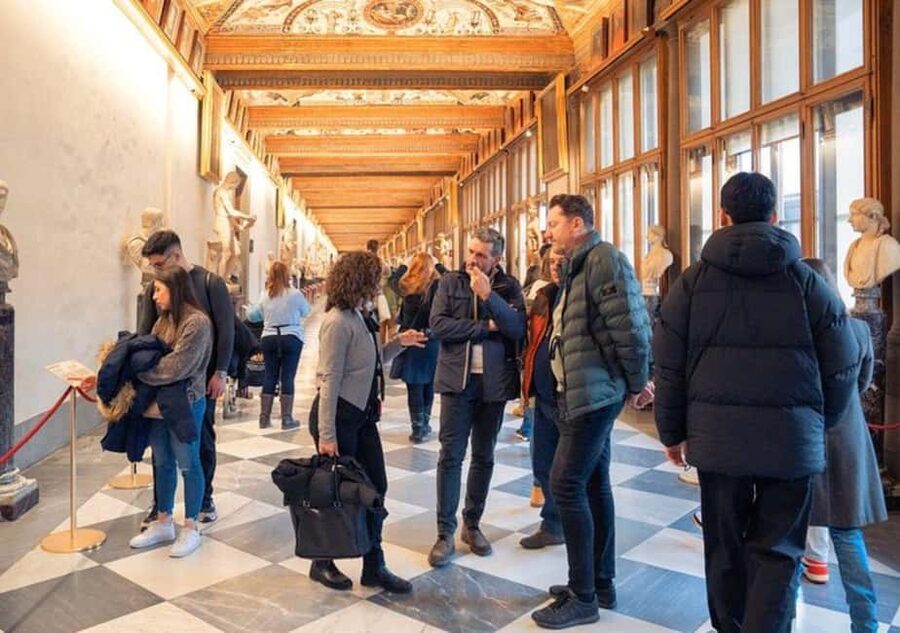
The Uffizi’s long corridors and formal rooms can feel confusing on a first visit. A guide gives you a route and a purpose. Instead of trying to decide which room matters most, you can listen for the changes in style, subject, and technique as the tour moves through several centuries.
The radio system is useful here. Museum rooms can be noisy, and groups often gather around the same paintings. With an earpiece, you can look at the work while still following the explanation. You are less likely to miss a point because you are standing at the back of a cluster.
The tour is described as semi-private, but the exact group size is not provided. A minimum of four people is required for the tour to operate. If too few people book, the operator may cancel after confirmation and offer an alternative or a full refund.
Giotto’s Madonna di Ognissanti and the move toward naturalism
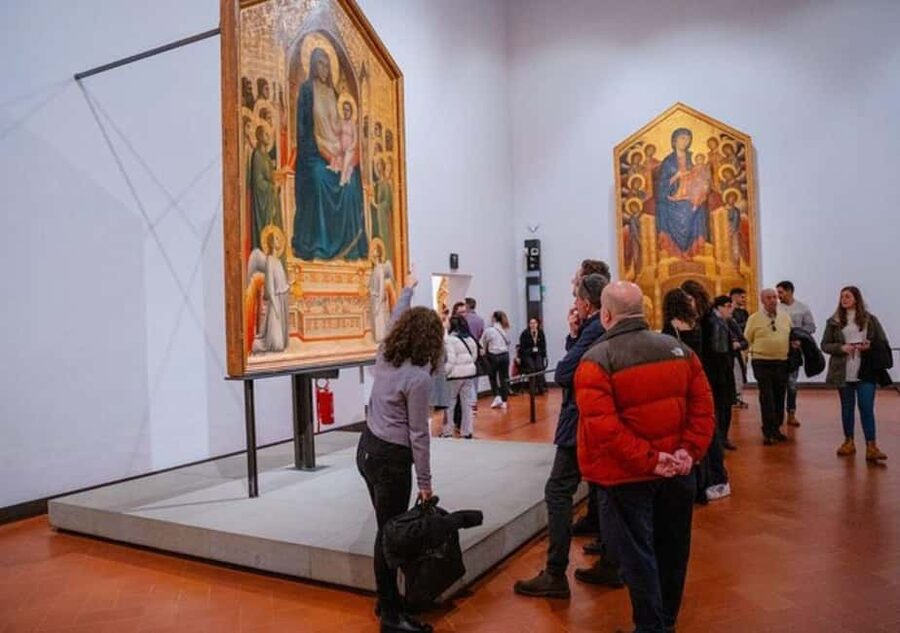
One of the early highlights is Giotto’s Madonna di Ognissanti, a major work from the 14th century. It gives you a useful starting point for seeing how Italian painting began to move away from flatter, more symbolic medieval forms.
The subject is familiar, but the presentation feels more solid and human. Giotto gives the figures weight and presence, helping you see the steps toward the Renaissance. Your guide can point out how the figures occupy space, how the throne is constructed, and how the arrangement of saints and angels creates depth.
This is the kind of painting that benefits from explanation. At a quick glance, you might simply note the gold background and formal religious scene. With context, you can see why the work matters and how it prepares the ground for later Florentine artists.
The route includes works from the 13th through the 18th centuries. That range gives you a broad view rather than a narrow concentration on the most famous Renaissance names. Still, the visit is selective. You will not see every room in equal detail during a short guided route.
More museums worth an hour:
- Florence: Leonardo Interactive Museum Entry Ticket
★ 4.5 · 11,763 reviews - Florence Accademia Gallery Tour with Entrance Ticket Included
★ 4.5 · 6,148 reviews - Uffizi Gallery Small Group Tour with Guide
★ 4.5 · 4,923 reviews - Florence: Accademia Gallery Guided Tour
★ 4.6 · 4,156 reviews
Brunelleschi and the changing language of Florentine art
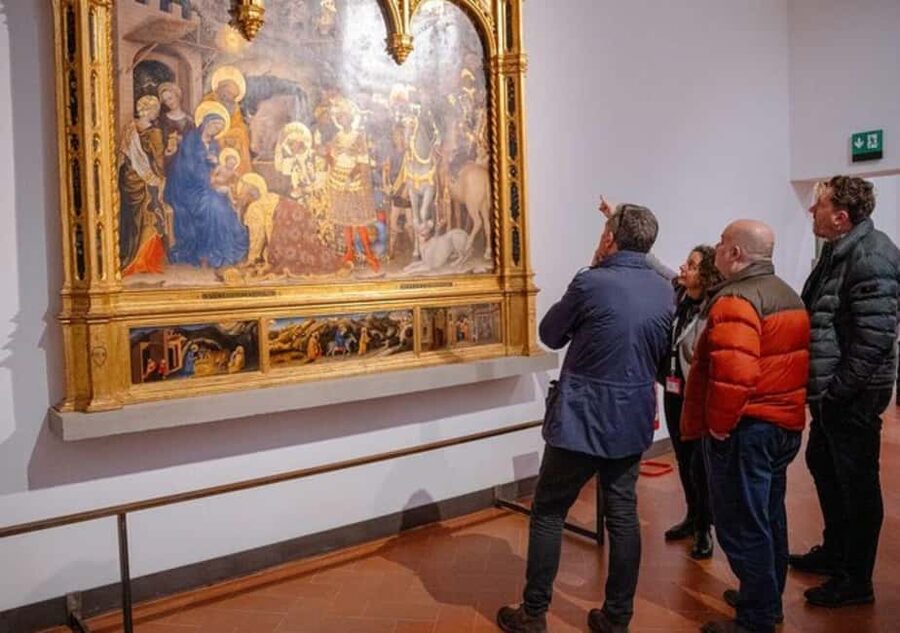
Filippo Brunelleschi is included among the artists discussed during the visit. He is best known as an architect, but his importance reaches into the larger Florentine shift toward proportion, perspective, and a more convincing sense of space.
The exact Brunelleschi work shown during this experience is not specified, so you should not book expecting one particular painting or sculpture. Instead, think of this stop as part of the wider explanation of how artists and architects in Florence changed the way people pictured the world.
That connection is one of the tour’s strengths. The Uffizi works better when you see artists as part of a conversation. Giotto, Brunelleschi, Botticelli, Leonardo, and Michelangelo were not isolated names on a wall. Their work reflects changing ideas about the body, nature, mathematics, religion, classical antiquity, and the role of the patron.
Botticelli’s The Birth of Venus, not Venus de Milo
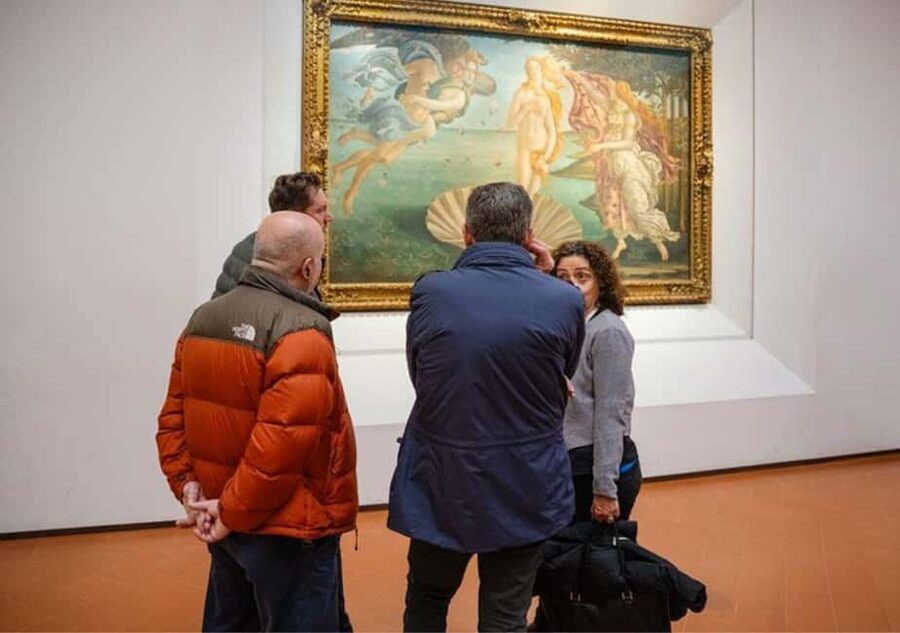
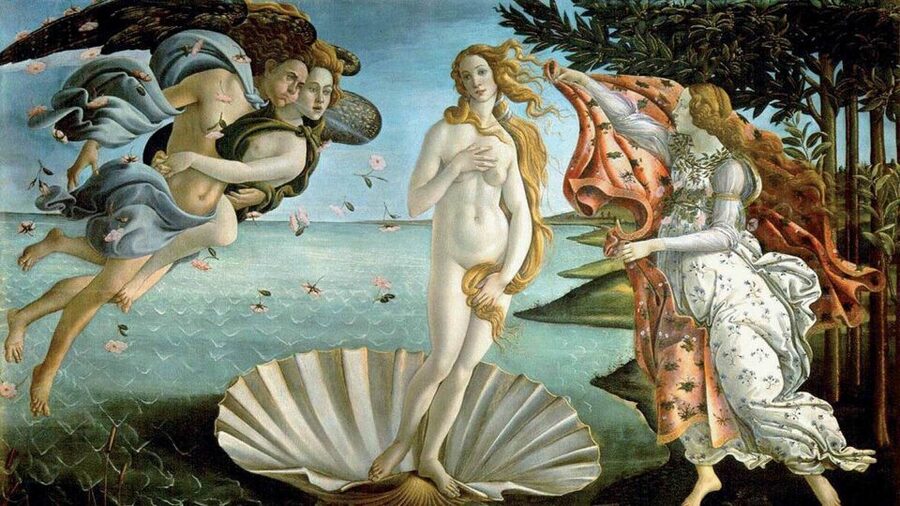
Botticelli’s The Birth of Venus is one of the Uffizi’s essential stops. The title is sometimes mixed up with the Venus de Milo, which is an ancient Greek sculpture in the Louvre. Here, you are looking at Botticelli’s famous painting of Venus arriving on shore.
The work rewards a few quiet minutes. Notice the flowing hair, the pale figure of Venus, the wind-blown garments, and the idealized setting. Your guide can help explain the painting’s classical references and the interests of the Florentine circle that supported Botticelli.
The picture is often surrounded by people, so the radio system again earns its keep. You can stand a little farther back, see the whole composition, and still hear the main points. If Botticelli is your priority, pay close attention during this section and plan to return after the tour if you want more time.
That return visit is one of the better features of a guided museum tour. Once the official route ends, you are free to revisit works that caught your attention, subject to normal museum access and closing time. You get the guide’s framework first, then a chance to look on your own.
Leonardo’s Annunciation and the value of close looking
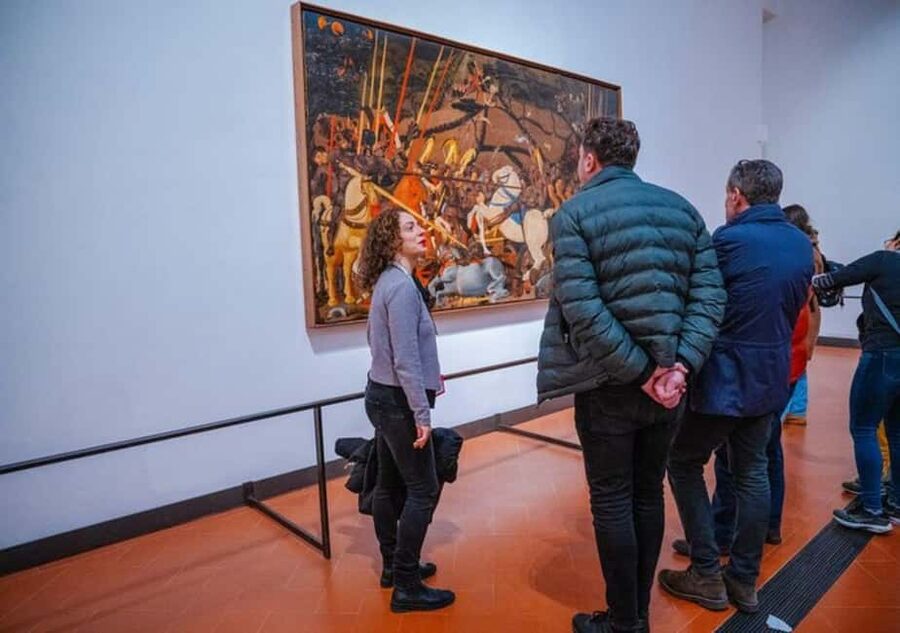
Leonardo da Vinci’s Annunciation brings the visit to another level of detail. The painting shows Mary receiving the news of Christ’s birth, but Leonardo’s treatment gives the scene a careful sense of place, gesture, and observation.
A guide can direct your eyes to the small decisions that make the picture feel convincing. The setting, the figures’ hands, the folds of clothing, and the distant view all matter. You do not need a specialist background to enjoy this. You simply need someone to slow the viewing down.
Leonardo is also connected to your meeting point, since the tour begins at his statue. That gives the visit a neat thread from the piazzale into the galleries. You start with the artist’s public image and then encounter one of his major works inside.
The Uffizi holds several layers of meaning in each room, and this is where a short guided visit can help. You may not remember every date or technical term, but you are more likely to leave knowing what to look for in Renaissance painting.
Michelangelo’s only panel painting
The tour includes what is described as the only panel painting in the world by Michelangelo. This is the Doni Tondo, a round panel painting of the Holy Family. It is an important work because Michelangelo is often associated first with sculpture, the Sistine Chapel, and monumental figures.
The painting lets you see his approach to anatomy, color, and forceful form in a different setting. The figures have a sculptural presence, even though they are painted on wood. Your guide can also place the work within the artistic competition and ambitions of Renaissance Florence.
This is a good example of why context helps. If you simply know that the painting is by Michelangelo, you may admire its fame and move on. If you understand how unusual it is within his output, you have a stronger reason to stop and study its design.
The tour does not promise every major Uffizi room, and the guide may spend more or less time at each work depending on the group and museum conditions. If Michelangelo is your main goal, tell the guide early or make this one of your first return stops afterward.
A short visit with a serious amount of art
The stated tour duration is 1.5 hours. That is enough for a guided introduction to the main works, but it is not enough for a leisurely museum visit. The Uffizi is large, and even a focused route can feel full when it includes architecture, Medici history, artists, and several major paintings.
One group found that its visit lasted nearly twice as long as expected because the guide continued beyond the planned overview. The guide was well-informed and enthusiastic, but the extra time created a real problem for people who had planned lunch and rest afterward. Some members left before the route was complete.
I would treat the 1.5-hour figure as a planning minimum, not a guarantee that you will be out the door at exactly 90 minutes. Leave at least another hour before a fixed reservation. If you have another standing tour afterward, the risk matters even more.
The positive side is that the extra explanation may suit you if you want art history rather than a quick checklist. The drawback is simple: a museum tour can become tiring when you are standing for a long time, especially if your day already includes several sights.
What the $104 price gets you
At $104 per person, this is not the cheapest way to enter the Uffizi. The price includes the museum ticket, reservation, official certified guide, and radio system. It also includes wine tasting and pairing only if you select that option.
The value depends on how you like to visit museums. If you are comfortable reading labels and choosing your own route, you may prefer a regular admission ticket and more freedom. If you want the major works explained in a logical order, the guide can save you time and help you get more from a first visit.
The skip-the-line promise is another part of the value. During busy periods, avoiding the standard ticket queue can protect a large part of your day. The operator guarantees this service even in peak season, except when delays or strikes by museum management interfere.
You are paying for structure as much as entry. The tour gives you a starting point, a route, and a human explanation of why the pictures matter. That is especially useful if you are new to Renaissance art or visiting Florence for only a short stay.
The optional wine tasting and pairing class
A wine tasting and pairing class is available as an option at Vino Tasting Global Srl. The listed itinerary gives this stop another 1.5 hours, so selecting it changes the length and shape of your day.
The supplied details do not specify the wines, foods, number of pours, or exact meeting arrangements for the tasting. Check those points before booking if the food and wine portion is important to you. The base Uffizi experience does not include food and drinks.
I would choose the wine option only if you want a separate food and wine activity after the museum. It is not a small add-on in terms of time. Together, the gallery and tasting can take at least three scheduled hours, before walking between locations or allowing for delays.
Languages, access, and practical limits
The live guide is available in English, French, Spanish, Italian, and German. Choose your language when checking availability, since not every departure necessarily runs in every language.
The experience is listed as wheelchair and stroller accessible. That is useful, but the Uffizi is a historic building with crowds, stairs, and long periods of standing. If you have specific mobility needs, confirm the route details with the operator before booking.
Transportation to and from the attractions is not included. Hotel pickup and drop-off are also not included, so you need to reach the Leonardo statue yourself and make your own way onward after the gallery.
You can cancel up to 24 hours before the activity for a full refund, and the reserve-now, pay-later option keeps your money free until later. The minimum of four participants is the main booking uncertainty. If the minimum is not met, you should receive an alternative or full refund.
Who should book this Uffizi visit?
I would recommend this tour to a first-time Uffizi visitor who wants a clear introduction to the Medici collection and the best-known Renaissance works. It also suits you if you prefer hearing an explanation rather than studying labels on your own.
Art lovers may appreciate the extra detail, but you should be honest about your stamina and schedule. A short museum visit can become a long one when the guide has more to say than the clock allows.
Families may find the guided route easier than managing the entire museum independently, although children who need frequent breaks may struggle with the standing time. Wheelchair users and people with strollers should confirm the exact access arrangements before arrival.
Should you book the Semi Private Uffizi Gallery Guided Tour?
Book it if you want the Uffizi’s major works tied to the Medici story, and if you value a guide who explains why the art matters. The strongest elements are the skip-the-line entry, radio system, focus on landmark paintings, and chance to revisit favorite works afterward.
Think twice if your schedule is tight or if you want a precisely timed 90-minute visit. The $104 price is reasonable for a guided, reserved-entry experience, but it is high for anyone who only wants to see a few pictures quickly. Arrive early, carry only a small permitted bag, and leave a generous buffer after the tour. That way, the Uffizi can be the thoughtful center of your Florence day rather than the reason the rest of it runs late.
FAQ
Where does the tour meet?
Meet at the Leonardo da Vinci statue in Piazzale degli Uffizi, 15 minutes before the departure time.
How long is the Uffizi guided tour?
The stated duration is 1.5 hours. The visit may run longer, so leave extra time before any fixed plans.
Is the Uffizi ticket included?
Yes. The package includes a Uffizi Gallery ticket and reservation.
Does the tour skip the ticket line?
Yes. Skip-the-line entry is included, with the operator noting exceptions for delays or strikes by museum management.
Which artists and works are included?
The route includes Giotto’s Madonna di Ognissanti, Botticelli’s The Birth of Venus, Leonardo da Vinci’s Annunciation, Brunelleschi-related art, and Michelangelo’s panel painting.
Is the wine tasting included?
Wine tasting and pairing are included only when you select that option. The listed tasting portion lasts 1.5 hours.
Which languages are available?
The live guide is available in English, French, Spanish, Italian, and German.
Is the tour wheelchair and stroller accessible?
Yes. The activity is listed as wheelchair and stroller accessible.
What happens if not enough people book?
The tour requires at least four participants. If the minimum is not met, the operator may cancel after confirmation and offer an alternative or a full refund.
Latest additions around Florence
- Florence: Cathedral Tour & Brunelleschi’s Dome Climb Ticket★ 5.0 · 3 reviews
- Palatina Gallery and Pitti Guided Tour in Florence★ 5.0 · 3 reviews
- Florence Uffizi Gallery Skip-the-line Tour w Art Historian Guide★ 5.0 · 3 reviews
- Private Tour: Pisa and Lucca from Florence★ 5.0 · 3 reviews
- San Gimignano Bike Tour (SOFT)★ 4.5 · 3 reviews
- Florence: Tour of Florence by rickshaw★ 5.0 · 3 reviews
- Center of Florence by golf cart★ 5.0 · 3 reviews
- From Firenze | Chianti day tour in a classic car★ 5.0 · 3 reviews
Uffizi Gallery Tours, compared.
Skip-The-Line Uffizi Gallery Timed Entry Ticket
Read our review →
Uffizi Priority Ticket & Masterpieces Audio App
Read our review →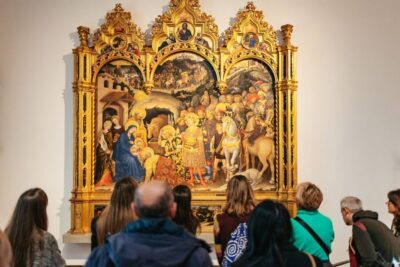

Skip the line: Uffizi and Accademia Small Group Walking Tour
Read our review →
Uffizi Gallery and Accademia Gallery Guided Tour
Read our review →
Uffizi Gallery Small-Group Guided Tour with Ticket
Read our review →
Michelangelo’s David, Accademia & Uffizi Small Group Tour
Read our review →Browse the lists this tour appears in