
Reviewed · FLORENCE
Mindgames of a Mentalist and Strolling through Florence
Florence is usually presented through paintings, palaces, and church facades. This experience takes a different route, using the city itself as a stage for mind games, memory tests, and playful demonstrations led by mentalist Darus. You move through six central sights while taking an active part instead of simply listening to a guide.
I like the way the tour connects the tricks to specific places, especially Dante’s home, the Duomo, and the Porcellino fountain. I also like its family appeal: the activities can involve teenagers, adults, skeptics, and people who do not usually enjoy standard sightseeing tours. The main drawback is that the experience depends on good weather and includes public outdoor spaces, so it is less appealing on a rainy or very hot day.
In This Review
- Key points to know before booking
- FAQ
- How long does the mentalist walking experience last?
- Where does the experience start?
- Where does the experience end?
- Which Florence sights are included in the route?
- Does the price include admission to the Duomo or museums?
- Who leads the experience?
- Is transportation included?
- Is bottled water provided?
- Can the experience be canceled because of weather?
Key points to know before booking
- Mind games tied to Florence: The demonstrations draw on Dante, local legends, historic buildings, and the character of each square.
- Darus leads the experience: He acts as both mentalist and walking host, mixing illusions with bits of local information.
- Six central stops in two hours: The route ends at Piazza Santissima Annunziata after starting near Piazza della Signoria.
- You take part: Expect to contribute thoughts, memories, choices, or physical participation rather than watch from the sidelines.
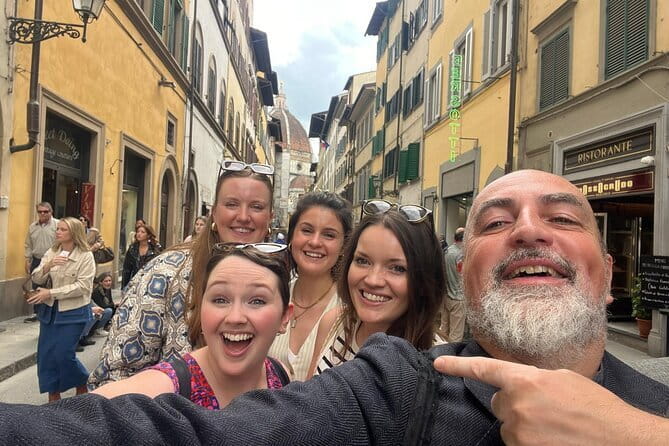
- Good for mixed-age groups: A family group with ages from 15 to 48 found ways for everyone to join in, including a skeptical 20-year-old.
- A small-group feel is possible, but not guaranteed: The maximum group size is 30, so the amount of personal attention may vary.
At $64.53 per person, this is not a substitute for a classic Florence walking tour. You will not go inside the cathedral, climb Giotto’s Campanile, or receive a full art-history lecture.
You are paying for something different: an entertainer, a carefully chosen route, and a series of interactive moments that make familiar places feel fresh. The value is strongest if you have already seen the main sights, are taking a break from museums, or want an activity that works for a family or small group with mixed interests.
The experience lasts about two hours. Six stops fill that time, with most locations receiving around 15 minutes and Piazza Santissima Annunziata receiving about 30 minutes. The route is compact and city-based, but you should still expect to walk between locations and spend much of the time outdoors.
Darus uses the landmarks as part of the performance. A thought-reading exercise at the Duomo is meant to feel different from the same trick in a hotel room. A memory experiment near the Ospedale degli Innocenti connects the activity to the square’s past. You may not accept the supernatural explanation, but the setting gives each demonstration a clear sense of place.
The meeting point is Via della Ninna, 1R, near Piazza della Signoria. This is a useful starting area because it puts you close to several of Florence’s most famous sights, including Palazzo Vecchio and the Uffizi area.
The first section sets the tone. Darus frames the walk as a movement from an inferno toward a mental paradise, borrowing the language and ideas associated with Dante Alighieri’s Divine Comedy. The historical reference is part of the flavor, not a substitute for a detailed Dante lecture.
Here, the mentalism begins with group experiments and demonstrations. You may be asked to make choices, focus on an idea, or take part in a short exercise with another person. The point is not simply to watch Darus perform. The format works best when you are willing to raise your hand and play along.
Piazza della Signoria can be crowded, and outdoor performance conditions are not always ideal. Keep your meeting details handy on your phone, and arrive with enough time to locate Via della Ninna. The ticket is mobile, which makes this simple, but you still need to be in the right place at the scheduled time.
The next stop is the Duomo, officially the Cattedrale di Santa Maria del Fiore. Its marble exterior and enormous dome make it one of Florence’s most dramatic settings, even if you are only standing outside.
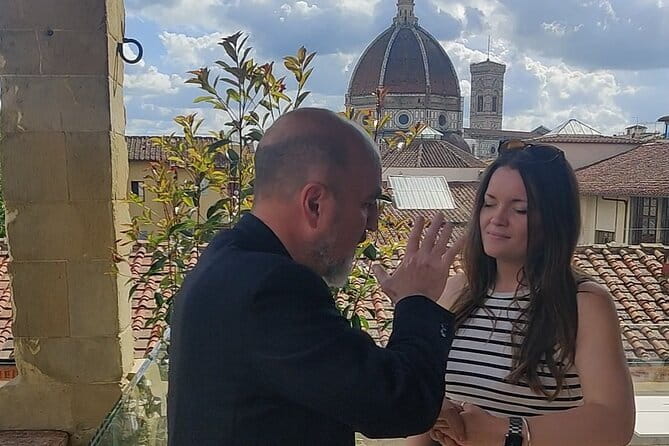
Darus uses the cathedral as the backdrop for a thought-reading demonstration. The activity is designed to connect your perception and thoughts with the atmosphere of the building. If you enjoy the mystery of mentalism, this is likely to be one of the more memorable stops.
There is an important practical distinction here. Admission to the stop is free, but this experience does not include entry into the cathedral or its related sites. You are seeing the Duomo as part of a street walk, not taking a guided visit through the interior.
That can be a plus. Florence’s cathedral complex often involves timed tickets, lines, and separate admission rules. This stop lets you enjoy the building without adding another reservation. If entering the Duomo is a priority, plan that separately.
The Museo Casa di Dante provides the next setting. The stop centers on the energy and associations of Dante Alighieri’s former home, with a series of mental experiments connected to the poet.
The museum itself is not included as an admission visit. The experience uses the surrounding location, so you should not book this expecting an indoor museum tour or a detailed examination of Dante’s manuscripts and belongings.
Still, this is a clever part of the route. Dante gives Darus a strong theme to work with: memory, imagination, inner journeys, and the boundary between the ordinary and the strange. The activity feels more specific when it is attached to a known figure and place.
A small amount of background knowledge may help you appreciate the references, but you do not need to be a Dante expert. The focus remains on taking part in the demonstrations.
The Baptistery is close to the cathedral, so this part of the walk keeps you in Florence’s central historic core. Its distinctive shape and decorated exterior provide another visual setting for Darus’s performance.
At this stop, the activity draws on the Baptistery’s features. The description is intentionally broad, so you should expect a demonstration shaped around the building rather than a fixed museum presentation with a published script.
This is one reason the experience may feel more personal than a standard sightseeing route. The landmarks are not just photo stops. Each one gives Darus a new theme, object, or story to use in the mind games.
The tradeoff is that the historical information appears to be light. You may hear bits of useful trivia, but this is not the right choice if your main goal is a serious explanation of Florentine architecture. Think of the place-based facts as seasoning for the performance.
The walk continues to the Fontana del Porcellino, the famous bronze boar fountain. The stop uses the fountain’s legend and history as the basis for another mental experiment.
This is a good example of how the route turns familiar sights into prompts for participation. You are not simply told that the fountain has a story. The story becomes part of a game designed to lead the group toward Darus’s idea of a mental paradise.
The Porcellino is also an easy place to recognize and remember. If you are meeting friends later in central Florence, it is a practical landmark, though the surrounding streets can be busy and crowded.
As with the other stops, no admission fee is listed because the activity takes place in the public area. You should not expect time for a full museum visit, shopping, or a long independent stop at each location. The two-hour schedule keeps the group moving.
The final stop is Piazza della Santissima Annunziata, where the tour spends about 30 minutes. That longer time allows Darus to build toward a concluding set of activities based on memory and the history of the Ospedale degli Innocenti.
The theme is a kind of journey back through your memories. This may involve personal recollections, links between participants, or exercises designed to test how people remember and connect ideas. The details can change with the group, which is part of the appeal of a live mentalism performance.
The square itself has an elegant, open layout and is a calmer finish than some of the tighter streets in central Florence. The end point is a few hundred meters from the Duomo, making it easy to continue sightseeing afterward.
It is also some distance from the starting point, so do not plan to return to Via della Ninna immediately unless you are happy to walk back. The start and finish are both central, but they are not the same place.
This is not a passive audio tour. Darus asks people to contribute energy, thoughts, memories, and choices. Some demonstrations may involve two people working together, while others may focus on one participant in front of the group.
That format can be excellent for families and friends. One particularly useful detail is that the experience has worked for groups ranging from teenagers to adults in their late forties. Even a skeptical young adult was drawn into the fun, which tells you something about the show’s social side.
Still, you should be comfortable with some attention. If you strongly dislike being asked to participate in front of other people, the experience may feel less relaxing than a normal walking tour. You can enjoy watching others, but the design clearly favors people who are ready to join in.
The mentalism itself is presented as mysterious and surprising. You do not need to decide if it is psychic ability, clever observation, suggestion, or performance technique. The practical question is simpler: do you enjoy being puzzled and laughing with a group?
A mentalist show could take place almost anywhere. Here, the city gives it structure.
The route links Piazza della Signoria with the Duomo, Dante’s home, the Baptistery, the Porcellino, and Santissima Annunziata. You get a compact introduction to several key parts of central Florence, even though the focus is not traditional sightseeing.
I like this combination because it helps you look at famous places in a new way. After hearing the usual facts about domes, statues, and Renaissance buildings, it can be refreshing to use the same surroundings for a strange memory test or a thought experiment.
The experience also encourages you to connect with the people you are traveling with. Some activities pair participants or use shared focus. That makes it a good choice for a family looking for something everyone can discuss afterward.
Do keep your expectations clear. The landmarks are settings for mentalism, not the main lesson. If you want dates, artists, architectural analysis, and museum access, choose a specialist walking tour instead or add one separately.
The maximum group size is 30 people. That is not a tiny private tour, so the amount of individual attention may depend on the final number and on how many people want to participate.
A group of 30 can create useful energy for a performance. It also means you may spend some time watching other participants. I would consider that a normal part of the format rather than wasted time, especially if the demonstrations are varied.
The tour is near public transportation, and most people can participate. Service animals are allowed. No private transportation is included, but none is really needed for this central walking route.
You receive bottled water, a small but welcome inclusion during an outdoor activity. Wear comfortable shoes and check the forecast before you go. The organizers can cancel for poor weather, offering another date or a full refund.
The experience also requires a minimum number of participants. If that minimum is not reached, you may be offered another date or experience, or a full refund. For schedule-sensitive trips, keep this possibility in mind.
The price makes sense if you value entertainment and participation more than formal sightseeing instruction. Two hours with Darus, six central locations, and a live sequence of demonstrations gives you an event rather than just a walk from one landmark to another.
The value is especially strong for a family or group of friends. You are buying a shared memory, and the activities give people something to talk about long after the tour ends. Several experiences described the event as a welcome break from ordinary sightseeing, which is exactly how I would frame its appeal.
The price is harder to justify if you mainly want access to Florence’s attractions. The tour does not include private transportation, cathedral admission, museum entry, or a full historical tour. You may still need to pay separately for those priorities.
The experience is booked, on average, eight days ahead. That does not guarantee a sellout, but it is a useful planning signal. If the date matters to you, reserve before arriving rather than treating it as a last-minute extra.
I would choose this for:
- Families with older children and teenagers
- Couples who want something beyond museums and churches
- Friends who enjoy puzzles, illusions, and group activities
- People who have already seen Florence’s major sights
- Visitors who do not usually enjoy formal guided tours
- Curious skeptics who like trying to work out how a trick was done
I would be more cautious if you want a quiet walk, dislike audience participation, or need an indoor activity that is protected from weather. It may also disappoint you if you expect a serious mental-health, psychology, or supernatural investigation. This is live entertainment with historical and local themes.
You can cancel for a full refund up to 24 hours before the experience begins. Changes or cancellations made less than 24 hours before the start time are not accepted for a refund.
The cut-off follows Florence local time. Because weather matters, a cancellation caused by poor conditions can lead to a different date or a full refund. The same applies if the minimum number of participants is not met.
Confirmation is provided at booking, and the ticket is mobile. Save the meeting address, Via della Ninna, 1R, before setting out, since the finish is at Piazza della Santissima Annunziata rather than back at the starting point.
Book it if you want a playful two-hour change of pace and like the idea of seeing Florence through live experiments rather than a standard lecture. Darus’s upbeat style, the mix of ages he can involve, and the use of places such as Dante’s home and the Porcellino give the walk a clear personality.
Skip it if you need indoor shelter, detailed art history, or guaranteed one-on-one attention. At $64.53, it is best viewed as a theatrical walking experience with sightseeing built around it. For the right audience, that unusual mix can become one of the most talked-about parts of a Florence visit.
FAQ
Other Florence outings people weigh against this one:
- Florence: Skip-The-Line Uffizi Gallery Timed Entry Ticket
★ 4.5 · 27,832 reviews - Tuscany Day Trip from Florence: Siena, San Gimignano, Pisa and Lunch at a Winery
★ 5.0 · 21,634 reviews - Florence: Timed Entrance Ticket to Michelangelo’s David
★ 4.6 · 16,983 reviews
How long does the mentalist walking experience last?
The experience lasts approximately two hours.
Where does the experience start?
It starts at Via della Ninna, 1R, 50122 Firenze FI, Italy.
Where does the experience end?
It ends at Piazza della Santissima Annunziata in Florence.
A different way to spend the same Florence day:
- Florence: Michelangelo’s David Skip-the-Line Entry Ticket
★ 4.5 · 12,764 reviews - The Best tour in Florence: Renaissance & Medici Tales – guided by a STORYTELLER
★ 5.0 · 12,316 reviews - Florence: Leonardo Interactive Museum Entry Ticket
★ 4.5 · 11,763 reviews - The Best Tour in Florence: Renaissance and Medici Tales
★ 5.0 · 10,810 reviews
Which Florence sights are included in the route?
The route includes Piazza della Signoria, the Duomo, Museo Casa di Dante, the Baptistery of San Giovanni, the Fontana del Porcellino, and Piazza della Santissima Annunziata.
Does the price include admission to the Duomo or museums?
No. The listed stops have free admission for this experience, and the activity does not include private admission to the cathedral or museums.
Who leads the experience?
Mentalist Darus leads the walking experience and the interactive mind games.
Is transportation included?
No. Private transportation is not included.
Is bottled water provided?
Yes. Bottled water is included.
Can the experience be canceled because of weather?
Yes. The experience requires good weather. If poor weather causes cancellation, you can be offered another date or a full refund.
Latest additions around Florence
- Palatina Gallery and Pitti Guided Tour in Florence★ 5.0 · 3 reviews
- Florence: Cathedral Tour & Brunelleschi’s Dome Climb Ticket★ 5.0 · 3 reviews
- Florence Uffizi Gallery Skip-the-line Tour w Art Historian Guide★ 5.0 · 3 reviews
- Private Tour: Pisa and Lucca from Florence★ 5.0 · 3 reviews
- San Gimignano Bike Tour (SOFT)★ 4.5 · 3 reviews
- Florence: Tour of Florence by rickshaw★ 5.0 · 3 reviews
- Center of Florence by golf cart★ 5.0 · 3 reviews
- From Firenze | Chianti day tour in a classic car★ 5.0 · 3 reviews