
Reviewed · MUSEUMS
Leonardo Interactive Museum® Entrance Ticket
Leonardo’s genius is easier to grasp when you can turn a gear, test a bridge, or study a flying-machine model instead of only looking at a page in a gallery. This compact Florence museum turns his drawings into hands-on exhibits arranged around earth, water, air, and fire.
I like the self-led format, which lets you spend time on the machines that catch your eye. I also like the mix of engineering, anatomy, and painting, so you see Leonardo as more than the artist behind the Mona Lisa. The main drawback is space: the museum is small, and it can feel crowded and noisy when several groups reach the machines at once.
In This Review
- Key points to know before you book
- What the Leonardo Interactive Museum actually offers
- Earth, water, air, and fire
- Hands-on machines, puzzles, and model building
- Leonardo the anatomist and painter
- Six languages and a self-guided format
- How long to spend and when it works best
- The $11.95 price and what you receive
- Who will enjoy this museum most
- Simple tips for a smoother visit
- Should you book the Leonardo Interactive Museum?
- FAQ
- How much does admission cost?
- How long does the museum visit take?
- Is the ticket guided?
- Are the exhibits available in English?
- Is the museum suitable for children?
- Do children under five need a ticket?
- Are food and drinks allowed inside?
- Can I cancel for a full refund?
Key points to know before you book
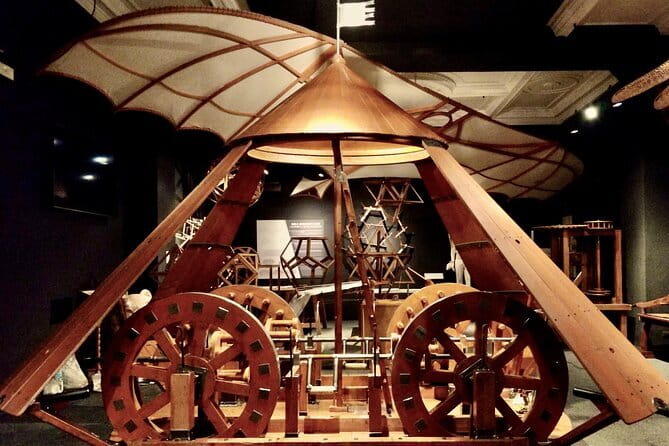
- Hands-on Leonardo models: Test and examine machines built from Leonardo’s designs, including flying machines, mechanical devices, bridges, and other engineering concepts.
- Good for families: Children and adults can work with many displays, puzzles, and construction models together.
- Four themed sections: The exhibits are grouped under earth, water, air, and fire, giving the museum a clear subject-based structure.
- More than machines: You’ll also find anatomical studies and high-resolution backlit reproductions of Leonardo’s major paintings.
- Short, central museum visit: Plan for about one to one and a half hours, with air-conditioned rooms, bathrooms, and access to public transportation nearby.
- Worth booking ahead: Admission costs $11.95 per person, and advance booking helps secure entry, especially during busy periods.
What the Leonardo Interactive Museum actually offers
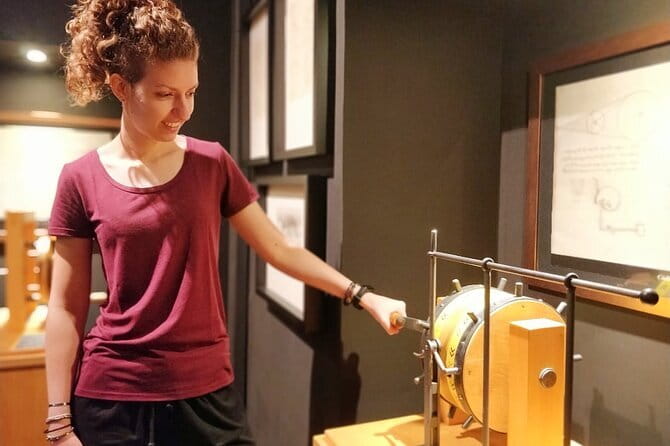
This is not a guided tour, and nobody leads you through Leonardo’s life in a fixed order. You receive admission and explore at your own speed, moving between machines, displays, multimedia information, and reproductions.
That arrangement works well if you like to stop, experiment, and read only what interests you. It works less well if you want a polished story with a guide explaining how each invention fits into Leonardo’s career.
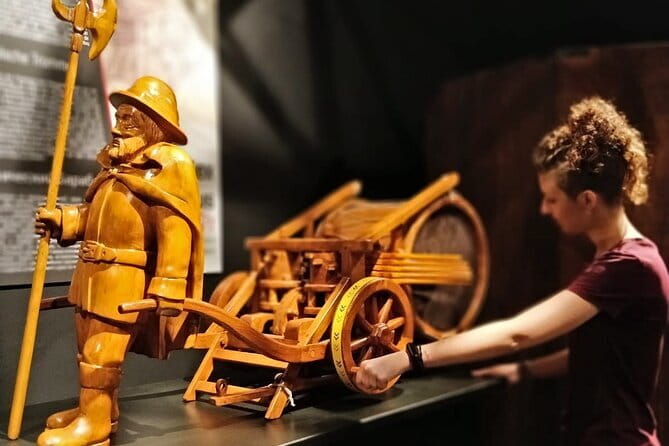
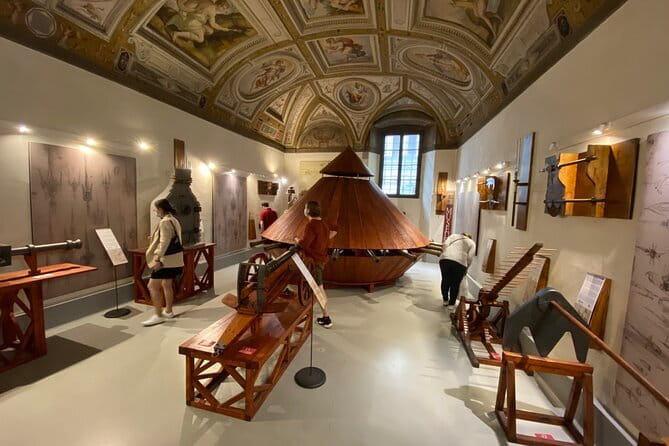
The museum is designed for children and adults alike. The machines are based on Leonardo’s drawings and, where possible, built to scale. That phrase matters because the displays are not simply framed diagrams. You can see how certain parts move and, at several stations, handle models or try simple mechanical ideas yourself.
The museum’s central appeal is practical. Leonardo’s notes can look abstract on paper. A working replica of a gear system, bridge, or flying machine gives you a better sense of the problem he was trying to solve.
More skip-the-line entries:
- Florence: Skip-The-Line Uffizi Gallery Timed Entry Ticket
★ 4.5 · 27,832 reviews - Florence: Timed Entrance Ticket to Michelangelo’s David
★ 4.6 · 16,983 reviews - Florence: Michelangelo’s David Skip-the-Line Entry Ticket
★ 4.5 · 12,764 reviews
Earth, water, air, and fire
The four main sections organize the exhibition by natural forces rather than by date. You can expect to encounter designs connected with movement, water power, flight, construction, and other mechanical ideas.
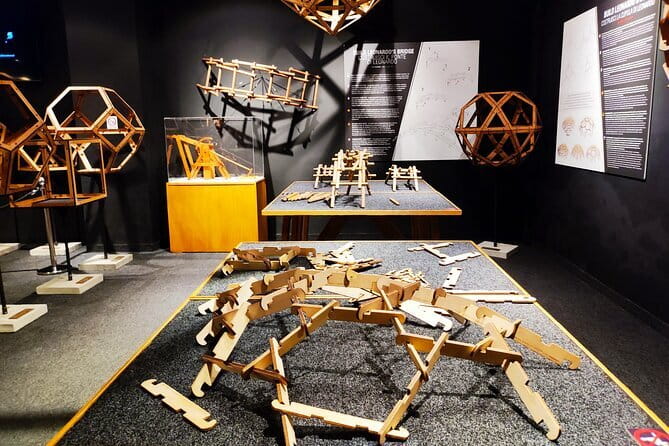
The earth section helps connect Leonardo’s imagination with machines that work on land and with construction. Mechanical models and bridge-building activities are especially useful here. One bridge station can become a shared project for a family, and building several three-dimensional models gives children a reason to think through balance and structure rather than simply press buttons.
The water section shows how Leonardo studied flow, movement, and devices that could use water as a force. You may find that some models are more interactive than others, but the physical displays still make his engineering questions easier to understand.
The air section is likely to attract the most attention. Leonardo’s flying-machine ideas are among the clearest examples of his habit of watching nature and asking how people might copy it. Seeing these concepts as physical models helps you understand both his ambition and the limits of the technology available in his time.
The fire section rounds out the display with machines linked to force, energy, and motion. The grouping is easy for children to follow, though it does not provide a strict chronology of Leonardo’s life. If you want a date-by-date account of his work, you’ll need to read the panels and multimedia material carefully.
Hands-on machines, puzzles, and model building
The machines are the reason to come. Many displays are built so you can turn, pull, test, or examine a mechanism. The experience is at its best when you take your time and let a child or companion work out what makes a model move.
Several exhibits also invite you to build models or solve hands-on puzzles. That gives the museum an unusual advantage over a traditional art stop in Florence. You are not only looking at Leonardo’s ideas, you are testing basic principles such as balance, motion, gears, and support.
I would set aside more time than the bare minimum if you are visiting with children. An hour may be enough for a quick circuit, but 90 minutes gives you a fair chance to wait for popular stations, read the descriptions, and build a few models.
The hands-on approach also suits adults with an interest in engineering. You do not need technical training, but you should enjoy figuring out how things work. If you already know Leonardo’s mechanical studies well, some displays may feel introductory rather than revealing.
A practical caution: the word interactive should not lead you to expect that every object is in perfect working condition. The machines receive heavy use, and some may feel worn. In a crowded room, you may also need to wait before you can try a popular exhibit.
Leonardo the anatomist and painter

The museum does not limit itself to machines. A separate area covers Leonardo’s anatomical studies, showing how closely his art and scientific observation were linked.
This section is valuable because it broadens the visit. Leonardo was not only drawing machines for future use. He was also studying the human body with intense attention to structure and movement. The anatomical material provides a useful counterpoint to the mechanical displays.
You’ll also find a gallery of important paintings reproduced with high-resolution backlight technology. These are reproductions, not original masterpieces, so you should not treat this as a substitute for Florence’s major art museums. Still, the display gives you a chance to connect Leonardo’s technical eye with his work as a painter.
That combination is one of the museum’s strongest features. A child may arrive for the flying machines and leave with a better idea of why Leonardo’s drawings mattered. An adult focused on the paintings may gain a clearer sense of the observation and problem-solving behind them.
More museums worth an hour:
- Florence: Leonardo Interactive Museum Entry Ticket
★ 4.5 · 11,763 reviews - Florence Accademia Gallery Tour with Entrance Ticket Included
★ 4.5 · 6,148 reviews - Uffizi Gallery Small Group Tour with Guide
★ 4.5 · 4,923 reviews - Florence: Accademia Gallery Guided Tour
★ 4.6 · 4,156 reviews
Six languages and a self-guided format
Descriptions accompany the exhibits in Italian, English, French, German, Spanish, and Russian. That makes the museum easier to use without a guide, particularly when you are visiting with a mixed-language family or group.
Multimedia displays add information about Leonardo’s life and work. The museum is self-led, so you control how much background you want. I recommend reading the short panel beside each machine first, then trying the model. That order helps you understand what the mechanism is meant to show.
The space can become noisy, especially when several people are testing machines and taking photographs. Audio information may be hard to hear inside at busy times. If you use the suggested audio content, you may find it easier to listen outside the exhibit area.
There is no defined route that carries you neatly from Leonardo’s youth to his later work. Think of this as a collection of themed stations rather than a chronological biography. Families often benefit from choosing a few sections to explore carefully instead of trying to absorb every label.
How long to spend and when it works best
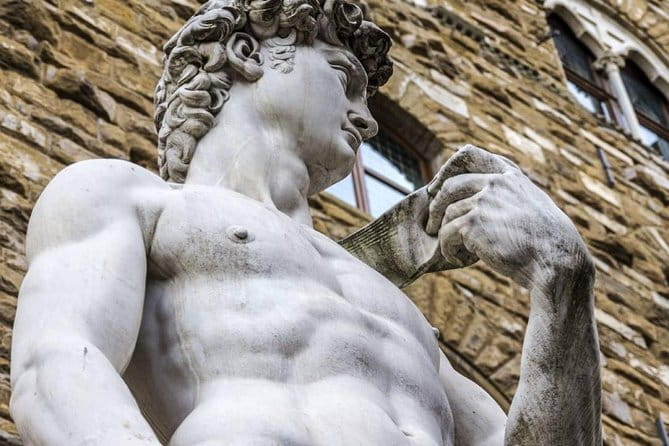
The advertised visit takes about one hour to one and a half hours. Many people can see everything in 90 minutes, but the real timing depends on how long you wait for the machines and how much you read.
A quick visit works as a break between larger Florence sights. The air-conditioned rooms are useful during a hot afternoon, and the bathrooms can be a real help for families. The museum is near public transportation, though the exact meeting point should be checked carefully before you set out.
Advance booking is sensible. The ticket is often booked about 14 days ahead, and prebooking guarantees your entry under the offered admission terms. Timed entry can help control crowding, but it does not guarantee a quiet visit. The museum may still feel tight when several groups arrive together.
Allow extra time if you are visiting with children aged seven to 13. Younger children may need close supervision, while older children can spend longer with the construction models and mechanical puzzles. Children under five enter free.
The $11.95 price and what you receive
At $11.95 per person, this is a modestly priced Florence attraction. The value depends on your expectations.
For a short, family-friendly activity that gives children something to do with their hands, the price is reasonable. You get admission without commissions or additional ticket costs, air-conditioned rooms, multilingual descriptions, bathrooms, and access to the museum shop.
For an adult who wants original Leonardo paintings or a major scholarly collection, the value is weaker. The paintings are faithful reproductions, and the museum’s mechanical material is presented at an accessible level. You are paying for the chance to interact with models and make Leonardo’s ideas easier to picture.
I would compare it with the cost and energy of another large Florence museum visit. This stop is shorter, less formal, and easier to fit into a packed day. It also gives you a change of pace after churches and galleries, particularly if your group needs an activity rather than another room of framed art.
The shop sells books and souvenirs, which can add a useful educational follow-up. You do not need to buy anything, but the selection may appeal if you want a book on Leonardo’s machines or a model to take home.
Who will enjoy this museum most
This is a strong choice for families. Children can test machines, build models, and work on puzzles instead of being asked to remain silent and still. Adults can join in, too, and the displays often work best when two generations solve a construction problem together.
It also suits visitors who like science, design, engineering, and the practical side of Renaissance thought. The museum gives you a physical way to understand Leonardo’s work, even if you know little about him before arriving.
Art lovers can enjoy the painting gallery and anatomical studies, but you should book this as an addition to Florence’s art museums, not as a replacement. The reproductions provide context, while Florence’s original works belong elsewhere.
The museum may disappoint you if you want a quiet, spacious setting or a detailed historical narrative. The rooms are small, crowding can limit access to the machines, and the self-guided layout does not always make Leonardo’s timeline clear.
Remember to book the interactive museum specifically. Florence has more than one Leonardo-themed attraction, including a historical museum, and the two are not the same. Check the name and location on your confirmation before heading out.
Simple tips for a smoother visit
- Visit with enough time to try the popular machines instead of rushing through.
- Keep food, chewing gum, and drinks out of the exhibit areas.
- Supervise children closely. Anyone who risks damaging the museum or disrupts other people may be asked to leave.
- Read the English descriptions before testing a machine, then let children work out the movement.
- Expect some noise and crowding, even with timed entry.
- Check the location carefully. The museum’s sales information can be easy to confuse with another nearby Leonardo attraction.
- Use the multilingual panels if audio material is difficult to hear in the room.
- Keep your ticket details handy. Confirmation is sent at booking, and free cancellation is available up to 24 hours before the start time.
Should you book the Leonardo Interactive Museum?
Book it if you want a short, affordable Florence activity that puts Leonardo’s ideas into your hands. The strongest reasons are the working models, the bridge-building and puzzle stations, the family appeal, and the chance to connect his machines with his anatomy and painting.
Skip it if you want original art, a quiet museum, or a guided explanation of Leonardo’s life. At $11.95, the risk is fairly low, but you should expect a compact, sometimes crowded exhibition rather than a grand museum visit.
For most families, science-minded adults, and first-time visitors curious about Leonardo’s inventions, I would book ahead and allow 90 minutes. Go in with the right expectation: this is a playful, accessible introduction to his mechanical imagination, not a full substitute for Florence’s major art collections.
FAQ
How much does admission cost?
The ticket costs $11.95 per person.
How long does the museum visit take?
The expected visit lasts about one hour to one and a half hours. Some people may want up to two hours if they take time with the models and interactive stations.
Is the ticket guided?
No. This is a self-led admission ticket, and no guided tour is included.
Are the exhibits available in English?
Yes. Exhibit descriptions are provided in Italian, English, French, German, Spanish, and Russian.
Is the museum suitable for children?
Yes. The exhibition is recommended for children and adults, with hands-on machines, puzzles, and model-building activities. Children must be supervised at all times.
Do children under five need a ticket?
Children under five receive free admission.
Are food and drinks allowed inside?
No. Food, chewing gum, and beverages are prohibited in the exhibit areas.
Can I cancel for a full refund?
Yes. You can cancel at least 24 hours before the experience start time for a full refund. Cancellations or changes made less than 24 hours in advance are not accepted for a refund.
Latest additions around Florence
- Florence: Cathedral Tour & Brunelleschi’s Dome Climb Ticket★ 5.0 · 3 reviews
- Palatina Gallery and Pitti Guided Tour in Florence★ 5.0 · 3 reviews
- Florence Uffizi Gallery Skip-the-line Tour w Art Historian Guide★ 5.0 · 3 reviews
- Private Tour: Pisa and Lucca from Florence★ 5.0 · 3 reviews
- San Gimignano Bike Tour (SOFT)★ 4.5 · 3 reviews
- Florence: Tour of Florence by rickshaw★ 5.0 · 3 reviews
- Center of Florence by golf cart★ 5.0 · 3 reviews
- From Firenze | Chianti day tour in a classic car★ 5.0 · 3 reviews
Museums, compared.
Skip-The-Line Uffizi Gallery Timed Entry Ticket
Read our review →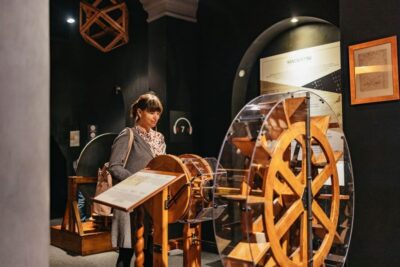

Florence Accademia Gallery Tour with Entrance Ticket Included
Read our review →


Accademia Gallery Guided Tour with Entry Ticket
Read our review →
Golf Cart Tour to Fiesole Roman Theatre and Museum
Read our review →
Uffizi Gallery and Accademia Gallery Guided Tour
Read our review →Browse the lists this tour appears in