
Reviewed · FLORENCE WALKING TOURS
Florence: Private Guided Walking Tour
Florence reveals its best stories on foot, and this private three-hour walk links the city’s major sights with the small details you could easily miss alone. You’ll move from Dante’s medieval quarter to the Duomo, then across Ponte Vecchio and past the Uffizi, with a guide explaining how art, politics, religion, and powerful families shaped the city.
I like the private format, especially for a group of friends or family sharing the $341 cost. I also like the flexible pace: guide Larla has allowed stops for gelato and photos, while other guides named on past walks include Constansa and Andrea. The main drawback is scope. Three hours gives you a strong Florence orientation, but not time to visit the Uffizi, climb the dome, or explore the palaces inside.
In This Review
- Key points to know before booking
- Why a private Florence walk works so well
- Starting in Florence’s medieval district
- Duomo Square and Florence’s great building project
- Piazza della Signoria as an open-air sculpture gallery
- The Uffizi colonnade and art without an admission ticket
- Ponte Vecchio and the route toward Pitti Palace
- The Vasari Corridor, a secretive link with limits
- The guide makes the difference
- Timing, walking effort, and practical limits
- What the $341 price really buys
- Who should book this Florence walking tour?
- Should you book it?
- FAQ
- How long is the Florence private walking tour?
- How much does the private tour cost?
- What sights are included on the walking route?
- Does the tour include entrance to the Uffizi Gallery?
- Does the tour include a visit inside the Vasari Corridor?
- Which languages are available?
- Where does the guide meet the group?
- Is the tour wheelchair accessible?
Key points to know before booking
- The route covers Florence’s headline sights: Duomo Square, Piazza della Signoria, the Uffizi colonnade, Ponte Vecchio, Pitti Palace, and the medieval district.
- You pay for guiding, not museum admission: Church and museum entrances, food, and drinks are not included.
- A private group of up to eight keeps the price reasonable: At full capacity, the cost works out to about $43 per person.
- The guide can shape the walk around your interests: Past guide Larla has made room for gelato stops and extra photo breaks.
- The route is packed with outdoor art: Loggia dei Lanzi works like a free sculpture gallery beside Palazzo Vecchio.
- You finish at Florence’s architectural heart: The Cathedral, Baptistery, Giotto’s Bell Tower, and Brunelleschi’s Cupola receive the final focus.
Why a private Florence walk works so well
Florence is compact, but it is not simple. A single street can carry traces of Roman planning, medieval trade, Medici power, Renaissance art, and modern tourism. If you walk without context, you’ll still see handsome buildings. With a guide, you have a better chance of understanding why they matter.
This tour is built for that first layer of understanding. You are not signing up for long museum visits or a formal lecture. You are walking from one landmark to the next while a local guide supplies the names, dates, rivalries, and small stories that turn stone into a city.
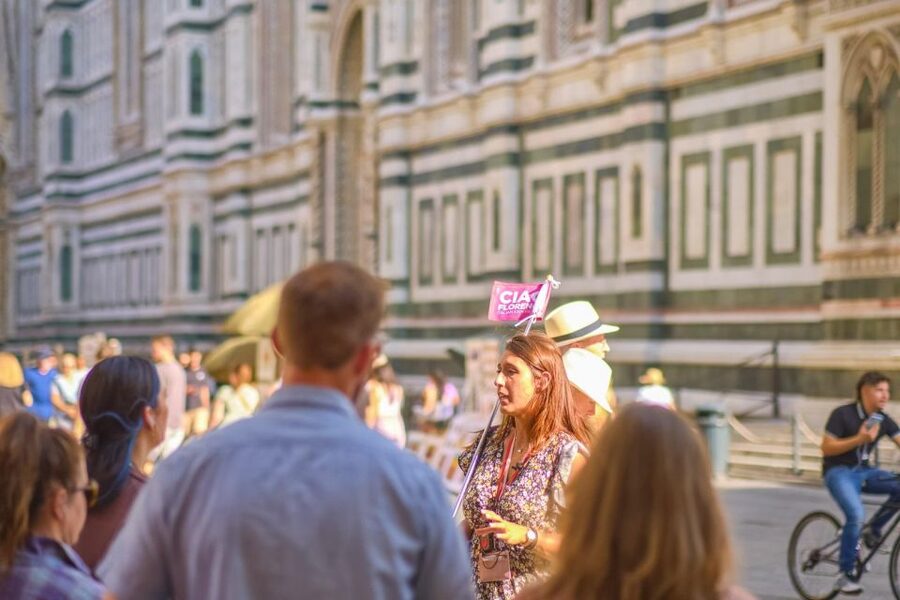
The private setup matters more than it might at first appear. You can ask why a particular statue is in a square, pause for a photograph, or spend a little longer on a subject that interests your group. A large public tour has to keep moving. Here, the guide can respond to your questions and adjust the rhythm.
The stated cost is $341 for up to eight people. For one or two people, that is a serious expense for three hours. For a full group, it is a much better deal, at roughly $43 per person. You are paying for a private guide, not tickets or meals, so the value is strongest when you care about orientation, conversation, and control of the pace.
More walking routes in Florence:
- Florence: Guided Walking Tour
★ 4.5 · 3,334 reviews - Skip the line: Uffizi and Accademia Small Group Walking Tour
★ 4.5 · 3,135 reviews - Florence: Guided Walking Tour
★ 4.6 · 1,602 reviews
Starting in Florence’s medieval district
The walk takes you into the medieval district and to the House of Dante. The stop is especially useful if you want to connect Florence’s streets with Dante Alighieri, the poet associated with the Divine Comedy. The experience does not promise entry to a museum or historic house, so expect this part to focus on the location, the surrounding lanes, and the guide’s explanation.
I like this early section because it shifts your attention away from Florence’s famous Renaissance label. Before the city became a showcase for Brunelleschi, Michelangelo, and the Medici, it was a crowded medieval city shaped by guilds, rival families, religious loyalties, and writers such as Dante.
The streets around this district can feel more personal than the grand squares. You may find narrow passages, old facades, and small architectural clues that are easy to pass without noticing. Ask your guide to point out the details that reveal how the district developed.
This is also a good place to ask practical questions about the rest of your stay. A private guide can help you understand the layout of central Florence before you begin independent visits to museums or churches. Since the route later crosses much of the historic center, the walk can serve as a useful map in your head.
Duomo Square and Florence’s great building project
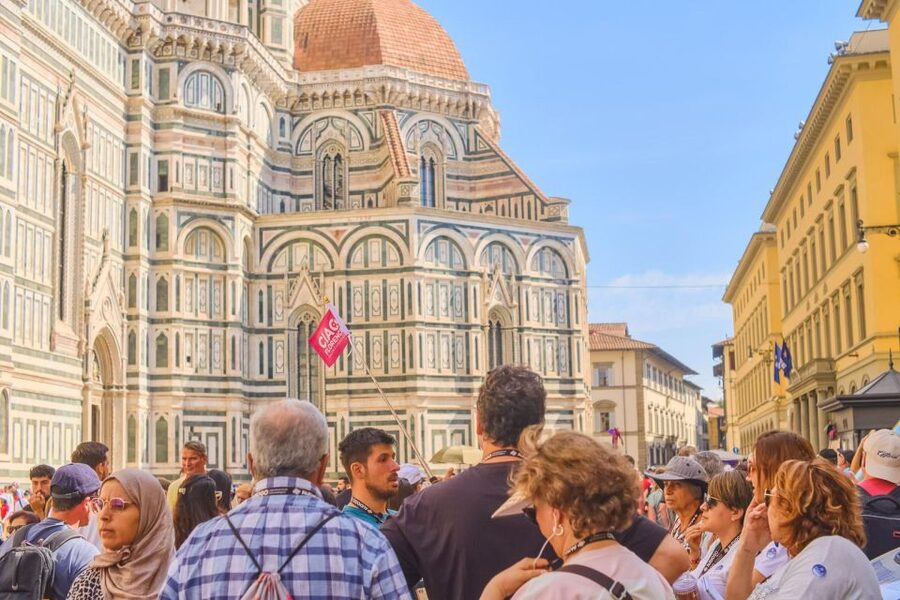
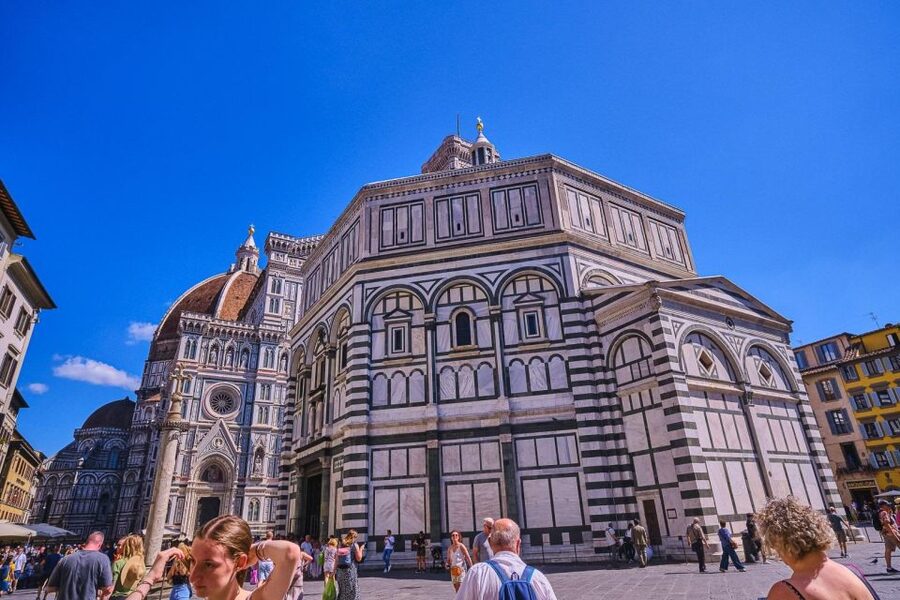
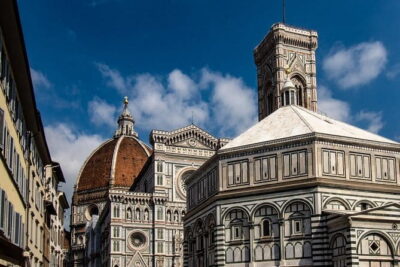
The tour concludes around Duomo Square, where the Cathedral of Santa Maria del Fiore, the Baptistery, Giotto’s Bell Tower, and Brunelleschi’s Cupola gather in one dramatic view. You will hear about their construction and the separate roles each building played in the religious and civic life of Florence.
This is one of the strongest parts of the route for first-time visitors. The square can look like one enormous church complex, but the buildings belong to different stages of Florence’s architectural story. A guide helps you sort out the Cathedral facade, the octagonal Baptistery, the campanile, and the famous dome.
Brunelleschi’s Cupola deserves special attention. Even if you do not climb it on this outing, its scale and engineering become easier to appreciate once someone explains the challenge of spanning the cathedral’s vast central space. The tour gives you that context from ground level.
Keep your expectations clear: entrance to churches is not included. The guide can explain what you are looking at from outside, but this is not a ticketed cathedral visit or a dome climb. If you want to go inside, plan a separate visit and check admission arrangements on your own.
The square is also one of the busiest photo stops in Florence. Your guide can help you frame the main monuments, but allow for crowds, passing pedestrians, and the need to keep moving. A gelato or photo pause may be possible, especially in a private group, but it is still wise to mention your priorities at the start.
Piazza della Signoria as an open-air sculpture gallery
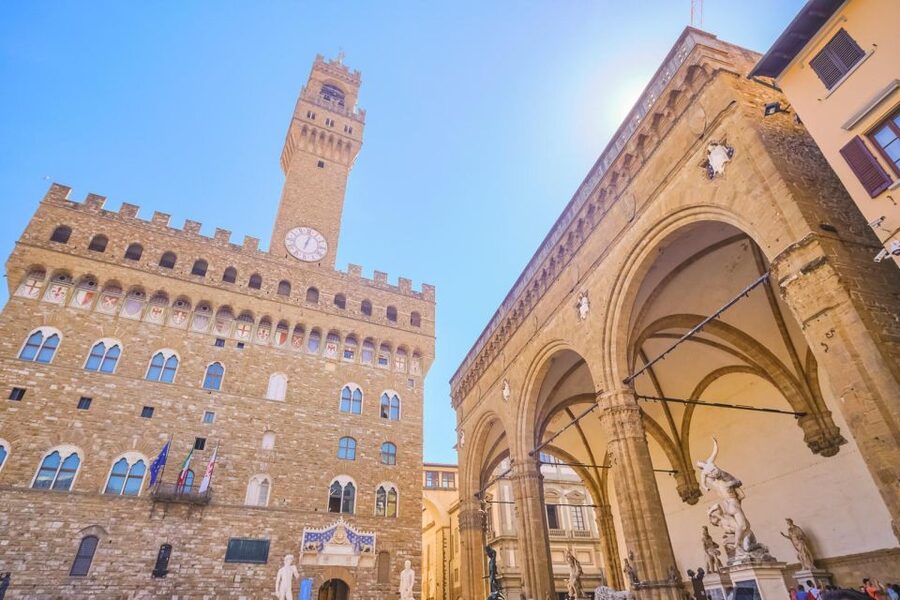
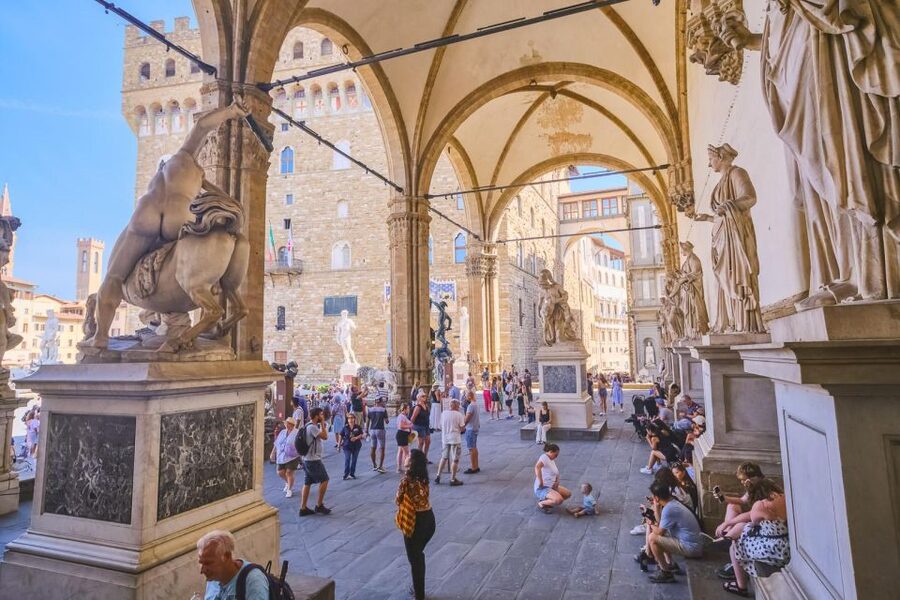
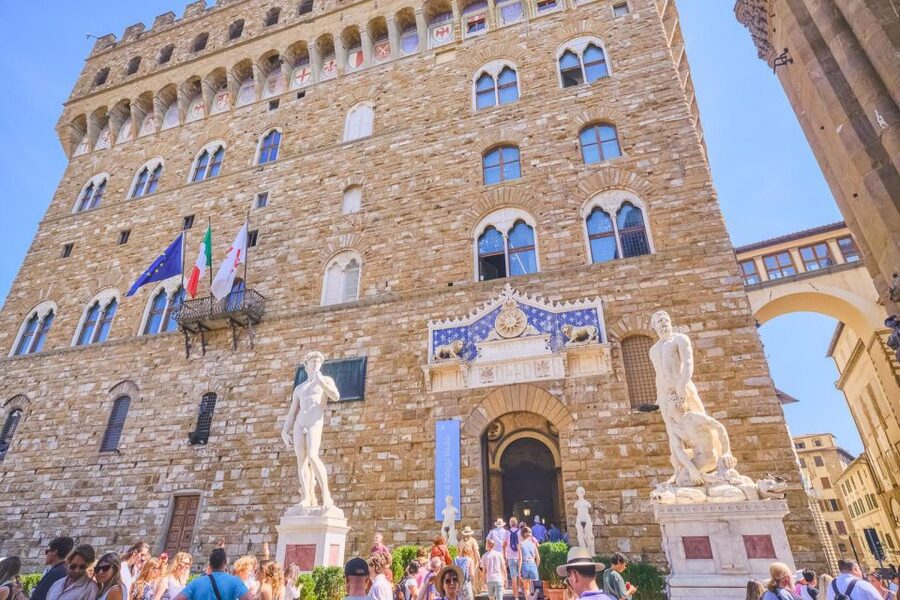
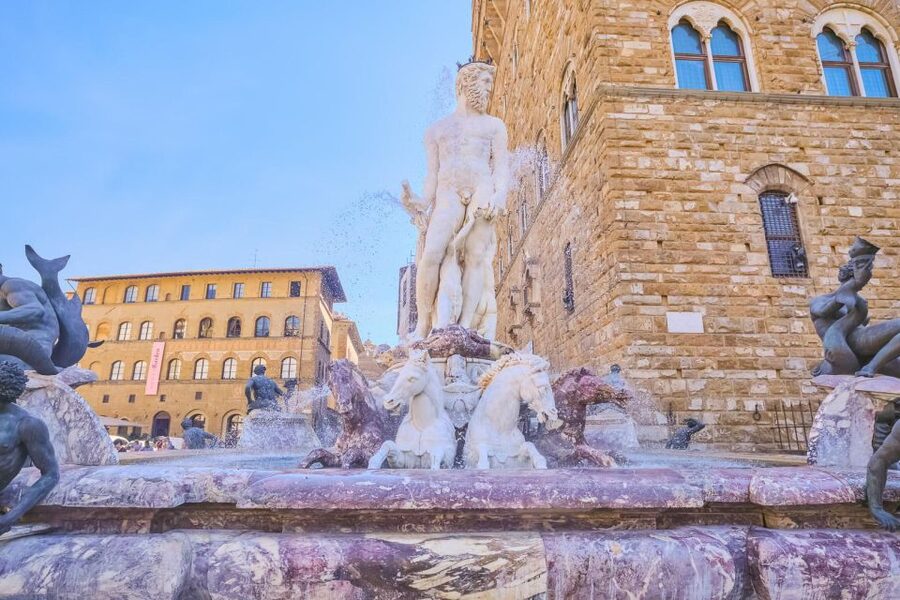
Piazza della Signoria gives the tour a change of mood. Here, Palazzo Vecchio forms the civic backdrop, while the Loggia dei Lanzi displays original statues under a colonnade. The square is not simply a pretty place to take pictures. It tells the story of Florence as a city where art and political power shared the same public stage.
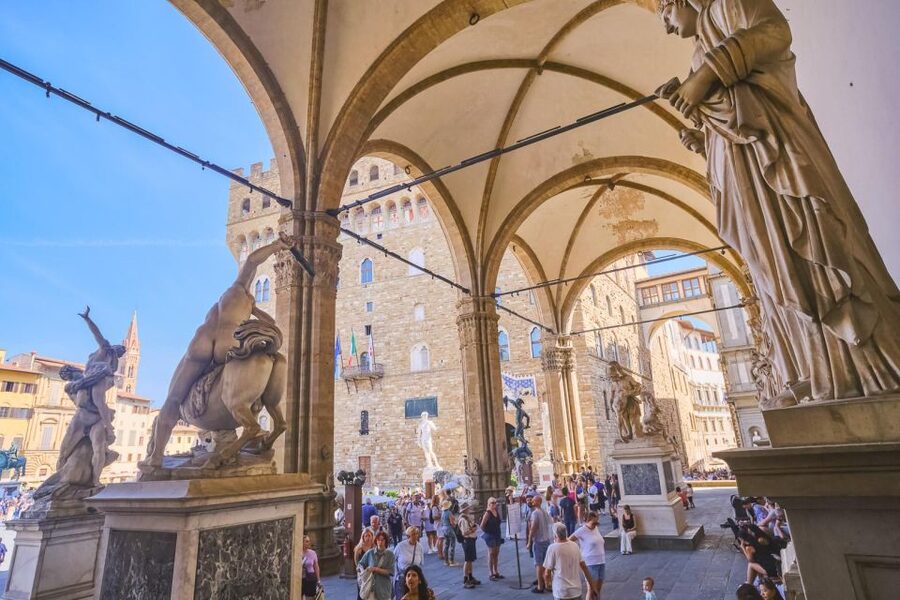
The Loggia dei Lanzi is particularly rewarding because it functions as a free, open-air collection. You can see works associated with artists such as Cellini and Giambologna without entering a museum. Your guide can explain the figures and their setting, then connect them to the larger role of public sculpture in Florence.
I would give this stop time rather than treating it as a quick crossing. Look up at the buildings, then return your eyes to the statues and their placement. The contrast between the severe Palazzo Vecchio and the theatrical sculpture beneath the loggia helps explain how Florence used art to project authority.
The drawback is that this square can feel crowded and noisy. You will not get the quiet concentration of a gallery. Still, the outdoor setting makes it a practical introduction to Florence’s art for anyone who plans to visit the Uffizi later.
More Florence options worth a look before you decide
- Cinque Terre and Pisa Tower Tour from Florence Semi Private
★ 5.0 · 1,406 reviews - From Florence: Private Chianti Hills Tour with Tasting
★ 4.3 · 809 reviews - Private Self-Guided E-Bike Ride in Tuscany with Vineyard Visit
★ 5.0 · 775 reviews - Florence Private Transportation in Rickshaw
★ 5.0 · 730 reviews
The Uffizi colonnade and art without an admission ticket
The walk takes you past the Uffizi Gallery and through its colonnade. You will not enter the museum, since admission is not included, but the exterior still offers useful context. The Uffizi is not just a famous name on a map. Its position beside the civic center reflects the political world that commissioned and collected much of Florence’s art.
For me, this stop works best as a preview. Your guide can explain how the Uffizi fits into the city’s history and point out the architectural setting before you return with a timed museum ticket. That preparation can make a later gallery visit less overwhelming.
Do not mistake this walk for an art museum tour. If Botticelli, Leonardo, or early Renaissance painting is your main reason for coming to Florence, you need a separate Uffizi visit. This tour gives you the citywide frame, not the gallery’s interior collection.
That distinction helps with planning. You can take the walking tour early in your visit, use it to decide which museums deserve your time, and then return to the Uffizi with a clearer sense of how its collections fit the city.
Ponte Vecchio and the route toward Pitti Palace
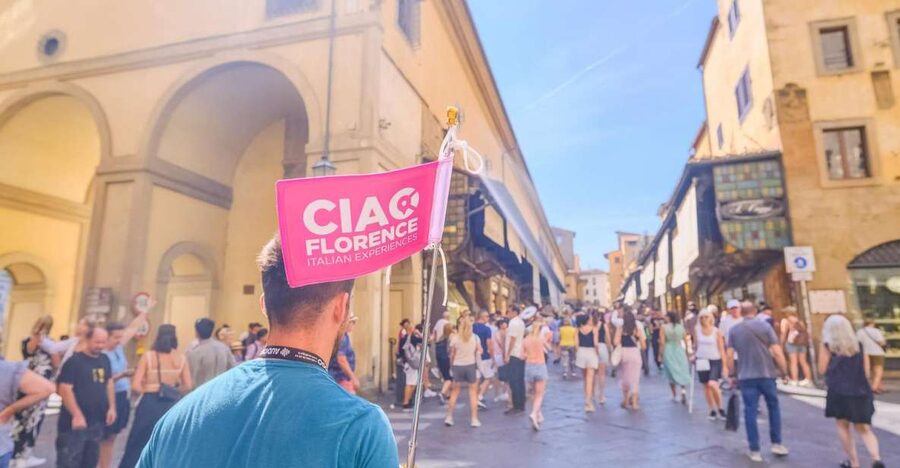
Crossing Ponte Vecchio is one of the walk’s most memorable transitions. The bridge is the oldest in Florence, and its tightly packed shops give it a distinctive profile over the Arno. From here, the tour continues toward Pitti Palace, another major marker of the city’s powerful ruling families.
Ponte Vecchio is easy to reduce to a shopping street and photo stop. A guide can help you see it as part of Florence’s broader urban structure, linking the central civic area with the district on the opposite bank. The crossing also gives you a chance to look along the river and photograph the bridge from changing angles.
Expect people, limited space, and plenty of interruptions for photographs. This is not a quiet riverside walk. The bridge is valuable because it is part of everyday central Florence, not because it offers a peaceful escape.
Pitti Palace is presented from the route rather than through an included palace visit. That is still useful. You’ll understand how the walk connects the old political center, the river crossing, and the palace district. If palace interiors or gardens matter to you, mark them for another outing.
The Vasari Corridor, a secretive link with limits
The Vasari Corridor is one of the more intriguing subjects on the route. This twisty passage connects Palazzo Vecchio with Pitti Palace, creating a private link across the city and over the river. The guide can show you where this unusual connection fits into Florence’s layout and explain why it captures so much attention.
The important practical point is that the corridor is not an included entrance. You should think of it as an architectural story and exterior discovery, not a promise that you will walk through the passage. That distinction prevents disappointment.
I like this part because it pulls together several earlier stops. The corridor links the civic palace, the Uffizi area, Ponte Vecchio, and Pitti Palace. In a few minutes, you can see how Florence’s ruling household moved through the city while remaining apart from ordinary street life.
It is also a good example of the tour’s approach. You get a connected story rather than isolated monuments. The guide is not simply pointing out one building after another. The route shows how the city’s major sites relate to each other.
The guide makes the difference
The strongest element here is the live guide. Past walks have been led by Larla, Constansa, and Andrea, and the available guide languages are English, Italian, Spanish, and French. You do not select a named guide in the information provided, so treat those names as examples of guides who have handled the experience, not a guarantee for your date.
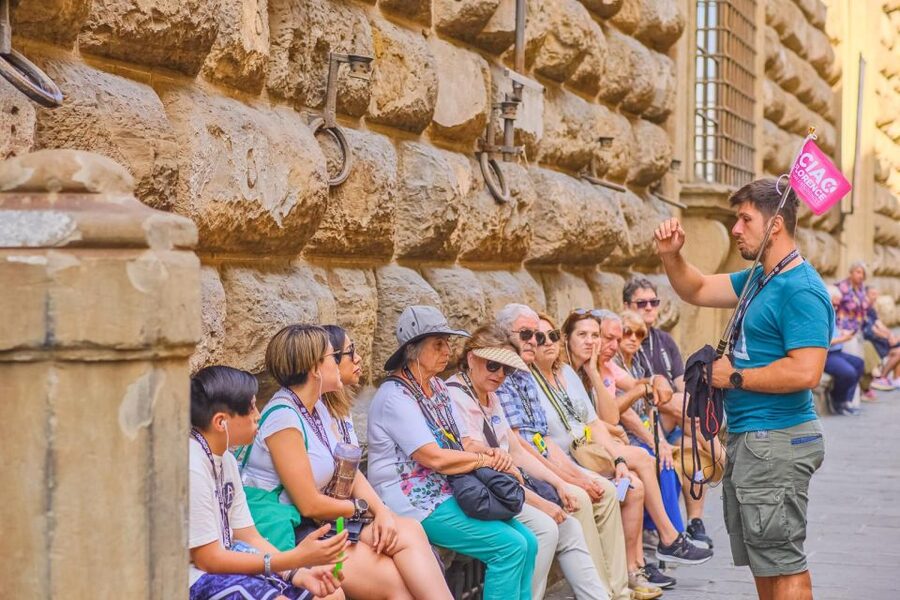
The guide’s role is more than reciting facts. You want someone who can answer questions, notice when your group needs a pause, and adjust the balance between major landmarks and small details. The private format gives that person room to do so.
A particularly useful feature is the possibility of changing the rhythm. Larla has accommodated gelato and photo stops, which tells me this is not meant to be a rigid march. Still, you should state your priorities at the beginning. If your group wants extra time at the Duomo, more attention to Dante, or a slower pace across Ponte Vecchio, say so before the route begins.
The guide can speak Italian, Spanish, English, or French. Choose the language that lets you ask natural questions. A three-hour walk passes quickly, and a language match improves the value of every minute.
Timing, walking effort, and practical limits
The activity lasts three hours and begins at a time you select from the available options. Your private guide meets you on foot at the main entrance of your hotel or apartment, which removes the need to find a separate meeting point in the center.
You will be walking through historic streets and public squares. The route includes major monuments, bridges, and crowded central areas, so comfortable shoes are sensible. The tour is described as wheelchair accessible, yet it is also marked as unsuitable for people with mobility impairments. Those details do not fully agree, so I would confirm the exact route and access arrangements before booking if mobility is a concern.
Because no meals or drinks are included, plan around the three-hour period. A gelato stop may be possible in a private group, but it is not part of the stated inclusions. Bring your own water and do not count on a scheduled lunch break.
The pace should be manageable for people who are comfortable with city walking, but the tour is not a seated sightseeing experience. You’ll move between several districts and landmarks. If your group includes young children, older relatives, or anyone who needs frequent rests, discuss that with the provider before confirming.
What the $341 price really buys
At $341 for up to eight people, this is a premium choice for a couple and a sensible shared expense for a larger party. Eight people paying together spend about $43 each, which compares favorably with booking several separate guided experiences. A smaller party pays more per person, but gets the full attention of a private guide.
The price covers the guide and the walking tour. It does not cover entry to the Uffizi, churches, or other museums, and it does not include lunch or drinks. You need to budget separately for any interior visits that catch your interest.
I see the best value for families and friend groups who want a flexible introduction to Florence. It is also useful for a short stay, since three hours can connect the city’s main areas without requiring you to plan the route yourself.
The value is weaker if you mainly want detailed museum interpretation or interior access. In that case, put your money toward a guided Uffizi visit or a ticketed cathedral experience. This walk is about connections, context, and orientation in the streets.
Who should book this Florence walking tour?
I would choose this tour if you are visiting Florence for the first time, have a group of up to eight, or prefer asking questions instead of following a large crowd. It suits people who want the city’s major monuments explained in one continuous route.
It is also a good fit if you like a little flexibility. The chance to add a photo pause or gelato stop makes the experience feel less formal than a fixed group excursion. Guides have been described as patient, professional, charming, and able to answer questions, which is exactly what I want from a private city walk.
I would hesitate if your main goal is to enter museums and churches. None of those admissions is included, and the three-hour schedule cannot provide serious time inside the Uffizi, Palazzo Vecchio, Pitti Palace, or the Cathedral.
Should you book it?
Book this private Florence guided walking tour if you want a clear introduction to the city’s medieval streets, Renaissance landmarks, river crossing, and political history. It offers strong value for a full group and useful flexibility for anyone who likes to stop, ask questions, and take photographs.
Skip it if you prefer exploring independently or already know Florence well. Also confirm accessibility details before booking, since the activity is described as wheelchair accessible but is not recommended for people with mobility impairments. For everyone else, this is a practical way to get your bearings before tackling Florence’s museums and churches on your own.
FAQ
How long is the Florence private walking tour?
The tour lasts three hours.
How much does the private tour cost?
The price is $341 for a private group of up to eight people.
What sights are included on the walking route?
The route includes the medieval district, Duomo Square, the House of Dante, Piazza della Signoria, the Uffizi colonnade, Ponte Vecchio, Pitti Palace, and views connected with the Vasari Corridor.
Does the tour include entrance to the Uffizi Gallery?
No. Entrance to museums and churches is not included.
Does the tour include a visit inside the Vasari Corridor?
The information provided describes the corridor as a discovery along the route, but does not include admission or promise an interior visit.
Which languages are available?
Live guides are available in Italian, Spanish, English, and French.
Where does the guide meet the group?
The guide picks up the group on foot at the main entrance of its hotel or apartment.
Is the tour wheelchair accessible?
The activity is marked as wheelchair accessible, but it is also listed as unsuitable for people with mobility impairments. If accessibility is important for your group, confirm the route details before booking.
Latest additions around Florence
- Florence: Cathedral Tour & Brunelleschi’s Dome Climb Ticket★ 5.0 · 3 reviews
- Palatina Gallery and Pitti Guided Tour in Florence★ 5.0 · 3 reviews
- Florence Uffizi Gallery Skip-the-line Tour w Art Historian Guide★ 5.0 · 3 reviews
- Private Tour: Pisa and Lucca from Florence★ 5.0 · 3 reviews
- San Gimignano Bike Tour (SOFT)★ 4.5 · 3 reviews
- Florence: Tour of Florence by rickshaw★ 5.0 · 3 reviews
- Center of Florence by golf cart★ 5.0 · 3 reviews
- From Firenze | Chianti day tour in a classic car★ 5.0 · 3 reviews
Florence Walking Tours, compared.

Skip the line: Uffizi and Accademia Small Group Walking Tour
Read our review →
Renaissance and Medici Tales Guided Walking Tour
Read our review →
Skip-the-Line Florence Highlights and David Walking Tour
Read our review →
Dark Mysteries and Legends Guided Walking Tour
Read our review →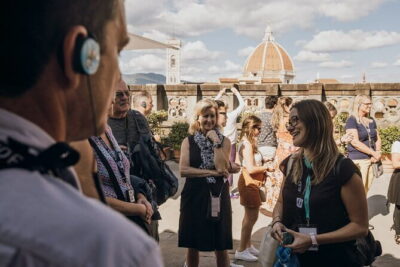
Florence in a Day: Michelangelo’s David, Uffizi and Guided City Walking Tour
Read our review →Browse the lists this tour appears in