
Reviewed · FLORENCE WALKING TOURS
Florence Must-See Squares Walking Tour with Vincenzo
Florence’s big sights come one after another on this short, well-planned walking tour. In 90 minutes, Vincenzo takes you from Santa Maria Novella to the Duomo, Piazza della Signoria, Palazzo Vecchio, and the Ponte Vecchio, giving you a useful first map of the city.
I like the small-group format, since it is easier to hear the guide and stay together in busy squares. I also like the mix of famous monuments and lesser-known details, such as Orsanmichele’s change from grain market to church and the old chariot races once held near Santa Maria Novella.
The main drawback is the pace of the commentary. One participant found the group standing in Piazza Santa Maria Novella for nearly 30 minutes, so this can feel talk-heavy if you prefer to keep moving. There are no entrance tickets, food, or hotel transfers included.
In This Review
- Key points to know
- A smart first walk through Florence
- Santa Maria Novella and Florence’s western gateway
- San Giovanni and the engineering wonder of the Duomo
- Orsanmichele, a smaller stop with an unusual past
- Piazza della Signoria and the power of Florence
- Ponte Vecchio, the lively finish beside the Arno
- What the 90-minute format means for you
- Guide style, group size, and language choices
- Is $28 a fair price?
- Should you book Florence’s must-see squares walk?
- FAQ
- How long does the Florence squares tour last?
- What sights are included?
- Where does the tour start?
- Where does the tour finish?
- Is the tour conducted in English?
- Are entrance tickets included?
- Is the tour wheelchair accessible?
- What should I bring?
- Can I cancel the booking?
Key points to know
- Six central Florence sights in 90 minutes: The route links Santa Maria Novella, the Duomo, Orsanmichele, Piazza della Signoria, Palazzo Vecchio, and Ponte Vecchio.
- Vincenzo leads in three languages: Live guiding is available in English, Spanish, and French.
- The tour stays outdoors: You see the main monuments and hear their stories, but admission fees are not included.
- Small groups help with the details: The compact format makes it easier to hear historical explanations in crowded piazzas.
- Good value at $28: It offers a quick orientation for first-time visitors, especially if you have only a day in Florence.
A smart first walk through Florence
Florence is compact, but its center can feel confusing on your first morning. The streets twist between churches, palaces, shops, and squares, and it is easy to walk past an important building without knowing why it matters.
This tour gives you a clear route through the historic center. You begin at Santa Maria Novella, move toward the Duomo, pass Orsanmichele, continue to Piazza della Signoria, and finish beside the Arno at Ponte Vecchio. The route is less about entering monuments and more about learning how Florence fits together.
That makes the experience most useful early in your stay. After 90 minutes with Vincenzo, you should know where the city’s main religious, civic, and commercial centers are located. You can then return on your own to visit the interiors that interest you most.
The tour is priced at $28 per person. For that amount, you are paying for a licensed guide, historical commentary, local suggestions, and a small-group walk. Since admission is not included, the price works best if you want orientation and context rather than a series of interior visits.
More walking routes in Florence:
- Florence: Guided Walking Tour
★ 4.5 · 3,334 reviews - Skip the line: Uffizi and Accademia Small Group Walking Tour
★ 4.5 · 3,135 reviews - Florence: Guided Walking Tour
★ 4.6 · 1,602 reviews
Santa Maria Novella and Florence’s western gateway
The meeting point is near Piazza Santa Maria Novella, with the exact starting location depending on the option you book. Check the confirmation carefully, since the listed meeting options can vary.
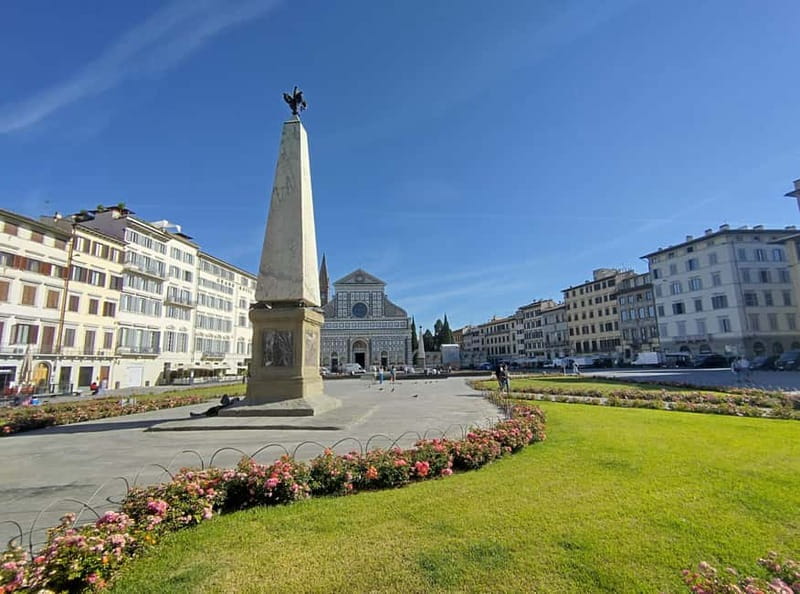
Santa Maria Novella is a strong place to begin. The square opens before one of Florence’s most important churches, whose bright Renaissance facade was designed by Leon Battista Alberti. Its clean shapes and carefully arranged marble make it one of the city’s most memorable exterior views.
Vincenzo also connects the square to older local traditions, including chariot racing. That detail helps you see the piazza as more than a pretty foreground for the church. It has long served as a public gathering place, and the open space still gives you a sense of how Florence used its squares for ceremony, religion, and spectacle.
The church belongs to the Dominican order and contains important artistic works. You should not expect to tour the interior as part of this experience, but the guide’s explanation gives you a reason to return later if you have time.
This is also where the tour’s style becomes clear. Vincenzo is described as fun, friendly, and full of anecdotes, with an approach that mixes facts with stories. That can make Florence’s past easier to follow than a string of dates and names.
One practical point: allow time to stand and listen. The commentary here may be detailed. One participant found that the group remained in the square for close to 30 minutes, which was the only clear criticism of an otherwise well-received experience. If you prefer a brisk walk, this slower opening may test your patience. If you like context, it gives you a useful start.
San Giovanni and the engineering wonder of the Duomo
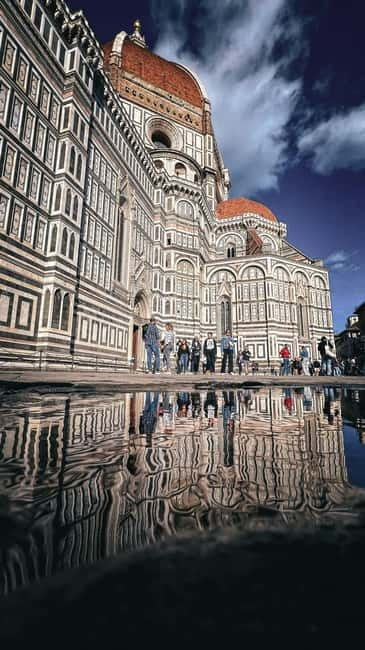
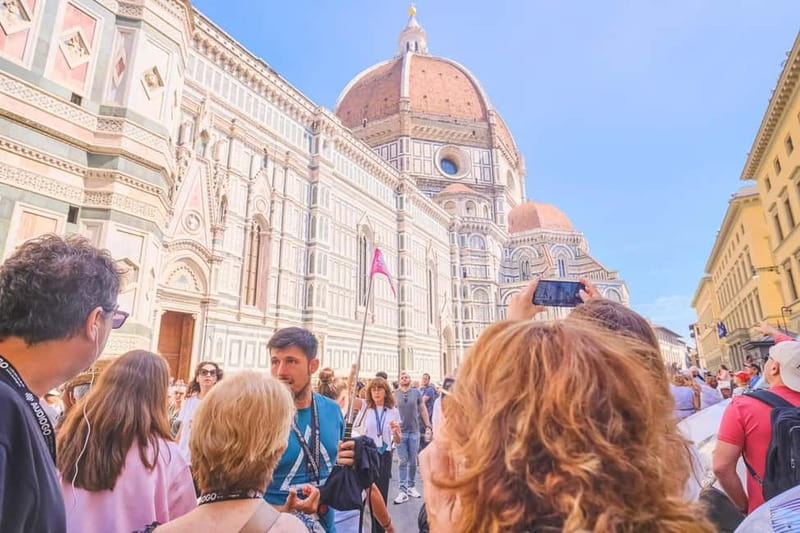
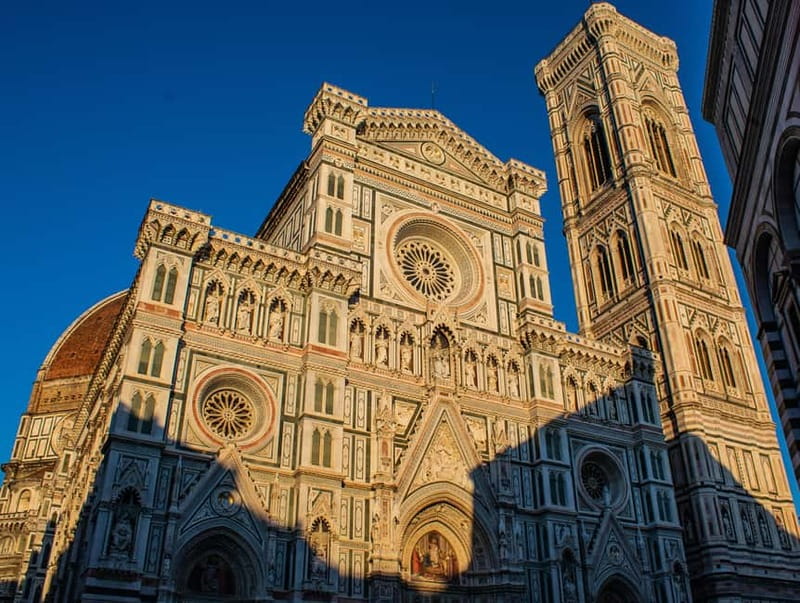
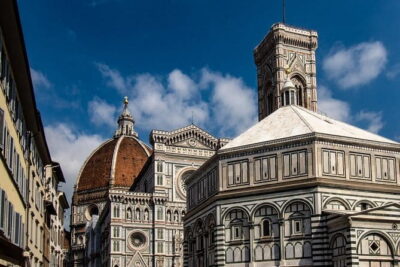
From Santa Maria Novella, you walk through the center toward Piazza San Giovanni, Florence’s religious heart. This is the point where the scale of the city changes. The Duomo, its dome, and the Baptistery crowd the view with marble, sculpture, and ambitious design.
The Cathedral of Santa Maria del Fiore is best known for Brunelleschi’s dome. Your guide explains why it mattered as an engineering achievement and how it changed the course of architecture. Even if you already know the basic story, hearing it while looking directly at the dome makes the subject more concrete.
You will also see the Baptistery and its celebrated Gates of Paradise by Lorenzo Ghiberti. The doors are known for their detailed relief work and are often linked with the claim that the Baptistery is Florence’s oldest building. The tour treats this square as a place of religious power, artistic competition, and technical ambition.
The scheduled stop is about 20 minutes, including a photo stop, guided explanation, walking, and scenic views along the way. That is enough time to take in the main features and understand their place in Florence, but not enough for an interior visit or a close study of every panel.
You should also expect crowds around the Duomo. The tour does not promise skip-the-line access, reserved entry, or time inside the cathedral complex. If you want to climb the dome, enter the cathedral, or visit the Baptistery interiors, you will need separate arrangements.
Still, this outdoor introduction is valuable. You get the big picture without spending the whole morning in one building. For a first visit, that balance can be helpful.
Orsanmichele, a smaller stop with an unusual past
The walk includes Orsanmichele Church, an often overlooked building between the Duomo and Piazza della Signoria. Its story is unusual: it changed from a grain market into a church.
That change reflects the way Florence’s public buildings could serve several purposes over time. Orsanmichele also displays statues by leading Renaissance artists, giving you a compact look at the artistic competition that shaped the city.
This stop adds variety to the route. Santa Maria Novella and the Duomo are huge, formal monuments. Orsanmichele feels more closely tied to everyday medieval commerce and the working life of the city. You get a reminder that Florence was not built only by painters, architects, and powerful families. Markets and trade were central to its growth.
Because the tour is brief, the guide’s explanation matters here. Without context, you might walk past Orsanmichele and mistake it for another attractive church. With Vincenzo’s commentary, its former market role and sculptural program give you a reason to pause.
The building is part of the walking route, but no entrance fee is included. Treat it as an exterior and historical stop unless your booking details say otherwise.
A different way to spend the same Florence day:
- Florence: Skip-The-Line Uffizi Gallery Timed Entry Ticket
★ 4.5 · 27,832 reviews - Tuscany Day Trip from Florence: Siena, San Gimignano, Pisa and Lunch at a Winery
★ 5.0 · 21,634 reviews - Florence: Timed Entrance Ticket to Michelangelo’s David
★ 4.6 · 16,983 reviews - Florence: Michelangelo’s David Skip-the-Line Entry Ticket
★ 4.5 · 12,764 reviews
Piazza della Signoria and the power of Florence
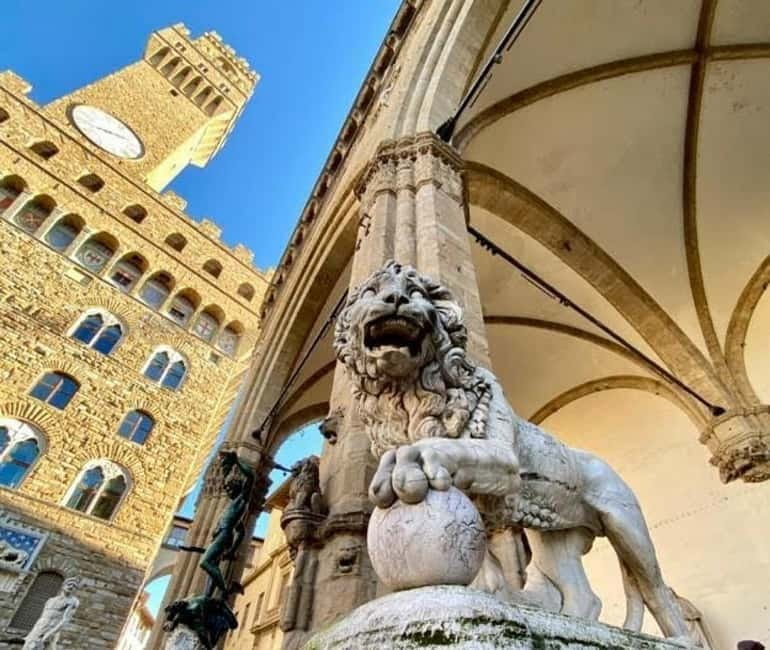
Piazza della Signoria changes the mood again. This was Florence’s political center from the Middle Ages onward, and its open space is filled with sculpture and reminders of civic power.
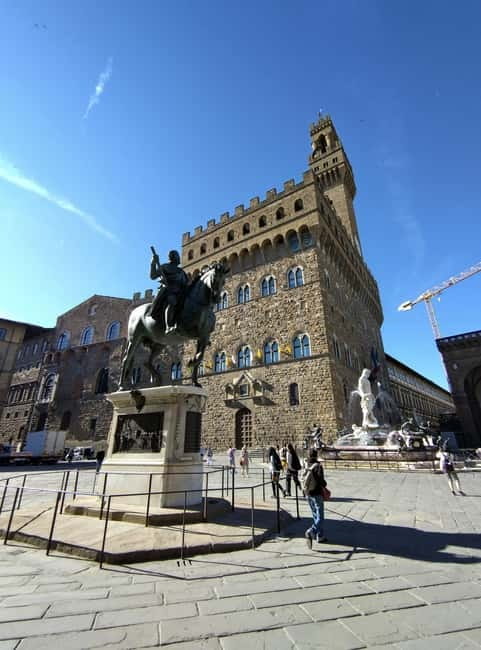
The main focus is Palazzo Vecchio, Florence’s town hall. Its fortress-like appearance makes a sharp contrast with the lighter marble of the Duomo. Here, Vincenzo explains the political struggles and major events that shaped the city.
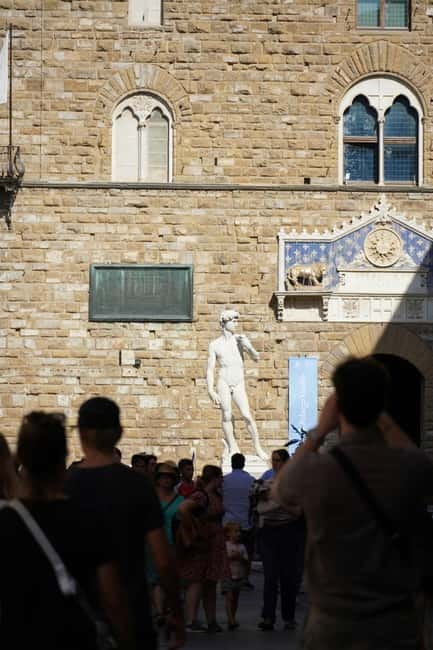
You will also see the replica of Michelangelo’s David outside Palazzo Vecchio. It is important to know what you are looking at: the famous original is now in the Accademia Gallery, while the figure in the square is a replica. The outdoor statue still marks the place where David once served as a symbol of Florence’s defiance and civic pride.
The Neptune Fountain adds another dramatic element. Together, the palace, statues, and fountain turn the piazza into an open-air lesson in Florence’s public image. You do not need an art-history background to appreciate the stop. Vincenzo’s job is to explain who commissioned these works and why they were placed where they are.
The scheduled visit lasts about 20 minutes. That makes it a good introduction, but a short one. If you want to study the sculptures, photograph architectural details, or visit Palazzo Vecchio inside, plan a separate block of time.
I like this part of the tour because it connects art to government. You are not simply looking at beautiful statues. You are seeing how Florence used public monuments to announce power, loyalty, ambition, and control.
Ponte Vecchio, the lively finish beside the Arno
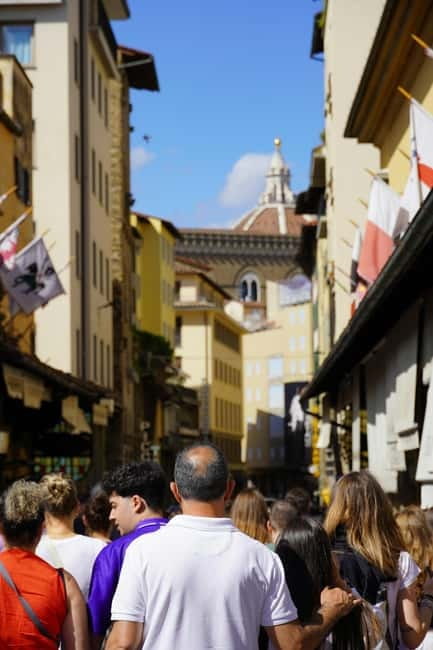
The walk ends at Ponte Vecchio, Florence’s oldest bridge over the Arno River. It is the most theatrical finish on the route, with its shops, river views, and constant foot traffic.
The bridge is famous for its jewelry stores today, but its commercial identity has changed over time. Vincenzo explains the history of the shops and points out the Vasari Corridor, the raised passage that runs above the bridge. The corridor is one of Florence’s most intriguing features, even though this walking tour does not include entry.
Ponte Vecchio works well as the final stop because it brings together several themes from the walk: trade, political power, architecture, and movement through the city. You finish near one of Florence’s best-known views, with the Arno below and the bridge’s unusual upper passage overhead.
The end of the activity is listed as Ponte Vecchio, though the general meeting information also says the activity ends back at the meeting point. Since those details do not fully match, check the exact booking information before you go. In practical terms, Ponte Vecchio is the stated finish point in the route.
This is a useful place to continue exploring on your own. Vincenzo offers suggestions for authentic restaurants, shopping areas, and less obvious places to see. Treat those recommendations as a starting point rather than a guarantee. One restaurant suggestion outside Florence was not a good match for one participant, so use your own judgment and confirm that a recommendation suits your plans.
What the 90-minute format means for you
Ninety minutes is the tour’s strength and its limit. You can fit it into a busy day, and you do not need to commit to a half-day activity. If you arrive in Florence by train, the Santa Maria Novella starting area is especially practical because it places you near the city center and the route’s first major square.
The short duration also means the tour focuses on exteriors and explanations. You will walk, stop for photos, hear historical stories, and move on. You will not have time for full visits to the cathedral complex, Palazzo Vecchio, or other museums.
That makes it a good choice for three kinds of people:
- First-time visitors who want to understand the central sights quickly.
- Short-stay visitors with only a day or two in Florence.
- Independent explorers who prefer a guided introduction, then want to continue alone.
It is less suitable if your main goal is detailed art study or interior access. In that case, you may prefer a museum tour or a cathedral-focused experience with reserved entry.
The pace should be manageable for many people, but comfortable shoes are essential. This is a walking tour through the historic center, and the experience includes standing in public squares. The activity is listed as wheelchair accessible, though you should still confirm the specific meeting point and route details when booking.
Guide style, group size, and language choices
Vincenzo is the named guide for this experience. The tone is interactive rather than purely scripted, with historical commentary, anecdotes, and time for local recommendations. The strongest praise centers on his friendly manner, humor, and ability to make the city easy to understand in a short period.
The small-group option is important. A compact group makes it easier to hear explanations in open squares and busy streets. It also reduces the chance of being separated from the guide while crossing the center.
The available languages are English, Spanish, and French. Choose carefully at booking, since the value of a history walk depends heavily on how comfortably you can follow the guide.
Bad weather can cause cancellation. Florence’s squares are the main setting, so bring suitable clothing and check conditions before leaving. The activity includes free cancellation up to 24 hours in advance, and you can reserve now while paying later, which is useful if your schedule is still changing.
Is $28 a fair price?
I consider $28 a reasonable price for this particular format. You receive 90 minutes with a licensed local guide, a planned route through several major sights, and practical suggestions for the rest of your stay.
The value comes from connection. You could walk between these places on your own, but you would need to research why the Baptistery matters, how Brunelleschi changed architecture, why Orsanmichele is unusual, and what Palazzo Vecchio represented in Florentine politics.
The price does not cover food, drinks, hotel pickup, or entrance tickets. Keep that in mind when comparing it with longer tours that include museum access. Here, you are buying orientation, storytelling, and a well-used hour and a half.
For a first day in Florence, that is often enough. You get the major landmarks without exhausting yourself before lunch, then decide which interiors deserve your time and money.
Should you book Florence’s must-see squares walk?
Book this tour if you want a friendly, efficient introduction to Florence and would rather hear the city explained than simply collect photographs. Vincenzo’s humor, local advice, and stories about places such as Orsanmichele give the walk more character than a basic monument checklist.
I would especially choose it if you have only one day. The route covers Florence’s essential public spaces, and the Ponte Vecchio finish leaves you well placed to continue exploring.
Skip it if you want museum entry, dome access, or a fast-moving walk with little talking. The extended explanation in Santa Maria Novella may feel slow to you. For everyone else, $28 is a sensible way to get your bearings before exploring Florence on your own.
FAQ
How long does the Florence squares tour last?
The tour lasts 1.5 hours, or 90 minutes. Check availability for the starting times offered on your chosen date.
What sights are included?
The route includes Santa Maria Novella, the Florence Duomo complex, Orsanmichele Church, Piazza della Signoria, Palazzo Vecchio, and Ponte Vecchio.
Where does the tour start?
The starting point is in the Santa Maria Novella area. The exact meeting point may vary depending on the option booked.
Where does the tour finish?
The route lists Ponte Vecchio as the finish point. General meeting information also refers to ending back at the meeting point, so check your booking details for the exact arrangement.
Is the tour conducted in English?
Yes. Live guiding is available in English, Spanish, and French.
Are entrance tickets included?
No. Entrance fees are not included, so the tour focuses on outdoor sights, guided explanations, and walking between the squares.
Is the tour wheelchair accessible?
Yes, the activity is listed as wheelchair accessible.
What should I bring?
Bring comfortable shoes. The experience involves walking and standing in Florence’s historic center.
Can I cancel the booking?
You can cancel up to 24 hours in advance for a full refund. The activity also offers a reserve-now-and-pay-later option.
Latest additions around Florence
- Palatina Gallery and Pitti Guided Tour in Florence★ 5.0 · 3 reviews
- Florence: Cathedral Tour & Brunelleschi’s Dome Climb Ticket★ 5.0 · 3 reviews
- Florence Uffizi Gallery Skip-the-line Tour w Art Historian Guide★ 5.0 · 3 reviews
- Private Tour: Pisa and Lucca from Florence★ 5.0 · 3 reviews
- San Gimignano Bike Tour (SOFT)★ 4.5 · 3 reviews
- Florence: Tour of Florence by rickshaw★ 5.0 · 3 reviews
- Center of Florence by golf cart★ 5.0 · 3 reviews
- From Firenze | Chianti day tour in a classic car★ 5.0 · 3 reviews
Florence Walking Tours, compared.

Skip the line: Uffizi and Accademia Small Group Walking Tour
Read our review →
Renaissance and Medici Tales Guided Walking Tour
Read our review →
Skip-the-Line Florence Highlights and David Walking Tour
Read our review →
Dark Mysteries and Legends Guided Walking Tour
Read our review →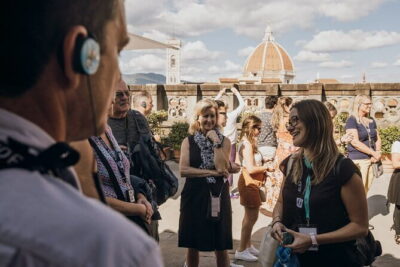
Florence in a Day: Michelangelo’s David, Uffizi and Guided City Walking Tour
Read our review →Browse the lists this tour appears in