
Reviewed · SKIP-THE-LINE TICKETS
Florence: Museo Galileo Entry Ticket
Museo Galileo gives you a close look at the tools that helped people measure the skies, track time, study the body, and understand motion long before computers. The most striking pieces are Galileo’s own instruments, including original thermometers and microscopes, along with huge globes, armillary spheres, compasses, and astronomical devices.
I like the quiet, flexible visit, since your ticket is valid for the day and you can move through the museum at your own pace. I also like the clear link between science and Florence’s ruling families, especially the Medici interest in mathematics and astronomy. The main drawback is that the displays can feel dense, and some visitors want more explanation or hands-on exhibits.
In This Review
- Key points to know before you go
- Why Museo Galileo belongs on your Florence list
- Entering with the one-day ticket
- The Medici rooms and the machinery of discovery
- Galileo’s original instruments and the human story
- The Lorraine rooms and the expansion of science
- How long should you spend inside?
- Audio guides, labels, and the pace of the visit
- Is Museo Galileo good for children?
- A practical stop near the Uffizi
- Who gets the best value from the $20 ticket?
- Should you book Museo Galileo?
- FAQ
- How long is the Museo Galileo ticket valid?
- Is a guided tour included?
- Can I enter at any time during the day?
- What can I see at Museo Galileo?
- Is Museo Galileo wheelchair accessible?
- Should I bring earbuds?
Key points to know before you go
- Galileo’s original instruments: See objects connected directly with Galileo, including thermometers, microscopes, and meteorological tools.
- Medici and Lorraine collections: Follow the development of science through instruments collected by two powerful European families.
- 18 thematic rooms: The museum covers astronomy, mechanics, medicine, clocks, chemistry, weights, and measures.
- A useful break from Florence’s art museums: The museum offers a different side of the Renaissance, with fewer crowds than the Uffizi or Accademia.
- Plan for one to three hours: You can make a quick visit in about an hour, but the displays reward a slower pace.
- Bring earbuds: The phone-based audio guide is useful, though its layout may take a little effort to understand.
Why Museo Galileo belongs on your Florence list
Florence is packed with paintings, chapels, sculptures, and grand palaces. Museo Galileo gives you another way to understand the city. Here, the Renaissance is not only about artists. It is also about measurement, observation, engineering, mathematics, and the growing belief that the natural world could be studied through evidence.
The museum is named for Galileo Galilei, the Florentine scientist and astronomer whose work changed how Europeans viewed the heavens. But this is not a small museum focused only on his life. You will also see instruments gathered by the Medici and Lorraine families, showing how scientific study developed across generations.
That wider focus is one of the museum’s strengths. You do not simply look at a telescope and move on. You see the tools that made astronomy possible, the instruments used to calculate position and distance, and the mechanical devices that turned ideas into working objects.
I would not send every art-loving visitor here automatically. If your interest stops at Renaissance painting, the museum may feel technical. But if you are curious about how people measured the world, or you enjoy seeing the early forms of tools we now take for granted, this is one of Florence’s most rewarding stops.
More skip-the-line entries:
- Florence: Skip-The-Line Uffizi Gallery Timed Entry Ticket
★ 4.5 · 27,832 reviews - Florence: Timed Entrance Ticket to Michelangelo’s David
★ 4.6 · 16,983 reviews - Florence: Michelangelo’s David Skip-the-Line Entry Ticket
★ 4.5 · 12,764 reviews
Entering with the one-day ticket
The ticket is simple. Show your confirmation voucher at the museum on the day of your visit, then begin exploring. Several people found the voucher easy to redeem, with no extra collection point required. The ticket is valid for one day rather than tied to a specific entry time, which gives you useful freedom in a city where plans often shift.
At about $20 per person, the ticket is not the cheapest museum admission in Florence. Its value depends on how much time you give it. If you spend only 45 minutes looking quickly at the instruments, the price may feel less attractive. Give yourself two hours, or longer if science interests you, and the cost becomes easier to justify.
The ticket includes the entry charge and booking fee, but not a guided tour. You are responsible for making sense of the exhibits yourself, using the written information and available phone audio. That arrangement suits independent visitors, but it may disappoint you if you prefer a guide to explain the scientific background as you go.
The museum is wheelchair accessible. If you need assistance while walking, note that seating may be limited inside the galleries. An elevator is available for visitors with mobility needs.
The Medici rooms and the machinery of discovery
The first part of the museum focuses on the Medici collections. These objects were first displayed in the Stanzino delle Matematiche, or Mathematics Room, in the Uffizi Gallery. That origin matters because it shows how closely scientific study was tied to Florence’s artistic and political life.
The Medici did not treat science as a hobby kept in a back room. They collected instruments with the same care given to paintings and sculpture. Many are beautifully made, with decorative details created by skilled Tuscan and European artists. You are looking at working equipment, but also at finely finished objects designed to impress.
Expect to see quadrants, astrolabes, dials, compasses, meridians, and armillary spheres. These can look mysterious at first. Take a moment to consider their basic purpose. They helped people locate stars, estimate time, calculate angles, understand the movement of celestial bodies, and navigate across distances.
The armillary spheres are especially effective for showing how earlier astronomers pictured the heavens. Their rings represent celestial circles and paths, turning abstract ideas into something you can see in three dimensions. The large globes also help you understand the scale of the questions these scientists were trying to answer.
You will find plenty of mathematics here, but the museum does not require an advanced background. A patient visitor can follow the broad story: observe something, measure it, record it, improve the instrument, and test the next idea.
Galileo’s original instruments and the human story
Galileo’s instruments give the museum its strongest personal connection. Seeing original objects changes the way you think about him. Galileo was not only a name in a schoolbook. He was a practical experimenter who worked with fragile, limited tools and still produced ideas that altered science.
The collection includes original thermometers, microscopes, and meteorological instruments. These are not modern devices with neat digital displays. They are early attempts to make invisible or changing conditions measurable.
Galileo’s work is also represented through instruments connected with motion and mass. Copies of some devices allow you to understand how an object’s movement relates to its weight and force. Hands-on access is limited, so do not expect a modern science center filled with interactive stations. Still, the working models help turn a glass case into a more understandable lesson.
One unusual exhibit is Galileo’s missing finger. It is a strange and slightly macabre reminder that scientific fame can turn a person’s remains into a relic. The object may raise a smile, but it also gives the collection a human edge.
The best approach is to resist rushing from Galileo’s name to the next case. Look at how simple the tools appear, then think about the precision their users were seeking. That contrast is the heart of the visit.
A different way to spend the same Florence day:
- Tuscany Day Trip from Florence: Siena, San Gimignano, Pisa and Lunch at a Winery
★ 5.0 · 21,634 reviews - The Best tour in Florence: Renaissance & Medici Tales – guided by a STORYTELLER
★ 5.0 · 12,316 reviews - Florence: Leonardo Interactive Museum Entry Ticket
★ 4.5 · 11,763 reviews - The Best Tour in Florence: Renaissance and Medici Tales
★ 5.0 · 10,810 reviews
The Lorraine rooms and the expansion of science
The second-floor rooms shift attention to instruments associated mainly with the Lorraine family. The subject becomes broader, moving into mechanical, electrostatic, and pneumatic applications.
This section helps you see that science did not stop with astronomy. Once people developed better ways to measure motion, pressure, electricity, and air, those discoveries opened paths into engineering, medicine, manufacturing, and daily life.
Mechanical clocks show the long effort to control and measure time. Sextants and octants connect the museum to navigation, where accurate readings could mean the difference between reaching a destination and losing one’s way. Pharmaceutical and chemical apparatus show how early scientific methods entered medical and laboratory work.
Weights and measures may sound less exciting than telescopes, but they are important. Trade, construction, medicine, and government all depend on agreed standards. A museum that includes these ordinary tools gives you a fuller picture of science as a practical system, not just a collection of dramatic discoveries.
The displays also include pneumatic equipment and electrostatic instruments. Some pieces may be difficult to understand from their appearance alone. This is where the audio guide or extra reading becomes useful. The objects are often well arranged and in excellent condition, but labels do not always provide as much detail as curious visitors want.
How long should you spend inside?
You can see the museum in about an hour if you move briskly. That is enough for a general look at the major objects, but it is not enough to absorb the connections between them.
I would plan on at least two hours. That gives you time to read selected labels, pause at Galileo’s instruments, and follow the progression from astronomy to mechanics, medicine, chemistry, and measurement.
If you enjoy science, mathematics, engineering, or the history of technology, allow three hours. Some people find they want another visit because the collection contains so much information. The museum is small enough to feel manageable, but full enough that a quick pass can leave you with only a blur of brass, glass, wood, and painted globes.
A morning visit may be a good choice if you prefer a calm museum. The building is often less crowded than Florence’s headline attractions. On Tuesdays, pay close attention to the schedule because the museum closes at 1:00 PM. That early closing can easily disrupt an afternoon plan.
Audio guides, labels, and the pace of the visit
The museum can be visited independently, but you need to prepare for a self-guided experience. A phone-based audio guide is available, and it can add useful context. Bring your own earbuds so you can listen comfortably. Earphones may also be available at the front desk, but it is better not to rely on finding a pair after you arrive.
The audio guide is not perfect. Its layout can be awkward, and some visitors have found it difficult to follow while moving through the rooms. I would use it selectively rather than trying to listen to every item.
Labels provide a general framework, but some objects would benefit from fuller explanations. If you want to know exactly how each device worked, you may find yourself wishing for clearer diagrams or more detailed text. This is the main weakness of the museum for visitors without a science background.
On the other hand, the self-guided format gives you control. You can spend ten minutes with a globe that catches your attention or skip a technical display that feels too dense. Families and mixed-interest groups may appreciate that freedom. You are not trapped in a fixed tour or forced to keep pace with a guide.
Is Museo Galileo good for children?
It can work very well for children who like science, space, machines, or puzzles. The collection offers a steady supply of unusual shapes and big visual objects, from globes to astronomical spheres and measurement tools.
Younger children may lose interest if you try to read every label. Keep the visit active by asking simple questions: What do you think this instrument measures? How would you find your way without a phone? Why would people need an accurate clock?
The museum does not appear to have enough interactive exhibits to satisfy every child. Some families would welcome more chances to operate models themselves. Still, the subject matter can hold the attention of children who already enjoy STEM topics, especially if you allow them to set the pace.
For adults, the museum works best when you accept that not every object will be instantly clear. You do not need to understand every technical detail to appreciate the larger story.
A practical stop near the Uffizi
Museo Galileo’s location makes it easy to pair with a day in Florence’s historic center. It can provide a welcome change after hours of religious art or Renaissance portraits. If you are planning time at the Uffizi, the museum makes a sensible nearby addition.
Do not treat it as a filler stop that you squeeze into 30 minutes between major attractions. The flexible ticket makes scheduling easy, but the collection deserves more than a quick glance.
The quiet atmosphere is another advantage. Florence’s busiest museums can feel like crowded corridors, especially during peak sightseeing hours. Museo Galileo often offers more breathing room, which makes it easier to examine delicate instruments and read at your own speed.
Basic facilities are available, though cleanliness of the bathrooms has not always been ideal. This is a minor issue, but it is worth knowing if you are planning a long visit.
Who gets the best value from the $20 ticket?
I think the ticket is a good buy for several types of visitors:
- Science and astronomy fans who want to see original instruments connected with Galileo.
- History of technology enthusiasts interested in how tools developed across centuries.
- Families with older children who enjoy machines, space, mathematics, and practical experiments.
- Visitors seeking a quieter museum away from Florence’s most crowded galleries.
- Repeat visitors to Florence who have already seen the major art museums and want a different side of the city.
The value is less certain if you dislike technical displays or have only a short time in Florence. The museum is not mainly a biography of Galileo, and you should not book it expecting a traditional life story told room by room.
The best value comes from treating the ticket as permission to slow down. You can enter at a convenient time, stay for as long as your interest lasts, and return to difficult sections during the same day if your schedule permits.
Should you book Museo Galileo?
Book it if you want to understand the scientific side of Florence, not just its art. Galileo’s original instruments, the Medici collections, and the later Lorraine devices create a useful story about how observation and measurement changed Europe.
I would especially recommend it to curious adults, science-minded families, and anyone looking for a less crowded museum with serious substance. Bring earbuds, allow at least two hours, and expect to read and think rather than simply admire.
Skip it if your Florence schedule is already packed and science is not your interest. But if you have room for one museum that explains how people began to measure the world, Museo Galileo is a smart choice.
FAQ
How long is the Museo Galileo ticket valid?
The entry ticket is valid for one day. Check the available opening times when booking, and remember that the museum closes at 1:00 PM on Tuesdays.
Is a guided tour included?
No. The ticket includes entry to Museo Galileo and the booking fee, but not a guided tour.
Can I enter at any time during the day?
The ticket is described as valid for one day rather than tied to a specific timed entry. Check the available starting times and museum hours for your chosen date.
What can I see at Museo Galileo?
You can see Galileo’s original instruments, including thermometers, microscopes, and meteorological devices. The museum also displays quadrants, astrolabes, compasses, armillary spheres, clocks, sextants, chemical apparatus, weights, and measures.
Is Museo Galileo wheelchair accessible?
Yes. Museo Galileo is wheelchair accessible, and an elevator is available for visitors with mobility needs.
Should I bring earbuds?
Yes. The museum offers a phone-based audio guide, and earbuds make it easier to use. The audio guide can be useful, though its layout may take some time to understand.
Latest additions around Florence
- Florence: Cathedral Tour & Brunelleschi’s Dome Climb Ticket★ 5.0 · 3 reviews
- Palatina Gallery and Pitti Guided Tour in Florence★ 5.0 · 3 reviews
- Florence Uffizi Gallery Skip-the-line Tour w Art Historian Guide★ 5.0 · 3 reviews
- Private Tour: Pisa and Lucca from Florence★ 5.0 · 3 reviews
- San Gimignano Bike Tour (SOFT)★ 4.5 · 3 reviews
- Florence: Tour of Florence by rickshaw★ 5.0 · 3 reviews
- Center of Florence by golf cart★ 5.0 · 3 reviews
- From Firenze | Chianti day tour in a classic car★ 5.0 · 3 reviews
Skip-the-Line Tickets, compared.
Skip-The-Line Uffizi Gallery Timed Entry Ticket
Read our review →
Timed Entrance Ticket to Michelangelo’s David
Read our review →
Michelangelo’s David Skip-the-Line Entry Ticket
Read our review →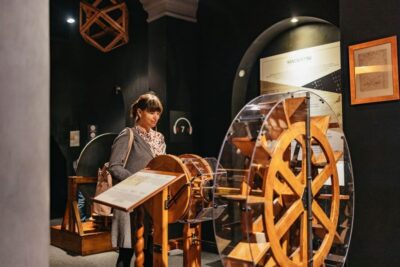
Uffizi Priority Ticket & Masterpieces Audio App
Read our review →
Florence Accademia Gallery Tour with Entrance Ticket Included
Read our review →

Browse the lists this tour appears in