
Reviewed · FLORENCE WALKING TOURS
Florence Jewish Quarter History Private Walking Tour
Florence’s Jewish story is easy to miss beneath the city’s famous churches and palaces. This private walk brings that story into view, from the old market and former ghetto to the arrests, deportations, and Holocaust remembrance connected with the city.
I like the way the tour links Jewish history to places you already plan to see, especially the Duomo, Piazza della Signoria, and Santa Croce. I also like the choice between a focused two-hour city walk and a three-hour option with entry to the Great Synagogue and Jewish Museum. The main consideration is that the Jewish Quarter is not presented as one intact, walkable district. Much of the tour is about traces, symbols, and former locations spread through central Florence.
In This Review
- Key points at a glance
- Why Florence’s Jewish story needs a guided walk
- Beginning near the Duomo and its Jewish inscription
- Piazza della Repubblica and the former ghetto
- Piazza della Signoria, the Medici, and Jewish commerce
- Santa Croce and the Star of David
- The Great Synagogue and Jewish Museum on the three-hour option
- The two-hour and three-hour choices
- Guide quality and the private format
- Food, present-day Florence, and the end of the walk
- Who should book this walk
- Should you book the Florence Jewish Quarter tour?
- FAQ
- Where does the Florence Jewish Quarter tour meet?
- How long does the tour last?
- Is the Great Synagogue included in the two-hour tour?
- Does the three-hour tour include skip-the-line entry?
- What does the Jewish Museum contain?
- Can I enter the Great Synagogue during services or concerts?
- What should I wear inside the synagogue?
- What languages are available?
- Is the tour wheelchair accessible?
- Can I cancel the booking?
Key points at a glance

- Start beside Florence Cathedral: Look for a Jewish inscription of the Ten Commandments on one of Florence’s best-known landmarks.
- Walk through the former ghetto: Piazza della Repubblica occupies the site of the old market, where Florence’s Jewish ghetto was established.
- Spot overlooked symbols: The guide points out a Star of David on the facade of Santa Croce Basilica.
- Connect commerce and power: Learn how Jewish people worked in trade and how their lives were tied to the Medici family.
- Choose the museum visit: The three-hour option includes skip-the-line entry to the Great Synagogue and Jewish Museum.
- End with local food advice: Your guide can suggest Balagan Café or another kosher restaurant.
Why Florence’s Jewish story needs a guided walk
Florence is often reduced to Renaissance art, grand churches, and the Medici. Those subjects matter, but they can make the city feel more uniform than it was. Jewish residents have been part of Florence’s story since the 14th century, and their presence shaped commerce, neighborhood life, religious practice, and the city’s painful modern history.
The difficulty is that much of this past is not obvious. You will not find a single preserved Jewish Quarter with clear signs at every corner. Buildings changed, the ghetto was demolished, and later Jewish residents moved elsewhere. A guide gives those scattered clues a useful order.
That is the real value here. You are not simply walking from one major monument to another. You are being shown how a familiar Florence scene can carry a second story. A church facade may hold Jewish symbolism. A busy square may occupy the site of the old market and ghetto. A grand center of power can open a discussion about trade, tolerance, and the limits placed on Jewish life.
The tour is private, so the pace can suit your group. You can ask for more detail about religious life, the Medici, wartime persecution, or present-day Jewish Florence instead of settling for a fixed script. The guides are offered in English, French, Italian, Polish, Russian, and Spanish.
More walking routes in Florence:
- Florence: Guided Walking Tour
★ 4.5 · 3,334 reviews - Skip the line: Uffizi and Accademia Small Group Walking Tour
★ 4.5 · 3,135 reviews - Florence: Guided Walking Tour
★ 4.6 · 1,602 reviews
Beginning near the Duomo and its Jewish inscription
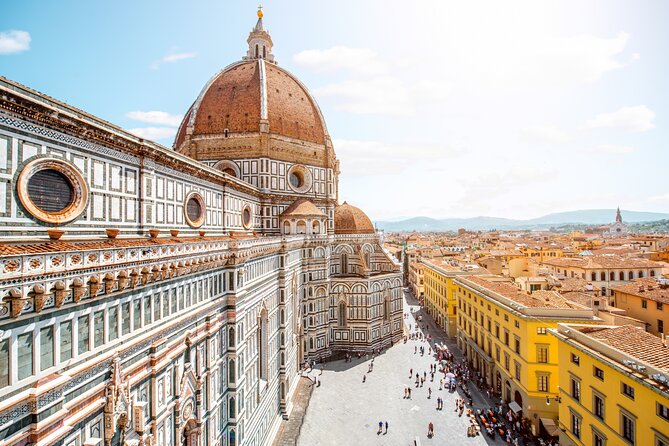
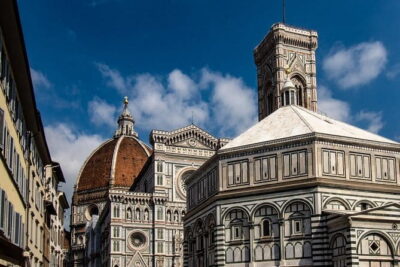
The meeting point is next to Florence Cathedral, though the exact point can vary with the option you book. This is a sensible place to begin because the Duomo is central, easy to recognize, and already on most first-time itineraries.
Your guide draws attention to a Jewish inscription of the Ten Commandments connected with the cathedral. It is the kind of detail many people pass without noticing. The point is not that Florence Cathedral was a Jewish site. Rather, the inscription gives you an early example of how Jewish references and symbols can appear within the city’s larger Christian setting.
Starting here also lets your guide establish the wider timeline. The walk follows Jewish life in Florence from the first arrivals in the 14th century through the era of the ghetto, the period of emancipation, World War II, and the present day.
You should expect a city walk on public streets, not a staged historical recreation. The strongest moments come when the guide helps you read the city around you. If you have already visited the Duomo, this added layer can make a familiar stop feel new without requiring another long museum visit.
Piazza della Repubblica and the former ghetto
The route continues to Piazza della Repubblica, the broad central square built over the area of Florence’s old market. This was also the location where the Jewish ghetto was established.
That change of setting matters. Today, the square is one of Florence’s most open and recognizable public spaces. Its present appearance can make it hard to picture a confined neighborhood with restrictions on where Jewish people could live and how they could move through the city.
The guide explains the role of Jewish people in commerce and the way their economic lives connected with Florence’s ruling Medici family. This section adds useful context to the city’s famous wealth. Renaissance Florence depended on trade, finance, craft, and exchange, but the people involved did not all have equal rights or social standing.
For me, this is one of the tour’s most useful stops because it turns a broad political story into a place you can stand in. You are not hearing about the ghetto in isolation. You are seeing where it existed in relation to the city’s market and commercial center.
There is also a limitation to keep in mind. The former ghetto is not presented as a fully preserved quarter with a continuous run of original buildings. If you expect a neighborhood that looks much as it did centuries ago, you may find the evidence less visual than expected. The guide’s explanations do much of the work.
Piazza della Signoria, the Medici, and Jewish commerce
At Piazza della Signoria, the tour brings Jewish history into contact with Florence’s political center. Palazzo Vecchio dominates the square, making this a natural place to discuss the Medici family and the city’s systems of power.
This stop helps you connect everyday commercial activity with decisions made by rulers. The tour’s subject is not only worship and persecution. It also covers the practical work of Jewish people in Florence, including their role in trade and their connection with the powerful Medici.
You may already know Piazza della Signoria as the setting for statues, public ceremonies, and the Palazzo Vecchio. The guide adds a less familiar perspective: who could trade, settle, work, and remain secure in the city depended on laws and political choices.
The square can be crowded, and a private guide is useful here because you can pause without being tied to a large group’s fixed pace. Still, this is an outdoor explanation in a busy public place. You will need to listen closely, especially if the square is noisy.
More history-first plans:
- Tipsy Tour: Guided Bar Crawl In Florence with Dark History
★ 5.0 · 271 reviews - Florence Cooking Course with Historic Local Market Visit
★ 4.5 · 151 reviews - Florence: Medici Family History Tour
★ 4.3 · 93 reviews - Historical Guided Tour of Florence’s Iconic Cathedral
★ 3.5 · 88 reviews
Santa Croce and the Star of David
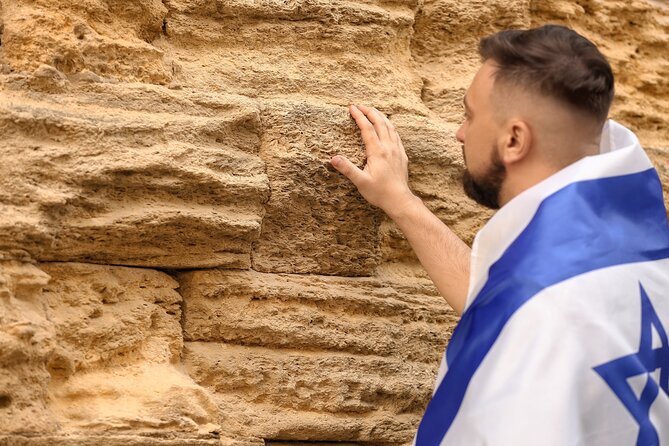
Santa Croce Basilica is another major Florence sight that gains a different meaning during this walk. Your guide points out a Star of David on the church’s facade, a detail that can be easy to overlook when your attention is drawn to the basilica’s larger artistic and religious features.
This is not a substitute for a full visit inside Santa Croce. The tour uses the basilica as a place to examine a symbol and discuss the way Jewish references appear within Florence’s public architecture. That makes the stop short but memorable.
I like this part because it rewards careful looking. Florence can overwhelm you with famous works and grand proportions. A small mark on a facade asks you to slow down and look at the building itself.
The route also addresses the former Jewish Quarter, where many Jewish residents moved after the ghetto was demolished. That detail is important. It shows that Jewish Florence did not end when the ghetto disappeared. The community changed location and continued, even as the physical shape of the old quarter was erased.
The Great Synagogue and Jewish Museum on the three-hour option
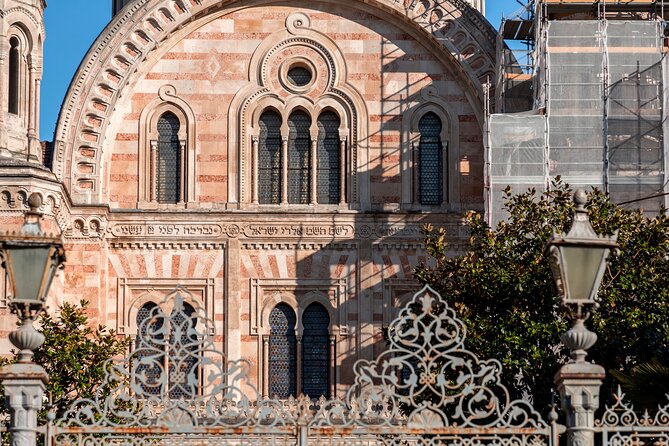
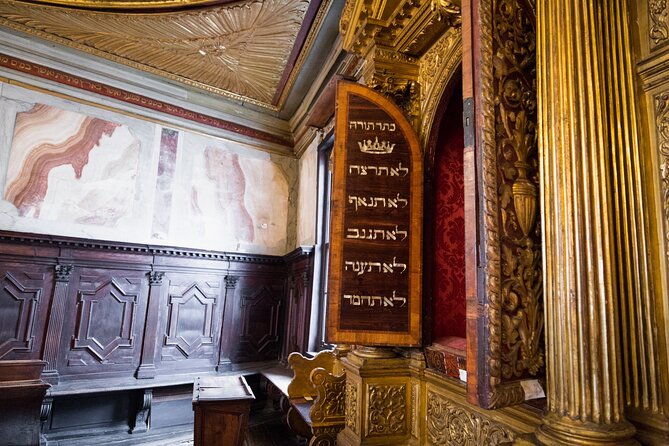
The 3-hour tour adds a visit to Florence’s Great Synagogue and Jewish Museum. Skip-the-line tickets are included, giving you entry at your booked time without waiting at the ticket office.
This is the option I would choose if Jewish history is a main reason for your visit. The street walk provides clues and local context, while the synagogue and museum give you a place to examine religious objects, clothing, and the community’s story in more depth.
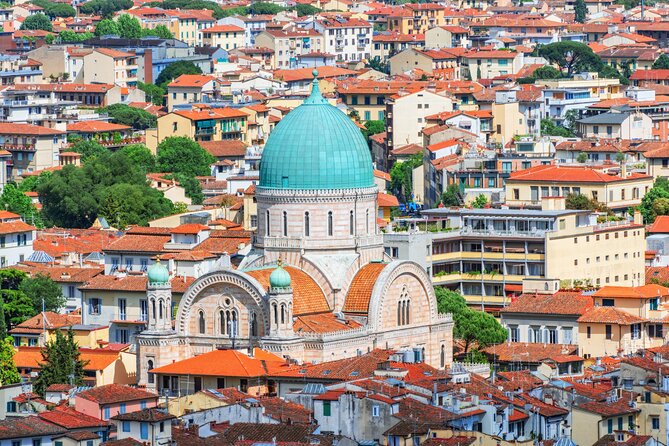
The Great Synagogue is described as one of the important synagogues built in Europe during the age of Jewish emancipation. Its importance is not only architectural. It reflects a period when Jewish communities gained new legal and civic possibilities, even though the road to full acceptance was neither simple nor permanent.
The Jewish Museum includes displays of religious items and clothing, along with exhibits commemorating Holocaust victims. That makes the visit essential for understanding the 20th-century portion of the tour. The walk covers arrests, deportations, and the Holocaust, but museum exhibits can give those subjects a more concrete setting.
Allow the full three hours if you want the synagogue and museum to feel like more than a quick add-on. The exact interior experience can be affected by scheduled events, including Sabbath services, prayer times, and concerts. The Great Synagogue remains an active place of worship, so access inside can be limited at those times.
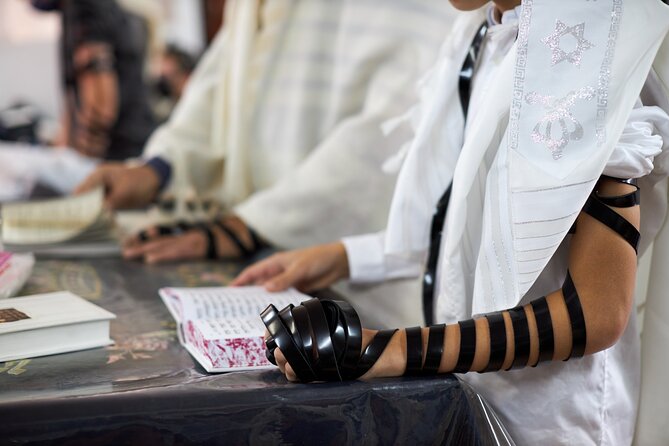
Dress and behave respectfully. Yarmulkes are available free at the synagogue. This is a place of worship first and a historic site second, and that distinction is worth remembering.
The two-hour and three-hour choices
The two-hour option is a good fit if you want a thematic introduction while keeping time for Florence’s other major sights. It includes the outdoor route through the central city, Jewish symbols near the Duomo and Santa Croce, the old market and ghetto area, Piazza della Signoria, and the former Jewish Quarter.
The 3-hour option adds the Great Synagogue and Jewish Museum. That extra hour changes the balance of the experience. The two-hour walk is mainly about location and interpretation. The longer tour adds objects, clothing, Holocaust exhibits, and the synagogue interior when access allows.
Think about your schedule before booking. Florence’s center is compact, but it is packed with museums and churches that can consume a full day. If you have only a short visit, the two-hour walk gives you a useful frame without taking over your day.
If you have a strong family, religious, or historical interest in Jewish life, the longer option offers better value because the museum material supports the subjects introduced outdoors. The included skip-the-line entry also removes one small task from your day, although it does not guarantee unrestricted access during worship or special events.
Guide quality and the private format
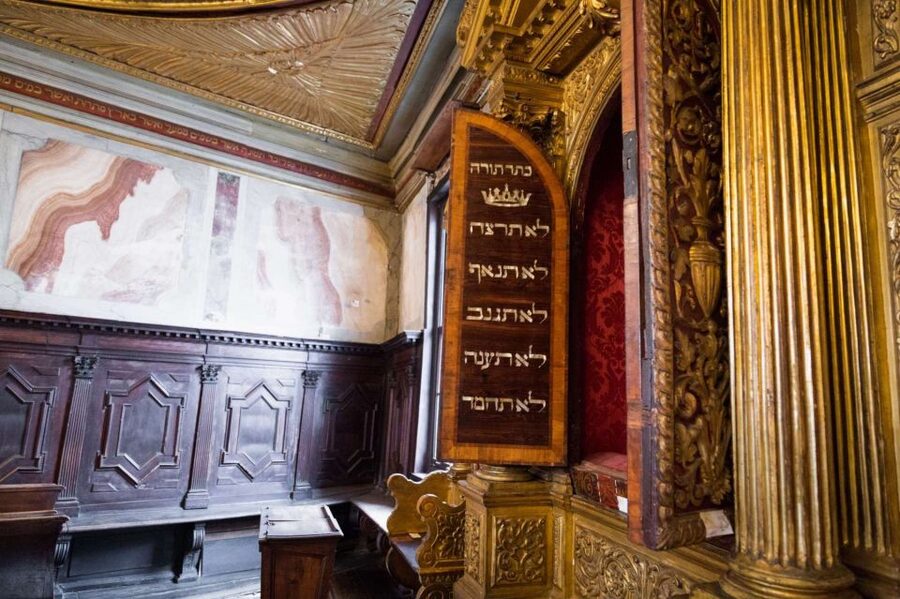
The experience is led by a local history expert, and the guide assigned to you may vary. Daniela led one recent tour and was praised for explaining both Jewish history and the wider story of Florence while pointing out lesser-known details around the city center.
That combination is exactly what this tour needs. A guide who knows only Jewish history might miss the political and architectural links. A guide who knows only Florence’s major monuments might treat the Jewish story as a footnote. Here, the stated focus is to connect both.
Because the group is private, you can ask questions and adjust the discussion to your interests. The stated guide ratio is one licensed guide for up to 25 people. Groups of 26 to 50 receive two guides so everyone can hear and ask questions, though the private format is most appealing for families, couples, and small groups.
The guide languages are English, French, Italian, Polish, Russian, and Spanish. Confirm the language and meeting point in the information sent by email the day before, since the meeting location can change with the option booked.
Food, present-day Florence, and the end of the walk
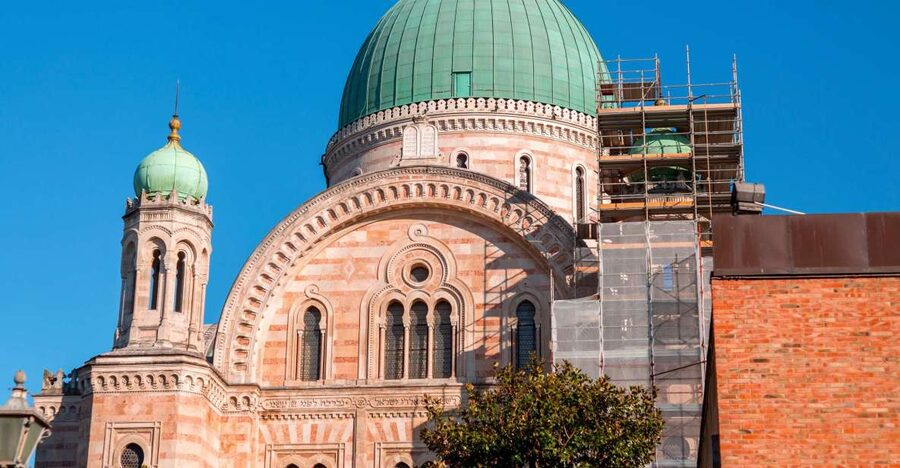
The tour finishes with a practical connection to Jewish Florence today. Your guide can recommend Balagan Café or another kosher restaurant.
That suggestion is useful because it gives the walk a present-day ending. The Jewish story here is not limited to medieval restrictions or wartime tragedy. A kosher café or restaurant recommendation gives you a way to continue thinking about the community through food and daily life.
The information provided does not promise a meal or a food tasting, so plan to pay for any restaurant visit separately. Treat the recommendation as local orientation, not as an included part of the tour.
I would ask the guide for the recommendation early if you want to eat afterward. A private guide can often tailor the suggestion to your timing and interests, but the available information does not specify opening hours or whether Balagan Café will be open on your tour date.
Who should book this walk
This tour suits you if you have already seen Florence’s most famous monuments and want a more focused subject. It also works well as an introduction for anyone interested in Jewish European history, religious heritage, the Holocaust, or the way political power shaped city life.
Families with older children may appreciate the clear route and the chance to spot symbols rather than spend several hours in a conventional museum. The private format also makes it easier to ask questions at your own pace.
You should think twice if you want a large, intact Jewish district with many preserved historic buildings. Florence’s Jewish past is often visible through fragments, former sites, inscriptions, and explanations. The experience depends heavily on the guide’s ability to make those traces meaningful.
The walk is wheelchair accessible, which removes one practical concern. It lasts two to three hours, so comfortable shoes still make sense. Florence’s historic center has many hard surfaces, and the itinerary takes place largely outdoors.
Free cancellation is available up to 24 hours before the tour, and you can reserve now and pay later. Those policies help if your Florence plans are still shifting, though the more important booking decision is choosing the right duration.
Should you book the Florence Jewish Quarter tour?
Book it if you want to see Florence through a subject that most standard city walks barely cover. The two-hour version gives you a well-focused look at the old ghetto, Jewish commerce, Medici connections, wartime persecution, and overlooked symbols near major landmarks.
Choose the three-hour option if you want the Great Synagogue and Jewish Museum to anchor the experience. The museum’s religious objects, clothing, and Holocaust exhibits add weight to the outdoor story, and the included timed entry improves the practical value.
I would not book this expecting a passive stroll through a preserved quarter. Book it for the guide’s interpretation, the links between familiar Florence sights, and the chance to notice details you would probably miss alone. For a private, focused introduction to Jewish Florence, it offers a thoughtful use of two or three hours.
FAQ
Where does the Florence Jewish Quarter tour meet?
The meeting point is next to Florence Cathedral, but it may vary depending on the option you book. Check the information sent by email the day before the tour.
How long does the tour last?
You can choose a two-hour or three-hour private walking tour. The longer option includes the Great Synagogue and Jewish Museum.
Is the Great Synagogue included in the two-hour tour?
No. The two-hour option does not include interior visits to the Great Synagogue or Jewish Museum.
Does the three-hour tour include skip-the-line entry?
Yes. The three-hour option includes skip-the-line tickets for immediate entry at your booked time, without waiting at the ticket office.
What does the Jewish Museum contain?
The museum displays religious items and clothing. It also has exhibits commemorating Holocaust victims.
Can I enter the Great Synagogue during services or concerts?
Interior access may be limited during scheduled events such as Sabbath, prayer times, and concerts. The synagogue is an active place of worship.
What should I wear inside the synagogue?
You should dress and act appropriately for a place of worship. Yarmulkes are available at the synagogue free of charge.
What languages are available?
The tour is offered in English, French, Italian, Polish, Russian, and Spanish.
Is the tour wheelchair accessible?
Yes, the activity is listed as wheelchair accessible.
Can I cancel the booking?
You can cancel up to 24 hours in advance for a full refund. A reserve-now, pay-later option is also available.
Latest additions around Florence
- Florence: Cathedral Tour & Brunelleschi’s Dome Climb Ticket★ 5.0 · 3 reviews
- Palatina Gallery and Pitti Guided Tour in Florence★ 5.0 · 3 reviews
- Florence Uffizi Gallery Skip-the-line Tour w Art Historian Guide★ 5.0 · 3 reviews
- Private Tour: Pisa and Lucca from Florence★ 5.0 · 3 reviews
- San Gimignano Bike Tour (SOFT)★ 4.5 · 3 reviews
- Florence: Tour of Florence by rickshaw★ 5.0 · 3 reviews
- Center of Florence by golf cart★ 5.0 · 3 reviews
- From Firenze | Chianti day tour in a classic car★ 5.0 · 3 reviews
Florence Walking Tours, compared.

Skip the line: Uffizi and Accademia Small Group Walking Tour
Read our review →
Renaissance and Medici Tales Guided Walking Tour
Read our review →
Skip-the-Line Florence Highlights and David Walking Tour
Read our review →
Dark Mysteries and Legends Guided Walking Tour
Read our review →
Florence in a Day: Michelangelo’s David, Uffizi and Guided City Walking Tour
Read our review →Browse the lists this tour appears in