
Reviewed · FLORENCE WALKING TOURS
Florence Highlights: Guided Walking Tour of the Historic Center
Florence’s center is compact, but its great sights come at you fast. This tour links the Duomo, Palazzo Vecchio, Uffizi, Medici churches, and old towers in one walk, while the app lets you keep exploring on your own afterward.
I like the easy meeting point near Via de’ Martelli, and I like the unusual freedom to leave the guide for lunch, then use the app to find the group again. The main caution is that the experience can feel impersonal if the group is large or the guide does not get the introduction off to a good start.
In This Review
- Key points to know before you book
- Florence in one walk, from Santa Maria Novella to the Duomo
- A church, a market, and the city’s political heart
- Palazzo Vecchio, the Neptune Fountain, and the Loggia dei Lanzi
- Romanesque stone and Florence’s palace-lined piazzas
- Medici churches and the Cathedral of Santa Maria del Fiore
- Baptistery, Giotto’s Bell Tower, and Florence’s oldest core
- Dante, the Chestnut Tower, and lesser-known corners
- How the Vox City app changes the experience
- Guide quality, group size, and timing
- Is $30.12 a fair price?
- Who should book this Florence walk?
- Should you book it?
- FAQ
- How long does the guided walking tour last?
- Where does the tour begin?
- Where does the tour end?
- What language is the live tour?
- What languages are available in the audio guide?
- Are headphones and a mobile phone included?
- Are attraction entry tickets included?
- How large can the group be?
- Can I leave and rejoin the guided walk?
- How long is the walking pass valid?
- What is the cancellation policy?
Key points to know before you book
- A guided and self-guided mix: Follow a live English guide for about 90 minutes, then continue with the sightseeing app.
- Florence’s major sights in one route: See the Duomo, Baptistery, Giotto’s Bell Tower, Palazzo Vecchio, Uffizi, Piazza della Signoria, and Medici landmarks.
- Flexible touring: The pass remains valid for 12 months from your selected date, and you may leave and rejoin the walking tour.
- Six audio languages: Pre-recorded commentary is available in English, French, German, Italian, Spanish, and Chinese.
- No attraction admission: The price covers the walking experience and app, not entry to the Uffizi, churches, museums, or towers.
- Small enough to manage, but not intimate: The group can reach 30 people, so your experience may depend on the guide and crowd size.
Florence in one walk, from Santa Maria Novella to the Duomo

At about $30.12 per person, this is a reasonably priced orientation walk rather than a museum tour or a full-day study of Renaissance art. You pay for a live English guide, an audio app, and a route through the city center. You do not pay for admission to the attractions themselves.
That distinction matters in Florence. The Uffizi, the Duomo complex, and several churches require separate planning and, in some cases, separate tickets. This walk gives you the outside view, the setting, and the basic story. It helps you decide where to spend your museum time later.
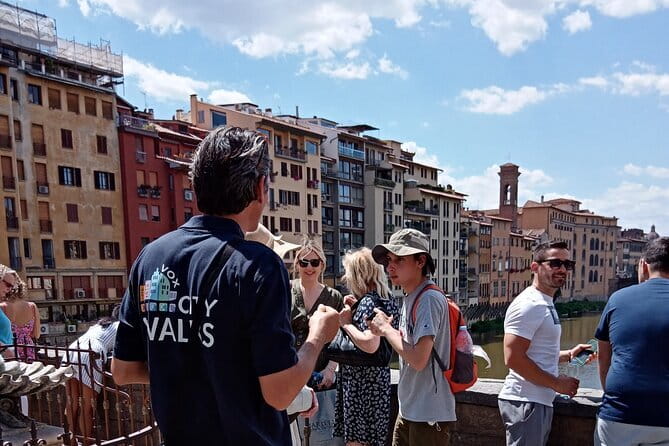
The walk begins at Cafè Firenze on Via de’ Martelli, 50/r, at the corner of Via de’ Pucci. The spot is central and easy to reach, close to the cathedral. Look for a guide in a dark blue Vox City uniform, and arrive about five minutes early.
The advertised live walk lasts 90 minutes, though the overall activity is described as taking one to two hours. The group can contain up to 30 people. That is manageable on Florence’s mostly walkable center streets, but you should not expect a private tour.
More walking routes in Florence:
- Florence: Guided Walking Tour
★ 4.5 · 3,334 reviews - Skip the line: Uffizi and Accademia Small Group Walking Tour
★ 4.5 · 3,135 reviews - Florence: Guided Walking Tour
★ 4.6 · 1,602 reviews
A church, a market, and the city’s political heart
The route opens with a 700-year-old church built on the site of a monastery and linked with art by Donatello. This is a useful reminder of how Florence works: a church is not simply a place of worship. It can also be an art gallery, a political marker, and a record of the families who paid for its decoration.
From there, you reach the covered market with Renaissance-style arches and the famous piglet fountain. The market gives the walk a change of pace. Instead of looking only at grand palaces, you see a place tied to ordinary city life, commerce, and the habits of Florentines.
The piglet fountain is a popular photo stop. You may see people rubbing the statue’s snout, a long-running local custom. The tour does not include a market meal or shopping time, so treat this as a quick orientation rather than a food visit.
The route then moves into Florence’s main square, recognizable for its unusual W shape and major political role. This is the kind of place that benefits from a guide. A square can look like an open space, but its shape, buildings, and public art reveal how the city once displayed power.
Palazzo Vecchio, the Neptune Fountain, and the Loggia dei Lanzi
Florence’s town hall rises over the political square. Palazzo Vecchio is one of the city’s clearest symbols, with its tower and fortress-like appearance. The building connects civic government with the wealth and influence that helped Florence shape the Renaissance.
You then pause at the large fountain commissioned by the Medici family nearly 500 years ago. It is a good photo stop, but it also shows how public decoration could serve political purposes. A powerful family did not need to put its name on every wall when its patronage was visible in the city’s grandest spaces.
Nearby, the arched gallery presents a collection of historic statues in an open-air setting. This is one of Florence’s pleasures: you can see major sculpture without entering a museum. The Loggia dei Lanzi also gives you a useful preview of the kind of art found in the Uffizi.
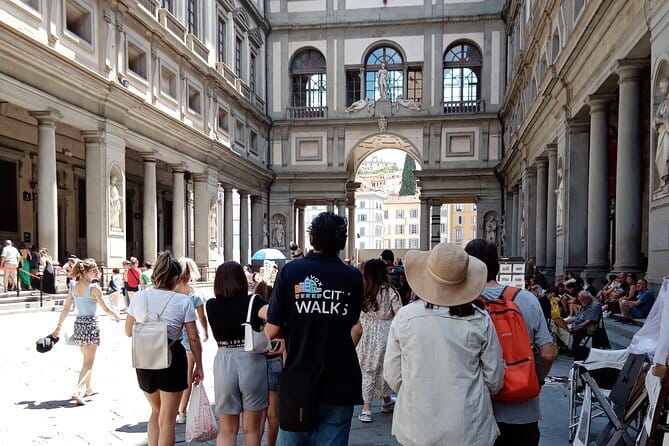
The walk continues past the Uffizi Gallery, one of Italy’s great collections of Renaissance painting and sculpture. The tour does not include admission, so you will see the building and its setting, not the galleries inside.
I find that useful if you are new to Florence. The guide can place the Uffizi in the city plan, while you can decide later if you want to commit several hours to the collection. If you already have a reserved Uffizi entry, this walk can help you understand the surrounding streets before or after your museum visit.
Romanesque stone and Florence’s palace-lined piazzas

One stop brings you to one of Florence’s oldest churches, noted for its Romanesque architecture. The style is different from the later Gothic and Renaissance buildings, with a more restrained use of arches, stone, and geometric forms.
That contrast is valuable. Florence is often presented as a Renaissance city, but the older layers have not vanished. The city’s churches and towers show how its appearance changed over centuries rather than appearing all at once.
You also walk through a triangular piazza lined with Gothic and Renaissance palaces. The setting is a lesson in urban scale. Florence’s important families built residences close together, competing through height, stonework, windows, and decoration.
Another highlight is a High Renaissance palace designed by Baccio d’Agnolo. The architecture rewards a slow look upward, especially if the guide points out details you could easily miss while moving between the larger sights.
The Strozzi family’s palace adds a political thread to the route. The Strozzi were long-standing rivals of the Medici, and their grand residence gives you a concrete way to understand Florence’s family rivalries. You are not just passing another elegant building. You are seeing how wealth and competition shaped the streets.
More history-first plans:
- Tipsy Tour: Guided Bar Crawl In Florence with Dark History
★ 5.0 · 271 reviews - Florence Cooking Course with Historic Local Market Visit
★ 4.5 · 151 reviews - Florence: Medici Family History Tour
★ 4.3 · 93 reviews - Historical Guided Tour of Florence’s Iconic Cathedral
★ 3.5 · 88 reviews
Medici churches and the Cathedral of Santa Maria del Fiore
The route reaches one of Florence’s popular squares, where statues line the Fountain of the Naiads. The stop is mainly for atmosphere and photographs, and it offers another open public space after the narrower streets.
Then comes the towering church that holds the remains of several Medici family members. The Medici connection is central to Florence, and this church helps tie the family’s political power to religious buildings, memorials, and artistic commissions.
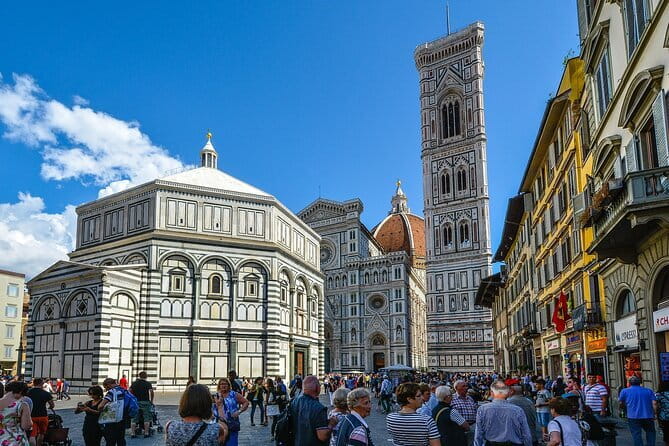
The cathedral is the big visual payoff. Santa Maria del Fiore dominates the skyline with Filippo Brunelleschi’s enormous dome, a UNESCO World Heritage Site and one of Europe’s best-known architectural sights.
The tour gives you more than one look at the cathedral. You get time to photograph the exterior and to take in the dome from different points along the route. That is sensible because the building is too large to understand from a single angle.
You should know what this experience does not provide. It does not include entry to the cathedral, the dome, the bell tower, or other paid attractions. If climbing Brunelleschi’s dome is on your list, you need a separate reservation and ticket.
Baptistery, Giotto’s Bell Tower, and Florence’s oldest core

The octagonal Baptistery sits near the cathedral. For centuries it was Florence’s exclusive place for baptism, which gives the building a special place in the city’s religious life.
Its shape is easy to recognize, but the guide’s commentary can help you see why it matters beyond its appearance. The Baptistery is part of the cathedral complex, yet it has its own history and identity.
Next comes the free-standing bell tower, built almost 700 years ago and more than 80 meters tall. Giotto’s Campanile is one of the most familiar parts of the cathedral group. From street level, you can appreciate its vertical design without taking on the climb.
The route also passes the oldest building still standing in Florence’s historic center. Its foundations reach back to the Roman era, though its exact origins are uncertain. That uncertainty is worth noting. Historic cities do not always offer a neat story, and a good walk should leave room for what is known and what remains unclear.
Dante, the Chestnut Tower, and lesser-known corners

The walk includes a museum dedicated to Dante Alighieri, the poet associated with The Divine Comedy. The stop gives the route a literary side, balancing the better-known art and architecture.
You also pass the well-preserved Chestnut Tower, one of the old towers in Florence’s center. Medieval towers once marked family power and offered defensive strength. Today, they are easy to overlook among the cathedral and palace facades, so this is one of the route’s quieter pleasures.
The final stretch is designed to show Florence beyond its headline monuments. You still get the city’s famous landmarks, but the route also points toward lesser-known corners and smaller details.
That balance is important if you have only a short time in Florence. You get a basic map of the center, then a few leads for your own wandering. The app is meant to support that second part.
How the Vox City app changes the experience

The app is not just a digital map. It includes pre-recorded audio in English, French, German, Italian, Spanish, and Chinese, along with the ability to locate the walking guide.
Before arrival, scan the QR code on your voucher and download the audio guide. You need your own phone and headphones, since neither is included. Downloading ahead of time is the practical move, especially if you do not want to deal with setup on a busy street.
The flexible system is the tour’s most unusual feature. You can follow the guide for part of the route, stop for food or a rest, then use the app to locate the guide and continue. One person found this especially useful after leaving when hunger set in, then reconnecting with the group later.
That flexibility makes the experience less rigid than a normal 90-minute walk. It also means you need to pay attention to the app and your voucher. If you want a guide beside you every minute, this format may feel less personal.
The pass is valid for 12 months from the selected travel date. If your plans change, you can use the voucher at another time, subject to the stated cancellation terms. Free cancellation is available up to 24 hours before the start time. Changes made inside that window are not accepted, and the payment is not refunded.
Guide quality, group size, and timing
The live portion is in English. The guides Laura, Elisabetta, and other Vox City staff have received particularly warm praise for making the walk friendly, organized, and enjoyable. A pair of guides, Elisabetta and Laura, have also led very small groups, which can make the experience feel much more personal.
Still, guide quality can vary. One poor experience involved a late start, no clear introduction, and a monotonous presentation. The scheduled 10:30 start became 10:50 because of organizational problems with other participants.
That is the main risk to keep in mind. A 90-minute walk is short, so a 20-minute delay takes a noticeable bite out of your sightseeing time. Arrive early, find the correct corner meeting point, and look for the dark blue uniform.
A group of up to 30 people may work well with an energetic guide, but it will not offer the close attention of a private tour. If you have hearing concerns, bring headphones for the app and stay near the guide during live commentary. The supplied information says most people can participate, but it does not provide detailed accessibility information.
Is $30.12 a fair price?
I consider the price fair if you want a quick introduction to Florence and plan to use the app. You receive a live walking tour, multilingual audio, and the freedom to continue independently. That is more useful than paying for a short walk that ends at the final monument.
The value drops if you only want a guide’s live commentary and do not plan to use the app. It also drops if you already know the center well or have arranged separate tours of the Duomo and Uffizi.
The price does not cover entry to attractions. Budget separately for museums, churches, and tower or dome visits. Think of this activity as a city orientation, not an all-inclusive Florence pass.
Who should book this Florence walk?
I would choose it for a first visit, a short stay, or a traveler who wants the city explained before deciding which interiors deserve time. Families and mixed-interest groups may also like the ability to stop and restart instead of staying on one fixed schedule.
It is also a good fit if you want commentary in a language other than English during the self-guided portion. The live guide speaks English, but the app covers five additional languages.
I would be more cautious if you want a slow, highly personal art lesson. The route covers many sights in a short time, and the maximum group size is 30. You may get a lively guide such as Laura or Elisabetta, but you should not book it expecting a private conversation at every stop.
Should you book it?
Book this tour if you want a practical first look at Florence, especially if you value flexibility and multilingual audio. The route packs in the cathedral, civic square, Uffizi area, Medici sites, old churches, towers, and literary landmarks without asking you to commit a full day.
Skip it if your priority is entering attractions or receiving a detailed specialist lecture. In that case, spend the $30.12 on a focused museum or cathedral experience instead.
For many visitors, the best plan is to take this walk early in a Florence stay, use it to get your bearings, and return later to the places that caught your attention.
FAQ
How long does the guided walking tour last?
The guided walking tour lasts about 90 minutes. The overall activity is described as taking approximately one to two hours.
Where does the tour begin?
Meet at Cafè Firenze, Via de’ Martelli, 50/r, at the corner of Via de’ Pucci, in Florence.
Where does the tour end?
The activity ends back at the meeting point.
What language is the live tour?
The live walking tour is conducted in English.
What languages are available in the audio guide?
The pre-recorded audio guide and sightseeing app are available in English, French, German, Italian, Spanish, and Chinese.
Are headphones and a mobile phone included?
No. You need to bring your own mobile device and headphones.
Are attraction entry tickets included?
No. Entry to attractions is not included in the tour price.
How large can the group be?
The activity can have a maximum of 30 participants.
Can I leave and rejoin the guided walk?
Yes. The app can help you locate the guide so you can leave the walk and rejoin it later.
How long is the walking pass valid?
The walking tour pass is valid for 12 months from your selected travel date.
What is the cancellation policy?
You can cancel up to 24 hours before the experience start time for a full refund. Cancellations or changes made less than 24 hours before the start time are not accepted for a refund.
Latest additions around Florence
- Palatina Gallery and Pitti Guided Tour in Florence★ 5.0 · 3 reviews
- Florence: Cathedral Tour & Brunelleschi’s Dome Climb Ticket★ 5.0 · 3 reviews
- Florence Uffizi Gallery Skip-the-line Tour w Art Historian Guide★ 5.0 · 3 reviews
- Private Tour: Pisa and Lucca from Florence★ 5.0 · 3 reviews
- San Gimignano Bike Tour (SOFT)★ 4.5 · 3 reviews
- Florence: Tour of Florence by rickshaw★ 5.0 · 3 reviews
- Center of Florence by golf cart★ 5.0 · 3 reviews
- From Firenze | Chianti day tour in a classic car★ 5.0 · 3 reviews
Florence Walking Tours, compared.

Skip the line: Uffizi and Accademia Small Group Walking Tour
Read our review →
Renaissance and Medici Tales Guided Walking Tour
Read our review →

Skip-the-Line Florence Highlights and David Walking Tour
Read our review →
Dark Mysteries and Legends Guided Walking Tour
Read our review →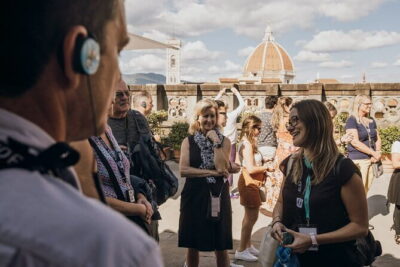
Florence in a Day: Michelangelo’s David, Uffizi and Guided City Walking Tour
Read our review →Browse the lists this tour appears in