
Reviewed · ACCADEMIA GALLERY TOURS
Florence City Tour & David
Michelangelo’s David is the star here, but the real prize is the story around him. You see the statue at the Accademia, then follow Florence’s streets to the Medici palace, cathedral district, Piazza della Signoria, and Ponte Vecchio. In three hours, the tour links art, power, religion, and politics in a way that makes the city easier to read.
I like the small maximum of 12 people, which should make it easier to hear the guide and ask questions. I also like the route itself: skip-the-line museum entry comes first, when your attention is fresh, and the rest unfolds outdoors through Florence’s compact center.
The main drawback is the price, listed at $464.43 per person. That is a serious spend for a three-hour walk, even with Accademia admission and a small group. You are paying for guided interpretation and time saved, not simply for entry tickets or transportation.
In This Review
- Key points to know before booking
- Why this Florence route works
- Seeing David at the Accademia
- Reading Medici ambition at Palazzo Medici Riccardi
- Florence’s cathedral and the Baptistery
- Piazza della Signoria and the original home of David
- The Vasari Corridor and Medici privacy
- Ponte Vecchio and the bridge’s wartime story
- Paul Costa’s teaching style
- Is $464.43 a fair price?
- Who should book this walk?
- My verdict: a smart introduction at a high price
- FAQ
- Where does the Florence City Tour and David begin?
- What time does the tour start?
- Where does the tour end?
- How long does the experience last?
- Is admission to the Accademia included?
- How large is the group?
- Can I cancel or change my booking?
Key points to know before booking
- David comes first: Begin at the Galleria dell’Accademia with skip-the-line admission and about an hour inside.
- The group is kept small: The stated limit is 12 people, with the tour described as a small group of up to 11 guests.
- Medici power shapes the route: The Palazzo Medici Riccardi and Piazza della Signoria show how one family influenced art, government, and city design.
- The cathedral district gets useful context: You learn why Florence built its great dome and why the Baptistery matters to Florentine Christians.
- The walk ends at Ponte Vecchio: The final stop connects the bridge to its 1333 rebuilding and its survival during World War II.
- The guide matters: Paul Costa is associated with this experience and is praised for teaching art through questions, humor, and clear explanations. Confirm who will lead your departure.
Why this Florence route works
Florence can feel like a museum without walls. A turn down one street reveals a palace; the next opens onto a church facade, a sculpture-filled square, or a bridge lined with shops. That abundance is wonderful, but it can also blur together if you do not understand who paid for the buildings and why they were made.
This tour gives you a clear thread: the Renaissance and the Medici family. You begin with Michelangelo’s David, then move through places where the Medici family displayed wealth, shaped public life, and used art to strengthen its position. The route finishes at the Arno, giving you a physical sense of how close Florence’s key landmarks are to one another.
The schedule is brisk but sensible. About one hour is set aside for the Accademia, followed by short stops at the Medici palace, Piazza della Signoria, and Ponte Vecchio. Additional explanations cover the cathedral, Baptistery, and Vasari Corridor while you walk between the main stops.
This is not a tour for checking off every room in every building. It is a guided orientation with one substantial museum visit and several outdoor landmarks. You get interpretation rather than long stretches of independent browsing.
More Accademia and David visits:
- Florence: Timed Entrance Ticket to Michelangelo’s David
★ 4.6 · 16,983 reviews - Florence: Michelangelo’s David Skip-the-Line Entry Ticket
★ 4.5 · 12,764 reviews - Florence Accademia Gallery Tour with Entrance Ticket Included
★ 4.5 · 6,148 reviews
Seeing David at the Accademia
The tour starts at Via Ricasoli, 58, near the Galleria dell’Accademia, at 9:10 a.m. The early start is helpful. Florence’s most famous statue draws a steady stream of people, and skip-the-line admission protects your limited morning time.
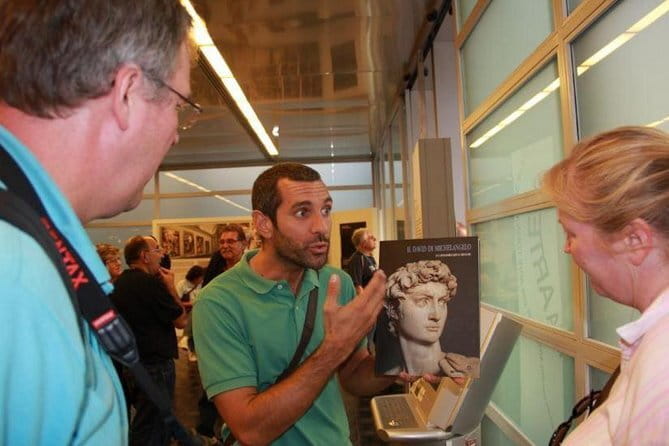
Inside, the focus is Michelangelo’s David, along with other paintings and artworks from the period. The guide also explains how people interpreted these works when they were new more than 500 years ago. That point is important because David is not only a beautiful marble figure. He carried a public and political meaning for Florence.
You also learn about the statue’s intended and original public setting. Michelangelo’s David was first placed in Piazza della Signoria, outside the Palazzo Vecchio, before being moved indoors for protection. The copy now in the square helps you connect the museum object with its civic role.
Allow yourself to look up as well as straight ahead. David’s scale and placement are part of the experience, and a guide can direct your attention to details that are easy to miss when the room is crowded. The hour inside is long enough for serious explanation, though short compared with a full art-museum visit.
That limit is both good and bad. You avoid museum fatigue and keep moving through the city, but art lovers may want more time with the Accademia’s other works. If your main goal is to study the museum at length, this tour may feel too tightly timed. If your goal is to understand David and then see Florence around him, the balance makes sense.
Reading Medici ambition at Palazzo Medici Riccardi
From the Accademia, the route continues to Palazzo Medici Riccardi. The visit includes the inner courtyard, where Roman, Greek, and Renaissance ideas meet in the setting created for Florence’s most powerful family.
The palace is a useful counterpoint to David. At the Accademia, you are looking at a single work with enormous civic meaning. Here, you see the setting of private wealth and family ambition. The Medici used architecture and art to show status, taste, and control.
The planned stop is short, about 15 minutes, and admission is free. That means the guide’s explanation does most of the work. You will not have time for a slow inspection of every architectural detail, but you should come away with a sharper understanding of how the Medici turned their home into a statement.
I like this stop because it keeps the Renaissance from becoming a parade of famous names. The buildings tell you who had money, who had influence, and how public image worked in a city where art and politics were closely linked.
Florence’s cathedral and the Baptistery
The route then covers Florence’s cathedral district, including the great church and its dome, and the Baptistery. These stops are part of the walking commentary rather than listed admission visits, so you should expect to view them from outside.
The cathedral discussion explains how and why Florence built what became the largest church and dome in the world during the 1300s and 1400s. That is a useful lesson in civic ambition. The project was not only religious. It also showed what Florence believed it could achieve through wealth, engineering, art, and competition with other Italian cities.
The Baptistery receives a different kind of attention. Florentine Christians regard it as the city’s most important building, and the tour explains who was baptized there, why baptism practices changed in the 1300s, and why the building’s shape matters. You also learn about its famous doors, often called the Doors of Paradise.
This part of the walk is especially valuable if you are seeing Florence for the first time. The cathedral, bell tower, and Baptistery are often treated as a single photogenic cluster. The guide gives each building a role, so you can understand how religious ceremony, civic pride, and artistic competition fit together.
Do not expect entry to the cathedral or Baptistery from the information provided. The tour focuses on explanation and exterior viewing at these points. If you want to go inside later, set aside separate time and check admission requirements for your date.
More Florence options worth a look before you decide
- City Sightseeing Florence Hop-On Hop-Off Bus Tour
★ 3.5 · 1,894 reviews - Florence: Eco-Friendly Golf Cart City Tour with Audio Guide
★ 4.6 · 1,094 reviews - Florence in a Day: Michelangelo’s David, Uffizi and Guided City Walking Tour
★ 4.5 · 1,048 reviews - Florence in a Day: David, Cathedral & City Highlights Guided Tour
★ 4.5 · 947 reviews
Piazza della Signoria and the original home of David
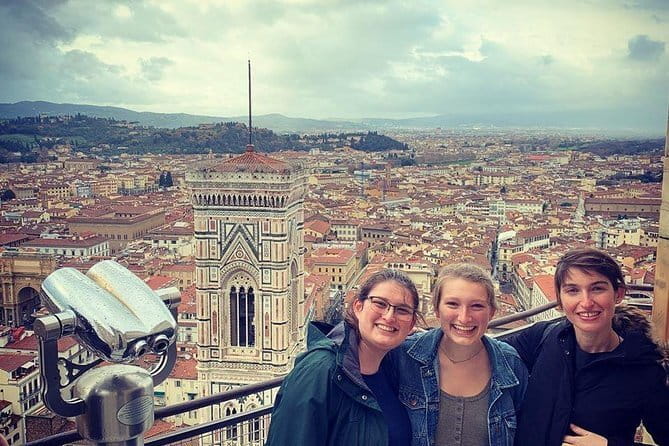
Piazza della Signoria is the tour’s outdoor art gallery. The square contains sculptures connected with Medici power, and it sits beside Palazzo Vecchio, Florence’s city hall and a museum.
The guide points out where Michelangelo’s original David was placed. This is one of the strongest moments of the route because it connects the statue you saw indoors with the political heart of Florence. David’s location was not random. The figure served as a symbol in a public space tied to government and civic identity.
Palazzo Vecchio has occupied this site since 1299 and still functions as a political building. It is also a museum, though this tour does not list an interior visit. You get a short stop of about 15 minutes, so think of the piazza as a lesson in public art and power, not a complete palace tour.
The square can be crowded and noisy, particularly around its famous sculptures. Stay close enough to hear the guide, and wear shoes suited to uneven city paving. The tour is only about three hours, but the walking portions are continuous, with no vehicle transfer between sights.
The Vasari Corridor and Medici privacy
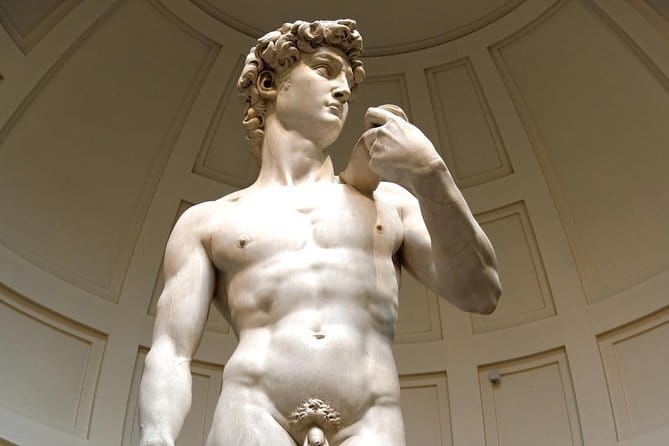
As you continue toward the river, the guide explains the private passageway built by Giorgio Vasari for Cosimo de’ Medici. The corridor allowed the Medici ruler to cross Florence without walking through public streets.
This detail neatly sums up the family’s position. The Medici were deeply involved in Florence’s public life, yet their private route allowed them to move above or apart from it. The passage also connects several major landmarks into one story, linking the political center to the river and beyond.
The experience does not include admission to the corridor. You learn about its purpose and place in the city while walking the public route below. That is enough to make the city’s layout more legible, even if you cannot tour the passage itself.
I find this kind of detail more useful than another list of dates. It gives you a vivid picture of daily power: who could move freely, who needed protection, and how architecture could serve personal comfort as well as public display.
Ponte Vecchio and the bridge’s wartime story
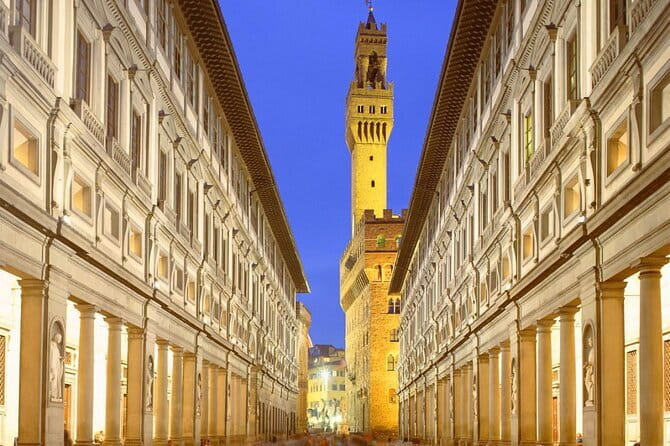
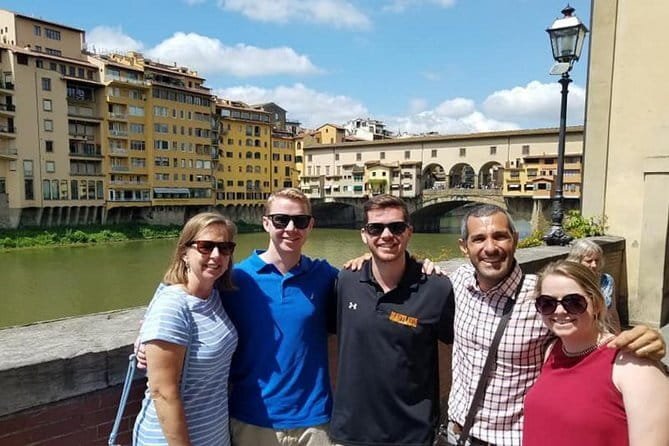
The walk finishes at Ponte Vecchio, near the bridge, at about 12:10 p.m. The bridge is the natural end point for a route through central Florence. It brings together commerce, the Arno, the Medici story, and the city’s wartime past.
You learn why Ponte Vecchio has survived from its rebuilding in 1333 to the present. The explanation also includes World War II and the role of the Axis and Allied powers in saving the bridge. That history adds weight to what can otherwise seem like a picturesque shopping crossing.
The stop is brief, about 10 minutes. You will have time to understand the bridge’s importance, but not to linger over every shop or walk slowly across it as part of the formal tour. Once the tour ends, you are well placed to continue on foot toward either side of the river.
The endpoint is practical if you are planning lunch or more sightseeing in central Florence. It is not a loop, so remember that you finish at Ponte Vecchio rather than returning to the Accademia. Florence’s center is walkable, but plan your next stop before the guide says goodbye.
Paul Costa’s teaching style
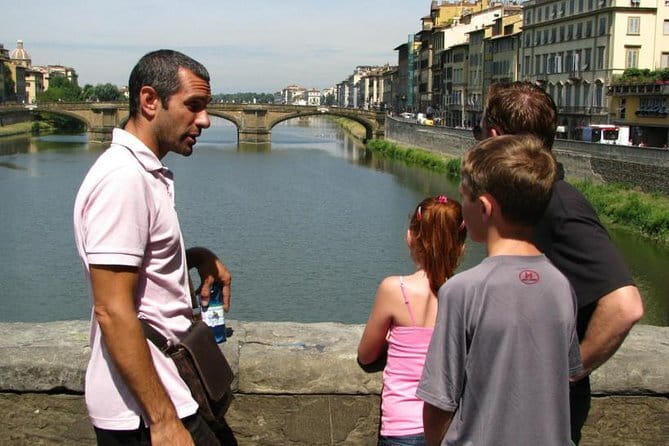
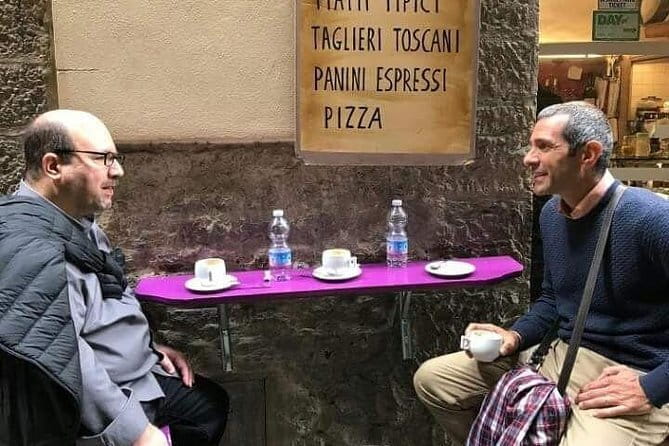
The guide can make or break a history walk, and this experience is closely associated with Paul Costa. His approach is described as animated, clear, and teacher-like. He uses questions, humor, and visual explanations to keep people involved rather than simply reciting dates.
That style seems particularly useful for families and mixed-age groups. Paul has kept teenagers engaged for three hours, and he has guided groups ranging from young adults to people in their eighties. He is also praised for answering questions and for making Renaissance art easier to understand without turning the walk into a lecture.
One unusual strength is the emphasis on learning how to look at art. The guide does not only identify the artist or year. He helps you consider how a work was understood in its own time and how it functioned in public life.
Still, ask about the assigned guide when booking. The supplied information connects Paul Costa strongly with the tour, but it does not guarantee that he personally leads every departure. If his teaching style is the main reason you are booking, confirm this in advance.
Is $464.43 a fair price?
At $464.43 per person, this is an expensive three-hour experience. The cost includes skip-the-line admission to the Accademia, but most of the other stops are outdoor visits without a separate admission charge.
The value comes from the guide, the limited group size, and the time saved at the Accademia. For a first visit with only one day in Florence, a strong guide can help you understand more in three hours than you might gather from wandering between famous buildings. The route also gives you a useful plan for what to see next.
The price is harder to justify if you are a confident independent visitor, have several days in Florence, or mainly want entry to David. You could spend less by visiting the Accademia with a timed ticket and walking the historic center on your own. You would lose the connected story and the guide’s explanations, but you would gain flexibility.
Group discounts are available, so larger parties should check how the final per-person price changes. The group limit also matters. A group of up to 12 is much easier to manage than a large coach tour, though it is not the same as a private walk.
Who should book this walk?
I would suggest it to first-time visitors who want a strong introduction to Florence without spending an entire day inside museums. It suits couples, families, and mixed-age groups who enjoy stories, art, and city politics in equal measure.
It is also a good fit if David is high on your list but you want more than a quick photograph. The route shows how Michelangelo’s statue connects to Florence’s government, the Medici family, and the public spaces around it.
Families with teenagers may appreciate the pace and the guide’s interactive approach. People with only 24 hours in Florence can use the tour as a morning orientation, then return to the places that caught their interest.
You may want another option if you need a wheelchair-specific route, a private experience, or extensive indoor visits. The information says most people can participate and that the tour is near public transportation, but it does not provide detailed accessibility notes. Ask before booking if mobility is a concern.
The cancellation terms also require care. The experience is non-refundable and cannot be changed after booking. If the minimum number is not met and the operator cancels, you are offered another date or experience, or a full refund. That exception does not apply to a change of your own plans.
My verdict: a smart introduction at a high price
This tour earns its appeal through connection. David, the Medici palace, the cathedral district, Piazza della Signoria, the Vasari Corridor, and Ponte Vecchio are not treated as unrelated sights. They become chapters in one story about art, faith, money, government, and civic pride.
I like the small group, the early Accademia entry, and the teacherly style associated with Paul Costa. I also like that the tour ends at Ponte Vecchio instead of circling back, leaving you in a useful part of central Florence.
The price is the decisive issue. Book it if you value expert guidance, have limited time, and want a lively explanation of Florence rather than a list of monuments. Skip it if $464.43 feels too steep for a short walk or if you prefer to set your own pace inside museums.
FAQ
Where does the Florence City Tour and David begin?
The tour begins at Via Ricasoli, 58, 50122 Firenze FI, Italy, near the Galleria dell’Accademia.
What time does the tour start?
The stated start time is 9:10 a.m.
Where does the tour end?
The tour ends at Ponte Vecchio, 50125 Firenze FI, Italy, near Florence’s famous bridge.
How long does the experience last?
The tour lasts approximately three hours.
Is admission to the Accademia included?
Yes. Skip-the-line admission to the Galleria dell’Accademia is included, with about one hour scheduled inside.
How large is the group?
The experience is described as a small-group tour with a maximum of 11 guests, while the additional information gives a maximum of 12 participants.
Can I cancel or change my booking?
No. The experience is non-refundable and cannot be changed for any reason. If the operator cancels because the minimum number is not reached, you are offered another date or experience, or a full refund.
Latest additions around Florence
- Florence: Cathedral Tour & Brunelleschi’s Dome Climb Ticket★ 5.0 · 3 reviews
- Palatina Gallery and Pitti Guided Tour in Florence★ 5.0 · 3 reviews
- Florence Uffizi Gallery Skip-the-line Tour w Art Historian Guide★ 5.0 · 3 reviews
- Private Tour: Pisa and Lucca from Florence★ 5.0 · 3 reviews
- San Gimignano Bike Tour (SOFT)★ 4.5 · 3 reviews
- Florence: Tour of Florence by rickshaw★ 5.0 · 3 reviews
- Center of Florence by golf cart★ 5.0 · 3 reviews
- From Firenze | Chianti day tour in a classic car★ 5.0 · 3 reviews
Accademia Gallery Tours, compared.

Timed Entrance Ticket to Michelangelo’s David
Read our review →
Michelangelo’s David Skip-the-Line Entry Ticket
Read our review →
Florence Accademia Gallery Tour with Entrance Ticket Included
Read our review →

Timed Entry Ticket to Michelangelo’s David & eBook
Read our review →
Skip the line: Uffizi and Accademia Small Group Walking Tour
Read our review →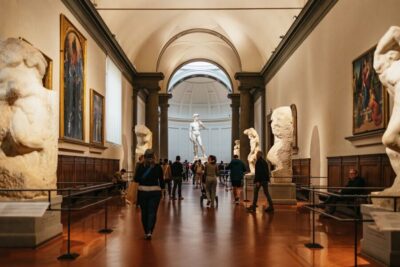

Accademia Gallery Guided Tour with Entry Ticket
Read our review →Browse the lists this tour appears in