
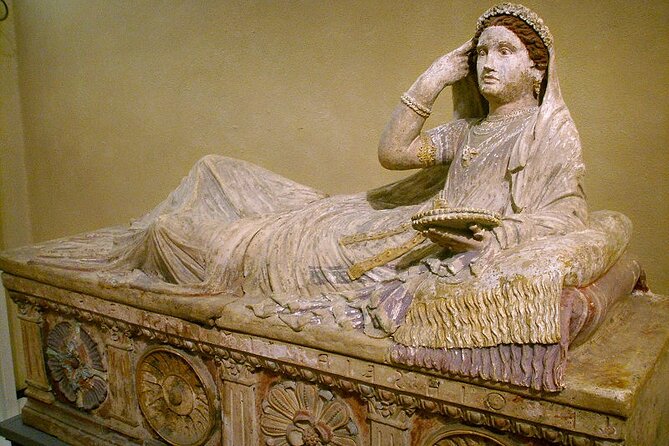
Reviewed · MUSEUMS
Florence Archaeological Museum: 2-Hour Private Guided Visit
Florence’s Archaeological Museum holds a terrific surprise: the Chimera of Arezzo, a snarling Etruscan bronze lion from 1553. Around it, you’ll find more than 10,000 objects from prehistoric times through the age of Copta, including Egyptian sarcophagi, Greek vases, Roman sculpture, and ancient bronzes. The museum is quieter and less famous than Florence’s headline sights, which gives the visit a calmer pace.
I like the private format, since your guide can shape the two hours around your interests instead of delivering a one-size-fits-all talk. I also like that reserved tickets are included, with central hotel pickup available. The main drawback is that some areas, including the second floor and Corridor of Gems, are temporarily closed, so the full museum is not currently open.
In This Review
- Key points at a glance
- Why Florence’s Archaeological Museum deserves two hours
- Starting at Piazza San Marco
- The Chimera of Arezzo is the museum’s star
- Egyptian rooms with sarcophagi, amulets, and more
- Greek and Roman objects fill out the picture
- Nine rooms and two warehouses in a two-hour route
- What the private format adds
- Is $144.05 per person good value?
- Practical details before you book
- Who should choose this museum visit?
- Should you book the two-hour private visit?
- FAQ
- How long is the Florence Archaeological Museum tour?
- Where does the tour start?
- Does the tour include museum admission?
- Is hotel pickup available?
- Is this a private tour?
- Which museum collections can you see?
- Are all parts of the museum open?
Key points at a glance
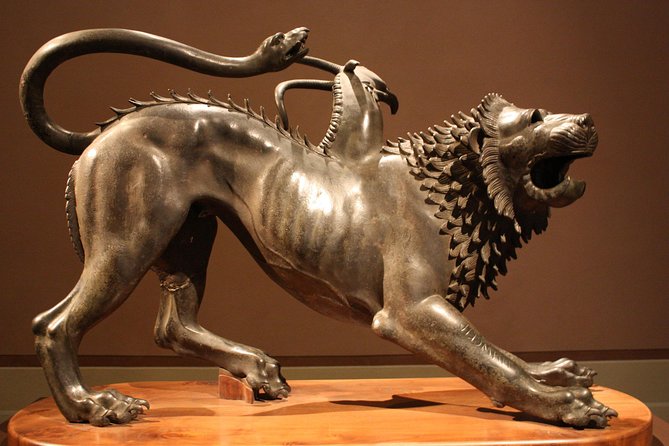
- The Chimera of Arezzo: See one of Italy’s most striking Etruscan bronzes, a lion discovered in Arezzo in 1553.
- Four ancient cultures in one visit: The route includes Egyptian, Greek, Roman, and Etruscan objects, from ceramics and vases to amulets and sarcophagi.
- A genuinely private experience: Only your group takes part, giving you room to ask questions and set the pace.
- Two hours with admission included: The time is long enough for a guided overview without taking over your entire Florence day.
- Central meeting point: Begin at Piazza San Marco, with hotel pickup available if you are staying centrally.
- Current closures matter: The second floor and Corridor of Gems are temporarily unavailable, and mask use is mandatory.
Why Florence’s Archaeological Museum deserves two hours
Most first-time visits to Florence focus on Renaissance painting, Michelangelo, and the city’s famous churches. That makes the Archaeological Museum an easy place to miss. I think that is exactly why it can work so well in a busy itinerary.
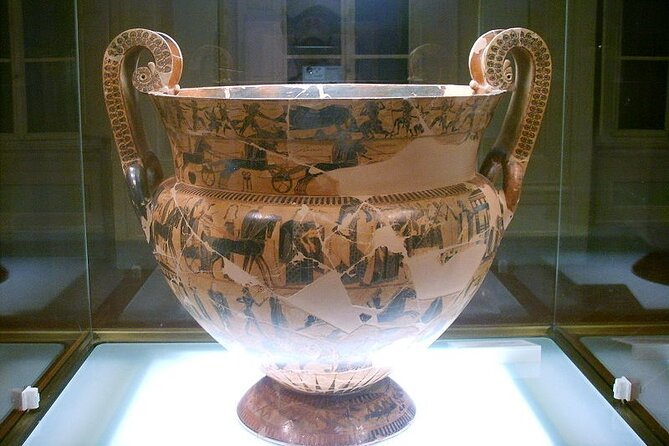
The museum was founded in 1855 and now contains more than 10,000 pieces. Its collections reach back to the prehistoric era and continue through Egyptian, Etruscan, Greek, Roman, and Copta material. You are not looking at one narrow slice of the ancient world. You are moving between cultures that shaped one another, sometimes closely and sometimes in surprising ways.
You might begin with a vase or bronze object and then see how a related form appears in another collection. A private guide can give those pieces a basic setting, explain why they matter, and help you avoid spending half your visit wondering what you are looking at. That context is especially useful in an archaeological museum, where a small ceramic fragment may matter more than a large statue.
The museum’s current route includes nine rooms and two warehouses in a renovated space. The warehouses are part of the collection’s unusual character. They remind you that this is not just a polished display of a few famous objects. It is a working museum with far more material than can fit into a standard tourist route.
More museums worth an hour:
- Florence: Skip-The-Line Uffizi Gallery Timed Entry Ticket
★ 4.5 · 27,832 reviews - Florence: Leonardo Interactive Museum Entry Ticket
★ 4.5 · 11,763 reviews - Florence Accademia Gallery Tour with Entrance Ticket Included
★ 4.5 · 6,148 reviews
Starting at Piazza San Marco
The meeting point is Piazza San Marco, at the museum’s address in central Florence. You meet your guide outside the Archaeological Museum and choose a departure time that fits your schedule, subject to availability.
That location is useful if you are already exploring the San Marco area. It also sits near public transportation, so reaching the start should be straightforward. If you are staying at a centrally located hotel, pickup is offered. Remember that the service includes hotel pickup but not hotel drop-off, so you finish back at the meeting point.
I would allow a little extra time to reach Piazza San Marco. Florence’s center is compact, but a relaxed arrival is better than turning up late to a private appointment. Your confirmation arrives within 48 hours of booking, subject to availability, so this is not the sort of activity I would leave until the final day of your trip.
The experience is booked, on average, about 87 days ahead. That does not mean you must plan it three months out, but it does tell you something useful: visitors often reserve this private visit well before arriving in Florence. If your dates are fixed, booking early makes sense.
The Chimera of Arezzo is the museum’s star
The clearest centerpiece is the Chimera of Arezzo, an Etruscan bronze lion discovered in Arezzo in 1553. It is beautifully preserved and immediately memorable, even if you know very little about Etruscan art before arriving.
The creature’s form gives the work its force. It is not a calm decorative animal. The lion appears tense and ready to attack, which makes it easy to understand why this piece commands attention in a museum filled with ancient objects.
Your guide should help place the Chimera within the museum’s Etruscan collection rather than treating it as an isolated trophy. That matters because the surrounding works give you a better sense of the people who made and used these objects. You may see additional bronzes, ceramics, and other pieces that turn the visit from a quick photo stop into a clearer look at Etruscan culture.
If your time is limited, make sure the Chimera is part of your route. It is the one object here that should be on every visitor’s short list.
Egyptian rooms with sarcophagi, amulets, and more
The Egyptian collection is another strong reason to choose this visit. It includes vases, sculptures, ceramics, bronzes, sarcophagi, amulets, and related objects. That range gives you more than a row of statues. You can see how ancient Egyptian life and religious practice appear through several types of material.
I especially like the chance to compare objects by function. A sarcophagus has a different role from an amulet, and both tell you something different from a ceramic vessel. Without a guide, it is easy to hurry past such pieces. With a private guide, you can ask why a particular item was made, how it was used, or what makes it important.
The Egyptian section received especially strong praise as a part of the museum. That fits the overall design of this experience: the collection offers a change of pace from Florence’s Renaissance focus and gives you a direct look at a civilization far older than the city’s better-known art.
The museum reaches through the age of Copta, as described for the collection, so the Egyptian material is not limited to one single period. Ask your guide to explain the time span as you move through the rooms. That is where a short guided visit can be much more useful than simply reading labels.
More Florence options worth a look before you decide
- Florence: 2-Hour Guided Sightseeing Bike Tour
★ 4.5 · 1,004 reviews - Florence: 2-Hour Guided Bike Tour
★ 4.7 · 646 reviews - Florence: Dan Brown’s Inferno 2-Hour Walking Tour
★ 4.5 · 187 reviews - Florence Duomo 2-Hour Monumental Tour
★ 4.2 · 167 reviews
Greek and Roman objects fill out the picture

The Greek and Roman collections add another layer to the visit. You will see vases, sculptures, ceramics, and bronzes, along with other ancient pieces. These sections help connect the museum’s different cultures and show how artistic ideas traveled across the Mediterranean world.
Greek vases can be easy to underestimate. Their painted scenes, shapes, and uses can tell you about mythology, daily life, and the values of the people who commissioned them. A guide can point out details that you might otherwise miss, especially if the museum labels are brief or technical.
The Roman collection brings a different feel. Roman sculpture and funerary objects often focus on public identity, family, status, or death. Sarcophagi can be visually heavy, but they also make ancient beliefs more concrete. You are looking at objects made for real people, not just textbook examples.
The private setting helps here. If you are fascinated by ceramics, you can spend more time with vases. If sculpture is your priority, you can ask for more attention there. A large group often needs to move along. Your group can stop, ask, and look again.
Nine rooms and two warehouses in a two-hour route

Two hours is a sensible length for this museum. It gives you enough time for an organized route through the main rooms without turning an already full Florence day into an all-day archaeology project.
The visit includes nine rooms and two warehouses in the renovated part of the museum. That is a lot to cover, so do not expect a detailed lecture on every object. The strength of the tour is selection. Your guide can identify the pieces that best explain the museum and keep the pace moving.
A private tour also lets you make practical choices. You might want a broad introduction to all four major collections, or you might prefer to focus on the Chimera and Egyptian material. Tell the guide what interests you at the beginning. Two hours passes quickly when the museum spans prehistoric objects, Egyptian works, Etruscan bronzes, Greek ceramics, and Roman sculpture.
The closed areas limit what you can see. The second floor and Corridor of Gems are temporarily unavailable to the public. This is important if you are choosing the museum because of a specific object or section. The current visit still includes substantial material, but you should not assume every room is open.
What the private format adds
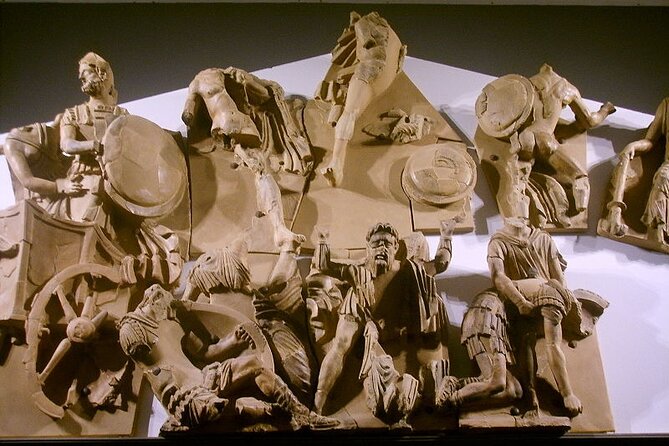
A private guide is the main reason to pay more for this experience instead of entering on your own. You are not simply buying admission. You are paying for a focused explanation, a planned route, and the ability to shape the visit around your group.
The private format is especially useful for families, couples with different interests, or anyone who finds archaeological displays hard to read without context. You can ask basic questions without feeling you are holding up a group. You can also ask for more detail when one object catches your attention.
The experience is limited to your group, not a shared tour. That makes the pace more comfortable and gives you a better chance to have a real exchange with the guide. The guide’s name is not provided in the available information, so you cannot request a particular guide in advance based on the details here.
Past feedback specifically praised the guide’s effort to create a personal experience and, in one case, the ability to move past the line. Reserved tickets are included, which should make entry easier, but I would not treat a guaranteed line skip as a promise unless it appears in your booking confirmation.
Is $144.05 per person good value?
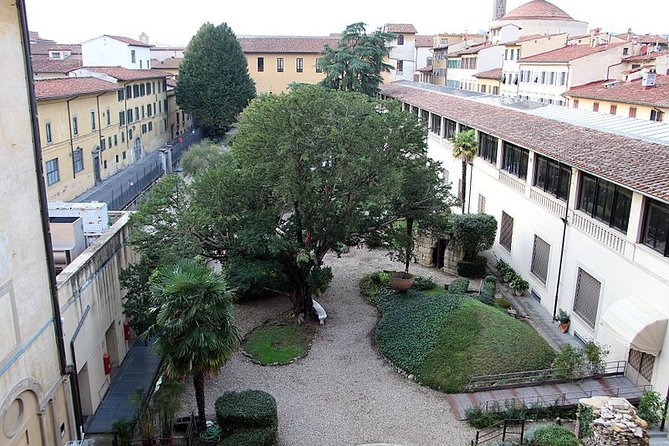
At $144.05 per person, this is not a budget museum visit. The price makes the most sense for people who value private attention and want a clear introduction to several ancient cultures in one sitting.
Admission tickets are included, as is an expert private guide. Central hotel pickup is also available, which adds convenience if you do not want to find the museum yourself. There is no hotel drop-off and no lunch, but those omissions are easy to manage in central Florence.
The value is strongest for a small group that would otherwise arrange several separate museum visits or hire a guide independently. If you are happy to read labels, move at your own pace, and focus only on the Chimera, a regular museum visit may cost less and suit you better.
I would also consider the cost in relation to your wider Florence plans. Two hours leaves room for other sights, and the museum gives you something different from the Uffizi or Accademia. For a history-minded visitor, that contrast can justify the price. For someone mainly interested in Renaissance painting, the same money may be better spent elsewhere.
Group discounts are available, so check the final price for your party rather than assuming the per-person figure will be unchanged.
Practical details before you book
Wear comfortable shoes. The visit covers several rooms and museum spaces, and comfortable footwear will make the experience easier.
Mask use is mandatory. Pack one and be ready to follow the museum’s current rules.
Most people can participate, and the museum is near public transportation. The available information does not provide detailed mobility specifications, so if you have particular access needs, confirm them before booking.
Free cancellation is available if you cancel at least 24 hours before the local start time. Cancellations or changes made within 24 hours are not accepted for a refund. Since confirmation is subject to availability, secure the booking early but keep that cutoff in mind.
The tour begins and ends at the meeting point. If you use the optional central hotel pickup, clarify the pickup arrangement when your booking is confirmed. Since there is no drop-off, plan your next stop from Piazza San Marco.
Who should choose this museum visit?
I would recommend this for you if you want more than a quick look at one famous bronze. It suits visitors who enjoy seeing connections among Egyptian, Etruscan, Greek, and Roman cultures, but who do not want to spend hours working through a large museum alone.
It is also a good fit if you have already visited Florence’s main Renaissance sights and want a change of subject. The quieter setting can provide a welcome pause from the city’s busiest attractions, while the Chimera gives the visit a clear focal point.
Families may appreciate the private format because the guide can adjust the pace and answer questions as they come up. Couples and small groups can also make better use of the two hours by choosing which collections deserve the most attention.
I would hesitate if you are looking for a complete museum experience. The duration is fixed at about two hours, and the second floor and Corridor of Gems are closed for now. I would also hesitate if ancient art is not a real interest, since the value here comes from taking time with objects that may not be immediately familiar.
Should you book the two-hour private visit?
Book it if the Chimera of Arezzo, Egyptian antiquities, and Etruscan art sound more appealing to you than another crowded Renaissance gallery. The museum offers a rare chance in Florence to move across several ancient cultures, and the private guide gives those objects a useful human frame.
The strongest reasons to choose it are the private setting, included admission, flexible departure time, and focused two-hour route. The main cautions are the relatively high price, current closures, mandatory mask use, and lack of hotel drop-off.
For a small group that wants personal guidance and a calm look at an overlooked Florence collection, I think this is a smart booking. If you prefer independent museum visits or only want to see the Chimera, save the money and enter on your own.
FAQ
How long is the Florence Archaeological Museum tour?
The guided visit lasts approximately two hours.
Where does the tour start?
You meet your guide outside the Archaeological Museum at Piazza San Marco, P.za di San Marco, 50121 Florence.
Does the tour include museum admission?
Yes. Reserved entrance tickets and admission to the guided museum visit are included.
Is hotel pickup available?
Hotel pickup is available if you are staying at a centrally located hotel. Hotel drop-off is not included.
Is this a private tour?
Yes. Only your group participates in the activity.
Which museum collections can you see?
The visit includes Egyptian, Etruscan, Greek, and Roman collections, with vases, sculptures, ceramics, bronzes, sarcophagi, amulets, and other objects.
Are all parts of the museum open?
No. The second floor and the Corridor of Gems are temporarily closed to the public. Mask use is mandatory.
Latest additions around Florence
- Florence: Cathedral Tour & Brunelleschi’s Dome Climb Ticket★ 5.0 · 3 reviews
- Palatina Gallery and Pitti Guided Tour in Florence★ 5.0 · 3 reviews
- Florence Uffizi Gallery Skip-the-line Tour w Art Historian Guide★ 5.0 · 3 reviews
- Private Tour: Pisa and Lucca from Florence★ 5.0 · 3 reviews
- San Gimignano Bike Tour (SOFT)★ 4.5 · 3 reviews
- Florence: Tour of Florence by rickshaw★ 5.0 · 3 reviews
- Center of Florence by golf cart★ 5.0 · 3 reviews
- From Firenze | Chianti day tour in a classic car★ 5.0 · 3 reviews
Museums, compared.
Skip-The-Line Uffizi Gallery Timed Entry Ticket
Read our review →

Florence Accademia Gallery Tour with Entrance Ticket Included
Read our review →


Accademia Gallery Guided Tour with Entry Ticket
Read our review →
Golf Cart Tour to Fiesole Roman Theatre and Museum
Read our review →
Uffizi Gallery and Accademia Gallery Guided Tour
Read our review →Browse the lists this tour appears in