Reviewed · PRIVATE
The Best Of Classic Florence – Private Tour
Florence packs a remarkable amount into a small historic center, and this private walk gives you a quick route through its greatest hits. In about two hours, you move from the Uffizi and Piazza della Signoria to the Duomo, Ponte Vecchio, Via de’ Tornabuoni, and Palazzo Pitti.
I like the private format, which lets your group ask questions instead of following a large crowd. I also like the Tuscan food bonus, with tastes such as extra-virgin olive oil, truffle specialties, schiacciata, and cantuccini. The main catch is time: this is an outside overview, and admission to the major monuments is not included.
In This Review
- Key points at a glance
- A fast first look at Florence’s great landmarks
- Starting near the Medici chapels and the Uffizi
- Piazza della Repubblica and Florence’s modern city center
- Ponte Vecchio and the Arno views
- Palazzo Vecchio and the political heart of Florence
- Piazza della Signoria’s outdoor sculpture gallery
- The Duomo complex and Brunelleschi’s great dome
- Via de’ Tornabuoni and Florence’s polished side
- Palazzo Pitti and the Oltrarno finish
- What the private guide adds
- Food tastings, timing, and physical demands
- Who should book this Florence walk?
- Should you book The Best Of Classic Florence?
- FAQ
- How long does The Best Of Classic Florence tour last?
- Is this a private tour?
- Is the tour offered in English?
- Can I be picked up at my hotel?
- Are admission fees included?
- What sights does the tour cover?
- Can I cancel for a full refund?
Key points at a glance
- Two hours on foot: A brisk route through Florence’s central sights, best for first-time orientation.
- Private English-speaking guide: Your group gets a more personal format, with earphones if needed.
- Seven major areas: The walk covers the Uffizi, Republic Square, Ponte Vecchio, Palazzo Vecchio, Piazza della Signoria, the Duomo, Via de’ Tornabuoni, and Palazzo Pitti.
- Tuscan tasting bonus: Expect a selection of local bites, including olive oil, truffle products, schiacciata, and cantuccini.
- Central-hotel pickup: Pickup is offered on foot if your hotel is in central Florence.
- No monument admission: The tour focuses on views and explanations from outside, unless you pay separately to enter.
A fast first look at Florence’s great landmarks
This experience works best as a city orientation rather than a museum tour. You’ll walk through the compact center, see where Florence’s political, religious, commercial, and Medici stories unfolded, and gather enough context to plan the rest of your stay.
The route is especially useful after an overnight flight or at the start of a short visit. One five-star account describes it as a very good introduction, and that is the right way to think about it. You get the broad picture first, then can return to the Uffizi, Palazzo Vecchio, the Duomo, or Palazzo Pitti with a better sense of what you’re seeing.
At $114.15 per person, the price is easier to justify for a couple or small private group than for a solo visitor. You are paying for a private guide, a two-hour walk, possible central pickup, and food samples. You are not paying for entry into Florence’s major museums or monuments, so budget separately if you want to go inside.
More Florence options worth a look before you decide
- Cinque Terre and Pisa Tower Tour from Florence Semi Private
★ 5.0 · 1,406 reviews - From Florence: Private Chianti Hills Tour with Tasting
★ 4.3 · 809 reviews - Private Self-Guided E-Bike Ride in Tuscany with Vineyard Visit
★ 5.0 · 775 reviews
Starting near the Medici chapels and the Uffizi
The stated meeting point is Piazza di Madonna degli Aldobrandini, 8, near the Basilica of San Lorenzo and the Medici Chapels area. Participants are asked to arrive 15 minutes early. If you qualify for pickup, the guide meets you at your centrally located hotel and walks with you to the departure point.
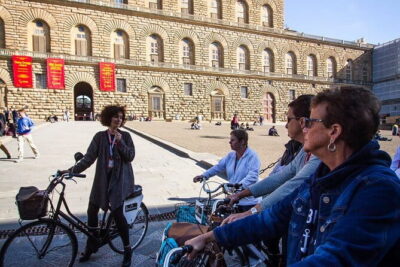
The first major sight is the Piazzale degli Uffizi, the long, elegant passage created by Giorgio Vasari in the 16th century. Its arcades and statues form an open-air introduction to Florence’s artistic world. Look up and around here, not just toward the museum entrance. The space itself helps explain how the Medici family used art and architecture to shape the city.
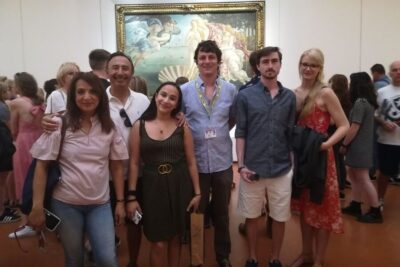
The Uffizi Gallery sits within this complex. It holds works by Botticelli, Leonardo da Vinci, Michelangelo, Raphael, and Caravaggio, including Botticelli’s The Birth of Venus and Primavera. This tour does not include Uffizi admission, so the guide’s value here comes from setting the museum in context and pointing out what deserves your attention if you visit later.
If you have only two hours in Florence, this outside look is practical. If the Uffizi is your top priority, plan a separate visit. A short walking tour cannot replace time inside one of the world’s great art collections.
Piazza della Repubblica and Florence’s modern city center
From the Uffizi area, the route reaches Piazza della Repubblica, one of Florence’s broadest and most social squares. It occupies the site of the ancient Roman forum and later served as the city’s market and Jewish ghetto.
The square took its current form in the 19th century, when Florence was briefly the capital of Italy. That change swept away much of the older street pattern and created the grand open space you see today. The Triumphal Arch marks the square, while historic cafés such as Caffè Gilli, Paszkowski, and Le Giubbe Rosse line its edges.
This is a good place to notice the contrast between medieval Florence and the later city built to project national importance. Street performers, musicians, shops, and cafés give the square a different feel from the narrower lanes nearby. The stop is listed at about 10 minutes, with no admission charge.
The tradeoff is that a quick stop gives you only a taste. If you want a leisurely coffee or time to browse the shops, you’ll need to return after the tour.
Ponte Vecchio and the Arno views
Ponte Vecchio is the tour’s most scenic crossing. Built in the 14th century, it is the only Florence bridge that survived the bombing of World War II. Its tightly packed jewelry shops and artisan boutiques still make it unlike any ordinary river crossing.
The bridge is also tied to the Medici story through the Vasari Corridor above it. Giorgio Vasari designed this enclosed passage in 1565 so the Medici could move between Palazzo Vecchio and Palazzo Pitti without mixing with the public below.
Your guide can help you read the bridge as more than a shopping street. The shop fronts, river views, and upper passage all point to Florence’s unusual blend of commerce, political power, and family privilege. The stop lasts about 10 minutes and is free to view from the street.
Because Ponte Vecchio is one of Florence’s most photographed spots, it can feel crowded. The private format helps your guide keep the explanation focused, but it cannot clear the bridge. Keep your expectations realistic: this is a short scenic walk, not a quiet riverside pause.
A different way to spend the same Florence day:
- Florence: Skip-The-Line Uffizi Gallery Timed Entry Ticket
★ 4.5 · 27,832 reviews - Tuscany Day Trip from Florence: Siena, San Gimignano, Pisa and Lunch at a Winery
★ 5.0 · 21,634 reviews - Florence: Timed Entrance Ticket to Michelangelo’s David
★ 4.6 · 16,983 reviews - Florence: Michelangelo’s David Skip-the-Line Entry Ticket
★ 4.5 · 12,764 reviews
Palazzo Vecchio and the political heart of Florence
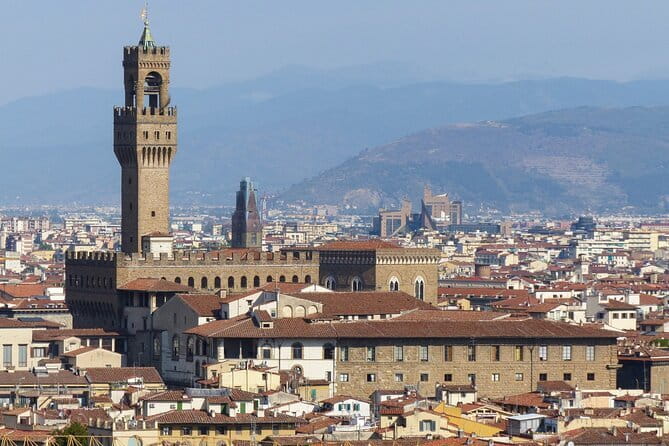
Next comes Palazzo Vecchio in Piazza della Signoria. With its battlemented tower rising 94 meters, the building is easy to recognize and hard to ignore. It began as the seat of Florentine government in the 14th century, later became a Medici residence, and still serves as Florence’s city hall.
The palace museum contains Renaissance furnishings, artworks, and secret rooms. Inside, the Hall of the Five Hundred is decorated with frescoes by Vasari and is one of Italy’s largest ceremonial halls.
The tour’s 10-minute stop is enough for an explanation of the facade, tower, and political role of the building. It is not enough for the museum. Admission is not included, so you’ll need a separate ticket if you want to explore the interior.
I find this stop valuable even for people less interested in art. Palazzo Vecchio explains how Florence functioned as a republic, how powerful families took control, and how public buildings became displays of authority. It also gives the surrounding square a clear purpose, rather than leaving you with a pile of impressive facades.
Piazza della Signoria’s outdoor sculpture gallery
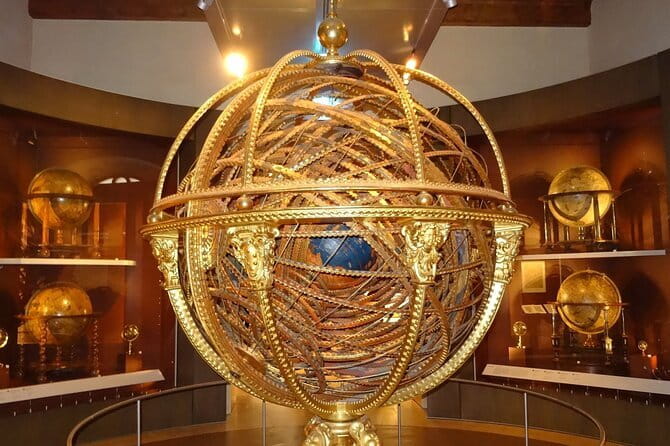
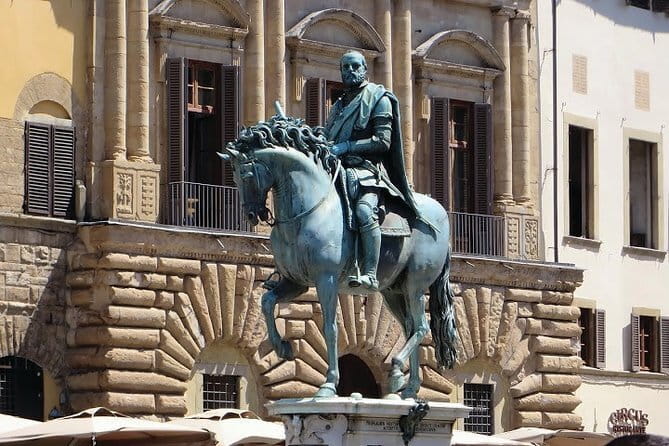
Piazza della Signoria is one of the strongest sections of the walk because the art is outdoors and free to see. The square served as Florence’s political center for centuries, and its sculptures continue that public display of power.
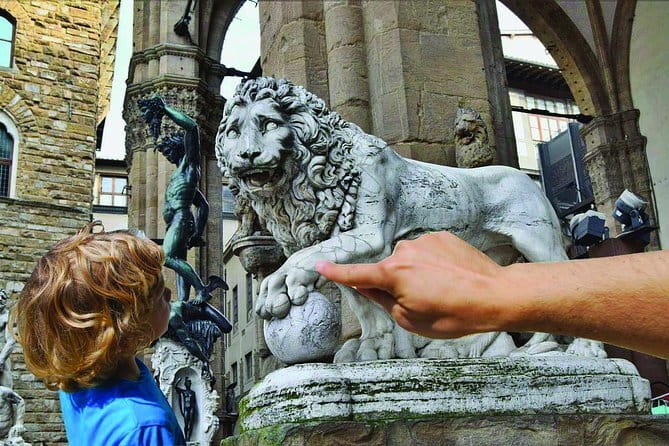
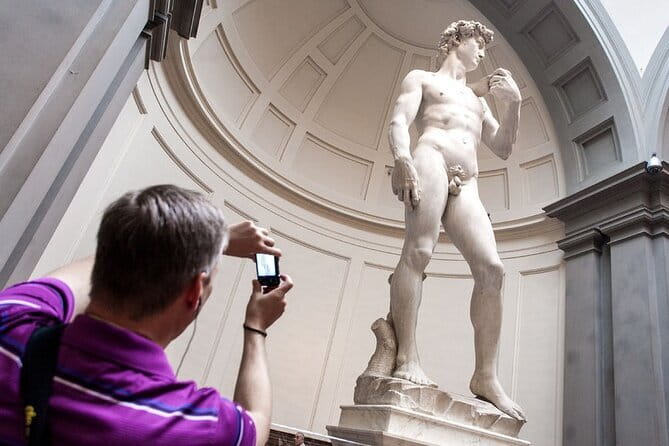
The Loggia dei Lanzi shelters works including Benvenuto Cellini’s Perseus with the Head of Medusa and Giambologna’s The Rape of the Sabine Women. You’ll also see the Fountain of Neptune and a replica of Michelangelo’s David.
This is a place where a guide can add real value in a short time. Without context, the sculptures can blur into a grand collection of marble and bronze. With a good explanation, you can understand why certain figures were placed here, what they represented, and how the square functioned as a public stage.
No ticket is needed to view the square or loggia. Still, expect other people taking photographs, stopping for explanations, and crossing the space. The city’s most famous sights are popular for good reason, but quiet contemplation is not guaranteed.
The Duomo complex and Brunelleschi’s great dome
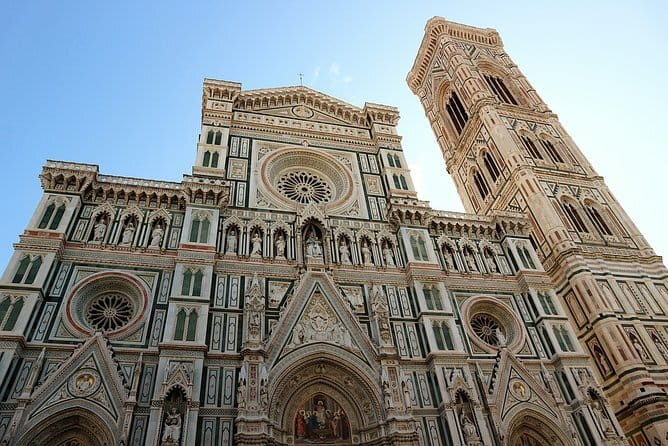
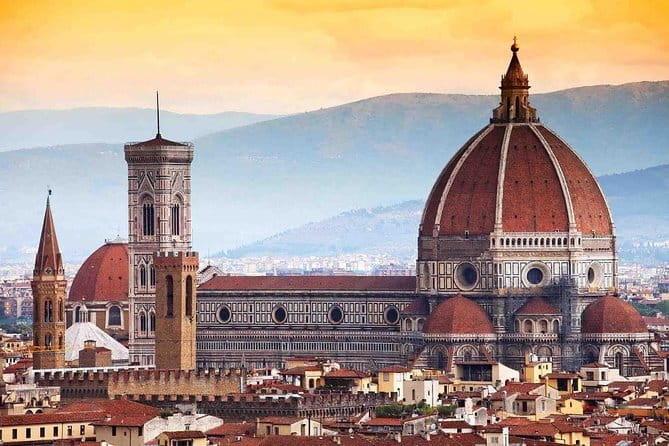
The route then reaches Piazza del Duomo, Florence’s spiritual and architectural center. Here you see the Cathedral of Santa Maria del Fiore, Brunelleschi’s vast dome, Giotto’s Bell Tower, and the Baptistery of St. John.
The square is one of Florence’s essential views. The cathedral’s colored marble exterior, the dome’s massive form, the campanile, and the Baptistery create a tight cluster of major monuments. The Baptistery is also known for its famous Gates of Paradise.
The guide’s explanation can help you separate the buildings and understand their roles. The tour does not include admission to the cathedral complex, and the 10-minute stop is mainly for an outside look. If climbing the dome or entering the cathedral is important to you, plan another visit and arrange the required admission separately.
This limitation matters. The Duomo is not a monument you can properly explore in ten minutes. Still, a guide’s introduction helps you decide how to spend your own time later, especially if you are trying to choose among the cathedral, dome, bell tower, and museum.
Via de’ Tornabuoni and Florence’s polished side
Via de’ Tornabuoni offers a change of mood. This elegant street runs between Piazza Santa Trinita and Piazza Antinori and is lined with luxury names such as Gucci, Prada, Ferragamo, Cartier, and Bulgari.
The shopping is only part of the story. Renaissance palaces give the street its shape, including Palazzo Strozzi and Palazzo Spini Feroni. The latter is connected with the Ferragamo fashion house and its museum of footwear and design.
A 10-minute walk here shows how Florence moved from banking and court power into modern fashion and luxury. You may find the shops more interesting as architecture and window displays than as places to buy something. This part of the route is free, but it is not a traditional art stop, so shoppers and design fans will get the most from it.
Palazzo Pitti and the Oltrarno finish
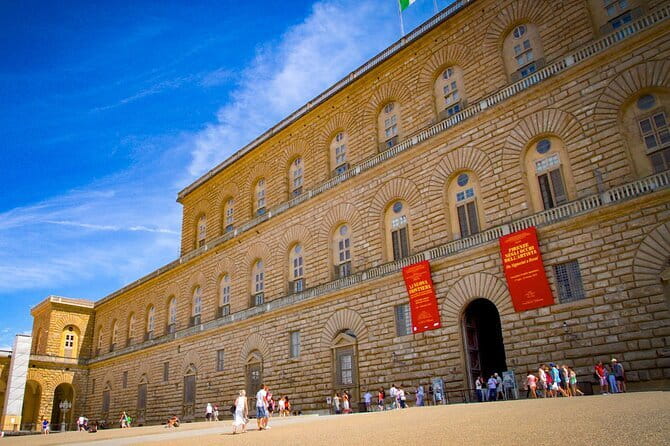
The final major sight is Palazzo Pitti, across the Arno in the Oltrarno district. Built for the Pitti family in the 15th century, it was later purchased by the Medici and became their grand ducal residence.
The palace now contains several museums. The Palatine Gallery includes works associated with Raphael, Titian, Rubens, and Caravaggio. Other sections cover silver, modern art, and fashion and costume. Behind the palace, the Boboli Gardens offer formal paths, fountains, statues, and tree-lined avenues.
The tour gives you an outside introduction, not palace admission. Entry fees are separate, and the stop is listed at about 10 minutes. That is enough to understand the palace’s role and location, but not enough to see the galleries or gardens.
Ending here can be useful if you want to continue in Oltrarno. The final point may vary by guide, so do not plan a tightly timed reservation immediately afterward unless you confirm the ending location. Drop-off at your accommodation is not included.
What the private guide adds
The strongest reports about this experience center on the guides’ explanations and personal attention. Manuela is praised for answering detailed questions about Florence’s past, while Gaetano Cantone is described as punctual, courteous, and well informed about the city.
That individual guide element matters more on a private tour than on a large group outing. You can ask why the Medici needed the Vasari Corridor, how Palazzo Vecchio changed roles, or what to look for in the Duomo facade. The guide can adjust the pace and sequence of stops, which may change depending on conditions in the city.
The experience is not guaranteed to feel identical every time. One three-star account describes a guide as disorganized and less engaged, especially on a very crowded day. That is worth taking seriously. A private tour gives you a smaller setting, but the quality still depends on the person leading it and the conditions outside.
The overall score is 4.8 from eight reviews, with several especially positive accounts praising the guide’s knowledge, patience, and willingness to continue during heavy rain. Treat that as a sign of generally strong satisfaction, not a promise that every guide will suit every group.
Food tastings, timing, and physical demands
The Tuscan snack bonus adds a welcome local touch to a route filled with monuments. The selection may include extra-virgin olive oil, truffle specialties, schiacciata, and cantuccini. These are small tastings, not a full meal, but they break up the sightseeing and give you something connected to the region’s food culture.
The entire experience lasts about two hours and is conducted on foot. You should expect steady walking across squares, streets, and the bridge. The tour is near public transportation, most people can participate, and service animals are allowed.
Pickup is offered only for hotels in central Florence, and it takes place on foot at the scheduled departure time. If your accommodation is outside the central area, go directly to the stated meeting point. Earphones are available if necessary, which can help when the streets are crowded.
Free cancellation is available up to 24 hours before the start time. Cancellations or changes made inside that window are not accepted for a refund.
Who should book this Florence walk?
I would choose this for a first visit, a short stay, or the first morning after arriving in Florence. It gives you the city’s basic framework quickly and helps you choose which interiors deserve your limited time.
It also suits families or couples who prefer asking their own questions, and groups that like a private pace. The food samples make it a little more distinctive than a standard landmark walk.
I would not choose it as your only Florence experience if you want long visits inside the Uffizi, Duomo, Palazzo Vecchio, or Palazzo Pitti. You’ll need separate admission and more time for those. I would also be cautious about booking it immediately before a train, museum slot, or meal reservation because the ending location can vary.
Should you book The Best Of Classic Florence?
Book it if you want a fast, private orientation with an English-speaking guide and a broad list of central sights. The route covers an impressive amount of Florence in two hours, and the Tuscan tastings add a pleasant local detail.
Skip it if your main goal is detailed museum time or a slow, atmospheric walk. At $114.15 per person, the value depends on using the guide’s context and the private format. For a small group with limited time, it can be a smart start. For a solo visitor or someone planning several paid attractions, the cost may be harder to defend.
FAQ
How long does The Best Of Classic Florence tour last?
The guided tour lasts approximately two hours.
Is this a private tour?
Yes. Only your group participates in the private activity.
Is the tour offered in English?
Yes. The experience is offered in English.
Can I be picked up at my hotel?
Pickup is available on foot if your hotel is centrally located in Florence. Drop-off at your accommodation is not included.
Are admission fees included?
No. Admission fees to the monuments along the route are not included.
What sights does the tour cover?
The route includes the Uffizi area, Piazza della Repubblica, Ponte Vecchio, Palazzo Vecchio, Piazza della Signoria, the Duomo area, Via de’ Tornabuoni, and Palazzo Pitti.
Can I cancel for a full refund?
Yes. You can cancel at least 24 hours before the experience begins for a full refund. Changes or cancellations made less than 24 hours before the start time are not accepted for a refund.
Latest additions around Florence
- Florence: Cathedral Tour & Brunelleschi’s Dome Climb Ticket★ 5.0 · 3 reviews
- Palatina Gallery and Pitti Guided Tour in Florence★ 5.0 · 3 reviews
- Florence Uffizi Gallery Skip-the-line Tour w Art Historian Guide★ 5.0 · 3 reviews
- Private Tour: Pisa and Lucca from Florence★ 5.0 · 3 reviews
- San Gimignano Bike Tour (SOFT)★ 4.5 · 3 reviews
- Florence: Tour of Florence by rickshaw★ 5.0 · 3 reviews
- Center of Florence by golf cart★ 5.0 · 3 reviews
- From Firenze | Chianti day tour in a classic car★ 5.0 · 3 reviews
Private, compared.
Cinque Terre and Pisa Tower Tour from Florence Semi Private
Read our review →
Private Self-Guided E-Bike Ride in Tuscany with Vineyard Visit
Read our review →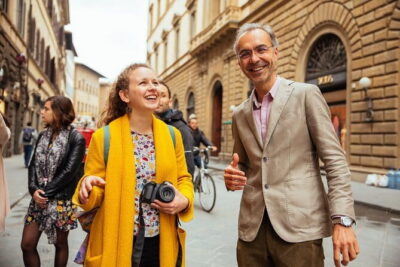
Private Uffizi Gallery Discovery Tour with Ticket
Read our review →
Florence Exclusive PRIVATE Food Tour with 6 or 10 Tastings
Read our review →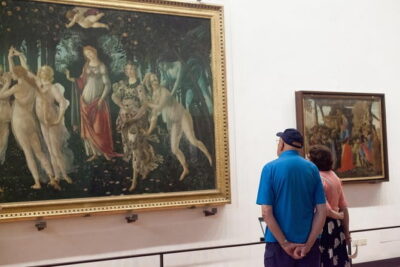
Uffizi Highlights, In-Depth Masterclass or Private Tour
Read our review →