

Reviewed · HISTORICAL TOURS
3-Hour Historic WhoDunIt Tour in Florence
Florence becomes your detective story in this self-guided Renaissance murder game. You receive the facts of a real killing, a suspect list, and a booklet that sends you through the old city looking for answers. The trick is less about chasing a villain through back streets and more about observing monuments closely.
I like two things here: you see both famous sights and less familiar corners, and you do not need admission tickets to find the answers. The main caution is value. At $27 per person, this is a paper-based city walk, and some of the questions involve counting or inspecting details rather than solving elaborate puzzles.
In This Review
- Key points to know before booking
- How the Florence murder game works
- Piazza Madonna degli Aldobrandini and the start of the route
- Famous Florence sights become evidence
- Lesser-known corners and careful looking
- Three hours, or a longer Florence outing?
- What you pay for at $27
- The murder story and the suspect list
- Who will enjoy this activity most?
- Practical ways to get more from the booklet
- Should you book the Florence WhoDunIt?
- FAQ
- How long does the Historic WhoDunIt Tour take?
- Is the tour guided?
- What is included in the price?
- Do I need tickets to the attractions?
- Where does the activity begin?
- How many people can join the group?
Key points to know before booking
- A real Renaissance murder provides the story, but the investigation is conducted with a printed booklet rather than a live mystery host.
- The route takes you through central Florence, including major squares, streets, monuments, and lesser-known spots.
- You may revisit some sights more than once, so the walk can feel less direct than a normal guided tour.
- No attraction tickets are needed to answer the questions, which is useful if you have already toured Florence’s museums and churches.
- Three hours is an estimate, not a firm finish time. With meals, snacks, photos, and proper sightseeing, the route may take much longer.
- The winner receives a gift, and the activity is limited to 10 participants.
How the Florence murder game works
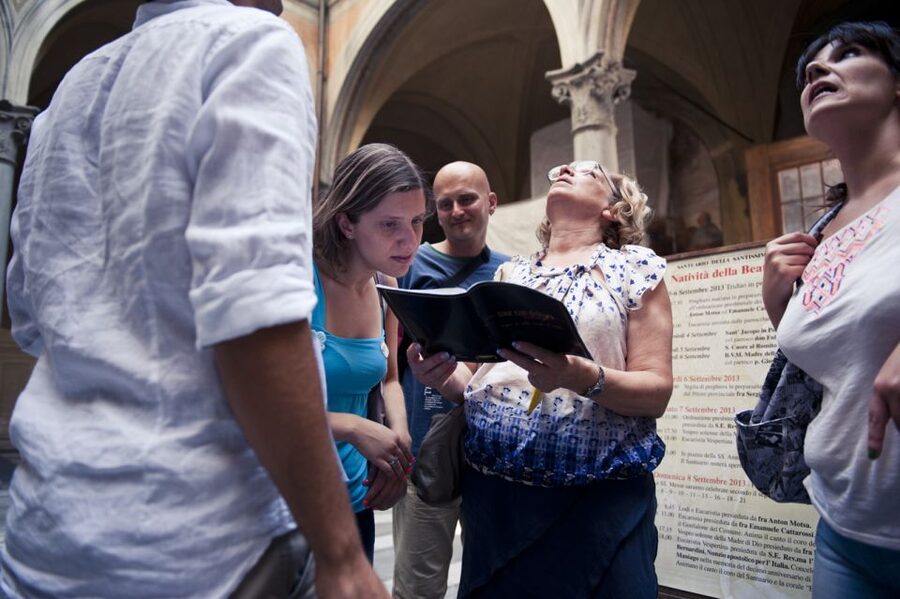
You meet on the second floor at Piazza Madonna degli Aldobrandini 8. There is no guide walking with you, so this first meeting is mainly about receiving the game booklet and getting the instructions you need.
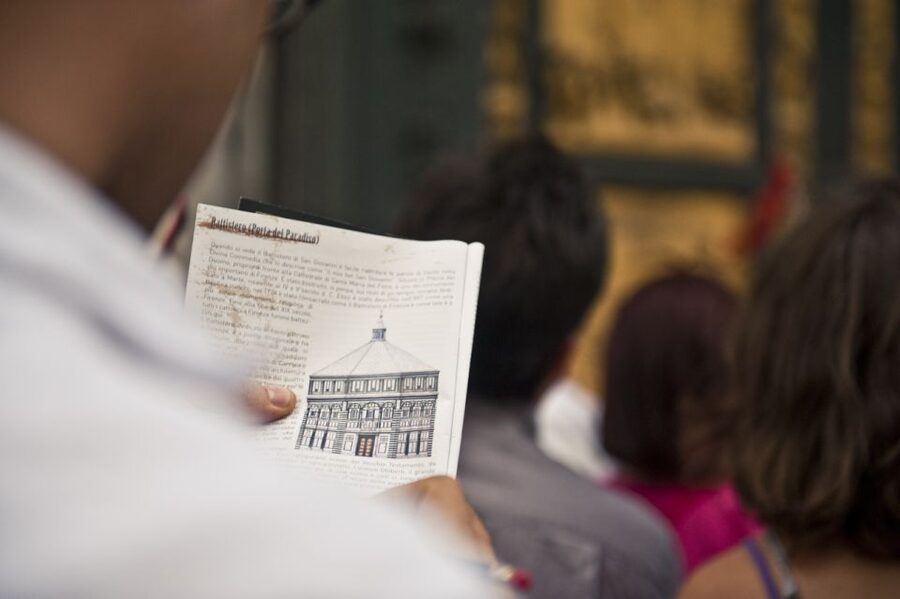
The booklet gives you the murder story and a list of possible suspects. From there, you follow a route through Florence and answer questions based on what you see. The city itself supplies the evidence. Look closely at statues, facades, architectural details, and public spaces, since a small visual detail may provide the answer to one of the questions.
That format is important to understand before you pay. This is not a traditional guided tour in which someone explains every building as you walk. It is also not a room-by-room escape game with locks, hidden compartments, and actors. Think of it as a self-guided observation challenge attached to a Florence sightseeing walk.
You can bring a magnifying glass or even wear a deerstalker hat if you want to play the part. Neither is required, but the playful detective theme works best when you treat the activity as a game rather than as a formal history tour.
More history-first plans:
- Tipsy Tour: Guided Bar Crawl In Florence with Dark History
★ 5.0 · 271 reviews - Florence Cooking Course with Historic Local Market Visit
★ 4.5 · 151 reviews - Florence: Medici Family History Tour
★ 4.3 · 93 reviews
Piazza Madonna degli Aldobrandini and the start of the route
The meeting point puts you in the historic center, close to the streets and monuments that make Florence easy to explore on foot. Starting here is practical because the investigation can move directly into the old city rather than requiring a separate transfer.
Since the experience is self-guided, take a few minutes at the beginning to read the booklet carefully. You will want to understand how the questions work before setting off. If you rush the opening instructions, you may spend much of the walk wondering if you missed a clue.
The small group limit of 10 people should help keep the game manageable. In a larger crowd, it would be difficult for everyone to inspect the same statue or architectural feature. Here, you can work as a group, split into pairs, or let children take charge of the visual searches.
The activity is listed as wheelchair accessible. Still, the exact ease of the route can depend on the streets, paving, crowds, and the time you spend moving between stops. If accessibility is a major concern, confirm the current route details before booking.
Famous Florence sights become evidence

The route leads through some of Florence’s best-known public spaces and monuments. You are not simply walking past them on the way to a puzzle. You are asked to study them, count details, and use what you see to answer questions.
One example involves counting female statues at the Loggia dei Lanzi. That gives you a good idea of the game’s style. The answer is not hidden in a coded message or handed to you by an actor. It comes from looking carefully at a real public monument.
This approach has a clear advantage. You can answer the questions without buying tickets to the attractions along the way. If you have already visited Florence’s major interiors, you will not pay again just to enter a site for one clue. You can focus on the outside details and keep moving.
The drawback is that some people may find the questions too simple for the price. If you expect a tightly plotted murder mystery with clever riddles, this format could feel more like a sightseeing worksheet. I would book it for the shared challenge and the route, not for complex puzzle design.
Lesser-known corners and careful looking
The booklet also takes you to less familiar parts of central Florence. That can be the best reason to choose the experience. Florence’s headline sights are easy to find, but a written route can make you pause in places you might otherwise pass without notice.
You will need to keep your eyes open. A quick walk from one famous square to another will not be enough if the answer depends on a detail carved into a building or displayed in a public space. The game rewards patience, and it gives children a reason to look up from the usual adult sightseeing routine.
I especially like this part for families. Children can count statues, search for visual details, and compete to spot the next piece of evidence. The activity is also suitable for friends who want a light challenge while walking through Florence, rather than another scheduled lecture.
The route may not feel perfectly direct. One account describes walking back and forth and seeing some sights several times. That can be frustrating if you want the shortest path, but it is less of a problem if you treat the repeated stops as part of the investigation.
More Florence options worth a look before you decide
- Private Florence Tour: 3-Hour Walking Tour with a Licenced Guide
★ 5.0 · 233 reviews - 3 Hour Florence Pasta Making & Unlimited wine
★ 5.0 · 24 reviews - 3 hour Walking Tour Statue of David and Florence Highlights
★ 5.0 · 23 reviews - Inferno Florence Private 3-Hour Tour
★ 4.8 · 20 reviews
Three hours, or a longer Florence outing?
The advertised duration is three hours. That may work if you move steadily, answer the questions quickly, and treat the sights mainly as checkpoints.
If you stop to take photos, read the booklet carefully, discuss suspects, eat lunch, or inspect the monuments properly, plan for more time. One detailed account recommends allowing at least eight hours with meal and snack breaks. That is a major difference from the stated three-hour duration.
You do not have to rush through the city. The booklet can serve as a framework for a full day in central Florence. Pause when you find a cafe, continue after lunch, and use the route as a loose plan for seeing the old center.
There is a tradeoff here. A longer schedule makes the activity more pleasant, but it also weakens the value if you expected a compact three-hour attraction. I would not place this immediately before a train, museum reservation, or other timed commitment.
Wear comfortable shoes and keep your schedule open. The supplied information does not give a precise distance, but the route covers multiple parts of the old city and requires enough walking to make footwear matter. You will also want room to stop without feeling pressed.
What you pay for at $27
The price is $27 per person. Included are the game booklet and a gift for the winner. A guide is not included, and the listing does not indicate that a pen or other writing tool is supplied, so bring your own.
The value depends on what you want from a Florence activity. If you judge it as a guided historical tour, $27 can feel high because no guide accompanies you. If you judge it as a small-group city game that adds structure to your sightseeing, the price may be reasonable for families or friends who enjoy a contest.
The no-ticket format helps. You can see the relevant outdoor sights without paying separate entry fees, and you can use the route even if you have already visited the main attractions. That keeps the cost predictable.
Still, the printed booklet carries much of the experience. Some questions are based on direct observation, such as counting statues, rather than on a sequence of sophisticated clues. For that reason, I would compare this price with a normal self-guided walk or a free city route before booking.
The gift for the winner adds a small competitive reward, but it should not be the reason you choose the tour. The real payoff is exploring Florence with a purpose and giving your group a shared challenge.
The murder story and the suspect list
The central case concerns an actual murder from Renaissance Florence. You receive the basic facts and work from a list of possible suspects. The historical setting gives the walk more character than a generic scavenger hunt.
At the same time, the available details do not promise a full scholarly account of the crime. You should expect enough information to support the game, not a long lecture on Florentine politics, families, or Renaissance law.
That distinction matters for history-minded visitors. If you want a detailed explanation of the Medici era or the city’s art, this activity will leave gaps. You may want to pair it with a museum visit, a standard walking tour, or your own reading.
For a group, the suspect list creates an easy way to keep everyone involved. One person can read the case, another can record answers, and others can inspect the monuments. Children can search for visual clues while adults keep track of the suspects.
The game works best when you discuss the evidence as you go. Do not let one person carry the booklet and solve everything alone. The fun comes from comparing what each member of the group notices.
Who will enjoy this activity most?
I would recommend it most strongly to families with school-age children, groups of friends, and repeat visitors who have already seen Florence’s major interiors. The questions give familiar sights a fresh purpose, and the outdoor format avoids extra admission costs.
It can also suit couples who enjoy puzzle games and do not mind setting their own pace. You can make the walk playful, stop for a snack, and turn the suspect list into a friendly argument.
First-time visitors should think carefully. You will see important parts of central Florence, but you will not receive the full explanation you might want on your first visit. If this is your only organized activity in the city, I would choose a live guide for your main orientation and save this game for later.
It is less suitable for anyone who dislikes backtracking, paper instructions, or open-ended timing. You may find the format thin if you expect actors, dramatic clues, or a guide revealing the story at each stop.
Practical ways to get more from the booklet
Bring a pen, even though one is not listed among the inclusions. A small notebook can also help if you want to compare answers or keep track of suspects.
Read each question before leaving a stop. That way, you know what to inspect instead of walking away and realizing you missed the relevant detail.
Work as a team, but do not crowd around one monument for too long. Florence’s center can be busy, and other people will need space to pass and see the same public artwork.
Use the three-hour estimate as a minimum planning guide, not a deadline. If you want to enjoy the route, allow time for food, rest, and photos. The experience becomes much less enjoyable when you treat every stop as a race.
If you have already visited the museums and churches, this is a useful way to spend time outdoors. You can revisit the public face of Florence without buying another ticket. If you have not yet seen the major interiors, do not let the game replace them.
Cancellation is flexible: you can cancel up to 24 hours before the activity for a full refund, and you can reserve now and pay later. Starting times vary, so check availability before choosing your day.
Should you book the Florence WhoDunIt?
Book this if you want a playful self-guided walk through central Florence, especially with children or friends who enjoy solving questions together. The real Renaissance murder, outdoor clues, lesser-known stops, and no-ticket requirement are useful strengths.
Skip it if you want a live guide, a tightly plotted mystery, or a short route that never repeats itself. At $27, the activity asks you to value the game structure and the group experience, not just the printed booklet.
My practical advice is to leave your schedule open, bring a pen, wear good shoes, and expect the route to take longer than three hours if you plan to stop and look properly. If that sounds like a good day in Florence, the game can turn familiar monuments into a playful investigation. If not, spend the same time on a guided city walk and explore the sights with more historical explanation.
FAQ
How long does the Historic WhoDunIt Tour take?
The stated duration is three hours. If you include lunch, snacks, photos, and careful sightseeing, you may need much longer, with one account allowing at least eight hours.
Is the tour guided?
No. It is a self-guided activity using a game booklet. A guide is not included.
What is included in the price?
The price includes the game booklet and a gift for the winner.
Do I need tickets to the attractions?
No. The answers can be found without tickets to the attractions along the route.
Where does the activity begin?
The meeting point is on the second floor at Piazza Madonna degli Aldobrandini 8.
How many people can join the group?
The activity is limited to 10 participants and is listed as wheelchair accessible.
Latest additions around Florence
- Florence: Cathedral Tour & Brunelleschi’s Dome Climb Ticket★ 5.0 · 3 reviews
- Palatina Gallery and Pitti Guided Tour in Florence★ 5.0 · 3 reviews
- Florence Uffizi Gallery Skip-the-line Tour w Art Historian Guide★ 5.0 · 3 reviews
- Private Tour: Pisa and Lucca from Florence★ 5.0 · 3 reviews
- San Gimignano Bike Tour (SOFT)★ 4.5 · 3 reviews
- Florence: Tour of Florence by rickshaw★ 5.0 · 3 reviews
- Center of Florence by golf cart★ 5.0 · 3 reviews
- The David from Michelangelo.★ 5.0 · 3 reviews
Historical Tours, compared.

Tipsy Tour: Guided Bar Crawl In Florence with Dark History
Read our review →
Florence Cooking Course with Historic Local Market Visit
Read our review →

Historical Guided Tour of Florence’s Iconic Cathedral
Read our review →
Fashion History Guided Walking Tour & Museum Visit
Read our review →
The History of Florence: The Renaissance Era Private Tour
Read our review →
Pitti Palace and Palatine Gallery: A Royal Art and History Tour
Read our review →
Private Tour of the Historic Center of Florence by Golf Car
Read our review →Browse the lists this tour appears in